VISION Of ST. BERNARD - Vintage 7x 5" Framed 15th Century Classic Art Print by Filippino Lippi-Perfect Gift for Students of Art and Religion
$ 24.99

VISION Of St. BERNARD - Vintage 7x 5" Framed 15th Century Classic Art Print by
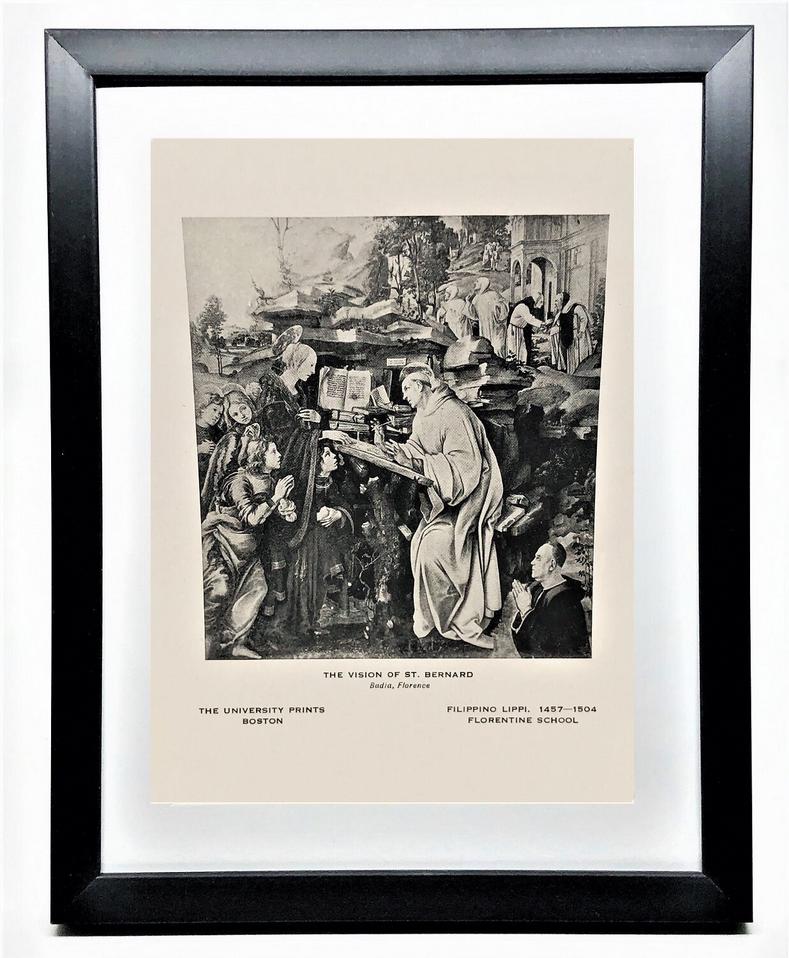
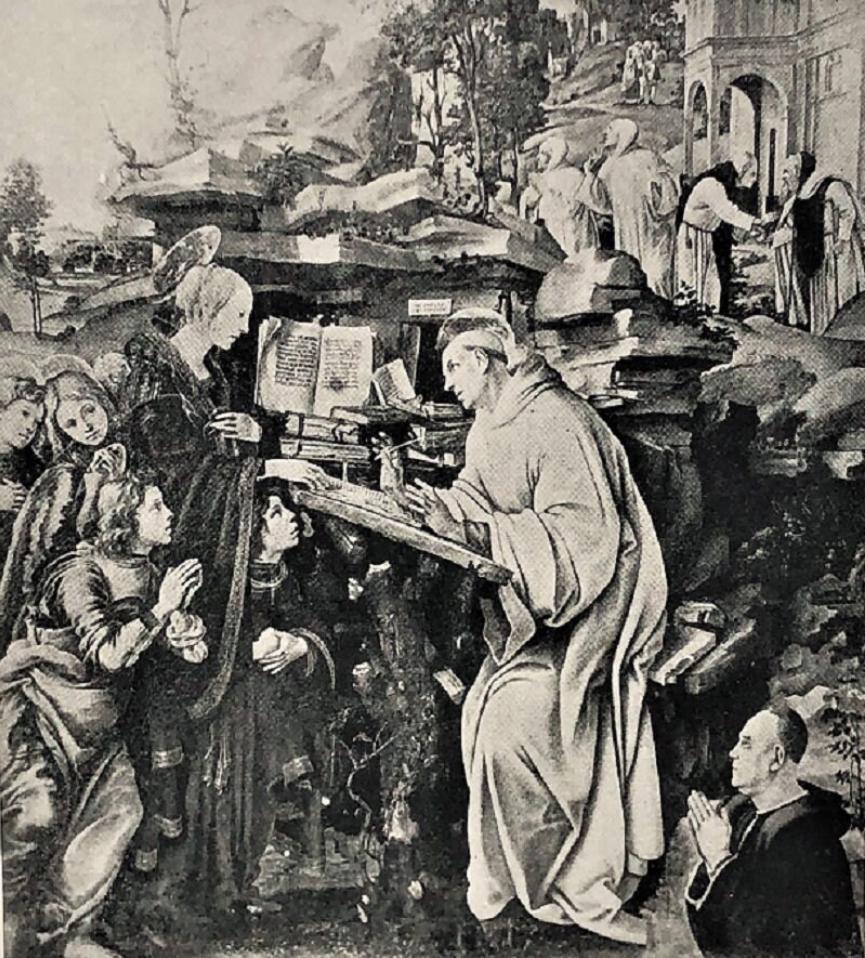
Filippino Lippi-Perfect Gift for Students of Art and ReligionVintage 1960's classic art print by Filippino Lippi (1457-1504): THE VISION OF ST. BERNARD (Aparition of the Virgin Mary) from the paintings located at the Church of Badia in Florence, Italy. Stunning black & white print-in mint condition, measures 5" high x 7" wide. The glass frame measures 7 1/4"H x 9 1/4"W and has easel on back for table display and eye hooks for wall hanging. Adds instant retro/classic charm to any room. Perfect gift for lovers of the Renaissance Art and students of religion.NOTE: Purchases totaling $35 and above qualify for FREE shipping. Add more items to your Etsy shopping cart and save $$$. We ship fast & safe worldwide every day!Painting information: Apparition of The Virgin to St Bernard 1486 Oil on panel, 210 x 195 cm Church of Badia, FlorenceThe high point of the early phase of Lippi's development is the Vision of St Bernard, one of the finest lyric pictures of the entire Renaissance. St Bernard of Clairvaux, seated at a desk with his pen poised, experiences a vision of the Virgin, who regularly had been the subject of his writings. The confrontation takes place out-of-doors (rather than in his study or in a church), enframed ingeniously by an outcropping of rock that creates a natural bench and bookshelves for the scholar. Behind Bernard, in the dark reaches of the rock, are two chained demons, while in the zone above, Cistercian monks converse or look heavenward in front of their fine Renaissance abbey. Still higher in the composition, a sick old man is being carried down toward the building. On the other side, a sweet landscape sweeps the eye into the distance.The format of the main figural group is echoed by the stony backdrop which, roughly speaking, forms a pyramid. Also included are the donor, Francesco del Pugliese, matched pictorially on the other side by the blond angel, leaning inward, hands clasped in prayer. The colours are confident, bright, and direct, adding to the exceptional visual excitement of the painting. Mary hovers above the ground facing Bernard. Her elegant form and finely silhouetted head are not dependent upon vigorous light-to-dark juxtapositions or even, as with Botticelli, a felicitously found, heavily accented line, but rather on the operation of fragile edges. The same is true for the figure of the saint, where light, colour, and lustrous paint, presumably oil, combine to produce the desired effect. The landscape is rather flat, despite all the implications of deep space. The painting, although not dated, may have been finished by 1485, the approximate completion date for another project of considerable importance, the Brancacci Chapel frescoes.Artist Bio:Filippino Lippi was born in Prato, Tuscany, the illegitimate son of the painter Fra Filippo Lippi and Lucrezia Buti. Filippino first trained under his father. They moved to Spoleto, where Filippino served as workshop adjuvant in the construction of the Cathedral. When his father died in 1469, he completed the frescoes with Storie della Vergine (Histories of the Virgin) in the cathedral. Filippino Lippi completed his apprenticeship in the workshop of Botticelli, who had been a pupil of Filippino's father. In 1472 the records of the painters' guild record that Botticelli had only Filippino Lippi as an assistant.His first works greatly resemble those of Botticelli, but with less sensitivity and subtlety. The very first ones (dating from 1475 onwards) were initially attributed to an anonymous "Amico di Sandro" ("Friend of Botticelli"). Eventually Lippi's style evolved into a more personal and effective one over the years 1480–1485. Works of the early period include: the Madonnas of Berlin, London and Washington, the Journeys of Tobia of the Galleria Sabauda, Turin, the Madonna of the Sea of Galleria dell'Accademia, Florence, and the Histories of Ester.Together with Perugino, Ghirlandaio and Botticelli, Lippi worked on the frescoed decoration of Lorenzo de' Medici's villa at Spedaletto. On December 31, 1482, he was commissioned to decorate a wall of the Sala dell'Udienza of Palazzo Vecchio in Florence, a work never begun. Soon after, probably in 1483–84, he was called to complete Masaccio's decoration of the Brancacci Chapel in the church of the Carmine, that had been left unfinished at the artist's death in 1428. Here he painted Stories of Saint Peter, in the following frescoes: Quarrel with Simon Magus in face of Nero, Resurrection of the Son of Teophilus, Saint Peter Jailed, Liberation and Crucifixion of Saint Peter.Lippi's work on the Sala degli Otto di Pratica, in the Palazzo Vecchio, was completed on February 20, 1486.[1] It is now in the Uffizi Gallery. At about this time, Piero di Francesco del Pugliese asked him to paint the altarpiece with the Apparition of the Virgin to St. Bernard, which is now in the Badia Fiorentina, Florence. This is Lippi's most popular picture: a composition of unreal items, with its very particular elongated figures, backed by a phantasmagorical scenario of rocks and almost anthropomorphic trunks. The work is dated to 1485–1487.[2]Later, he worked for Tanai de' Nerli in Florence's Santo Spirito church.On April 21, 1487, Filippo Strozzi asked him to decorate the Strozzi family chapel in Santa Maria Novella with Stories of St. John Evangelist and St. Philip. He worked on this commission intermittently, over a long time. He only completed it in 1503, after Strozzi's death. The windows with musical themes, in the same chapel, also designed by Filippino, were completed between June and July 1503. These paintings can be seen as a mirror of the political and religious crisis in Florence at the time: the theme of the fresco, the clash between Christianity and Paganism, was hotly debated in the Florence of Girolamo Savonarola.Filippino depicted his characters in a landscape which recreated the ancient world in its finest details, showing the influence of the Grottesco style he had seen on his time in Rome. In this way he created an "animated", mysterious, fantastic but disquieting style, showing the unreality of nightmare. Thus, Filippino portrayed ruthless executioners with the grimmest of faces, who raged against the Saints. In the scene of St. Philip expelling a monster from the temple, the statue of the pagan god is represented as a living figure which seems to dare the Christian saint.In 1488, Lippi went to Rome, where Lorenzo de' Medici had advised Cardinal Oliviero Carafa to entrust him with the decoration of the family chapel in Santa Maria sopra Minerva. These frescoes show a new kind of inspiration, quite different from his earlier works, but confirm Lippi's continued research on the themes of the Ancient era. He finished the cycle by 1493.Lippi's return to Florence took place--the date is disputed--at some time between 1491 and 1494. Works of this period include: Apparition of Christ to the Virgin (c. 1493, now in Munich), Adoration of the Magi (1496, for the church of San Donato in Scopeto, now in the Uffizi), Sacrifice of Laocoön (end of the century, for the villa of Lorenzo de' Medici at Poggio a Caiano), St. John Baptist and Maddalena (Valori Chapel in San Procolo, Florence, inspired to some way extent by Luca Signorelli's art).He also worked outside the area of his home city, on the Certosa, or Chapterhouse, in Pavia and in Prato, where in 1503 he completed the Tabernacle of the Christmas Song, now in the City Museum; in 1501 Lippi painted the Mystic Wedding of St. Catherine for the Basilica of San Domenico in Bologna.Lippi's final work was the Deposition for the Santissima Annunziata church, Florence, which at his death in April 1504 was unfinished.Because of Lippi's fame and reputation, on the day of his burial all the workshops of the city closed for him. Noted art critic Paul George Konody wrote of Lippi that "some of his qualities show him to be the most subtle psychologist of his time, the most modern in spirit of all the artists of the Renaissance".
Filippino Lippi-Perfect Gift for Students of Art and ReligionVintage 1960's classic art print by Filippino Lippi (1457-1504): THE VISION OF ST. BERNARD (Aparition of the Virgin Mary) from the paintings located at the Church of Badia in Florence, Italy. Stunning black & white print-in mint condition, measures 5" high x 7" wide. The glass frame measures 7 1/4"H x 9 1/4"W and has easel on back for table display and eye hooks for wall hanging. Adds instant retro/classic charm to any room. Perfect gift for lovers of the Renaissance Art and students of religion.NOTE: Purchases totaling $35 and above qualify for FREE shipping. Add more items to your Etsy shopping cart and save $$$. We ship fast & safe worldwide every day!Painting information: Apparition of The Virgin to St Bernard 1486 Oil on panel, 210 x 195 cm Church of Badia, FlorenceThe high point of the early phase of Lippi's development is the Vision of St Bernard, one of the finest lyric pictures of the entire Renaissance. St Bernard of Clairvaux, seated at a desk with his pen poised, experiences a vision of the Virgin, who regularly had been the subject of his writings. The confrontation takes place out-of-doors (rather than in his study or in a church), enframed ingeniously by an outcropping of rock that creates a natural bench and bookshelves for the scholar. Behind Bernard, in the dark reaches of the rock, are two chained demons, while in the zone above, Cistercian monks converse or look heavenward in front of their fine Renaissance abbey. Still higher in the composition, a sick old man is being carried down toward the building. On the other side, a sweet landscape sweeps the eye into the distance.The format of the main figural group is echoed by the stony backdrop which, roughly speaking, forms a pyramid. Also included are the donor, Francesco del Pugliese, matched pictorially on the other side by the blond angel, leaning inward, hands clasped in prayer. The colours are confident, bright, and direct, adding to the exceptional visual excitement of the painting. Mary hovers above the ground facing Bernard. Her elegant form and finely silhouetted head are not dependent upon vigorous light-to-dark juxtapositions or even, as with Botticelli, a felicitously found, heavily accented line, but rather on the operation of fragile edges. The same is true for the figure of the saint, where light, colour, and lustrous paint, presumably oil, combine to produce the desired effect. The landscape is rather flat, despite all the implications of deep space. The painting, although not dated, may have been finished by 1485, the approximate completion date for another project of considerable importance, the Brancacci Chapel frescoes.Artist Bio:Filippino Lippi was born in Prato, Tuscany, the illegitimate son of the painter Fra Filippo Lippi and Lucrezia Buti. Filippino first trained under his father. They moved to Spoleto, where Filippino served as workshop adjuvant in the construction of the Cathedral. When his father died in 1469, he completed the frescoes with Storie della Vergine (Histories of the Virgin) in the cathedral. Filippino Lippi completed his apprenticeship in the workshop of Botticelli, who had been a pupil of Filippino's father. In 1472 the records of the painters' guild record that Botticelli had only Filippino Lippi as an assistant.His first works greatly resemble those of Botticelli, but with less sensitivity and subtlety. The very first ones (dating from 1475 onwards) were initially attributed to an anonymous "Amico di Sandro" ("Friend of Botticelli"). Eventually Lippi's style evolved into a more personal and effective one over the years 1480–1485. Works of the early period include: the Madonnas of Berlin, London and Washington, the Journeys of Tobia of the Galleria Sabauda, Turin, the Madonna of the Sea of Galleria dell'Accademia, Florence, and the Histories of Ester.Together with Perugino, Ghirlandaio and Botticelli, Lippi worked on the frescoed decoration of Lorenzo de' Medici's villa at Spedaletto. On December 31, 1482, he was commissioned to decorate a wall of the Sala dell'Udienza of Palazzo Vecchio in Florence, a work never begun. Soon after, probably in 1483–84, he was called to complete Masaccio's decoration of the Brancacci Chapel in the church of the Carmine, that had been left unfinished at the artist's death in 1428. Here he painted Stories of Saint Peter, in the following frescoes: Quarrel with Simon Magus in face of Nero, Resurrection of the Son of Teophilus, Saint Peter Jailed, Liberation and Crucifixion of Saint Peter.Lippi's work on the Sala degli Otto di Pratica, in the Palazzo Vecchio, was completed on February 20, 1486.[1] It is now in the Uffizi Gallery. At about this time, Piero di Francesco del Pugliese asked him to paint the altarpiece with the Apparition of the Virgin to St. Bernard, which is now in the Badia Fiorentina, Florence. This is Lippi's most popular picture: a composition of unreal items, with its very particular elongated figures, backed by a phantasmagorical scenario of rocks and almost anthropomorphic trunks. The work is dated to 1485–1487.[2]Later, he worked for Tanai de' Nerli in Florence's Santo Spirito church.On April 21, 1487, Filippo Strozzi asked him to decorate the Strozzi family chapel in Santa Maria Novella with Stories of St. John Evangelist and St. Philip. He worked on this commission intermittently, over a long time. He only completed it in 1503, after Strozzi's death. The windows with musical themes, in the same chapel, also designed by Filippino, were completed between June and July 1503. These paintings can be seen as a mirror of the political and religious crisis in Florence at the time: the theme of the fresco, the clash between Christianity and Paganism, was hotly debated in the Florence of Girolamo Savonarola.Filippino depicted his characters in a landscape which recreated the ancient world in its finest details, showing the influence of the Grottesco style he had seen on his time in Rome. In this way he created an "animated", mysterious, fantastic but disquieting style, showing the unreality of nightmare. Thus, Filippino portrayed ruthless executioners with the grimmest of faces, who raged against the Saints. In the scene of St. Philip expelling a monster from the temple, the statue of the pagan god is represented as a living figure which seems to dare the Christian saint.In 1488, Lippi went to Rome, where Lorenzo de' Medici had advised Cardinal Oliviero Carafa to entrust him with the decoration of the family chapel in Santa Maria sopra Minerva. These frescoes show a new kind of inspiration, quite different from his earlier works, but confirm Lippi's continued research on the themes of the Ancient era. He finished the cycle by 1493.Lippi's return to Florence took place--the date is disputed--at some time between 1491 and 1494. Works of this period include: Apparition of Christ to the Virgin (c. 1493, now in Munich), Adoration of the Magi (1496, for the church of San Donato in Scopeto, now in the Uffizi), Sacrifice of Laocoön (end of the century, for the villa of Lorenzo de' Medici at Poggio a Caiano), St. John Baptist and Maddalena (Valori Chapel in San Procolo, Florence, inspired to some way extent by Luca Signorelli's art).He also worked outside the area of his home city, on the Certosa, or Chapterhouse, in Pavia and in Prato, where in 1503 he completed the Tabernacle of the Christmas Song, now in the City Museum; in 1501 Lippi painted the Mystic Wedding of St. Catherine for the Basilica of San Domenico in Bologna.Lippi's final work was the Deposition for the Santissima Annunziata church, Florence, which at his death in April 1504 was unfinished.Because of Lippi's fame and reputation, on the day of his burial all the workshops of the city closed for him. Noted art critic Paul George Konody wrote of Lippi that "some of his qualities show him to be the most subtle psychologist of his time, the most modern in spirit of all the artists of the Renaissance".
Other Products