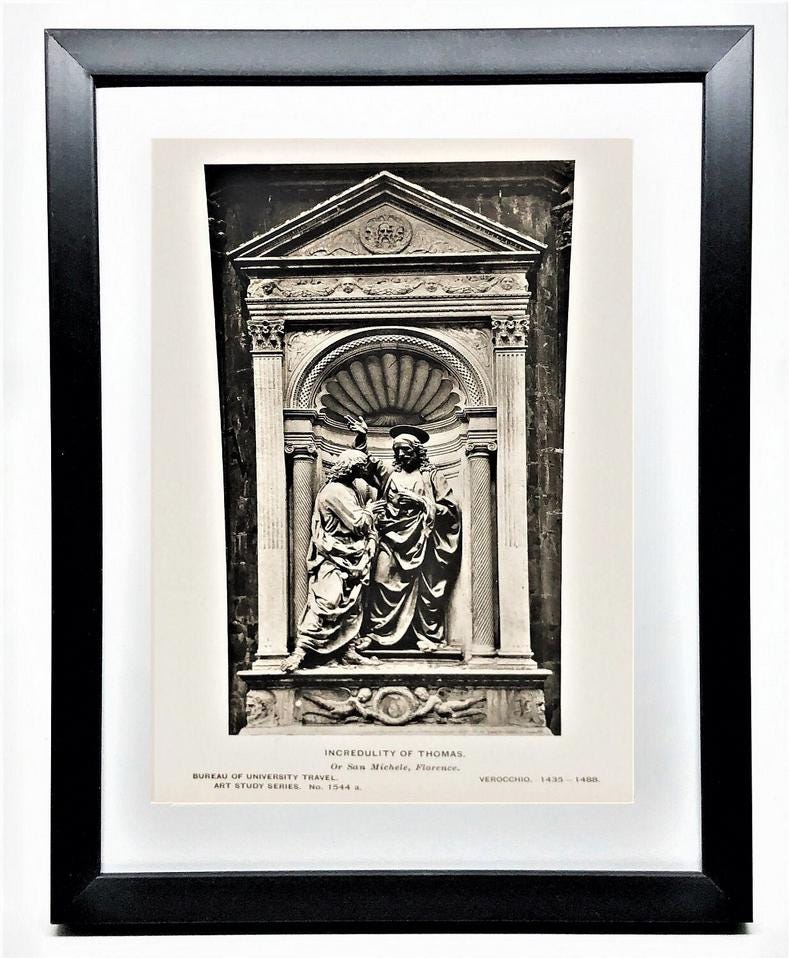
JESUS and DOUBTING THOMAS - 5"x7" Religious Art Print -13th Century Bronze Sculptures-by Verocchio-Perfect Gift for Art & Religion Students!
$ 24.99

JESUS and DOUBTING THOMAS - 5"x7" Religious Art Print -13th Century Bronze
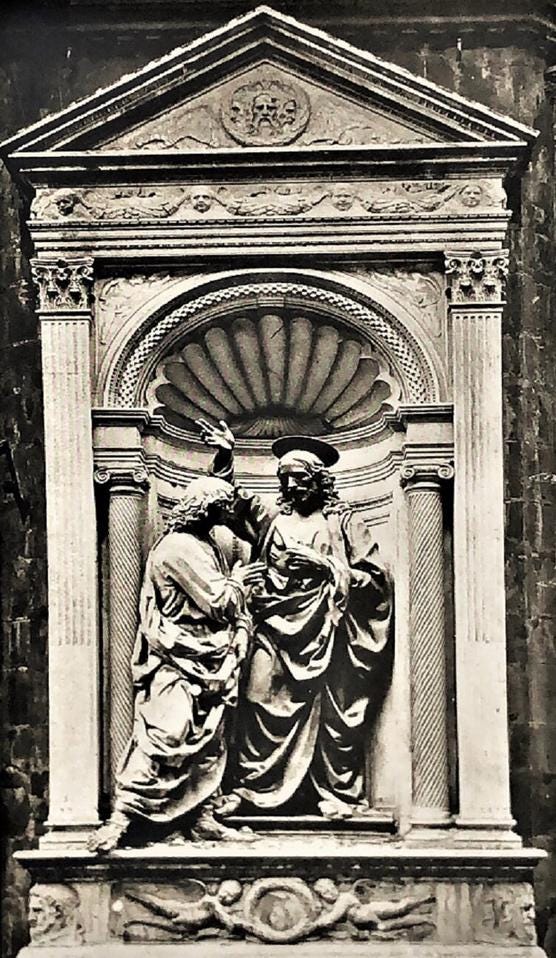
Sculptures-by Verocchio-Perfect Gift for Art & Relgion Students!Original B.O.U.T. vintage 1960 art print of 13th century bronze statues Jesus Christ and Doubting Thomas created by artist Verocchio (1435-1488). Previously located in Orsanmichele, in Florence, Italy. This beautiful black and white print-measures 7" long x 5" wide. The glass & black frame measures 9 1/4"L x 7 1/4"W and has easel on back for table display and eye hooks for wall hanging. Adds instant retro-charm to any room. Perfect gift for students of religion and/or Art. We ship fast & safe worldwide every day!NOTE: Purchases totaling $35 and above qualify for FREE shipping. Add more items to your Etsy shopping cart and save $$$.ART HISTORY: Verrocchio worked on this group for the Orsanmichele between 1476 and 1483. The figure of Christ was executed at about 1477-78, while that of Thomas at 1482-83.Verrocchio tailored his composition to a niche originally designed by Donatello for a single figure (his St Louis). There was no precedent for the subject in the three-dimensional tradition, yet Verrocchio solved the problems magnificently, abandoning symmetry by placing St Thomas on the extreme left, projecting out of the niche. Thus the viewer enters the composition via the diagonal of St Thomas's foot overlapping the ledge. The gestures of the figures inextricably bind them together. Christ's upraised hand is traditional in this scene but Verrocchio has modified it to resemble both a blessing and a baptism. Even the drapery evokes the two personalities: the majestic folds of Christ's garment contrast with the more agitated cloth of the saint who doubted Christ's resurrection.Verrocchio's interest in physiognomy and expressive drapery was passed on to Leonardo. Indeed, there is a a striking resemblance between Verrocchio's Christ and Leonardo's in The Last Supper (c. 1494). It has been suggested that Leonardo worked on Christ's head for the sculpture, although it is more likely that he adopted Verrocchio's type for the painting.The stone niche is the work of Donatello and Michelozzo.When the group was removed for safekeeping during World War II, it was discovered that the figures have no backs; seen from behind they are hollow shells of bronze.
Sculptures-by Verocchio-Perfect Gift for Art & Relgion Students!Original B.O.U.T. vintage 1960 art print of 13th century bronze statues Jesus Christ and Doubting Thomas created by artist Verocchio (1435-1488). Previously located in Orsanmichele, in Florence, Italy. This beautiful black and white print-measures 7" long x 5" wide. The glass & black frame measures 9 1/4"L x 7 1/4"W and has easel on back for table display and eye hooks for wall hanging. Adds instant retro-charm to any room. Perfect gift for students of religion and/or Art. We ship fast & safe worldwide every day!NOTE: Purchases totaling $35 and above qualify for FREE shipping. Add more items to your Etsy shopping cart and save $$$.ART HISTORY: Verrocchio worked on this group for the Orsanmichele between 1476 and 1483. The figure of Christ was executed at about 1477-78, while that of Thomas at 1482-83.Verrocchio tailored his composition to a niche originally designed by Donatello for a single figure (his St Louis). There was no precedent for the subject in the three-dimensional tradition, yet Verrocchio solved the problems magnificently, abandoning symmetry by placing St Thomas on the extreme left, projecting out of the niche. Thus the viewer enters the composition via the diagonal of St Thomas's foot overlapping the ledge. The gestures of the figures inextricably bind them together. Christ's upraised hand is traditional in this scene but Verrocchio has modified it to resemble both a blessing and a baptism. Even the drapery evokes the two personalities: the majestic folds of Christ's garment contrast with the more agitated cloth of the saint who doubted Christ's resurrection.Verrocchio's interest in physiognomy and expressive drapery was passed on to Leonardo. Indeed, there is a a striking resemblance between Verrocchio's Christ and Leonardo's in The Last Supper (c. 1494). It has been suggested that Leonardo worked on Christ's head for the sculpture, although it is more likely that he adopted Verrocchio's type for the painting.The stone niche is the work of Donatello and Michelozzo.When the group was removed for safekeeping during World War II, it was discovered that the figures have no backs; seen from behind they are hollow shells of bronze.
Other Products