Vintage 5x7 Framed Classical Art Print APHRODITE OF MELOS - Beautiful Ancient Stone Sculpture-Louvre, Paris - Perfect Gift for Art Students!
$ 24.99

Vintage 5x7 Framed Classical Art Print APHRODITE OF MELOS - Beautiful Ancient
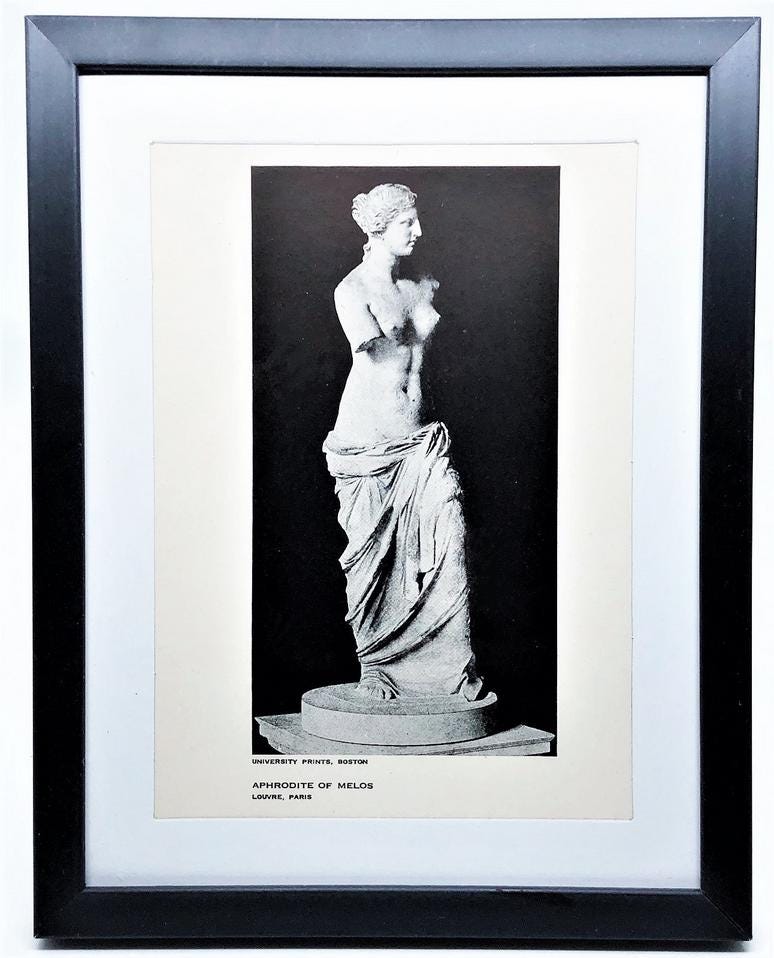
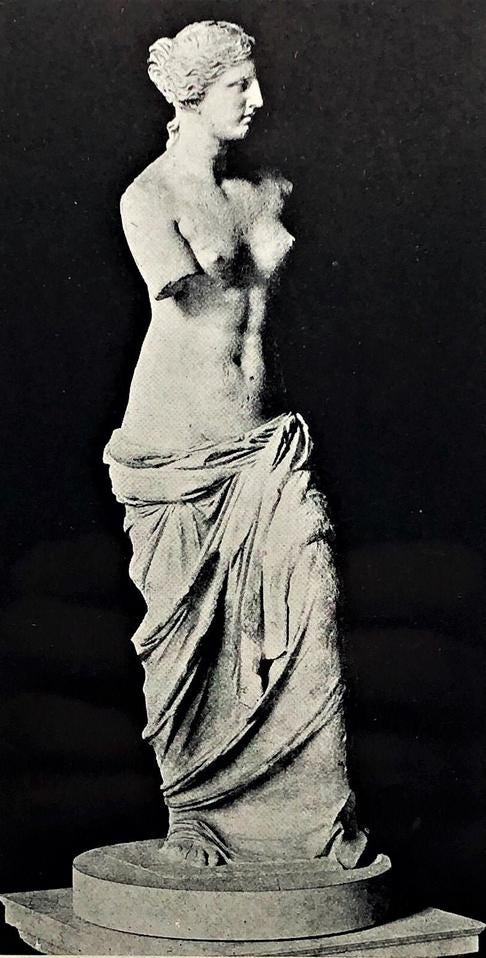
Stone Sculpture-Louvre, Paris - Perfect Gift for Art Students!Vintage 1960's art print of APHRODITE of MELOS-beautiful ancient stone sculpture located at the Louvre Museum in Paris France. The print is in mint condition and measures 7" long x 5" wide. The glass frame measures 9 1/4"L x 7 1/4"W and has easel on back for table display and eye hooks for wall hanging. Adds instant charm to any room. Perfect gift for students of Greek and Classical Art. We ship fast & safe worldwide everyday! Read Art history below....NOTE: Purchases totaling $35 and above qualify for FREE shipping. Add more items to your Etsy shopping cart and save $$$.ART HISTORY: Aphrodite, according to the Greek poet Hesiod, was born from sea-foam gathered around the dismembered genitals of Ouranos, the god of the heavens, who was castrated by his son Kronos. The goddess arose from the sea and came ashore on the island of Cyprus (or Kythera). As she walked along the beach, flowers sprang forth in her footsteps. Awestruck by her beauty, the gods were consumed by love and adoration for the goddess, and at once received her into Mt. Olympus. She awoke within them a passion and desire never felt before. Her ability to excite this feeling gave her the power to rule over the hearts of gods and men alike, and she thus became the goddess of love, beauty, and sexuality.In the late Hellenistic Period, the demand for Greek art in the growing Roman Republic was tremendous. Fascinated and awed by the Greek past, Romans eagerly collected Classical sculpture or copies and variants of it. To satisfy the growing market, Greek sculptors often produced works that incorporated Classical traits into more recent styles. Artists offered a variety of subjects, including the new and popular theme of eroticism and female beauty. Images of the goddess Aphrodite abounded.In 1820, French archaeologists unearthed the Aphrodite on the island of Melos in the southern Aegean. The goddess stands with her drapery loosely clinging to her hips, her body somewhat twisted as she gazes off into the distance. Her garment, with deep folds, threatens to fall; her knee juts out and throws the body askew. The now-missing arms undoubtedly balanced the composition. They probably held a shield supported on the goddesses’ knee, which would explain its protruding position. The shield would have been that of the war god Ares, Aphrodite’s most famous lover. In this context, she uses the shield as a mirror. Representing the union of love and war, the adulterous relationship of Aphrodite and Ares was probably a humorous paradox to ancient Greek viewers. Using an implement of war as a beauty aid added further humor to the story.The Aphrodite represents a mixture of Classical and Hellenistic traits, which create a unique and alluring visual experience befitting the goddess of beauty and grace. The body’s twisting pose and jagged, deeply carved drapery is indicative of Hellenistic styles, but the soft, flowing musculature is similar to the Praxitelean S-curve associated with Late Classical art. The proportions of the body are also Classical, and the face is sculpted with the restrained and idealized Classical demeanor. This amalgam of styles was much sought after by Roman patrons of art. Today, the original stands in the Louvre Museum of Paris, where it continues to attract much attention.
Stone Sculpture-Louvre, Paris - Perfect Gift for Art Students!Vintage 1960's art print of APHRODITE of MELOS-beautiful ancient stone sculpture located at the Louvre Museum in Paris France. The print is in mint condition and measures 7" long x 5" wide. The glass frame measures 9 1/4"L x 7 1/4"W and has easel on back for table display and eye hooks for wall hanging. Adds instant charm to any room. Perfect gift for students of Greek and Classical Art. We ship fast & safe worldwide everyday! Read Art history below....NOTE: Purchases totaling $35 and above qualify for FREE shipping. Add more items to your Etsy shopping cart and save $$$.ART HISTORY: Aphrodite, according to the Greek poet Hesiod, was born from sea-foam gathered around the dismembered genitals of Ouranos, the god of the heavens, who was castrated by his son Kronos. The goddess arose from the sea and came ashore on the island of Cyprus (or Kythera). As she walked along the beach, flowers sprang forth in her footsteps. Awestruck by her beauty, the gods were consumed by love and adoration for the goddess, and at once received her into Mt. Olympus. She awoke within them a passion and desire never felt before. Her ability to excite this feeling gave her the power to rule over the hearts of gods and men alike, and she thus became the goddess of love, beauty, and sexuality.In the late Hellenistic Period, the demand for Greek art in the growing Roman Republic was tremendous. Fascinated and awed by the Greek past, Romans eagerly collected Classical sculpture or copies and variants of it. To satisfy the growing market, Greek sculptors often produced works that incorporated Classical traits into more recent styles. Artists offered a variety of subjects, including the new and popular theme of eroticism and female beauty. Images of the goddess Aphrodite abounded.In 1820, French archaeologists unearthed the Aphrodite on the island of Melos in the southern Aegean. The goddess stands with her drapery loosely clinging to her hips, her body somewhat twisted as she gazes off into the distance. Her garment, with deep folds, threatens to fall; her knee juts out and throws the body askew. The now-missing arms undoubtedly balanced the composition. They probably held a shield supported on the goddesses’ knee, which would explain its protruding position. The shield would have been that of the war god Ares, Aphrodite’s most famous lover. In this context, she uses the shield as a mirror. Representing the union of love and war, the adulterous relationship of Aphrodite and Ares was probably a humorous paradox to ancient Greek viewers. Using an implement of war as a beauty aid added further humor to the story.The Aphrodite represents a mixture of Classical and Hellenistic traits, which create a unique and alluring visual experience befitting the goddess of beauty and grace. The body’s twisting pose and jagged, deeply carved drapery is indicative of Hellenistic styles, but the soft, flowing musculature is similar to the Praxitelean S-curve associated with Late Classical art. The proportions of the body are also Classical, and the face is sculpted with the restrained and idealized Classical demeanor. This amalgam of styles was much sought after by Roman patrons of art. Today, the original stands in the Louvre Museum of Paris, where it continues to attract much attention.
Other Products