INFANT SAMUEL - Vintage 7"x5" Framed Sir Joshua Reynolds CLASSIC Art Print - Perfect Gift for Art Lovers & Students!
$ 24.99

INFANT SAMUEL - Vintage 7"x5" Framed Sir Joshua Reynolds CLASSIC ART Print -
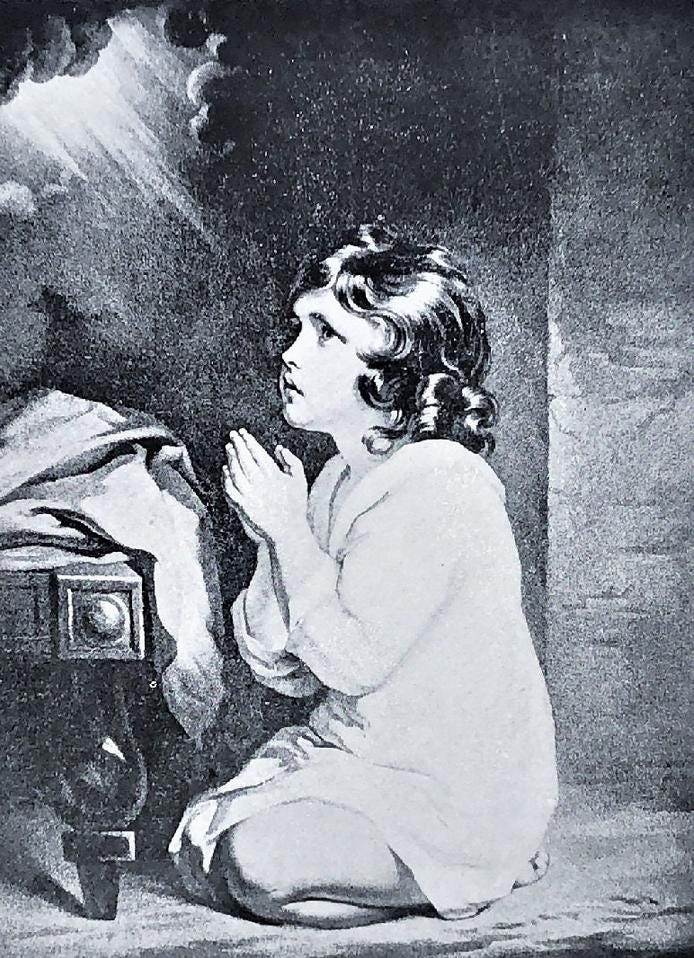
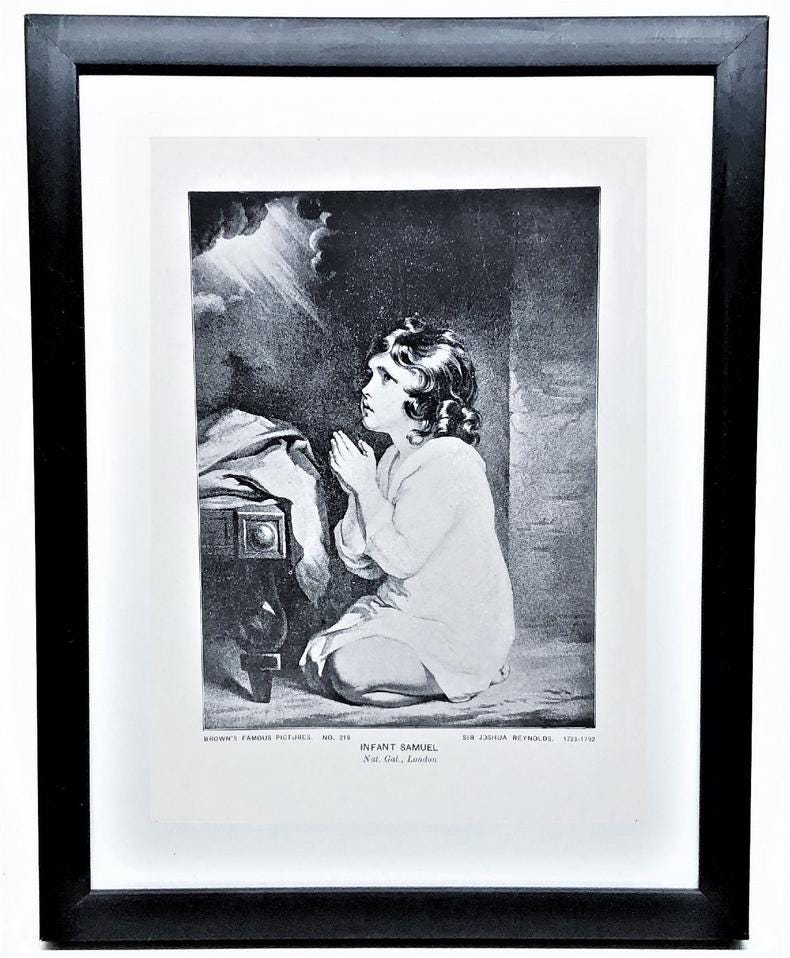
Perfect Gift for Art Lovers & Students!Vintage 1960's classic art print of the infamous Sir Joshua Reynolds: INFANT SAMUEL; a segment from the paintings located at the National Gallery Museum in London, England. Stunning black & white print is in mint condition and measures 5" high x 7" wide. The glass frame measures 7 1/4"H x 9 1/4"W and has easel on back for table display and eye hooks for wall hanging. Adds instant retro/classic charm to any room. Perfect gift for lovers of the Renaissance, Religion, and Art and history students.A description of "Infant Samuel":A young boy kneeling in prayer in front of a low table with drapery on it; almost in full profile to left, wearing a shirt and with bare legs; behind him a corner of a wall, in the background above left an opening in the clouds from which rays of light are directed to his face. The Infant Samuel portrait by Sir Joshua Reynolds, was painted during 1776 depicts Samuel the last judge of Israel and their first prophet as a young boy on his knees prayingPaolo Veronese and his works:Reynolds was born in Plympton in Devonshire on 16 July 1723, seventh child in the large family of the Reverend Samuel Reynolds and Theophilia Potter. Inspired to become an artist by Jonathan Richardson's elevated Essay on the Theory of Painting, Reynolds was apprenticed in 1740 to Thomas Hudson, the most fashionable portraitist of the day, with whom he remained until 1743.After two years of independent practice in London and another two in his native Devonshire, Reynolds was introduced by his father's friend Lord Edgcumbe to Commodore Augustus Keppel, about to sail to the Mediterranean, who invited him to join his expedition. After a stay in Minorca he spent over two years in Rome, from 1750 to 1752, returning through Florence, Venice and northern Italy, Lyons, and Paris. He brought back with him Giuseppe Marchi, whom he employed as an assistant until the end of his life. Although he never received any academic training, this experience of Italy, his reverence for Raphael, Michelangelo, and the Venetians, and the notebooks that he filled with drawings from classical antiquity and from the Old Masters were the foundation of his ideals and practice as a painter.Armed with introductions from Lord Edgcumbe to aristocratic sitters, and immediately establishing his reputation in London with his masterly and dramatic full-length portrait of Keppel in the pose of the Apollo Belvedere, Reynolds soon supplanted Hudson as the capital's leading portraitist, his only serious competitor being Ramsay. In 1759 he had more than 150 sitters; the following year he bought a grand house on Leicester Fields, took on pupils, and ran a coach. He never married; his household was run first by his sister Frances, then by his niece, Mary Palmer.The press of business was so great, especially in the middle years of his career, that, as had been customary with a busy portraitist since the time of Lely, the drapery and subordinate parts of his portraits were usually largely executed by assistants--at first by Peter Toms, and later by his own pupils. He employed the finest engravers to publish his principal compositions in mezzotint, a medium in which British eighteenth-century printmakers excelled. He also contributed regularly to the exhibitions first of the Society of Artists, then of the Royal Academy. Though he was uninterested in politics and no courtier, his eminence was such that it was inevitably he who was appointed first president of the Royal Academy of Arts in 1768. He was then knighted.In 1781 Reynolds visited Flanders and Holland, where he was greatly impressed by the work of Rubens. In 1784 he was appointed principal portrait painter to the king in succession to Ramsay. The following year he was commissioned by Catherine II of Russia to paint an historical picture of his own choosing; The Infant Hercules was his largest and most ambitious work. Apart from experiencing chronic deafness he had always enjoyed vigorous good health until he suffered a stroke in 1782; in 1789 he lost the sight of his left eye, and on 23 February 1792 he died in his home on Leicester Fields. He was given a quasi-state funeral and was buried in Saint Paul's Cathedral.NOTE: Purchases totaling $35 and above qualify for FREE shipping. Add more items to your Etsy shopping cart and save $$$.
Perfect Gift for Art Lovers & Students!Vintage 1960's classic art print of the infamous Sir Joshua Reynolds: INFANT SAMUEL; a segment from the paintings located at the National Gallery Museum in London, England. Stunning black & white print is in mint condition and measures 5" high x 7" wide. The glass frame measures 7 1/4"H x 9 1/4"W and has easel on back for table display and eye hooks for wall hanging. Adds instant retro/classic charm to any room. Perfect gift for lovers of the Renaissance, Religion, and Art and history students.A description of "Infant Samuel":A young boy kneeling in prayer in front of a low table with drapery on it; almost in full profile to left, wearing a shirt and with bare legs; behind him a corner of a wall, in the background above left an opening in the clouds from which rays of light are directed to his face. The Infant Samuel portrait by Sir Joshua Reynolds, was painted during 1776 depicts Samuel the last judge of Israel and their first prophet as a young boy on his knees prayingPaolo Veronese and his works:Reynolds was born in Plympton in Devonshire on 16 July 1723, seventh child in the large family of the Reverend Samuel Reynolds and Theophilia Potter. Inspired to become an artist by Jonathan Richardson's elevated Essay on the Theory of Painting, Reynolds was apprenticed in 1740 to Thomas Hudson, the most fashionable portraitist of the day, with whom he remained until 1743.After two years of independent practice in London and another two in his native Devonshire, Reynolds was introduced by his father's friend Lord Edgcumbe to Commodore Augustus Keppel, about to sail to the Mediterranean, who invited him to join his expedition. After a stay in Minorca he spent over two years in Rome, from 1750 to 1752, returning through Florence, Venice and northern Italy, Lyons, and Paris. He brought back with him Giuseppe Marchi, whom he employed as an assistant until the end of his life. Although he never received any academic training, this experience of Italy, his reverence for Raphael, Michelangelo, and the Venetians, and the notebooks that he filled with drawings from classical antiquity and from the Old Masters were the foundation of his ideals and practice as a painter.Armed with introductions from Lord Edgcumbe to aristocratic sitters, and immediately establishing his reputation in London with his masterly and dramatic full-length portrait of Keppel in the pose of the Apollo Belvedere, Reynolds soon supplanted Hudson as the capital's leading portraitist, his only serious competitor being Ramsay. In 1759 he had more than 150 sitters; the following year he bought a grand house on Leicester Fields, took on pupils, and ran a coach. He never married; his household was run first by his sister Frances, then by his niece, Mary Palmer.The press of business was so great, especially in the middle years of his career, that, as had been customary with a busy portraitist since the time of Lely, the drapery and subordinate parts of his portraits were usually largely executed by assistants--at first by Peter Toms, and later by his own pupils. He employed the finest engravers to publish his principal compositions in mezzotint, a medium in which British eighteenth-century printmakers excelled. He also contributed regularly to the exhibitions first of the Society of Artists, then of the Royal Academy. Though he was uninterested in politics and no courtier, his eminence was such that it was inevitably he who was appointed first president of the Royal Academy of Arts in 1768. He was then knighted.In 1781 Reynolds visited Flanders and Holland, where he was greatly impressed by the work of Rubens. In 1784 he was appointed principal portrait painter to the king in succession to Ramsay. The following year he was commissioned by Catherine II of Russia to paint an historical picture of his own choosing; The Infant Hercules was his largest and most ambitious work. Apart from experiencing chronic deafness he had always enjoyed vigorous good health until he suffered a stroke in 1782; in 1789 he lost the sight of his left eye, and on 23 February 1792 he died in his home on Leicester Fields. He was given a quasi-state funeral and was buried in Saint Paul's Cathedral.NOTE: Purchases totaling $35 and above qualify for FREE shipping. Add more items to your Etsy shopping cart and save $$$.
Other Products