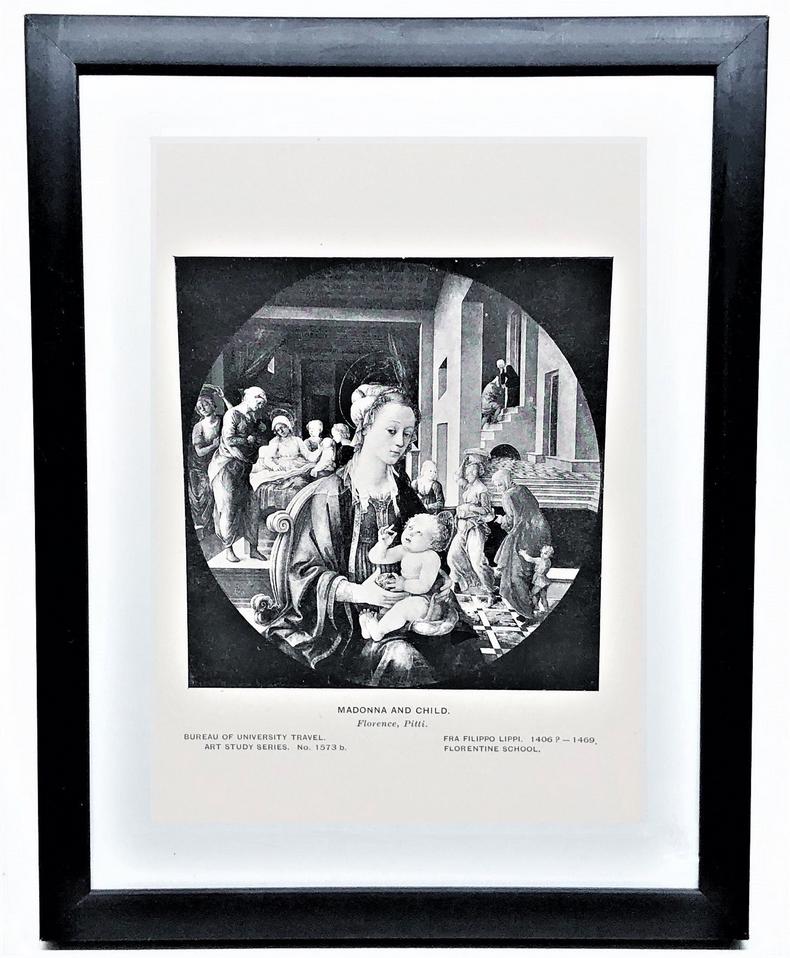
Madonna and Child - Vintage 7"x 5" Framed Fra Filippo Lippi 15th Century Classic Art Print - Perfect Gift for Art Lovers & Students!
$ 24.99

Madonna and Child - Vintage 7"x 5" Framed Fra Filippo Lippi 15th Century Classic
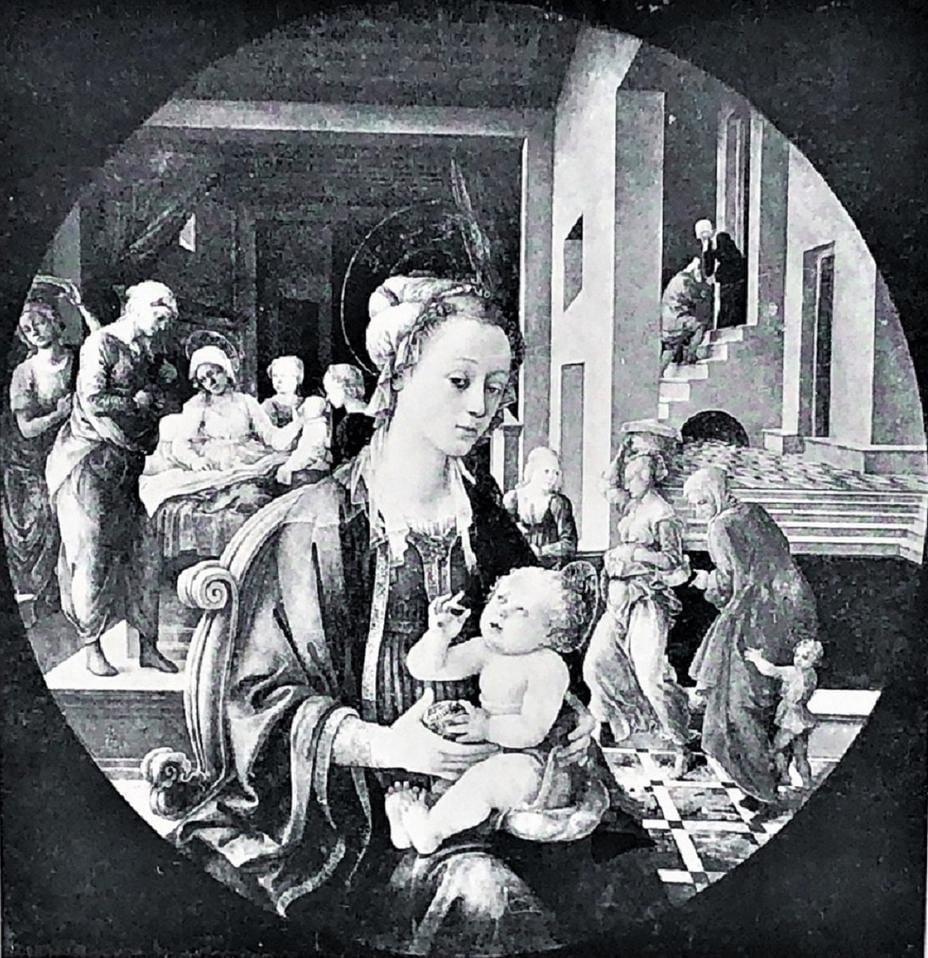
Art Print - Perfect Gift for Art Lovers & Students!Vintage 1960's classic art print of the infamous Fra Filippo Littpi (1406-1469): MADONNA And CHILD; a segment from the paintings located at the Florentine School in Florence, Italy. Stunning black & white print is in mint condition and measures 5" high x 7" wide. The glass frame measures 7 1/4"H x 9 1/4"W and has easel on back for table display and eye hooks for wall hanging. Adds instant retro/classic charm to any room. Perfect gift for lovers of the Renaissance, Religion, and Art and history students. We ship fast & safe worldwide everyday!A description of "Madonna and Child":The group of Madonna and Child is, unusually for the period, placed in front of an open window beyond which is a landscape inspired to Flemish painting.[7] The Madonna sits on a chair, at the window of a house located on a hilltop, which offers a view of an elaborate landscape of “plains, distant mountains, a city and a bay”. Her eyes are pointed down and her hands are folded in prayers before child Jesus, who is held up to her by two angels. She is wearing an elaborate coiffure with a soft veil and pearls: these elements, along with her costume, represent the elegance of the mid-1400s and were re-used in numerous late 15th century works in Florence.[1] Furthermore, as in many Renaissance paintings, the Madonna's hair is shaved farther back because, “the forehead [was] an object of special beauty” that resembled “a glowing, beautifully set pearl”.[1]Fra Filippo Lippin:Fra Filippo was born in 1406 in Florence to a poor family where his father was a butcher. He entered a monastery with his brother at an early age. Later in his life, he was moved to a monastery in Prato, and here fell in love with a nun, Lucrezia Buti, with whom he had two children. He encountered more trouble when his patrons claimed that Fra Filippo did not fulfill his contracts. Fra Filippo's main patrons were the Medicis.[1] HistoryThe commission and the exact execution date of the painting are unknown. In 1457, Giovanni de’ Medici wished to gift a panel to the King of Naples and commissioned Fra Filippo to paint it. Fra Filippo, who was working in Prato at that time, decided to temporarily return to his residence in Florence to work on this project. Fra Filippo wrote letters to Giovanni that show that the painter abandoned the project because of a lack of funding. Although art historian Ulmann believes that Fra Filippo presented the Uffizi Madonna to Giovanni to thank him for acting as an intermediary between him and the King of Naples, Edward C. Strutt states that this belief is incorrect. However, he also states that the Uffizi Madonna was in all probability executed around this time, while Fra Filippo was staying in Florence. This is also demonstrated by the techniques that Fra Filippo used to realize this painting: the blunt execution and the bold colors highlight how the painter was influenced by the technique of fresco painting. Since he acquired such techniques by working at the Prato Cathedral, long before he moved to Florence, Strutt believes that Fra Filippo must have executed this painting after his time working at the Cathedral.[3]NOTE: Purchases totaling $35 and above qualify for FREE shipping. Add more items to your Etsy shopping cart and save $$$.
Art Print - Perfect Gift for Art Lovers & Students!Vintage 1960's classic art print of the infamous Fra Filippo Littpi (1406-1469): MADONNA And CHILD; a segment from the paintings located at the Florentine School in Florence, Italy. Stunning black & white print is in mint condition and measures 5" high x 7" wide. The glass frame measures 7 1/4"H x 9 1/4"W and has easel on back for table display and eye hooks for wall hanging. Adds instant retro/classic charm to any room. Perfect gift for lovers of the Renaissance, Religion, and Art and history students. We ship fast & safe worldwide everyday!A description of "Madonna and Child":The group of Madonna and Child is, unusually for the period, placed in front of an open window beyond which is a landscape inspired to Flemish painting.[7] The Madonna sits on a chair, at the window of a house located on a hilltop, which offers a view of an elaborate landscape of “plains, distant mountains, a city and a bay”. Her eyes are pointed down and her hands are folded in prayers before child Jesus, who is held up to her by two angels. She is wearing an elaborate coiffure with a soft veil and pearls: these elements, along with her costume, represent the elegance of the mid-1400s and were re-used in numerous late 15th century works in Florence.[1] Furthermore, as in many Renaissance paintings, the Madonna's hair is shaved farther back because, “the forehead [was] an object of special beauty” that resembled “a glowing, beautifully set pearl”.[1]Fra Filippo Lippin:Fra Filippo was born in 1406 in Florence to a poor family where his father was a butcher. He entered a monastery with his brother at an early age. Later in his life, he was moved to a monastery in Prato, and here fell in love with a nun, Lucrezia Buti, with whom he had two children. He encountered more trouble when his patrons claimed that Fra Filippo did not fulfill his contracts. Fra Filippo's main patrons were the Medicis.[1] HistoryThe commission and the exact execution date of the painting are unknown. In 1457, Giovanni de’ Medici wished to gift a panel to the King of Naples and commissioned Fra Filippo to paint it. Fra Filippo, who was working in Prato at that time, decided to temporarily return to his residence in Florence to work on this project. Fra Filippo wrote letters to Giovanni that show that the painter abandoned the project because of a lack of funding. Although art historian Ulmann believes that Fra Filippo presented the Uffizi Madonna to Giovanni to thank him for acting as an intermediary between him and the King of Naples, Edward C. Strutt states that this belief is incorrect. However, he also states that the Uffizi Madonna was in all probability executed around this time, while Fra Filippo was staying in Florence. This is also demonstrated by the techniques that Fra Filippo used to realize this painting: the blunt execution and the bold colors highlight how the painter was influenced by the technique of fresco painting. Since he acquired such techniques by working at the Prato Cathedral, long before he moved to Florence, Strutt believes that Fra Filippo must have executed this painting after his time working at the Cathedral.[3]NOTE: Purchases totaling $35 and above qualify for FREE shipping. Add more items to your Etsy shopping cart and save $$$.
Other Products