MYSTICAL NATIVITY - Vintage 7"x 5" Framed Fra Filippo Lippi 15th Century Classic Art Print - Perfect Gift for Art Lovers & Students!
$ 24.99

MYSTICAL NATIVITY - Vintage 7"x 5" Framed Fra Filippo Lippi 15th Century Classic
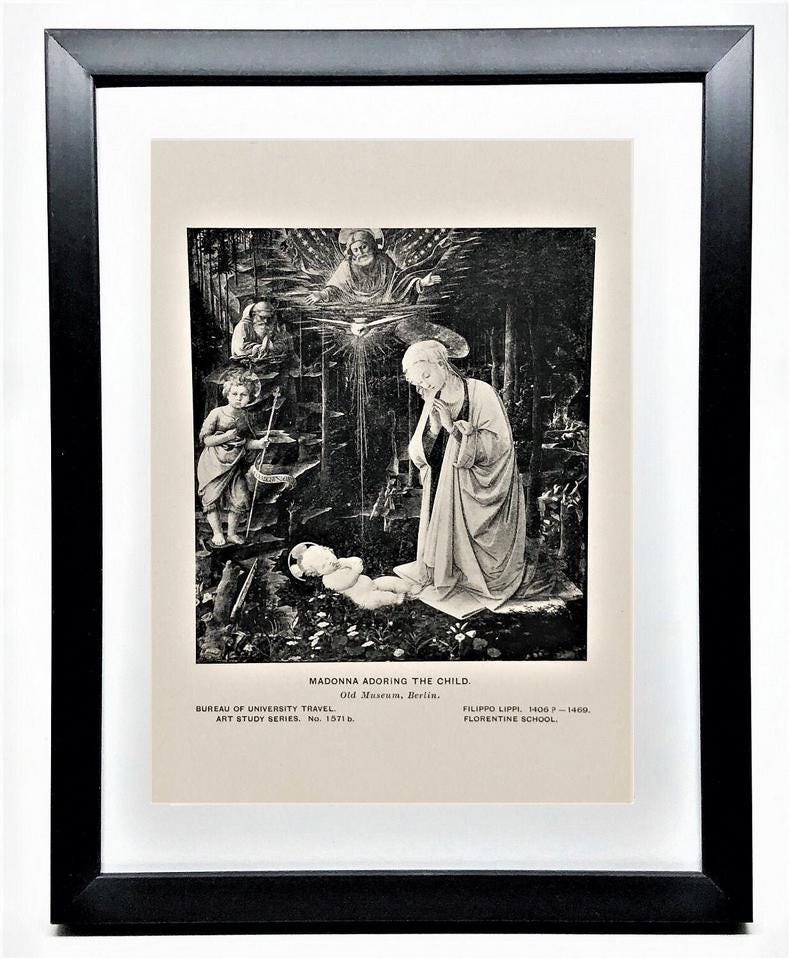
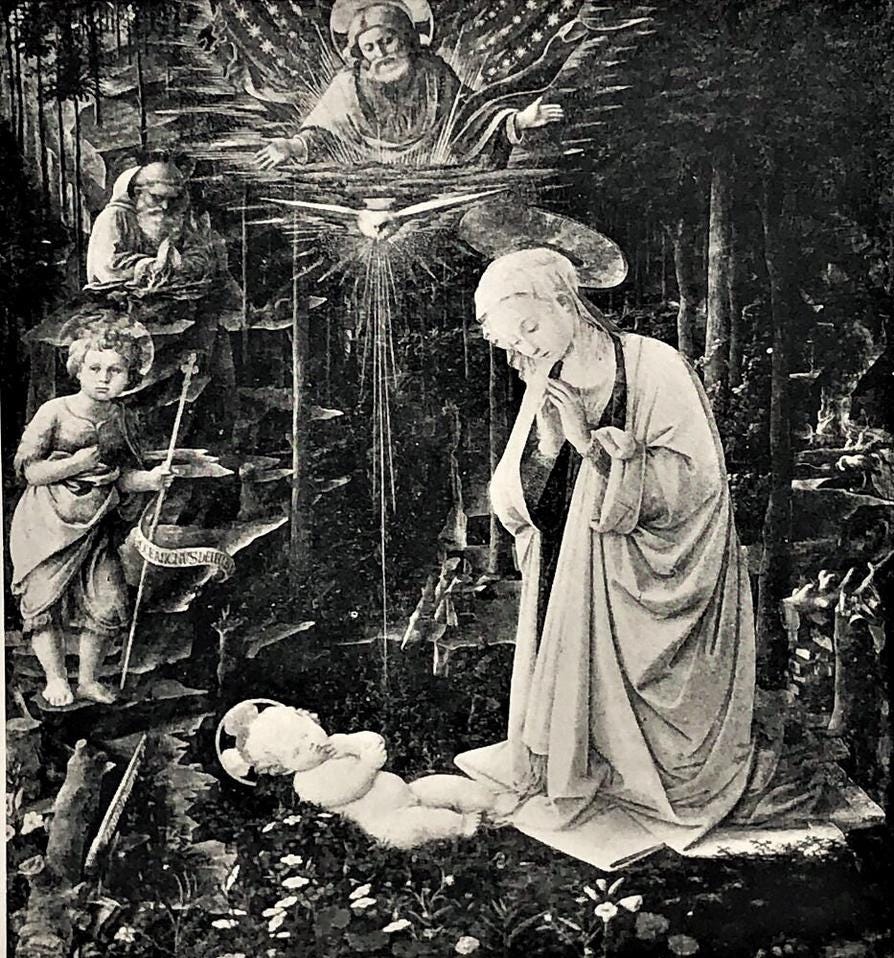
Art Print - Perfect Gift for Art Lovers & Students!Vintage 1960's classic art print of the infamous Fra Filippo Littpi (1406-1469): MYSTICAL NATIVITY (aka Madonna Adoring The Child) from the paintings located at the Old Museum in Berlin, Germany. Stunning black & white print is in mint condition and measures 5" high x 7" wide. The glass frame measures 7 1/4"H x 9 1/4"W and has easel on back for table display and eye hooks for wall hanging. Adds instant retro/classic charm to any room. Perfect gift for lovers of the Renaissance, Religion, and Art and history students. We ship fast & safe worldwide every day!See painting information and artist bio below.NOTE: Purchases totaling $35 and above qualify for FREE shipping. Add more items to your Etsy shopping cart and save $$$.About the painting:The moment shown is known as the Adoration of the Child in art, as the almost naked baby Jesus is placed on the ground, and "adored" by his mother Mary. The lower part of his body is covered by a gauzy and transparent cloth. They are on a patch of ground with grass, several types of flower in bloom, but also some of the debris of forestry that appears throughout the forest background. To the left, the infant John the Baptist stands, wearing his attribute of a camelskin coat under a red robe. He carries a small cross on a long staff, and holds a banderole inscribed Ecce Agnus Dei ("Behold the Lamb of God"). However, he is shown as perhaps five or six years old, a much bigger age difference with the newborn Jesus than the church taught.[5] The signature on the axe handleAbove John the Baptist is the praying figure of Saint Romuald (c.951 – c. 1025/27), founder of the Camaldolese order of monks, to which the Medici family, the patrons of the painting had connections.[6] At the top of the painting, slightly off-centre, are the two other persons of the Christian Holy Trinity, God the Father and the Holy Spirit, represented as a dove. All these figures form a near-continuous rough circle, slightly off-centre to the left. John's figure almost reaches the left edge of the painted surface, but on the right of the composition there is a generous slice of background, interrupted only by Mary's robe. It is not uncommon to have saints and persons not mentioned in the biblical accounts in Nativity scenes, but in addition to the normal elements. In contrast, as Hartt puts it, here there is "no cave, no shed, no Joseph, no angels, no ox, no ass".[7]The scene is set on a steep slope in a rather dark forest, mostly consisting of pine trees, which runs right to the top of the composition, so that no sky can be seen. Stumps, discarded pieces of tree and other evidence of woodcutting is all around,[8] and Lippi has signed his name ("FRATER PHILIPPUS P[inxit]" – "Brother Phillip painted this") along the handle of an axe struck into a stump in the bottom left-hand corner.[9] A small, evidently fast-running, stream runs down the right-hand side of the painting, crossed by a crude bridge of planks. On the other side of this, near the top of the painting there is a small hut-like building. On the near side of the stream a crane or heron preens itself. A small goldfinch is perched on a stump at the front of the picture-space, near Jesus's foot; a common symbol in art for the Passion of Christ in the future.[10]Bio:Fra Filippo Lippi was born in 1406 in Florence to a poor family where his father was a butcher. He entered a monastery with his brother at an early age. Later in his life, he was moved to a monastery in Prato, and here fell in love with a nun, Lucrezia Buti, with whom he had two children. He encountered more trouble when his patrons claimed that Fra Filippo did not fulfill his contracts. Fra Filippo's main patrons were the Medicis.[1]History:The commission and the exact execution date of the painting are unknown. In 1457, Giovanni de’ Medici wished to gift a panel to the King of Naples and commissioned Fra Filippo to paint it. Fra Filippo, who was working in Prato at that time, decided to temporarily return to his residence in Florence to work on this project. Fra Filippo wrote letters to Giovanni that show that the painter abandoned the project because of a lack of funding. Although art historian Ulmann believes that Fra Filippo presented the Uffizi Madonna to Giovanni to thank him for acting as an intermediary between him and the King of Naples, Edward C. Strutt states that this belief is incorrect. However, he also states that the Uffizi Madonna was in all probability executed around this time, while Fra Filippo was staying in Florence. This is also demonstrated by the techniques that Fra Filippo used to realize this painting: the blunt execution and the bold colors highlight how the painter was influenced by the technique of fresco painting. Since he acquired such techniques by working at the Prato Cathedral, long before he moved to Florence, Strutt believes that Fra Filippo must have executed this painting after his time working at the Cathedral.[3]
Art Print - Perfect Gift for Art Lovers & Students!Vintage 1960's classic art print of the infamous Fra Filippo Littpi (1406-1469): MYSTICAL NATIVITY (aka Madonna Adoring The Child) from the paintings located at the Old Museum in Berlin, Germany. Stunning black & white print is in mint condition and measures 5" high x 7" wide. The glass frame measures 7 1/4"H x 9 1/4"W and has easel on back for table display and eye hooks for wall hanging. Adds instant retro/classic charm to any room. Perfect gift for lovers of the Renaissance, Religion, and Art and history students. We ship fast & safe worldwide every day!See painting information and artist bio below.NOTE: Purchases totaling $35 and above qualify for FREE shipping. Add more items to your Etsy shopping cart and save $$$.About the painting:The moment shown is known as the Adoration of the Child in art, as the almost naked baby Jesus is placed on the ground, and "adored" by his mother Mary. The lower part of his body is covered by a gauzy and transparent cloth. They are on a patch of ground with grass, several types of flower in bloom, but also some of the debris of forestry that appears throughout the forest background. To the left, the infant John the Baptist stands, wearing his attribute of a camelskin coat under a red robe. He carries a small cross on a long staff, and holds a banderole inscribed Ecce Agnus Dei ("Behold the Lamb of God"). However, he is shown as perhaps five or six years old, a much bigger age difference with the newborn Jesus than the church taught.[5] The signature on the axe handleAbove John the Baptist is the praying figure of Saint Romuald (c.951 – c. 1025/27), founder of the Camaldolese order of monks, to which the Medici family, the patrons of the painting had connections.[6] At the top of the painting, slightly off-centre, are the two other persons of the Christian Holy Trinity, God the Father and the Holy Spirit, represented as a dove. All these figures form a near-continuous rough circle, slightly off-centre to the left. John's figure almost reaches the left edge of the painted surface, but on the right of the composition there is a generous slice of background, interrupted only by Mary's robe. It is not uncommon to have saints and persons not mentioned in the biblical accounts in Nativity scenes, but in addition to the normal elements. In contrast, as Hartt puts it, here there is "no cave, no shed, no Joseph, no angels, no ox, no ass".[7]The scene is set on a steep slope in a rather dark forest, mostly consisting of pine trees, which runs right to the top of the composition, so that no sky can be seen. Stumps, discarded pieces of tree and other evidence of woodcutting is all around,[8] and Lippi has signed his name ("FRATER PHILIPPUS P[inxit]" – "Brother Phillip painted this") along the handle of an axe struck into a stump in the bottom left-hand corner.[9] A small, evidently fast-running, stream runs down the right-hand side of the painting, crossed by a crude bridge of planks. On the other side of this, near the top of the painting there is a small hut-like building. On the near side of the stream a crane or heron preens itself. A small goldfinch is perched on a stump at the front of the picture-space, near Jesus's foot; a common symbol in art for the Passion of Christ in the future.[10]Bio:Fra Filippo Lippi was born in 1406 in Florence to a poor family where his father was a butcher. He entered a monastery with his brother at an early age. Later in his life, he was moved to a monastery in Prato, and here fell in love with a nun, Lucrezia Buti, with whom he had two children. He encountered more trouble when his patrons claimed that Fra Filippo did not fulfill his contracts. Fra Filippo's main patrons were the Medicis.[1]History:The commission and the exact execution date of the painting are unknown. In 1457, Giovanni de’ Medici wished to gift a panel to the King of Naples and commissioned Fra Filippo to paint it. Fra Filippo, who was working in Prato at that time, decided to temporarily return to his residence in Florence to work on this project. Fra Filippo wrote letters to Giovanni that show that the painter abandoned the project because of a lack of funding. Although art historian Ulmann believes that Fra Filippo presented the Uffizi Madonna to Giovanni to thank him for acting as an intermediary between him and the King of Naples, Edward C. Strutt states that this belief is incorrect. However, he also states that the Uffizi Madonna was in all probability executed around this time, while Fra Filippo was staying in Florence. This is also demonstrated by the techniques that Fra Filippo used to realize this painting: the blunt execution and the bold colors highlight how the painter was influenced by the technique of fresco painting. Since he acquired such techniques by working at the Prato Cathedral, long before he moved to Florence, Strutt believes that Fra Filippo must have executed this painting after his time working at the Cathedral.[3]
Other Products