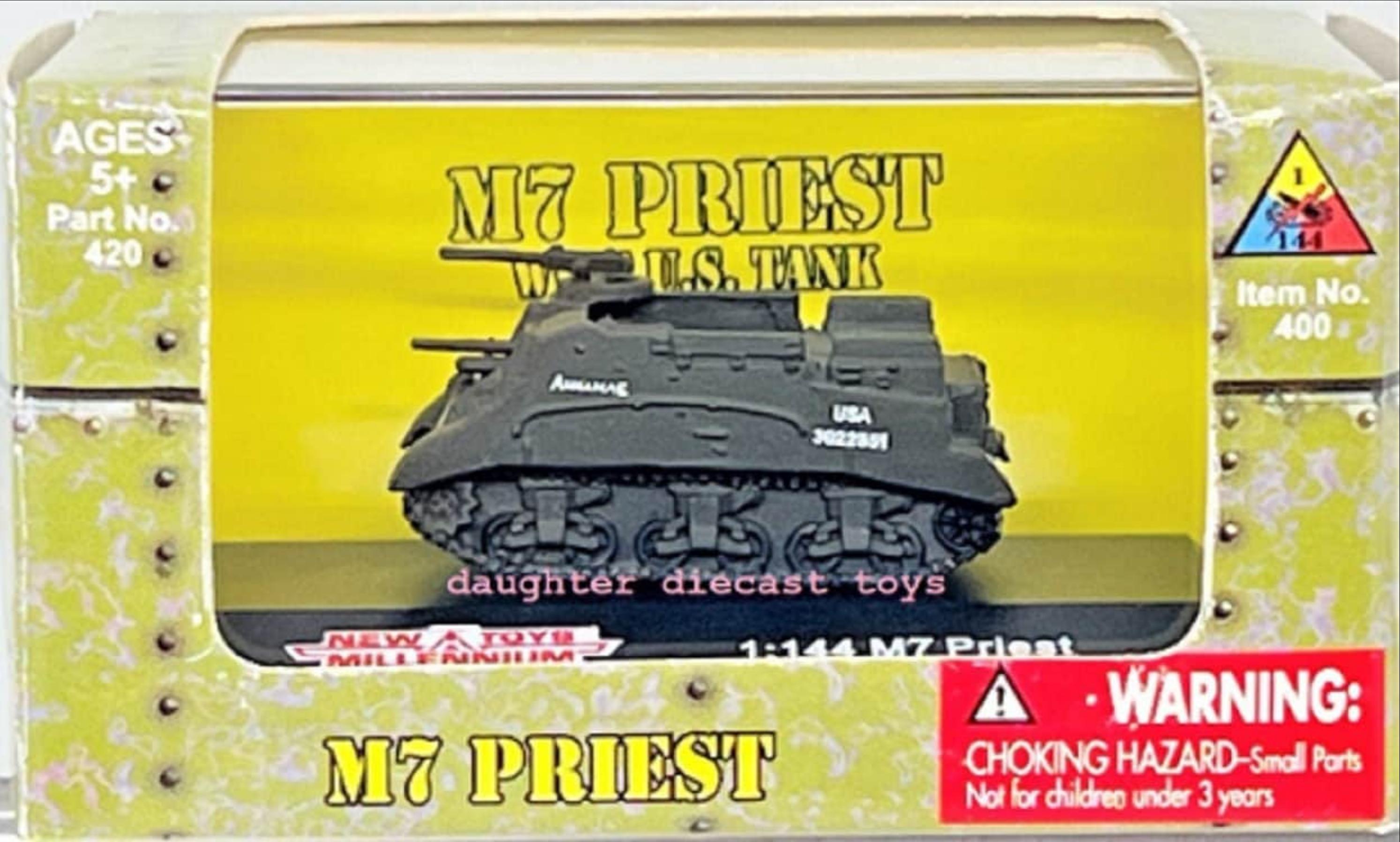
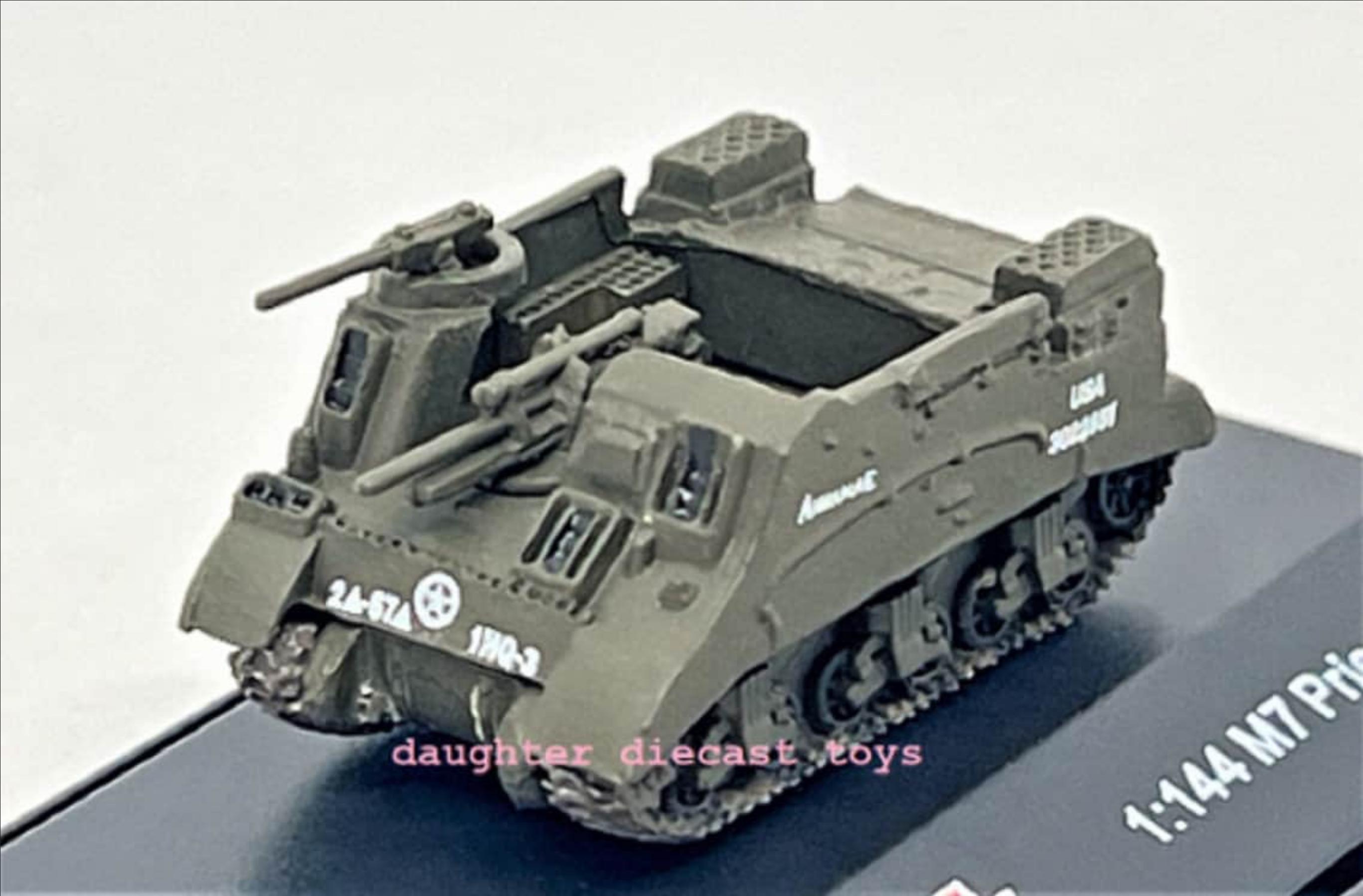
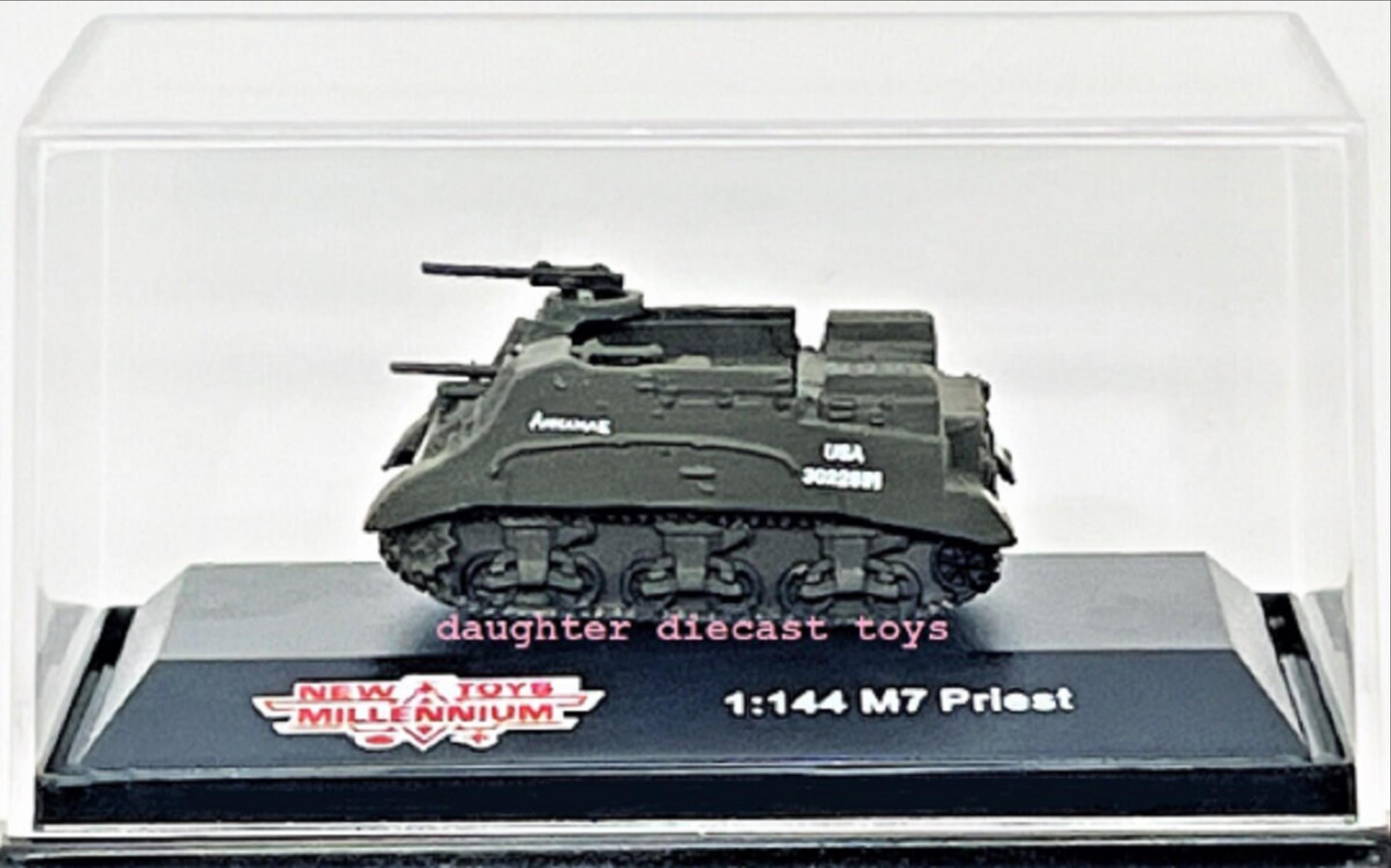
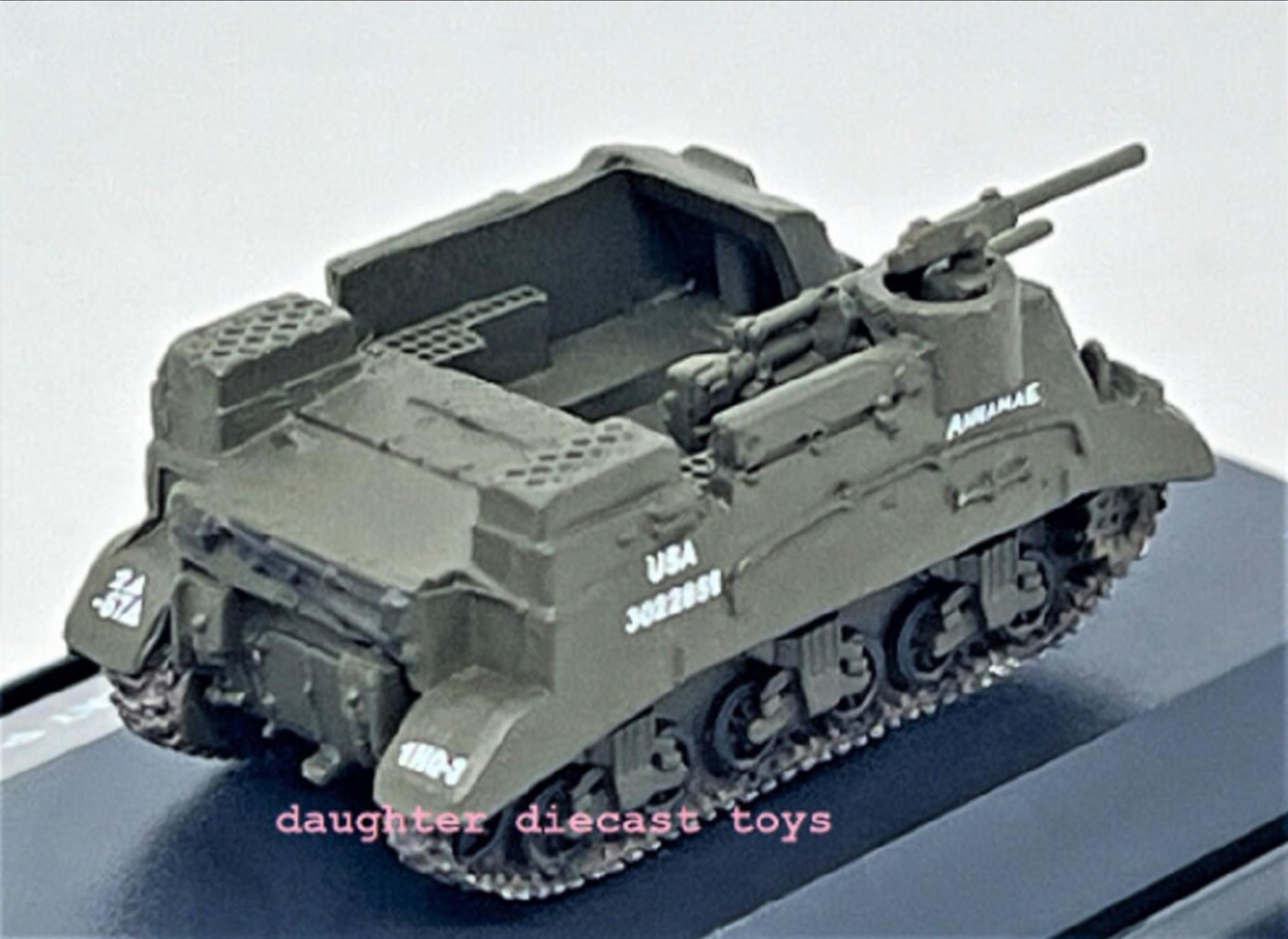

WWII Army M7 TANK 1:144 Scale-Intricate mini-replica in Pristine Condition! Perfect Gift for Military Diorama Artists & War History Buffs!
$ 9.99

WWII Army M7 PRIEST TANK 1:144 Scale-Intricate mini-replica in Pristine
Condition! Perfect Gift for Military Diorama Artists & War History Buffs!Awesome! WWII US ARMY M7 PRIEST TANK Intricately detailed hard plastic model made by New Millennium Toys. Scale-1:44. Measures 1 1/4"L x 3/4"W x 3 /4"H. Pristine condition never handled or displayed (until today for our listing photos). Comes in factory-sealed box, mounted on display base with clear plastic showcase. Perfect gift for toy/tank collectors, Military diorama artists, history buffs, and veterans! 100% happiness guaranteed. See Tank bio below....
•
•
•FOR A LIMITED TIME
•
•
•Purchases totaling $35 and above qualify for FREE shipping to USA! Add more items to your Etsy shopping cart to save $$$.NOTE: My dad owned a Diecast toy store for 30 years. I inherited the store inventory when he passed away many years ago. I am just now, beginning to sell the mint condition vintage models. All are store-inventory is new-old-stock, models have never been "played with". Please visit often-as I adding more cool stuff every day!TANK BIO: M7 PREISTType: Self-propelled gun Place of origin: United States Service history: (used by) U.S. Army, Argentine army, Austrian Army, Belgian army, British Army, Canadian Army, French Army, Israel Defense Forces, Italian Army, Norwegian army, Pakistan Army, Philippine Army, Philippine Constabulary, Republic of China Armed Forces, Bundeswehr (West German Army), Yugoslav People's Army. Production history Manufacturer:American Locomotive Company (M7) Pressed Steel Car Federal Machine and Welder Produced: April 1942 – July 1945 No. built M7: 3489, M7B1: 826 M7B2: 127 converted from M7B1 Variants: M7, M7B1, M7B2 Specifications: Mass 50,640 lb (22.97 metric tons) Length 19 ft 9 in (6.02 m)[5] Width 9 ft 5 in (2.87 m) with sandshields Height 8 ft 4 in (2.54 m)[5] 9 ft 8 in (2.95 m) over AA machine gun Crew 8 Armor 12–62 mm[5] Main armament 105 mm M1/M2 Howitzer 69 rounds Secondary armament 1 × 0.5 in (12.7 mm) M2 Browning machine gun 300 rounds Engine Continental R-975 C1/C4 Ford GAA (M7B1) 400 or 340 hp (298 or 254 kW) Suspension Vertical volute spring Operational range 120 mi (193 km) Maximum speed 24 mph (39 km/h) on road 15 mph (24 km/h) off roadDesign and development:During the early stages of World War II, US Army observers realized that they would need a self-propelled artillery vehicle with sufficient firepower to support armored operations. Lessons learned with half-tracks (such as the T19 Howitzer Motor Carriage (HMC) with a 105 mm howitzer on the M3 Half-track chassis) also showed that this vehicle would have to be armored and fully tracked. It was decided to use the M3 Lee chassis as the basis for this new vehicle design, named T32.[6] The pilot vehicles used the M3 chassis with an open-topped superstructure, mounting an M2A1 105 mm howitzer, with a machine-gun added after trials.The T32 was accepted for service as the M7 in February 1942 and production began that April. The British Tank Mission had requested 2,500 to be delivered by the end of 1942 and a further 3,000 by the end of 1943, an order which was never fully completed.[7][8]As the M4 Sherman tank replaced the M3, it was decided to continue production using the M4 chassis (the M4 chassis was a development of the M3). The M7 was subsequently supplanted by the M37 105 mm Howitzer Motor Carriage (on the "Light Combat Team" chassis that also gave the M24 Chaffee light tank).[8]Operational history A total of 3,489 M7s and 826 M7B1s were built. They proved to be reliable weapons, continuing to see front-line service in the US and other armies well past the end of World War II.[4][9]North Africa During the North African campaign, 90 M7s were received by the British Eighth Army in North Africa, which was also the first to use it, during the Second Battle of El Alamein, alongside the Bishop, a self-propelled gun based on the 87.6 mm calibre Ordnance QF 25-pounder gun-howitzer.[10]The British Commonwealth armies had logistical problems in supplying the M7, as it used US ammunition that was not compatible with standard British artillery pieces or tank guns, and had to be supplied separately.[10] Whereas the Sexton – a rival self-propelled gun developed in Canada - featured the standard British QF 25-pounder (on an M3 or M4 chassis).[6]Despite supply problems, British Commonwealth forces used the M7 throughout the campaigns in North Africa and Italy.North-West Europe During the invasion of Normandy, from June 1944, the artillery regiments of the British 3rd and 50th divisions, and the Canadian 3rd Division were equipped with the M7; however, these were replaced by towed 25-pounder guns in early August.[11][12] M7 Priest passes by a Humber Scout Car as it moves into position to support an attack on Caen, 8 July 1944. During the Battle of the Bulge, each US armored division had three battalions of M7s, giving them unparalleled mobile artillery support.[13]Pacific War The M7 was also used by US and British forces in Pacific and Asian theaters.During the Burma campaign, the Priest played a significant role, in particular, at the Battle of Meiktila and the advance on Rangoon (1945).From early 1944 it was used in the South West Pacific theater, by the US Sixth Army in the later stages of the campaign in New Guinea and surrounding islands. The M7 also saw action in the Philippines campaign, with the US Eighth and Sixth armies.
Condition! Perfect Gift for Military Diorama Artists & War History Buffs!Awesome! WWII US ARMY M7 PRIEST TANK Intricately detailed hard plastic model made by New Millennium Toys. Scale-1:44. Measures 1 1/4"L x 3/4"W x 3 /4"H. Pristine condition never handled or displayed (until today for our listing photos). Comes in factory-sealed box, mounted on display base with clear plastic showcase. Perfect gift for toy/tank collectors, Military diorama artists, history buffs, and veterans! 100% happiness guaranteed. See Tank bio below....
•
•
•FOR A LIMITED TIME
•
•
•Purchases totaling $35 and above qualify for FREE shipping to USA! Add more items to your Etsy shopping cart to save $$$.NOTE: My dad owned a Diecast toy store for 30 years. I inherited the store inventory when he passed away many years ago. I am just now, beginning to sell the mint condition vintage models. All are store-inventory is new-old-stock, models have never been "played with". Please visit often-as I adding more cool stuff every day!TANK BIO: M7 PREISTType: Self-propelled gun Place of origin: United States Service history: (used by) U.S. Army, Argentine army, Austrian Army, Belgian army, British Army, Canadian Army, French Army, Israel Defense Forces, Italian Army, Norwegian army, Pakistan Army, Philippine Army, Philippine Constabulary, Republic of China Armed Forces, Bundeswehr (West German Army), Yugoslav People's Army. Production history Manufacturer:American Locomotive Company (M7) Pressed Steel Car Federal Machine and Welder Produced: April 1942 – July 1945 No. built M7: 3489, M7B1: 826 M7B2: 127 converted from M7B1 Variants: M7, M7B1, M7B2 Specifications: Mass 50,640 lb (22.97 metric tons) Length 19 ft 9 in (6.02 m)[5] Width 9 ft 5 in (2.87 m) with sandshields Height 8 ft 4 in (2.54 m)[5] 9 ft 8 in (2.95 m) over AA machine gun Crew 8 Armor 12–62 mm[5] Main armament 105 mm M1/M2 Howitzer 69 rounds Secondary armament 1 × 0.5 in (12.7 mm) M2 Browning machine gun 300 rounds Engine Continental R-975 C1/C4 Ford GAA (M7B1) 400 or 340 hp (298 or 254 kW) Suspension Vertical volute spring Operational range 120 mi (193 km) Maximum speed 24 mph (39 km/h) on road 15 mph (24 km/h) off roadDesign and development:During the early stages of World War II, US Army observers realized that they would need a self-propelled artillery vehicle with sufficient firepower to support armored operations. Lessons learned with half-tracks (such as the T19 Howitzer Motor Carriage (HMC) with a 105 mm howitzer on the M3 Half-track chassis) also showed that this vehicle would have to be armored and fully tracked. It was decided to use the M3 Lee chassis as the basis for this new vehicle design, named T32.[6] The pilot vehicles used the M3 chassis with an open-topped superstructure, mounting an M2A1 105 mm howitzer, with a machine-gun added after trials.The T32 was accepted for service as the M7 in February 1942 and production began that April. The British Tank Mission had requested 2,500 to be delivered by the end of 1942 and a further 3,000 by the end of 1943, an order which was never fully completed.[7][8]As the M4 Sherman tank replaced the M3, it was decided to continue production using the M4 chassis (the M4 chassis was a development of the M3). The M7 was subsequently supplanted by the M37 105 mm Howitzer Motor Carriage (on the "Light Combat Team" chassis that also gave the M24 Chaffee light tank).[8]Operational history A total of 3,489 M7s and 826 M7B1s were built. They proved to be reliable weapons, continuing to see front-line service in the US and other armies well past the end of World War II.[4][9]North Africa During the North African campaign, 90 M7s were received by the British Eighth Army in North Africa, which was also the first to use it, during the Second Battle of El Alamein, alongside the Bishop, a self-propelled gun based on the 87.6 mm calibre Ordnance QF 25-pounder gun-howitzer.[10]The British Commonwealth armies had logistical problems in supplying the M7, as it used US ammunition that was not compatible with standard British artillery pieces or tank guns, and had to be supplied separately.[10] Whereas the Sexton – a rival self-propelled gun developed in Canada - featured the standard British QF 25-pounder (on an M3 or M4 chassis).[6]Despite supply problems, British Commonwealth forces used the M7 throughout the campaigns in North Africa and Italy.North-West Europe During the invasion of Normandy, from June 1944, the artillery regiments of the British 3rd and 50th divisions, and the Canadian 3rd Division were equipped with the M7; however, these were replaced by towed 25-pounder guns in early August.[11][12] M7 Priest passes by a Humber Scout Car as it moves into position to support an attack on Caen, 8 July 1944. During the Battle of the Bulge, each US armored division had three battalions of M7s, giving them unparalleled mobile artillery support.[13]Pacific War The M7 was also used by US and British forces in Pacific and Asian theaters.During the Burma campaign, the Priest played a significant role, in particular, at the Battle of Meiktila and the advance on Rangoon (1945).From early 1944 it was used in the South West Pacific theater, by the US Sixth Army in the later stages of the campaign in New Guinea and surrounding islands. The M7 also saw action in the Philippines campaign, with the US Eighth and Sixth armies.
Other Products