
Vintage 1988 LUFTHANSA AIRLINES D.C.10 Hard to find Jet Airplane, Diecast Metal Pristine Condition / Factory Sealed! Ertl-Perfect gift!
$ 49.99

Vintage 1988 LUFTHANSA AIRLINES D.C.10 Hard to find Jet Airplane, Diecast Metal
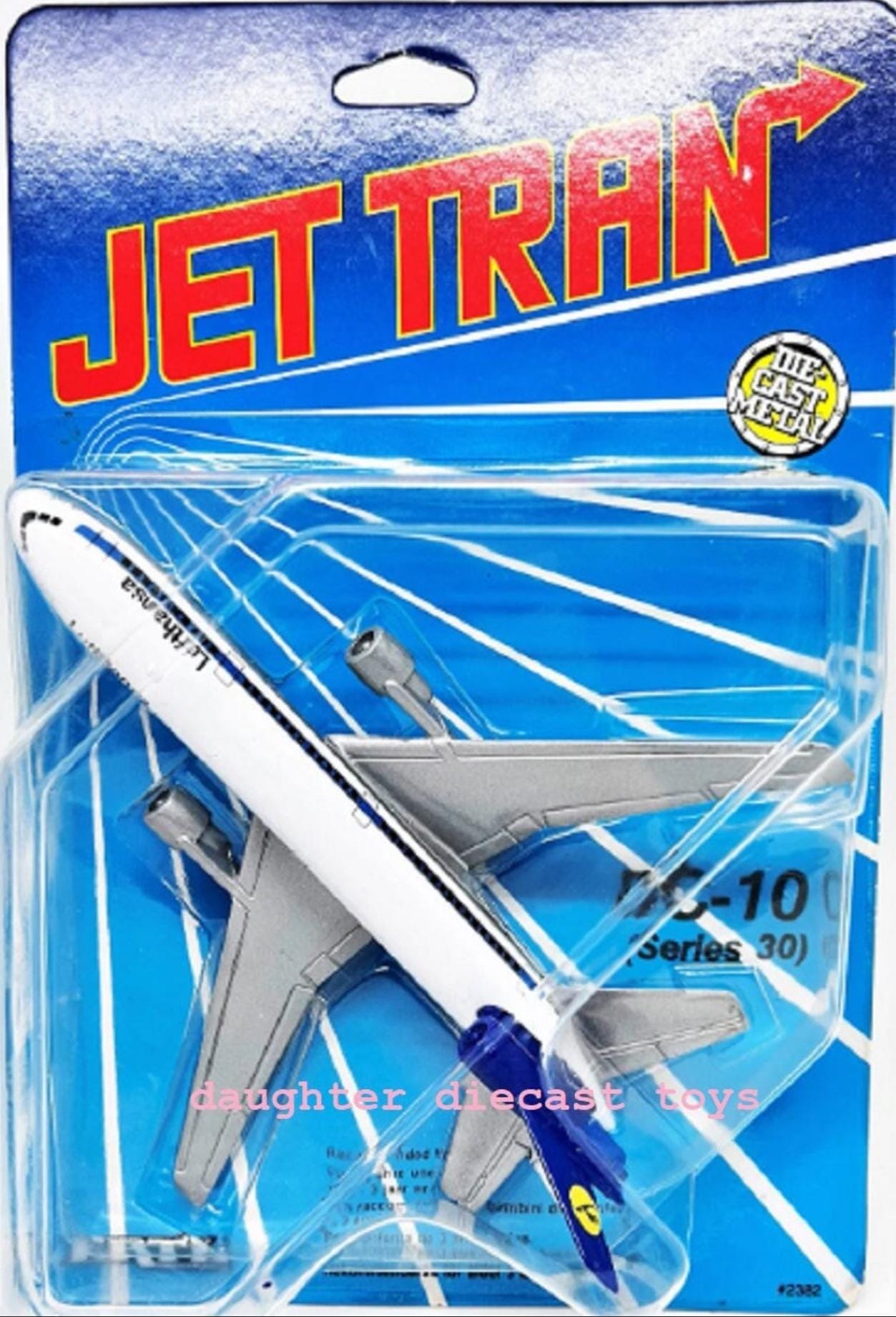
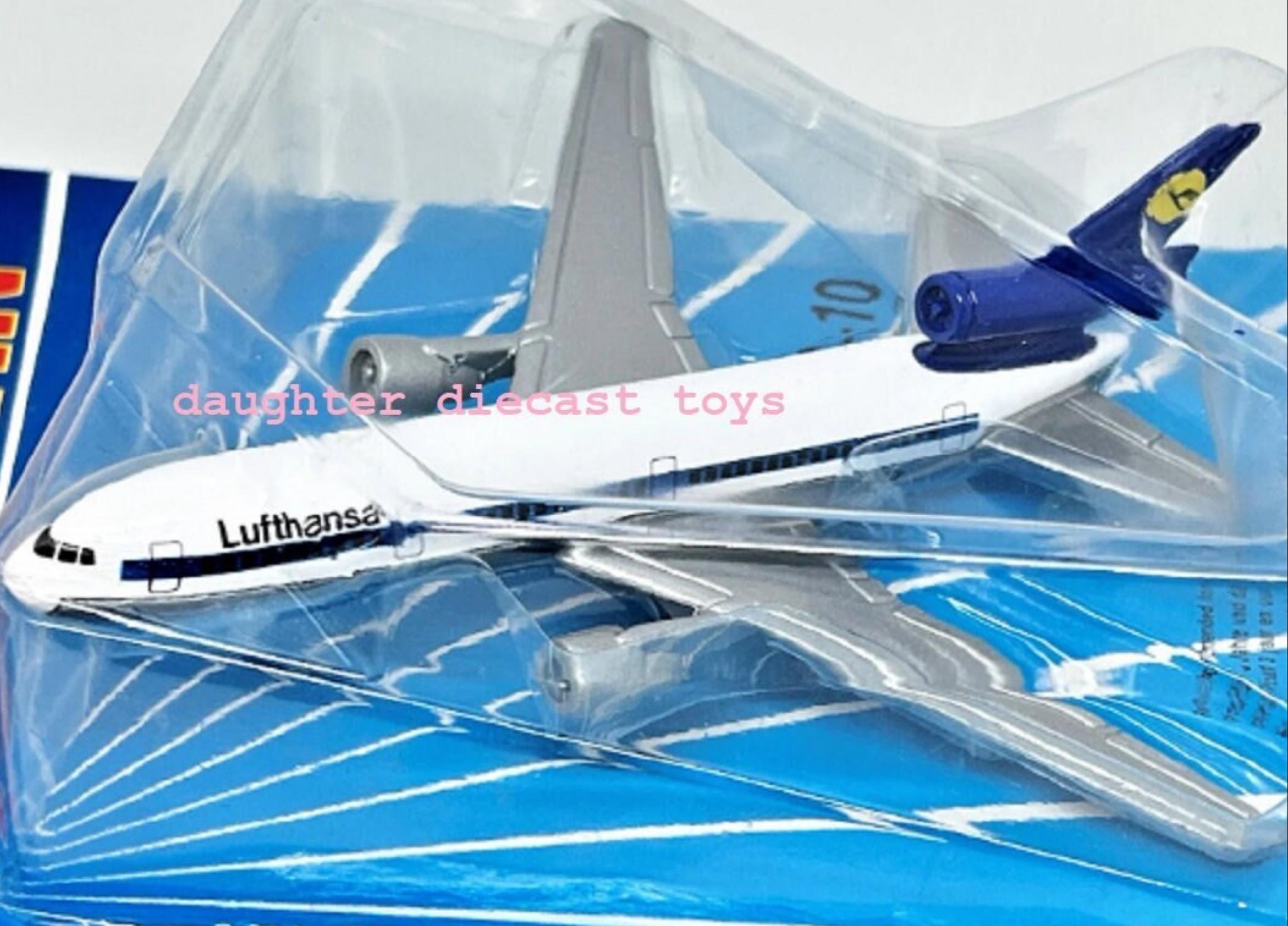
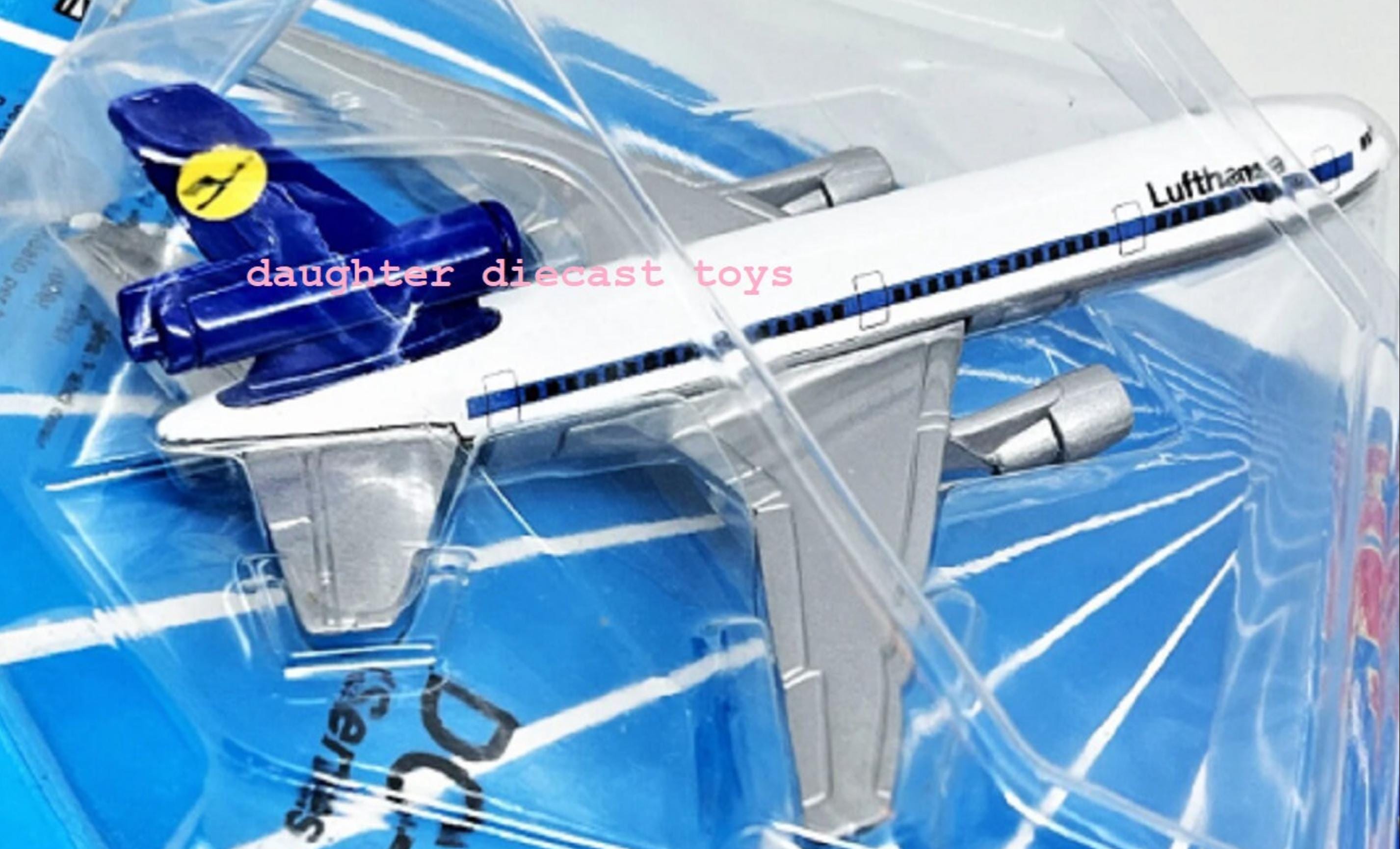
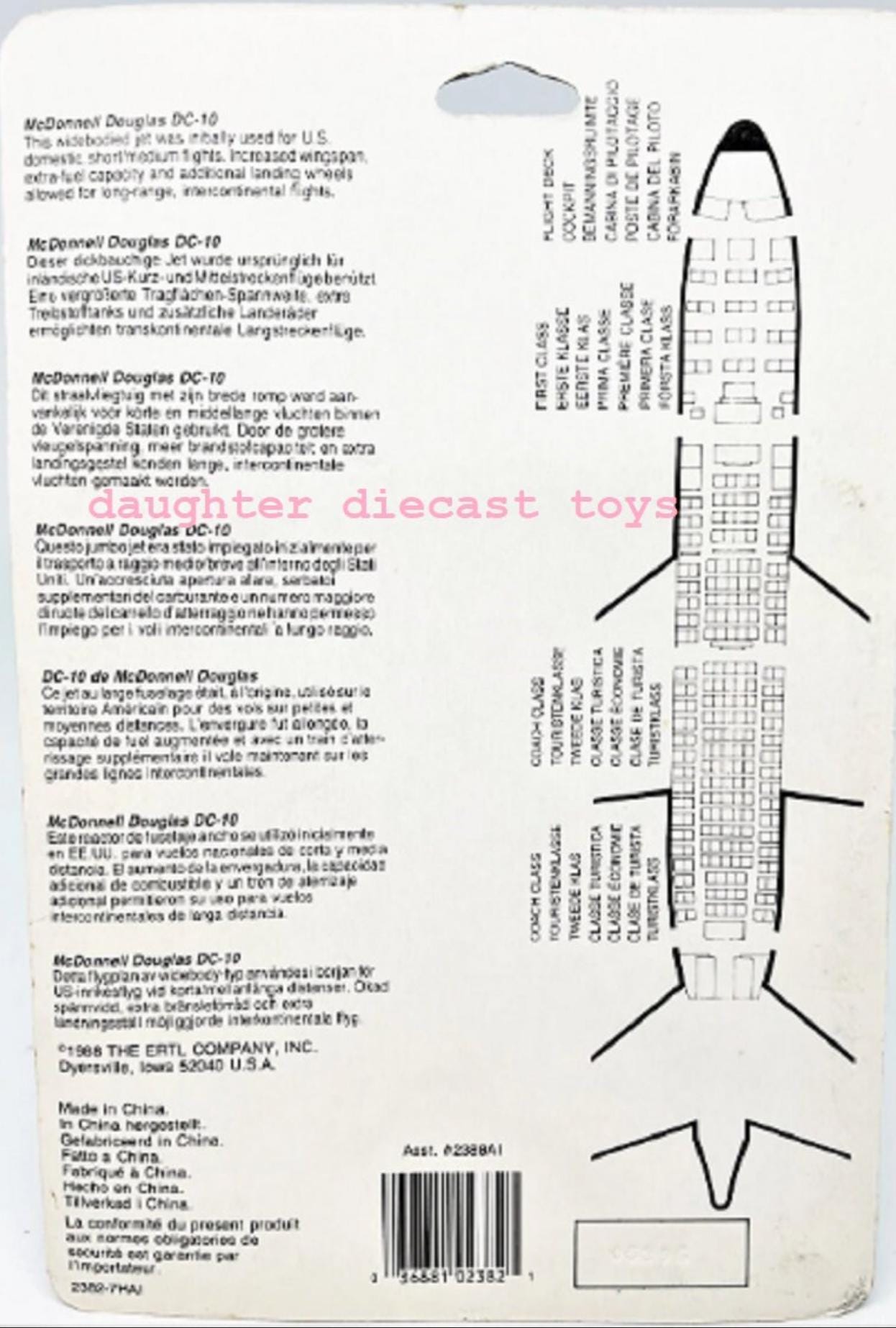
Pristine Condition / Factory Sealed! Ertl-Perfect gift!Awesome looking & hard to find: LUFTHANSA AIRLINES DC-10 JET AIRPLANE. Constructed of die cast metal. Made in 1988 by ERTL. Highly sought-after, hard to find model! Large model-Measures 6"L x 5 1/2"W x 2"H. Beautiful, rare model-in Pristine condition-never been removed from its factory-sealed card. Perfect gift for Luthansa Airlines employees, Airplane, Ertl and vintage die cast metal toy collectors! Read DC10 bio below....Note: My dad owned a Diecast toy store for 30 years. I inherited the store inventory when he passed away several years ago. I am (just now) able to bring myself to begin selling his cars-so they can be shared with the world. All pristine and mint condition vintage models will (eventually) be listed here on ETSY. All the inventory is NEW (vintage) merchandise-which was intended for retail sale. Please know-our diecast toys have NEVER been "played-with” we do not sell used, or damaged toys.
•
•
•FOR A LIMITED TIME
•
•
•Purchases totaling $35 and above qualify for FREE shipping to USA! Add more items to your Etsy shopping cart to save $$$.The McDonnell Douglas DC-10 is an American tri-jet wide-body airliner manufactured by McDonnell Douglas. The DC-10 was intended to succeed the DC-8 for long-range flights. It first flew on August 29, 1970; it was introduced on August 5, 1971, by American Airlines.The trijet has two turbofans on underwing pylons and a third one at the base of the vertical stabilizer. The twin-aisle layout has a typical seating for 270 in two classes. The initial DC-10-10 had a 3,500 nmi (6,500 km) range for transcontinental flights. The DC-10-15 had more powerful engines for hot and high airports. The DC-10-30 and -40 models (with a third main landing gear leg to support higher weights) each had intercontinental ranges of up to 5,200 nmi (9,600 km). The KC-10 Extender (based on the DC-10-30) is a U.S. Air Force tanker.A design flaw in the cargo doors caused a poor safety record in early operations. Following the American Airlines Flight 191 crash (the deadliest aviation accident in US history), the US Federal Aviation Administration (FAA) grounded all U.S. DC-10s in June 1979. In August 1983, McDonnell Douglas announced that production would end due to a lack of orders, as it had a widespread public apprehension after the 1979 crash and a poor fuel economy reputation.[2] Design flaws were rectified and fleet hours increased, for a safety record later comparable to similar era passenger jets.Production ended in 1989, with 386 delivered to airlines along with 60 KC-10 tanker aircraft. The DC-10 outsold the similar Lockheed L-1011 TriStar. It was succeeded by the lengthened, heavier McDonnell Douglas MD-11. After merging with McDonnell Douglas in 1997, Boeing upgraded many in-service DC-10s as the MD-10 with a glass cockpit to eliminate the flight engineer position. In February 2014, the DC-10 made its last commercial passenger flight. Cargo airlines continue to operate it as a freighter, its largest operator is FedEx Express. The Orbis Flying Eye Hospital is a DC-10 adapted for eye surgery. A few DC-10s have been converted for aerial firefighting use. Some DC-10s are on display, while other retired aircraft are in storage.Development The 3-4-3 (left) and 2-5-2 (right) seating configurationFollowing an unsuccessful proposal for the U.S. Air Force's CX-HLS (Heavy Logistics System) in 1965, Douglas Aircraft began design studies based on its CX-HLS design. In 1966, American Airlines offered a specification to manufacturers for a widebody aircraft smaller than the Boeing 747 but capable of flying similar long-range routes from airports with shorter runways. The DC-10 became McDonnell Douglas's first commercial airliner after the merger between McDonnell Aircraft Corporation and Douglas Aircraft Company in 1967.[3] An early DC-10 design proposal was for a four-engine double-deck wide-body jet airliner with a maximum seating capacity of 550 passengers and similar in length to a DC-8. The proposal was shelved in favor of a trijet single-deck wide-body airliner with a maximum seating capacity of 399 passengers, and similar in length to the DC-8 Super 60.[4]On February 19, 1968, in what was supposed to be a knockout blow to the competing Lockheed L-1011, George A. Spater, President of American Airlines, and James S. McDonnell of McDonnell Douglas announced American Airlines' intention to acquire the DC-10. This was a shock to Lockheed and there was general agreement within the U.S. aviation industry that American Airlines had left its competitors at the starting gate. Together with American Airlines' decision to announce the DC-10 order, it was also reported that American Airlines had declared its intention to have the British Rolls-Royce RB211 turbofan engine on its DC-10 aircraft.[5] A prototype during flight testing, the DC-10 made its first flight on August 29, 1970The DC-10 was first ordered by launch customers American Airlines with 25 orders, and United Airlines with 30 orders and 30 options in 1968.[6][7] The first DC-10, a series 10, made its maiden flight on August 29, 1970.[8] Following a test program with 929 flights covering 1,551 hours, the DC-10 received its type certificate from the FAA on July 29, 1971.[9] It entered commercial service with American Airlines on August 5, 1971 on a round trip flight between Los Angeles and Chicago, with United Airlines beginning DC-10 flights later that month.[10] American's DC-10s had seating for 206 and United's seated 222; both had six-across seating in first-class and eight-across (four pairs) in coach.[11] The DC-10's similarity to the Lockheed L-1011 in design, passenger capacity, and launch date resulted in a sales competition that affected profitability of the aircraft. Continental Airlines six-abreast interior in 1973The first DC-10 version was the "domestic" series 10 with a range of 3,800 miles (3,300 nmi, 6,110 km) with a typical passenger load and a range of 2,710 miles (2,350 nmi, 4,360 km) with maximum payload. The series 15 had a typical load range of 4,350 miles (3,780 nmi, 7,000 km).[12][13] The series 20 was powered by Pratt & Whitney JT9D turbofan engines, whereas the series 10 and 30 engines were General Electric CF6. Before delivery of its aircraft, Northwest's president asked that the "series 20" aircraft be redesignated "series 40" because the aircraft was much improved over the original design. The FAA issued the series 40 certificate on October 27, 1972.[14] In 1972, unit cost was US$20M[15] ($124M today).The series 30 and 40 were the longer-range "international" versions. The main visible difference between the models is that the series 10 has three sets of landing gear (one front and two main) while the series 30 and 40 have an additional centerline main gear. The center main two-wheel landing gear (which extends from the center of the fuselage) was added to distribute the extra weight and for additional braking. The series 30 had a typical load range of 6,220 mi (10,010 km) and a maximum payload range of 4,604 mi (7,410 km). The series 40 had a typical load range of 5,750 miles (9,265 km) and a maximum payload range of 4,030 miles (3,500 nmi, 6,490 km).[12][16]The DC-10 had two engine options and introduced longer-range variants a few years after entering service; these allowed it to distinguish itself from its main competitor, the L-1011. The 446th and final DC-10 rolled off the Long Beach, California Products Division production line in December 1988 and was delivered to Nigeria Airways in July 1989.[17][18] The production run exceeded the 1971 estimate of 438 deliveries needed to break even on the project.[19] As the final DC-10s were delivered McDonnell Douglas had started production of its successor, the MD-11.[20]In the late 1980s, as international travel was growing due to lower oil prices and more economic freedom, widebody demand could not be met by the delayed Boeing 747-400, MD-11 and the Airbus A330/A340 while the B747-200/300 and DC-10 production ended, and the used DC10-30s value nearly doubled from less than $20 million to nearly $40 million.[21] Design The DC-10 has a three-crew cockpit including a flight engineerThe DC-10 is a low-wing cantilever monoplane, powered by three turbofan engines. Two engines are mounted on pylons that attach to the bottom of the wings, while the third engine is encased in a protective banjo-shaped structure that is mounted on the top of the rear fuselage. The vertical stabilizer, with its two-segment rudder, is mounted on top of the tail engine banjo. The horizontal stabilizer with its four-segment elevator is attached to the sides of the rear fuselage in the conventional manner. The airliner has a retractable tricycle landing gear. To enable higher gross weights, the later -30 and -40 series have an additional two-wheel main landing gear, which retracts into the center of the fuselage.[22]It was designed for medium to long-range flights that can accommodate 250 to 380 passengers and is operated by a cockpit flight crew of three. The fuselage has underfloor storage for cargo and baggage.[23] 481.2
Pristine Condition / Factory Sealed! Ertl-Perfect gift!Awesome looking & hard to find: LUFTHANSA AIRLINES DC-10 JET AIRPLANE. Constructed of die cast metal. Made in 1988 by ERTL. Highly sought-after, hard to find model! Large model-Measures 6"L x 5 1/2"W x 2"H. Beautiful, rare model-in Pristine condition-never been removed from its factory-sealed card. Perfect gift for Luthansa Airlines employees, Airplane, Ertl and vintage die cast metal toy collectors! Read DC10 bio below....Note: My dad owned a Diecast toy store for 30 years. I inherited the store inventory when he passed away several years ago. I am (just now) able to bring myself to begin selling his cars-so they can be shared with the world. All pristine and mint condition vintage models will (eventually) be listed here on ETSY. All the inventory is NEW (vintage) merchandise-which was intended for retail sale. Please know-our diecast toys have NEVER been "played-with” we do not sell used, or damaged toys.
•
•
•FOR A LIMITED TIME
•
•
•Purchases totaling $35 and above qualify for FREE shipping to USA! Add more items to your Etsy shopping cart to save $$$.The McDonnell Douglas DC-10 is an American tri-jet wide-body airliner manufactured by McDonnell Douglas. The DC-10 was intended to succeed the DC-8 for long-range flights. It first flew on August 29, 1970; it was introduced on August 5, 1971, by American Airlines.The trijet has two turbofans on underwing pylons and a third one at the base of the vertical stabilizer. The twin-aisle layout has a typical seating for 270 in two classes. The initial DC-10-10 had a 3,500 nmi (6,500 km) range for transcontinental flights. The DC-10-15 had more powerful engines for hot and high airports. The DC-10-30 and -40 models (with a third main landing gear leg to support higher weights) each had intercontinental ranges of up to 5,200 nmi (9,600 km). The KC-10 Extender (based on the DC-10-30) is a U.S. Air Force tanker.A design flaw in the cargo doors caused a poor safety record in early operations. Following the American Airlines Flight 191 crash (the deadliest aviation accident in US history), the US Federal Aviation Administration (FAA) grounded all U.S. DC-10s in June 1979. In August 1983, McDonnell Douglas announced that production would end due to a lack of orders, as it had a widespread public apprehension after the 1979 crash and a poor fuel economy reputation.[2] Design flaws were rectified and fleet hours increased, for a safety record later comparable to similar era passenger jets.Production ended in 1989, with 386 delivered to airlines along with 60 KC-10 tanker aircraft. The DC-10 outsold the similar Lockheed L-1011 TriStar. It was succeeded by the lengthened, heavier McDonnell Douglas MD-11. After merging with McDonnell Douglas in 1997, Boeing upgraded many in-service DC-10s as the MD-10 with a glass cockpit to eliminate the flight engineer position. In February 2014, the DC-10 made its last commercial passenger flight. Cargo airlines continue to operate it as a freighter, its largest operator is FedEx Express. The Orbis Flying Eye Hospital is a DC-10 adapted for eye surgery. A few DC-10s have been converted for aerial firefighting use. Some DC-10s are on display, while other retired aircraft are in storage.Development The 3-4-3 (left) and 2-5-2 (right) seating configurationFollowing an unsuccessful proposal for the U.S. Air Force's CX-HLS (Heavy Logistics System) in 1965, Douglas Aircraft began design studies based on its CX-HLS design. In 1966, American Airlines offered a specification to manufacturers for a widebody aircraft smaller than the Boeing 747 but capable of flying similar long-range routes from airports with shorter runways. The DC-10 became McDonnell Douglas's first commercial airliner after the merger between McDonnell Aircraft Corporation and Douglas Aircraft Company in 1967.[3] An early DC-10 design proposal was for a four-engine double-deck wide-body jet airliner with a maximum seating capacity of 550 passengers and similar in length to a DC-8. The proposal was shelved in favor of a trijet single-deck wide-body airliner with a maximum seating capacity of 399 passengers, and similar in length to the DC-8 Super 60.[4]On February 19, 1968, in what was supposed to be a knockout blow to the competing Lockheed L-1011, George A. Spater, President of American Airlines, and James S. McDonnell of McDonnell Douglas announced American Airlines' intention to acquire the DC-10. This was a shock to Lockheed and there was general agreement within the U.S. aviation industry that American Airlines had left its competitors at the starting gate. Together with American Airlines' decision to announce the DC-10 order, it was also reported that American Airlines had declared its intention to have the British Rolls-Royce RB211 turbofan engine on its DC-10 aircraft.[5] A prototype during flight testing, the DC-10 made its first flight on August 29, 1970The DC-10 was first ordered by launch customers American Airlines with 25 orders, and United Airlines with 30 orders and 30 options in 1968.[6][7] The first DC-10, a series 10, made its maiden flight on August 29, 1970.[8] Following a test program with 929 flights covering 1,551 hours, the DC-10 received its type certificate from the FAA on July 29, 1971.[9] It entered commercial service with American Airlines on August 5, 1971 on a round trip flight between Los Angeles and Chicago, with United Airlines beginning DC-10 flights later that month.[10] American's DC-10s had seating for 206 and United's seated 222; both had six-across seating in first-class and eight-across (four pairs) in coach.[11] The DC-10's similarity to the Lockheed L-1011 in design, passenger capacity, and launch date resulted in a sales competition that affected profitability of the aircraft. Continental Airlines six-abreast interior in 1973The first DC-10 version was the "domestic" series 10 with a range of 3,800 miles (3,300 nmi, 6,110 km) with a typical passenger load and a range of 2,710 miles (2,350 nmi, 4,360 km) with maximum payload. The series 15 had a typical load range of 4,350 miles (3,780 nmi, 7,000 km).[12][13] The series 20 was powered by Pratt & Whitney JT9D turbofan engines, whereas the series 10 and 30 engines were General Electric CF6. Before delivery of its aircraft, Northwest's president asked that the "series 20" aircraft be redesignated "series 40" because the aircraft was much improved over the original design. The FAA issued the series 40 certificate on October 27, 1972.[14] In 1972, unit cost was US$20M[15] ($124M today).The series 30 and 40 were the longer-range "international" versions. The main visible difference between the models is that the series 10 has three sets of landing gear (one front and two main) while the series 30 and 40 have an additional centerline main gear. The center main two-wheel landing gear (which extends from the center of the fuselage) was added to distribute the extra weight and for additional braking. The series 30 had a typical load range of 6,220 mi (10,010 km) and a maximum payload range of 4,604 mi (7,410 km). The series 40 had a typical load range of 5,750 miles (9,265 km) and a maximum payload range of 4,030 miles (3,500 nmi, 6,490 km).[12][16]The DC-10 had two engine options and introduced longer-range variants a few years after entering service; these allowed it to distinguish itself from its main competitor, the L-1011. The 446th and final DC-10 rolled off the Long Beach, California Products Division production line in December 1988 and was delivered to Nigeria Airways in July 1989.[17][18] The production run exceeded the 1971 estimate of 438 deliveries needed to break even on the project.[19] As the final DC-10s were delivered McDonnell Douglas had started production of its successor, the MD-11.[20]In the late 1980s, as international travel was growing due to lower oil prices and more economic freedom, widebody demand could not be met by the delayed Boeing 747-400, MD-11 and the Airbus A330/A340 while the B747-200/300 and DC-10 production ended, and the used DC10-30s value nearly doubled from less than $20 million to nearly $40 million.[21] Design The DC-10 has a three-crew cockpit including a flight engineerThe DC-10 is a low-wing cantilever monoplane, powered by three turbofan engines. Two engines are mounted on pylons that attach to the bottom of the wings, while the third engine is encased in a protective banjo-shaped structure that is mounted on the top of the rear fuselage. The vertical stabilizer, with its two-segment rudder, is mounted on top of the tail engine banjo. The horizontal stabilizer with its four-segment elevator is attached to the sides of the rear fuselage in the conventional manner. The airliner has a retractable tricycle landing gear. To enable higher gross weights, the later -30 and -40 series have an additional two-wheel main landing gear, which retracts into the center of the fuselage.[22]It was designed for medium to long-range flights that can accommodate 250 to 380 passengers and is operated by a cockpit flight crew of three. The fuselage has underfloor storage for cargo and baggage.[23] 481.2
Other Products