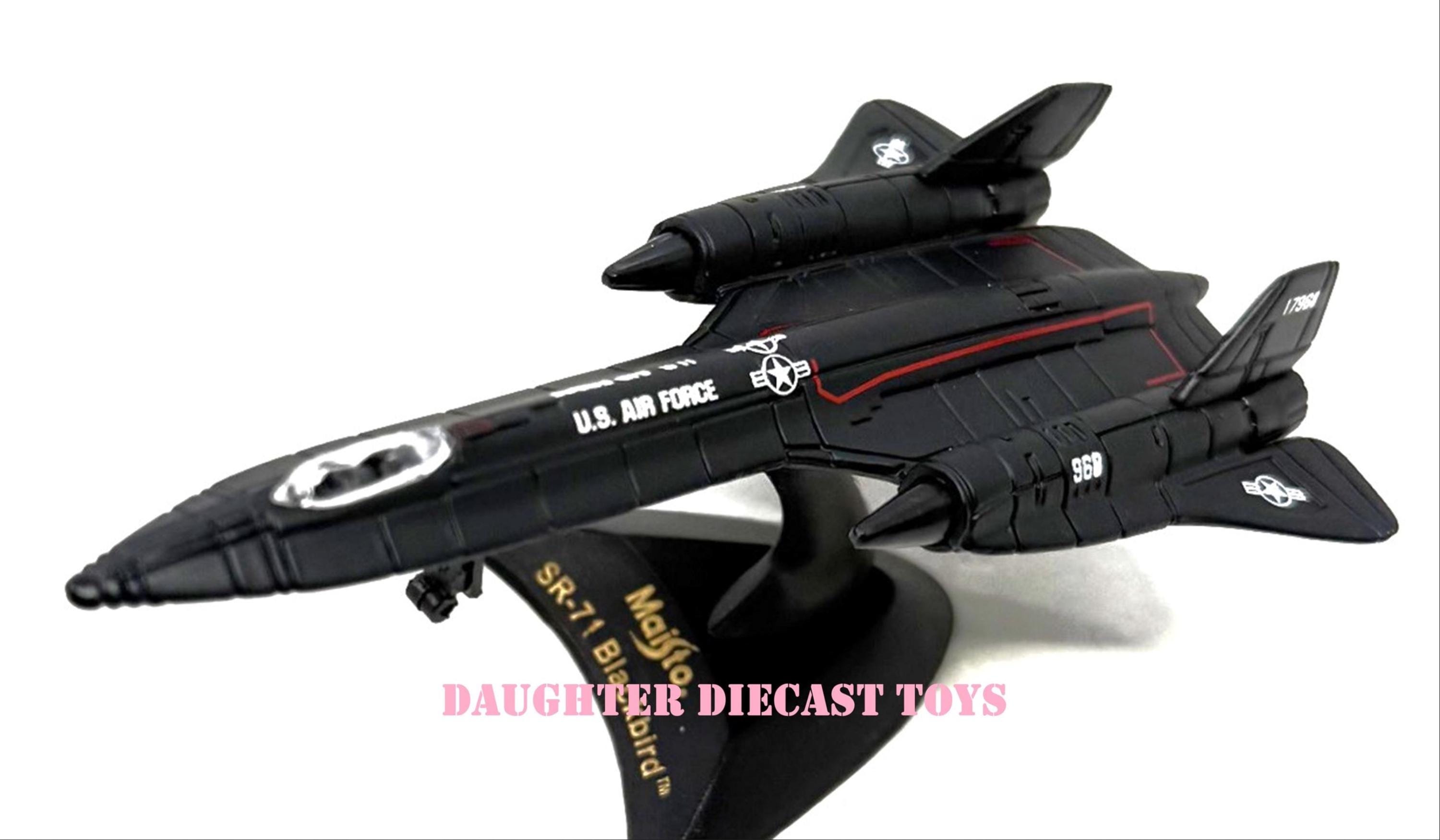
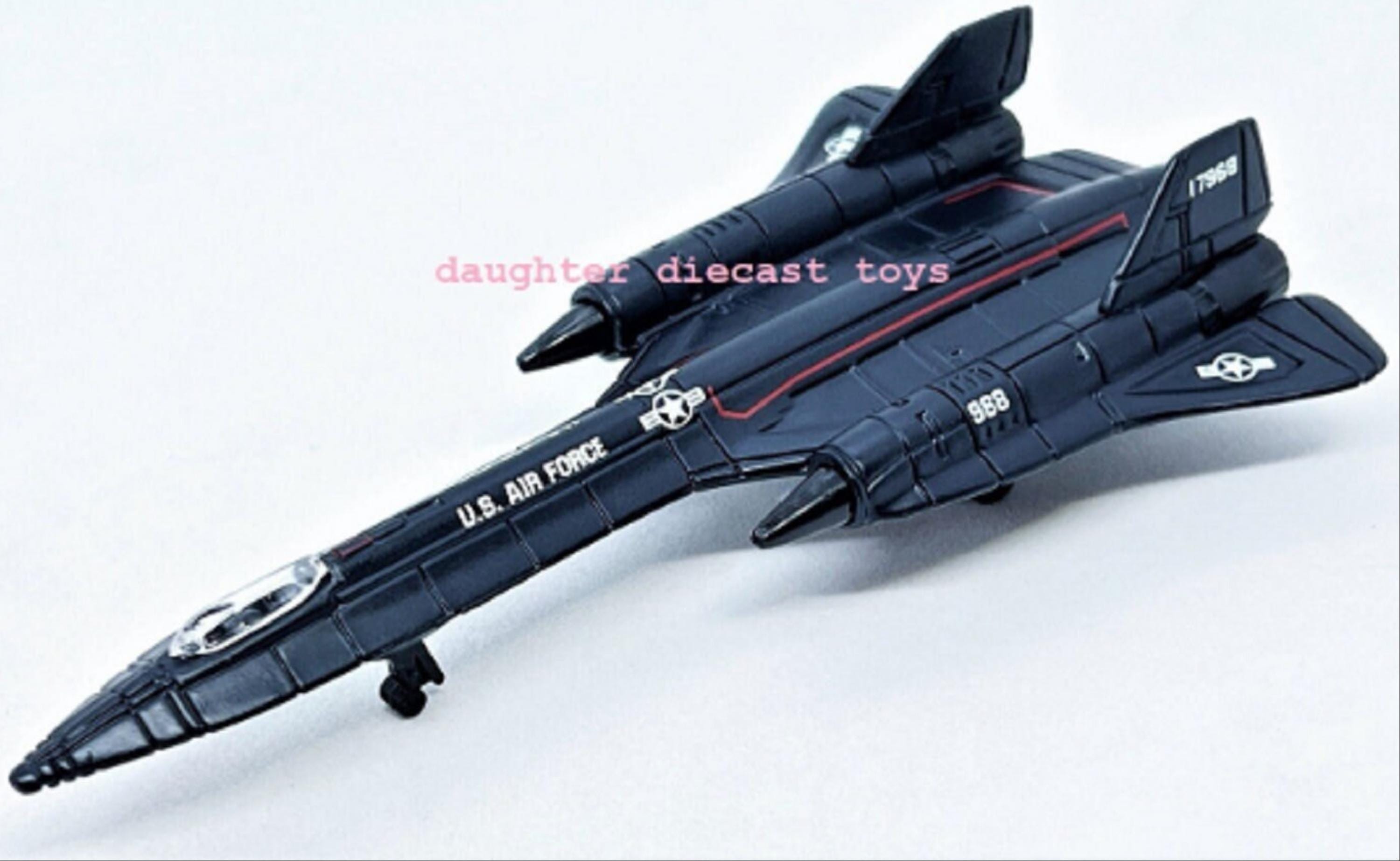
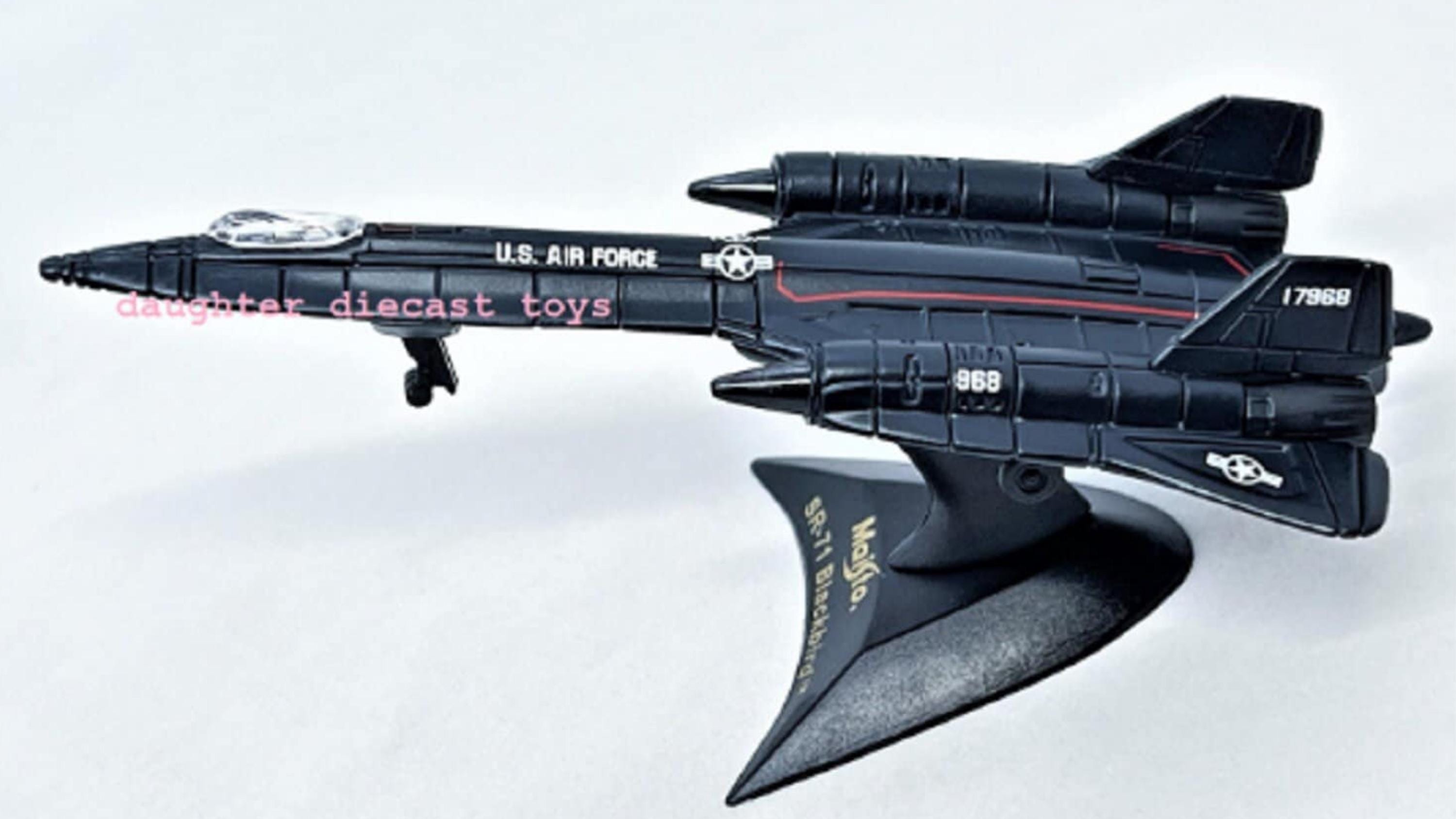
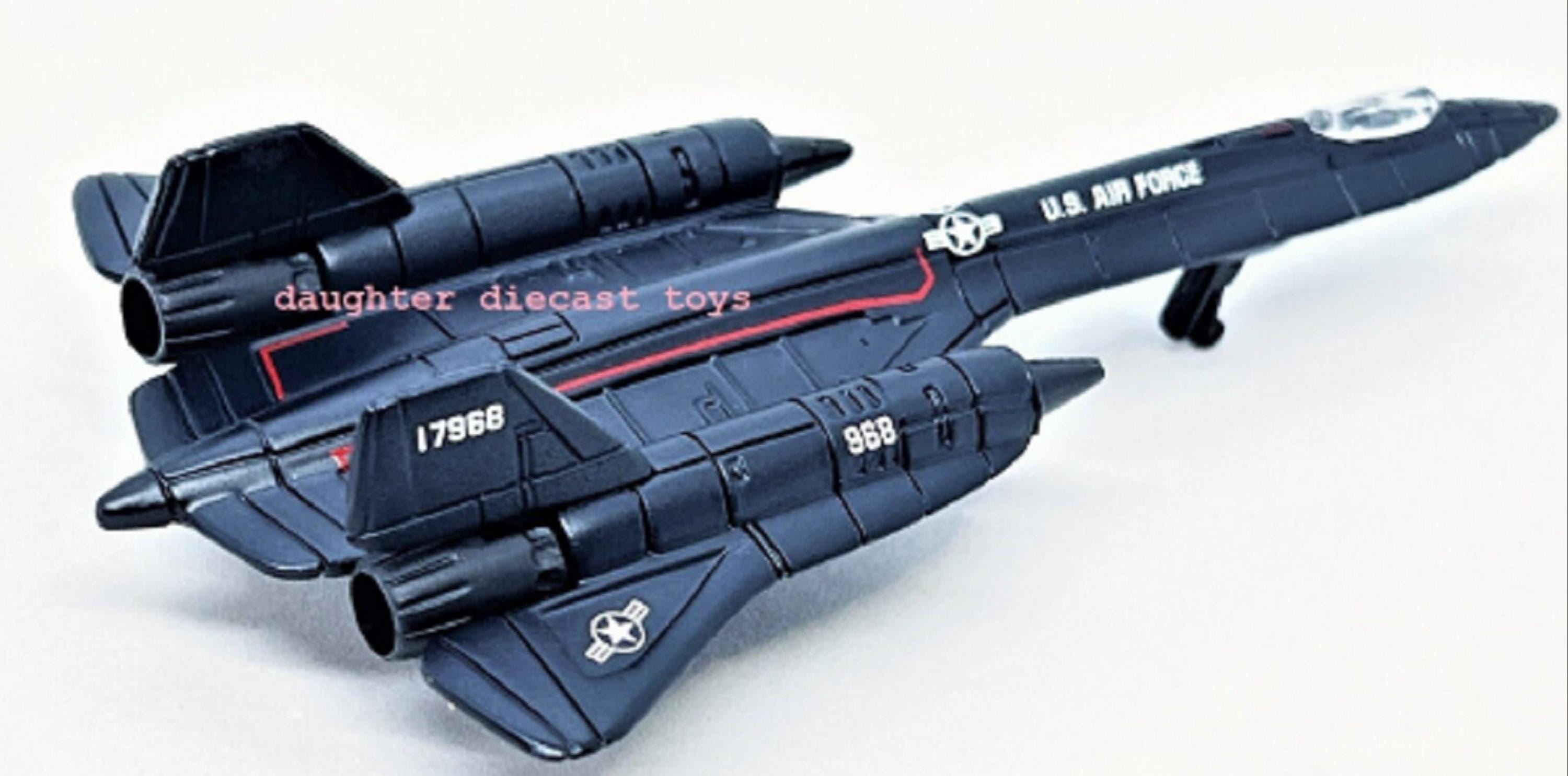
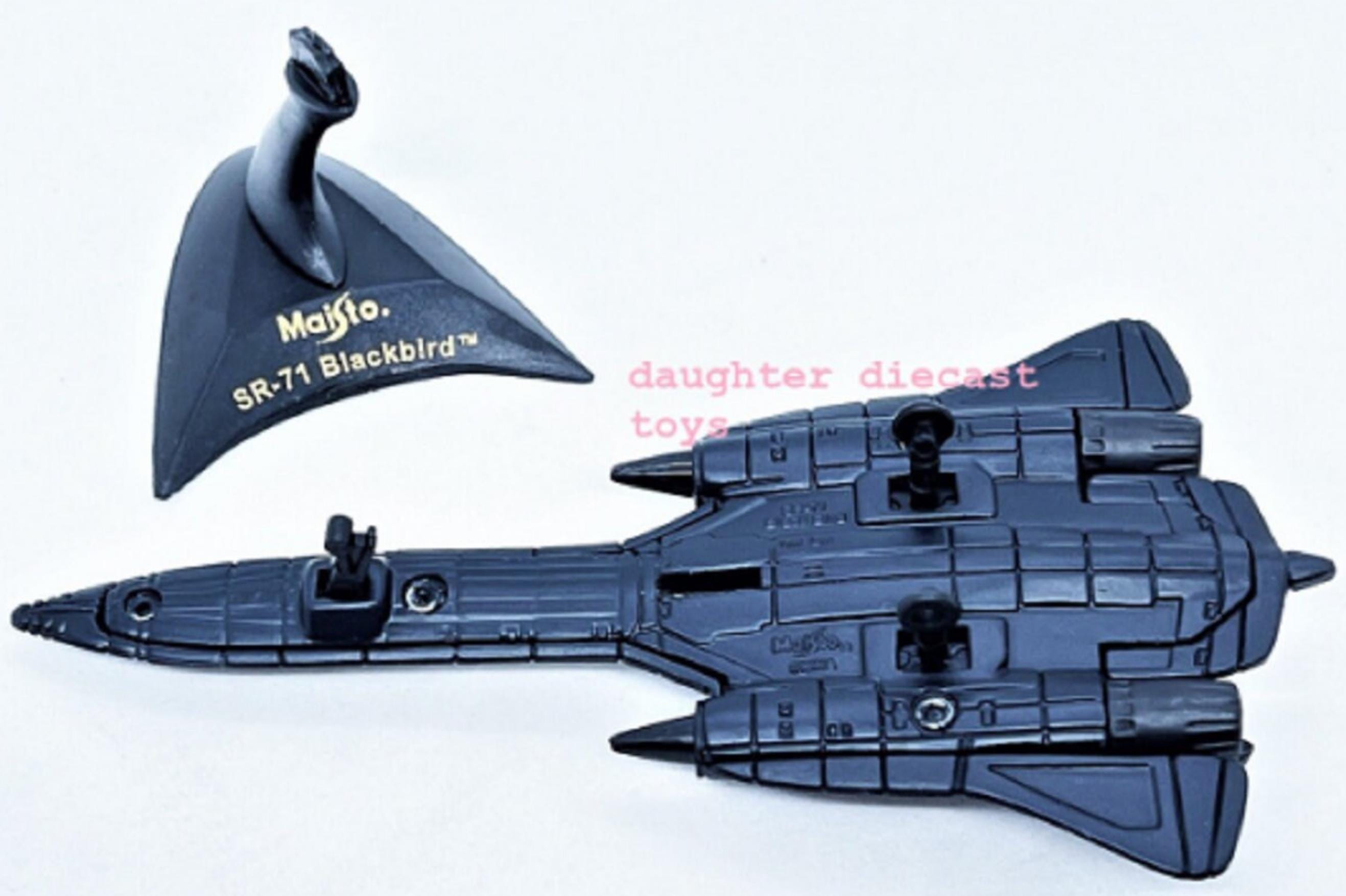

Skunk Works USAF SR-71 BLACKBIRD -Adult Collector Diecast Metal-w/Stand-Pristine Condition/Maisto-Perfect Gift for Aviation History Buffs!
$ 45.00

LOCKHEED SKUNK WORKS/USAF SR-71 BLACKBIRD-HIGH ALTITUDE RECONNAISSANCE JET
-Adult Collector Diecast Metal-w/Stand-Pristine Condition/Maisto-Perfect Gift for Aviation History Buffs!Awesome! LOCKHEED SKUNK WORKS/USAF SR-71 BLACKBIRD-HIGH ALTITUDE RECONNAISSANCE JET. Weighty, constructed of diecast metal. Intricately-detailed, adult collector-made by Maisto. Hard to find vintage model! Desktop display model-comes with (easy to set up) stand. Scale=1/72 prox, measures 5"L x 3"W x 2 1/2 "H (mounted). Pristine/mint condition model-never previously handled or displayed (until today for our photos). Sold loose in collectors bag with display-stand. The perfect gift for aviation history fans (like me!), vintage toy collectors, and veterans. We ship fast & safe worldwide every day. See Aircraft Bio below....489.1Note: My dad owned a Diecast toy store for 30 years. I inherited the store inventory when he passed away several years ago. I am (just now) able to bring myself to begin selling his cars-so they can be shared with the world. All pristine and mint condition vintage models will (eventually) be listed here on ETSY. All the inventory is NEW (vintage) merchandise-which was intended for retail sale. Please know-our diecast toys have NEVER been "played-with” we do not sell used, or damaged toys.
•
•
•FOR A LIMITED TIME
•
•
•Purchases totaling $35 and above qualify for FREE shipping to USA! Add more items to your Etsy shopping cart to save $$$.Aircraft bio:SR-71 "Blackbird" National origin :United States Manufacturer :Lockheed Corporation Design group: Lockheed Skunk Works Designer: Clarence "Kelly" Johnson First flight :22 December 1964 Introduction January 1966 Retired 1998 (USAF), 1999 (NASA) Primary users: United States Air Force (historical),NASA (historical) Number built :32 Developed from Lockheed A-12The Lockheed SR-71 "Blackbird" is a long-range, high-altitude, Mach 3+ strategic reconnaissance aircraft developed and manufactured by the American aerospace company Lockheed Corporation.[N 1] The SR-71 has several nicknames, including "Blackbird" and "Habu".[1]The SR-71 was developed as a black project from the Lockheed A-12 reconnaissance aircraft during the 1960s by Lockheed's Skunk Works division. American aerospace engineer Clarence "Kelly" Johnson was responsible for many of the aircraft's innovative concepts.[2] The shape of the SR-71 was based on that of the Lockheed A-12, which was one of the first aircraft to be designed with a reduced radar cross-section. Initially, a bomber variant of the A-12 was requested by Curtis LeMay, before the program was focused solely on reconnaissance. The SR-71 was longer and heavier than the A-12, allowing it to hold more fuel as well as a two-seat cockpit. The SR-71's existence was revealed to the public in July 1964; it entered service in the United States Air Force (USAF) in January 1966.[3] In 1989, the USAF retired the SR-71, largely for political reasons; several were briefly reactivated during the 1990s before their second retirement in 1998. NASA was the final operator of the Blackbird, using it as a research platform; it was retired again in 1999.[4]Mission equipment for the plane's aerial reconnaissance role included signals intelligence sensors, side looking airborne radar, and a camera.[5] During missions, the SR-71 operated at high speeds and altitudes (Mach 3.2 and 85,000 feet, 25,900 meters), allowing it to outrace or entirely avoid threats.[5] If a surface-to-air missile launch was detected, the standard evasive action was simply to accelerate and outpace the missile.[6] On average, each SR-71 could fly once per week due to the extended turnaround required after mission recovery. A total of 32 aircraft were built; 12 were lost in accidents with none lost to enemy action.[7][8]Since its retirement, the SR-71's role has been taken up by a combination of reconnaissance satellites and unmanned aerial vehicles (UAVs); a proposed UAV successor, the SR-72, is under development by Lockheed Martin, and scheduled to fly in 2025.[9] As of 2023 the SR-71 holds the world record, which it set in 1976, as the fastest air-breathing manned aircraft, previously held by the related Lockheed YF-12.[10][11][12]Operational history Main era:The first flight of an SR-71 took place on 22 December 1964, at USAF Plant 42 in Palmdale, California, piloted by Bob Gilliland.[92][93] The SR-71 reached a top speed of Mach 3.4 during flight testing,[94][95] with pilot Major Brian Shul reporting a speed in excess of Mach 3.5 on an operational sortie while evading a missile over Libya.[96] The first SR-71 to enter service was delivered to the 4200th (later, 9th) Strategic Reconnaissance Wing at Beale Air Force Base, California, in January 1966.[97]SR-71s first arrived at the 9th SRW's Operating Location (OL-8) at Kadena Air Base, Okinawa, Japan on 8 March 1968.[98] These deployments were code-named "Glowing Heat", while the program as a whole was code-named "Senior Crown". Reconnaissance missions over North Vietnam were code-named "Black Shield" and then renamed "Giant Scale" in late 1968.[99] On 21 March 1968, Major (later General) Jerome F. O'Malley and Major Edward D. Payne flew the first operational SR-71 sortie in SR-71 serial number 61-7976 from Kadena AFB, Okinawa.[98] During its career, this aircraft (976) accumulated 2,981 flying hours and flew 942 total sorties (more than any other SR-71), including 257 operational missions, from Beale AFB; Palmdale, California; Kadena Air Base, Okinawa, Japan; and RAF Mildenhall, UK. The aircraft was flown to the National Museum of the United States Air Force near Dayton, Ohio in March 1990.The USAF could fly each SR-71, on average, once per week, because of the extended turnaround required after mission recovery. Very often an aircraft would return with rivets missing, delaminated panels or other broken parts such as inlets requiring repair or replacement. There were cases of the aircraft not being ready to fly again for a month due to the repairs needed. Rob Vermeland, Lockheed Martin's manager of Advanced Development Program, said in an interview in 2015 that high-tempo operations were not realistic for the SR-71. "If we had one sitting in the hangar here and the crew chief was told there was a mission planned right now, then 19 hours later it would be safely ready to take off."[100]From the beginning of the Blackbird's reconnaissance missions over North Vietnam and Laos in 1968, the SR-71s averaged approximately one sortie a week for nearly two years. By 1970, the SR-71s were averaging two sorties per week, and by 1972, they were flying nearly one sortie every day. Two SR-71s were lost during these missions, one in 1970 and the second aircraft in 1972, both due to mechanical malfunctions.[101][102] Over the course of its reconnaissance missions during the Vietnam War, the North Vietnamese fired approximately 800 SAMs at SR-71s, none of which managed to score a hit.[103] Pilots did report that missiles launched without radar guidance and no launch detection, had passed as close as 150 yards (140 m) from the aircraft.[104] Early project Habu logoWhile deployed at Okinawa, the SR-71s and their aircrew members gained the nickname Habu (as did the A-12s preceding them) after a pit viper indigenous to Japan, which the Okinawans thought the plane resembled.[1]Operational highlights for the entire Blackbird family (YF-12, A-12, and SR-71) as of about 1990 included:[105]3,551 mission sorties flown 17,300 total sorties flown 11,008 mission flight hours 53,490 total flight hours 2,752 hours Mach 3 time (missions) 11,675 hours Mach 3 time (total)Only one crew member, Jim Zwayer, a Lockheed flight-test reconnaissance and navigation systems specialist, was killed in a flight accident.[86] The rest of the crew members ejected safely or evacuated their aircraft on the ground.An SR-71 was used domestically in 1971 to assist the FBI in their manhunt for the skyjacker D.B. Cooper. The Blackbird was to retrace and photograph the flightpath of the hijacked 727 from Seattle to Reno and attempt to locate any of items that Cooper was known to have parachuted with from the aircraft.[106] Five flights were attempted but on each occasion no photographs of the flight path were obtained due to low visibility.[107] European flightsEuropean operations were from RAF Mildenhall, England. There were two routes. One was along the Norwegian west coast and up the Kola Peninsula, which contained several large naval bases belonging to the Soviet Navy's Northern Fleet. Over the years, there were several emergency landings in Norway, four in Bodø and two of them in 1981 (flying from Beale) and 1985. Rescue parties were sent in to repair the planes before leaving. On one occasion, one complete wing with engine was replaced as the easiest way to get the plane airborne again.[108][109] The other route, from Mildenhall over the Baltic Sea, was known as the Baltic Express.Swedish Air Force fighter pilots have managed to lock their radar on an SR-71 on multiple occasions within shooting range.[110][111][clarification needed] Target illumination was maintained by feeding target location from ground-based radars to the fire-control computer in the JA 37 Viggen interceptor.[112] The most common site for the lock-on was the thin stretch of international airspace between Öland and Gotland that the SR-71s used on their return flights.[113][114][115]On 29 June 1987, an SR-71 was on a mission around the Baltic Sea to spy on Soviet postings when one of the engines exploded. The aircraft, which was at 20 km altitude, quickly lost altitude and turned 180° to the left and turned over Gotland to search for the Swedish coast. Thus, Swedish airspace was violated, whereupon two unarmed[116] Saab JA 37 Viggens on an exercise at the height of Västervik were ordered there. The mission was to do an incident preparedness check and identify an aircraft of high interest. It was found that the plane was in obvious distress and a decision was made that the Swedish Air Force would escort the plane out of the Baltic Sea. A second round of armed JA-37s from Ängelholm replaced the first pair and completed the escort to Danish airspace. The event had been classified for over 30 years, and when the report was unsealed, data from the NSA showed that multiple MiG-25s with the order to shoot down the SR-71 or force it to land, had started right after the engine failure. A MiG-25 had locked a missile on the damaged SR-71, but as the aircraft was under escort, no missiles were fired. On 28 November 2018, the four Swedish pilots involved were awarded medals from the USAF.[117]
-Adult Collector Diecast Metal-w/Stand-Pristine Condition/Maisto-Perfect Gift for Aviation History Buffs!Awesome! LOCKHEED SKUNK WORKS/USAF SR-71 BLACKBIRD-HIGH ALTITUDE RECONNAISSANCE JET. Weighty, constructed of diecast metal. Intricately-detailed, adult collector-made by Maisto. Hard to find vintage model! Desktop display model-comes with (easy to set up) stand. Scale=1/72 prox, measures 5"L x 3"W x 2 1/2 "H (mounted). Pristine/mint condition model-never previously handled or displayed (until today for our photos). Sold loose in collectors bag with display-stand. The perfect gift for aviation history fans (like me!), vintage toy collectors, and veterans. We ship fast & safe worldwide every day. See Aircraft Bio below....489.1Note: My dad owned a Diecast toy store for 30 years. I inherited the store inventory when he passed away several years ago. I am (just now) able to bring myself to begin selling his cars-so they can be shared with the world. All pristine and mint condition vintage models will (eventually) be listed here on ETSY. All the inventory is NEW (vintage) merchandise-which was intended for retail sale. Please know-our diecast toys have NEVER been "played-with” we do not sell used, or damaged toys.
•
•
•FOR A LIMITED TIME
•
•
•Purchases totaling $35 and above qualify for FREE shipping to USA! Add more items to your Etsy shopping cart to save $$$.Aircraft bio:SR-71 "Blackbird" National origin :United States Manufacturer :Lockheed Corporation Design group: Lockheed Skunk Works Designer: Clarence "Kelly" Johnson First flight :22 December 1964 Introduction January 1966 Retired 1998 (USAF), 1999 (NASA) Primary users: United States Air Force (historical),NASA (historical) Number built :32 Developed from Lockheed A-12The Lockheed SR-71 "Blackbird" is a long-range, high-altitude, Mach 3+ strategic reconnaissance aircraft developed and manufactured by the American aerospace company Lockheed Corporation.[N 1] The SR-71 has several nicknames, including "Blackbird" and "Habu".[1]The SR-71 was developed as a black project from the Lockheed A-12 reconnaissance aircraft during the 1960s by Lockheed's Skunk Works division. American aerospace engineer Clarence "Kelly" Johnson was responsible for many of the aircraft's innovative concepts.[2] The shape of the SR-71 was based on that of the Lockheed A-12, which was one of the first aircraft to be designed with a reduced radar cross-section. Initially, a bomber variant of the A-12 was requested by Curtis LeMay, before the program was focused solely on reconnaissance. The SR-71 was longer and heavier than the A-12, allowing it to hold more fuel as well as a two-seat cockpit. The SR-71's existence was revealed to the public in July 1964; it entered service in the United States Air Force (USAF) in January 1966.[3] In 1989, the USAF retired the SR-71, largely for political reasons; several were briefly reactivated during the 1990s before their second retirement in 1998. NASA was the final operator of the Blackbird, using it as a research platform; it was retired again in 1999.[4]Mission equipment for the plane's aerial reconnaissance role included signals intelligence sensors, side looking airborne radar, and a camera.[5] During missions, the SR-71 operated at high speeds and altitudes (Mach 3.2 and 85,000 feet, 25,900 meters), allowing it to outrace or entirely avoid threats.[5] If a surface-to-air missile launch was detected, the standard evasive action was simply to accelerate and outpace the missile.[6] On average, each SR-71 could fly once per week due to the extended turnaround required after mission recovery. A total of 32 aircraft were built; 12 were lost in accidents with none lost to enemy action.[7][8]Since its retirement, the SR-71's role has been taken up by a combination of reconnaissance satellites and unmanned aerial vehicles (UAVs); a proposed UAV successor, the SR-72, is under development by Lockheed Martin, and scheduled to fly in 2025.[9] As of 2023 the SR-71 holds the world record, which it set in 1976, as the fastest air-breathing manned aircraft, previously held by the related Lockheed YF-12.[10][11][12]Operational history Main era:The first flight of an SR-71 took place on 22 December 1964, at USAF Plant 42 in Palmdale, California, piloted by Bob Gilliland.[92][93] The SR-71 reached a top speed of Mach 3.4 during flight testing,[94][95] with pilot Major Brian Shul reporting a speed in excess of Mach 3.5 on an operational sortie while evading a missile over Libya.[96] The first SR-71 to enter service was delivered to the 4200th (later, 9th) Strategic Reconnaissance Wing at Beale Air Force Base, California, in January 1966.[97]SR-71s first arrived at the 9th SRW's Operating Location (OL-8) at Kadena Air Base, Okinawa, Japan on 8 March 1968.[98] These deployments were code-named "Glowing Heat", while the program as a whole was code-named "Senior Crown". Reconnaissance missions over North Vietnam were code-named "Black Shield" and then renamed "Giant Scale" in late 1968.[99] On 21 March 1968, Major (later General) Jerome F. O'Malley and Major Edward D. Payne flew the first operational SR-71 sortie in SR-71 serial number 61-7976 from Kadena AFB, Okinawa.[98] During its career, this aircraft (976) accumulated 2,981 flying hours and flew 942 total sorties (more than any other SR-71), including 257 operational missions, from Beale AFB; Palmdale, California; Kadena Air Base, Okinawa, Japan; and RAF Mildenhall, UK. The aircraft was flown to the National Museum of the United States Air Force near Dayton, Ohio in March 1990.The USAF could fly each SR-71, on average, once per week, because of the extended turnaround required after mission recovery. Very often an aircraft would return with rivets missing, delaminated panels or other broken parts such as inlets requiring repair or replacement. There were cases of the aircraft not being ready to fly again for a month due to the repairs needed. Rob Vermeland, Lockheed Martin's manager of Advanced Development Program, said in an interview in 2015 that high-tempo operations were not realistic for the SR-71. "If we had one sitting in the hangar here and the crew chief was told there was a mission planned right now, then 19 hours later it would be safely ready to take off."[100]From the beginning of the Blackbird's reconnaissance missions over North Vietnam and Laos in 1968, the SR-71s averaged approximately one sortie a week for nearly two years. By 1970, the SR-71s were averaging two sorties per week, and by 1972, they were flying nearly one sortie every day. Two SR-71s were lost during these missions, one in 1970 and the second aircraft in 1972, both due to mechanical malfunctions.[101][102] Over the course of its reconnaissance missions during the Vietnam War, the North Vietnamese fired approximately 800 SAMs at SR-71s, none of which managed to score a hit.[103] Pilots did report that missiles launched without radar guidance and no launch detection, had passed as close as 150 yards (140 m) from the aircraft.[104] Early project Habu logoWhile deployed at Okinawa, the SR-71s and their aircrew members gained the nickname Habu (as did the A-12s preceding them) after a pit viper indigenous to Japan, which the Okinawans thought the plane resembled.[1]Operational highlights for the entire Blackbird family (YF-12, A-12, and SR-71) as of about 1990 included:[105]3,551 mission sorties flown 17,300 total sorties flown 11,008 mission flight hours 53,490 total flight hours 2,752 hours Mach 3 time (missions) 11,675 hours Mach 3 time (total)Only one crew member, Jim Zwayer, a Lockheed flight-test reconnaissance and navigation systems specialist, was killed in a flight accident.[86] The rest of the crew members ejected safely or evacuated their aircraft on the ground.An SR-71 was used domestically in 1971 to assist the FBI in their manhunt for the skyjacker D.B. Cooper. The Blackbird was to retrace and photograph the flightpath of the hijacked 727 from Seattle to Reno and attempt to locate any of items that Cooper was known to have parachuted with from the aircraft.[106] Five flights were attempted but on each occasion no photographs of the flight path were obtained due to low visibility.[107] European flightsEuropean operations were from RAF Mildenhall, England. There were two routes. One was along the Norwegian west coast and up the Kola Peninsula, which contained several large naval bases belonging to the Soviet Navy's Northern Fleet. Over the years, there were several emergency landings in Norway, four in Bodø and two of them in 1981 (flying from Beale) and 1985. Rescue parties were sent in to repair the planes before leaving. On one occasion, one complete wing with engine was replaced as the easiest way to get the plane airborne again.[108][109] The other route, from Mildenhall over the Baltic Sea, was known as the Baltic Express.Swedish Air Force fighter pilots have managed to lock their radar on an SR-71 on multiple occasions within shooting range.[110][111][clarification needed] Target illumination was maintained by feeding target location from ground-based radars to the fire-control computer in the JA 37 Viggen interceptor.[112] The most common site for the lock-on was the thin stretch of international airspace between Öland and Gotland that the SR-71s used on their return flights.[113][114][115]On 29 June 1987, an SR-71 was on a mission around the Baltic Sea to spy on Soviet postings when one of the engines exploded. The aircraft, which was at 20 km altitude, quickly lost altitude and turned 180° to the left and turned over Gotland to search for the Swedish coast. Thus, Swedish airspace was violated, whereupon two unarmed[116] Saab JA 37 Viggens on an exercise at the height of Västervik were ordered there. The mission was to do an incident preparedness check and identify an aircraft of high interest. It was found that the plane was in obvious distress and a decision was made that the Swedish Air Force would escort the plane out of the Baltic Sea. A second round of armed JA-37s from Ängelholm replaced the first pair and completed the escort to Danish airspace. The event had been classified for over 30 years, and when the report was unsealed, data from the NSA showed that multiple MiG-25s with the order to shoot down the SR-71 or force it to land, had started right after the engine failure. A MiG-25 had locked a missile on the damaged SR-71, but as the aircraft was under escort, no missiles were fired. On 28 November 2018, the four Swedish pilots involved were awarded medals from the USAF.[117]
Other Products