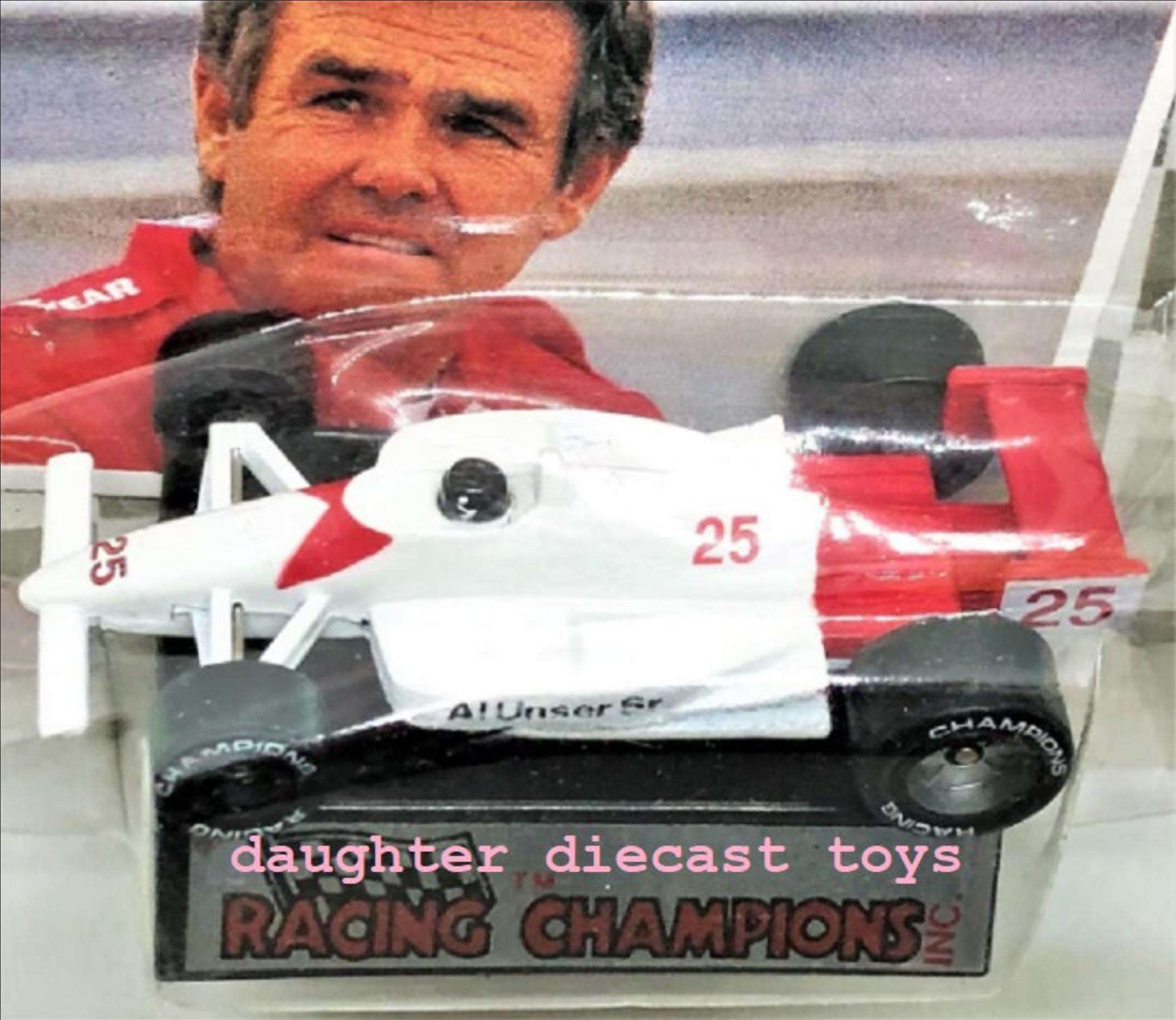
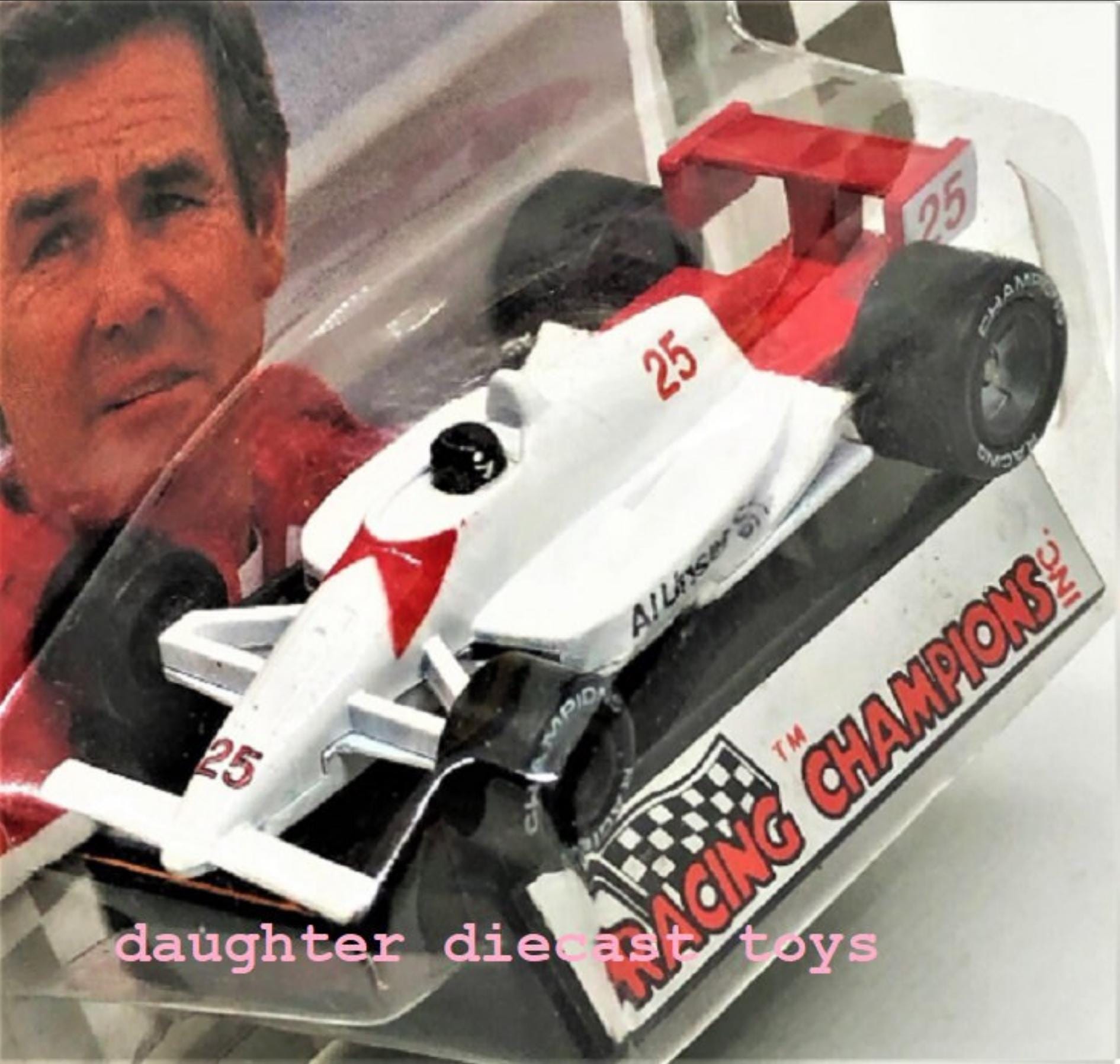
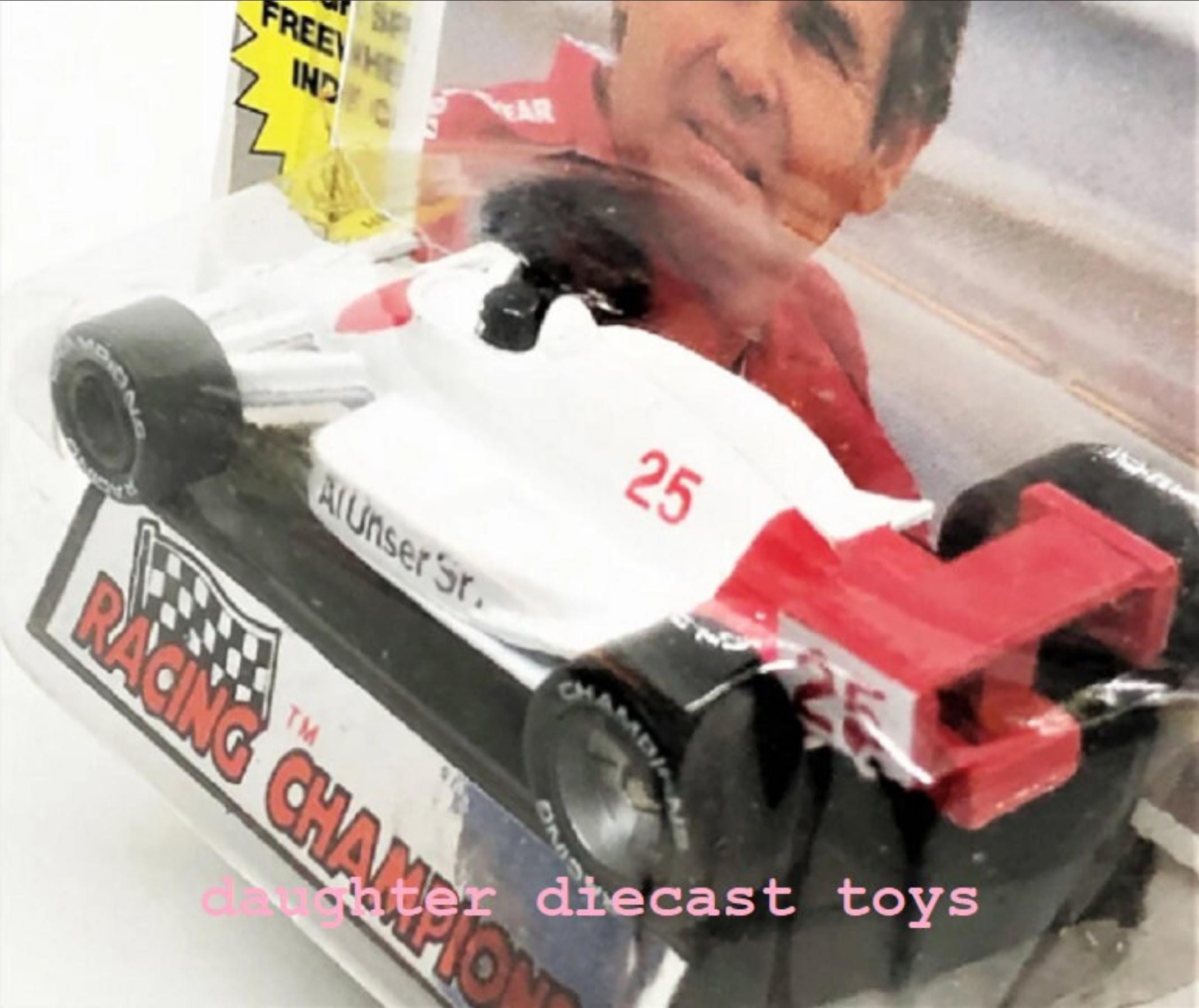
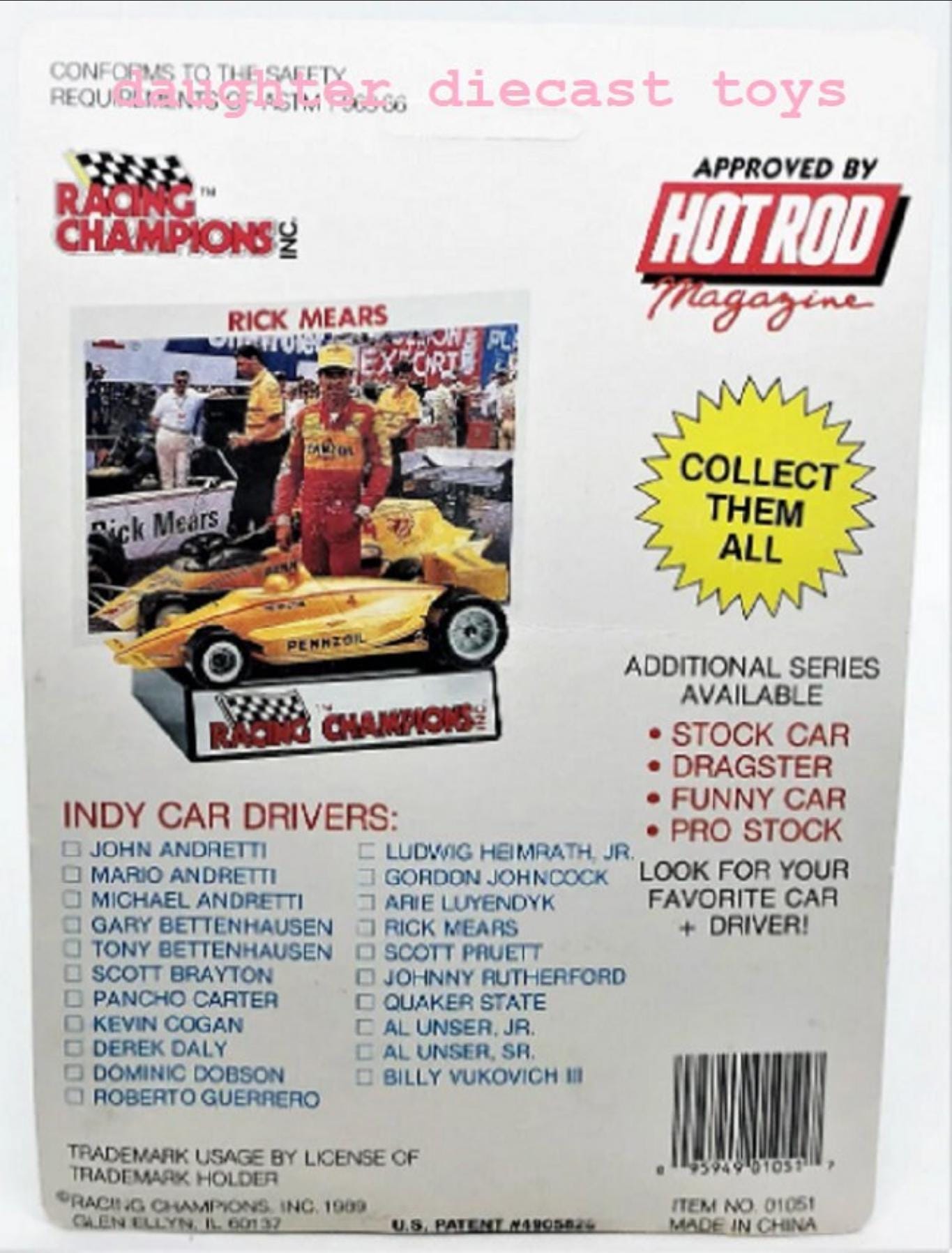

Al Unser INDIANAPOLIS 500 RACE CAR - Diecast Metal Car Pristine Condition/Factory Sealed Box! Perfect gift for Indy 500 Fans!
$ 14.99

Al Unser INDIANAPOLIS 500 RACE CAR - Diecast Metal Car Pristine
Condition/Factory Sealed Box! Perfect gift for Indy 500 Fans!Excellent! Racing Champions Indy Car/Collectors Series 1: Fantastic looking AL UNSER INDY 500 RACE CAR. Scale=1/64. Measures 3" L x 1"W x 3/4H. Pristine condition, diecast metal model-never removed from factory-sealed packaging. Collector card and car stand are included. Perfect gift for Racing Indycar, Unser fans and vintage toy collectors. We ship fast & safe worldwide-everyday! See car and driver info below...
•
•
•FOR A LIMITED TIME
•
•
•Purchases totaling $35 and above qualify for FREE shipping to USA! Add more items to your Etsy shopping cart to save $$$.NOTE: My dad owned a Diecast toy store for 30 years. I inherited the store inventory when he passed away many years ago. I am just now, beginning to sell the mint condition vintage models. All are store-inventory is new-old-stock, models have never been "played with". Please visit often-as I am adding more cool stuff every day!What is an Indy Car?These stars drive single-seat, open-cockpit cars that feature a 2.2-liter, twin turbocharged, direct-injected V-6 engine optimized to run at 12,000 RPM with an estimated 500-700 horsepower depending on the turbocharger boost setting.Alfred "Al" Unser (born May 29, 1939) is an American automobile racing driver, the younger brother of fellow racing drivers Jerry and Bobby Unser, and father of Al Unser Jr. Now retired, he is the second of three men to have won the Indianapolis 500-Mile Race four times, the fourth of five to have won the race in consecutive years, and won the National Championship in 1970, 1983, and 1985. The Unser family has won the Indy 500 a record nine times. He is the only person to have both a sibling (Bobby) and child (Al Jr.) as fellow Indy 500 winners (coincidentally, all three captured their final Indy 500 wins racing for Team Penske). Al's nephews Johnny and Robby Unser have also competed in that race.After his son Al Unser Jr. joined the national championship circuit in 1983, Unser has generally been known by the retronymic name of "Al Unser Sr." or "Big Al."Racing career and Indianapolis 500He began racing in 1957, at age 18, initially competing primarily in modified roadsters, sprint cars and midgets. In 1965 he raced in the Indianapolis 500 for the first time and finished ninth.He won the Indy 500 in 1970, two years after his brother, Bobby. During the race, he led for all but 10 of the 200 laps and averaged 155.749 miles per hour (250.654 km/h). His quick pit stops were a factor in the victory. That season he won a record 10 times on oval, road and dirt tracks to capture the United States Auto Club national championship. Unser competed in USAC's Stock Car division in 1967, and was the series Rookie of the Year.In 1971 he won the Indy 500 again, starting from the fifth position with an average speed of 157.735 mph.Unser's bid to become the first three-time consecutive Indy 500 champion was thwarted when he finished second to Mark Donohue in the 1972 Indianapolis 500.Despite starting the 1978 Indianapolis 500 from the fifth position in a First National City Travelers Checks Chaparral Lola, Unser's car was considered before the race to be a second-tier entry at best, if not an outright long shot to win. Moving to the front of the field for the first time on lap 75, he and opponent Danny Ongais engaged in an on-again off-again duel for 75 more laps, before an engine failure on Ongais' car on lap 150 allowed Unser to assume a commanding 35 second lead. Although suffering right front-wing misalignment due to impacting a tire on his final pit stop, a situation that led to the lead shrinking steadily over the race's final 20 laps, it nevertheless proved wide enough for victory by 9 seconds to spare at the checkered flag. Unser's race average speed of 161.363 mph (259.689 km/h) ranked as the then-second fastest ever run (one mile per hour less than the then-1972 record), and would not itself be topped for second for four more years.In the 1983 season, Unser joined Team Penske and drove for 4 years in a Penske-owned car. Unser controlled the late stages of the 1983 Indianapolis 500, leading 61 laps. With less than 20 laps to go, Unser got challenges from Tom Sneva who led the most laps. With help from his son - who was several laps down - Unser began pulling away from Sneva. However Sneva got by Al Jr., and set sail for Unser Sr.. Sneva caught up to Unser within 1 lap of passing Al Jr., and passed him to retake the lead with 9 laps to go. Sneva then easily pulled away to win the race by 11 seconds, avenging his firing from the team in 1978. After the race, Unser Jr. was penalized 2 laps for his actions as well as having passed 2 cars under caution on lap 170. Fourth Indianapolis 500 victory Al Unser's 1987 Indy 500 winning car. Main article: 1987 Indianapolis 500In 1987, Penske's slate of drivers included Rick Mears, Danny Sullivan, and Danny Ongais. Al Unser Sr. was dropped from the team, and entered the month of May without a ride. During the first week of practice, Al Sr. spent much of the week shopping for a ride, and a few offers were made by owners. Al Sr., however, refused the offers, as he insisted on landing a ride in a competitive, well-funded car only. Unser planned on staying through the week, and if he did not have a ride by the end of the first week of time trials, he was planning to return home. Coincidentally, his son Al Unser Jr. (driving for Shierson Racing) was having difficulty with his car's handling. At the end of the first weekend of time trials, Al Jr. surprisingly had not yet qualified. Al Sr. agreed to stay through the week in order to help his son get his car up to speed.Danny Ongais crashed into the wall during the first week of practice, suffering a serious concussion, and was declared unfit to drive. Meanwhile, the Penske team's new Penske PC-16 chassis had been uncompetitive during practice. By the end of the first week of practice, Penske parked the PC-16s and elected to qualify back-up cars for the race. Mears and Sullivan were provided 1986 March-Ilmor Chevrolet machines, while a third car, a 1986 March-Cosworth, was planned for third driver.Midway through the second week of practice, Roger Penske consummated a deal with Al Sr. to drive the third car. Penske promised Unser a well-funded effort, and a brand new Cosworth engine, the same chassis/engine combination that had won the previous four Indy 500s. The year-old March was removed from a Penske Racing display at a Sheraton hotel in the team's hometown of Reading, Pennsylvania, and hurriedly prepared for a return to active competition. Unser easily put the car in the field on the third day of time trials.At the start Unser was in the 20th position. On a day when heavy attrition felled most of the field's front-runners, including the overwhelmingly dominant Newman-Haas entry of Mario Andretti, Unser worked his way steadily forward and took the lead on the 183rd lap, after Roberto Guerrero's car stalled on his final pit stop. Averaging 162.175 mph (260.995 km/h), Unser bested a charging Guerrero by 4.5 seconds to win his fourth Indy 500, only five days before his 48th birthday. In doing so he tied Foyt as the winningest Indy 500 driver and broke brother Bobby's record as the oldest Indy winner.Unser rode the wave of his fourth Indy victory to secure a ride at Penske for the Michigan 500, Pocono 500, and Marlboro Challenge for 1987. Near the end of the year, Unser had two other starts. He drove as a substitute for Roberto Guerrero at Nazareth, and had a competitive run until crashing a few laps short of the finish. He was then hired to drive the brand new Porsche Indy car at Laguna Seca. The team was still in its infancy, and the car dropped out. Unser left the team after only one race.In 1988 and 1989, Unser returned to Penske to secure a ride at the three 500-miles races (Indianapolis, Michigan, Pocono).Career highlightsUnser has led the most laps of any driver in the history of the Indianapolis 500, at 644. Unser tied Ralph DePalma's long standing record of 612 laps led on the last lap of his 4th victory.Unser holds the record of being the oldest driver to ever win the 500 at 47 years old (1987), breaking the previous record set by his brother Bobby.Unser won two 500-mile races at Pocono (in 1976 and 1978) and two more at Ontario (in 1977 and 1978) bringing his total of 500-mile race wins (including four Indianapolis 500s) to eight.Unser was the 1978 IROC champion. He also competed in the 1968 Daytona 500 and four other NASCAR Winston Cup & Grand National races, all held on road courses with a best finish of fourth (twice). AwardsIn 1986, Unser was inducted into the Indianapolis Motor Speedway Hall of Fame. In 1998, he was inducted into the International Motorsports Hall of Fame. He was inducted in the Motorsports Hall of Fame of America in 1991.[2]
Condition/Factory Sealed Box! Perfect gift for Indy 500 Fans!Excellent! Racing Champions Indy Car/Collectors Series 1: Fantastic looking AL UNSER INDY 500 RACE CAR. Scale=1/64. Measures 3" L x 1"W x 3/4H. Pristine condition, diecast metal model-never removed from factory-sealed packaging. Collector card and car stand are included. Perfect gift for Racing Indycar, Unser fans and vintage toy collectors. We ship fast & safe worldwide-everyday! See car and driver info below...
•
•
•FOR A LIMITED TIME
•
•
•Purchases totaling $35 and above qualify for FREE shipping to USA! Add more items to your Etsy shopping cart to save $$$.NOTE: My dad owned a Diecast toy store for 30 years. I inherited the store inventory when he passed away many years ago. I am just now, beginning to sell the mint condition vintage models. All are store-inventory is new-old-stock, models have never been "played with". Please visit often-as I am adding more cool stuff every day!What is an Indy Car?These stars drive single-seat, open-cockpit cars that feature a 2.2-liter, twin turbocharged, direct-injected V-6 engine optimized to run at 12,000 RPM with an estimated 500-700 horsepower depending on the turbocharger boost setting.Alfred "Al" Unser (born May 29, 1939) is an American automobile racing driver, the younger brother of fellow racing drivers Jerry and Bobby Unser, and father of Al Unser Jr. Now retired, he is the second of three men to have won the Indianapolis 500-Mile Race four times, the fourth of five to have won the race in consecutive years, and won the National Championship in 1970, 1983, and 1985. The Unser family has won the Indy 500 a record nine times. He is the only person to have both a sibling (Bobby) and child (Al Jr.) as fellow Indy 500 winners (coincidentally, all three captured their final Indy 500 wins racing for Team Penske). Al's nephews Johnny and Robby Unser have also competed in that race.After his son Al Unser Jr. joined the national championship circuit in 1983, Unser has generally been known by the retronymic name of "Al Unser Sr." or "Big Al."Racing career and Indianapolis 500He began racing in 1957, at age 18, initially competing primarily in modified roadsters, sprint cars and midgets. In 1965 he raced in the Indianapolis 500 for the first time and finished ninth.He won the Indy 500 in 1970, two years after his brother, Bobby. During the race, he led for all but 10 of the 200 laps and averaged 155.749 miles per hour (250.654 km/h). His quick pit stops were a factor in the victory. That season he won a record 10 times on oval, road and dirt tracks to capture the United States Auto Club national championship. Unser competed in USAC's Stock Car division in 1967, and was the series Rookie of the Year.In 1971 he won the Indy 500 again, starting from the fifth position with an average speed of 157.735 mph.Unser's bid to become the first three-time consecutive Indy 500 champion was thwarted when he finished second to Mark Donohue in the 1972 Indianapolis 500.Despite starting the 1978 Indianapolis 500 from the fifth position in a First National City Travelers Checks Chaparral Lola, Unser's car was considered before the race to be a second-tier entry at best, if not an outright long shot to win. Moving to the front of the field for the first time on lap 75, he and opponent Danny Ongais engaged in an on-again off-again duel for 75 more laps, before an engine failure on Ongais' car on lap 150 allowed Unser to assume a commanding 35 second lead. Although suffering right front-wing misalignment due to impacting a tire on his final pit stop, a situation that led to the lead shrinking steadily over the race's final 20 laps, it nevertheless proved wide enough for victory by 9 seconds to spare at the checkered flag. Unser's race average speed of 161.363 mph (259.689 km/h) ranked as the then-second fastest ever run (one mile per hour less than the then-1972 record), and would not itself be topped for second for four more years.In the 1983 season, Unser joined Team Penske and drove for 4 years in a Penske-owned car. Unser controlled the late stages of the 1983 Indianapolis 500, leading 61 laps. With less than 20 laps to go, Unser got challenges from Tom Sneva who led the most laps. With help from his son - who was several laps down - Unser began pulling away from Sneva. However Sneva got by Al Jr., and set sail for Unser Sr.. Sneva caught up to Unser within 1 lap of passing Al Jr., and passed him to retake the lead with 9 laps to go. Sneva then easily pulled away to win the race by 11 seconds, avenging his firing from the team in 1978. After the race, Unser Jr. was penalized 2 laps for his actions as well as having passed 2 cars under caution on lap 170. Fourth Indianapolis 500 victory Al Unser's 1987 Indy 500 winning car. Main article: 1987 Indianapolis 500In 1987, Penske's slate of drivers included Rick Mears, Danny Sullivan, and Danny Ongais. Al Unser Sr. was dropped from the team, and entered the month of May without a ride. During the first week of practice, Al Sr. spent much of the week shopping for a ride, and a few offers were made by owners. Al Sr., however, refused the offers, as he insisted on landing a ride in a competitive, well-funded car only. Unser planned on staying through the week, and if he did not have a ride by the end of the first week of time trials, he was planning to return home. Coincidentally, his son Al Unser Jr. (driving for Shierson Racing) was having difficulty with his car's handling. At the end of the first weekend of time trials, Al Jr. surprisingly had not yet qualified. Al Sr. agreed to stay through the week in order to help his son get his car up to speed.Danny Ongais crashed into the wall during the first week of practice, suffering a serious concussion, and was declared unfit to drive. Meanwhile, the Penske team's new Penske PC-16 chassis had been uncompetitive during practice. By the end of the first week of practice, Penske parked the PC-16s and elected to qualify back-up cars for the race. Mears and Sullivan were provided 1986 March-Ilmor Chevrolet machines, while a third car, a 1986 March-Cosworth, was planned for third driver.Midway through the second week of practice, Roger Penske consummated a deal with Al Sr. to drive the third car. Penske promised Unser a well-funded effort, and a brand new Cosworth engine, the same chassis/engine combination that had won the previous four Indy 500s. The year-old March was removed from a Penske Racing display at a Sheraton hotel in the team's hometown of Reading, Pennsylvania, and hurriedly prepared for a return to active competition. Unser easily put the car in the field on the third day of time trials.At the start Unser was in the 20th position. On a day when heavy attrition felled most of the field's front-runners, including the overwhelmingly dominant Newman-Haas entry of Mario Andretti, Unser worked his way steadily forward and took the lead on the 183rd lap, after Roberto Guerrero's car stalled on his final pit stop. Averaging 162.175 mph (260.995 km/h), Unser bested a charging Guerrero by 4.5 seconds to win his fourth Indy 500, only five days before his 48th birthday. In doing so he tied Foyt as the winningest Indy 500 driver and broke brother Bobby's record as the oldest Indy winner.Unser rode the wave of his fourth Indy victory to secure a ride at Penske for the Michigan 500, Pocono 500, and Marlboro Challenge for 1987. Near the end of the year, Unser had two other starts. He drove as a substitute for Roberto Guerrero at Nazareth, and had a competitive run until crashing a few laps short of the finish. He was then hired to drive the brand new Porsche Indy car at Laguna Seca. The team was still in its infancy, and the car dropped out. Unser left the team after only one race.In 1988 and 1989, Unser returned to Penske to secure a ride at the three 500-miles races (Indianapolis, Michigan, Pocono).Career highlightsUnser has led the most laps of any driver in the history of the Indianapolis 500, at 644. Unser tied Ralph DePalma's long standing record of 612 laps led on the last lap of his 4th victory.Unser holds the record of being the oldest driver to ever win the 500 at 47 years old (1987), breaking the previous record set by his brother Bobby.Unser won two 500-mile races at Pocono (in 1976 and 1978) and two more at Ontario (in 1977 and 1978) bringing his total of 500-mile race wins (including four Indianapolis 500s) to eight.Unser was the 1978 IROC champion. He also competed in the 1968 Daytona 500 and four other NASCAR Winston Cup & Grand National races, all held on road courses with a best finish of fourth (twice). AwardsIn 1986, Unser was inducted into the Indianapolis Motor Speedway Hall of Fame. In 1998, he was inducted into the International Motorsports Hall of Fame. He was inducted in the Motorsports Hall of Fame of America in 1991.[2]
Other Products