

Vintage LUFTHANSA 767 Diecast Metal Airplane Pristine Condition/Factory-Sealed-Sky Wings Toy-Perfect Gift for Commercial Aviation Buffs!
$ 29.99

VINTAGE LUFTHANSA 767 DIECAST METAL AIRPLANE Pristine
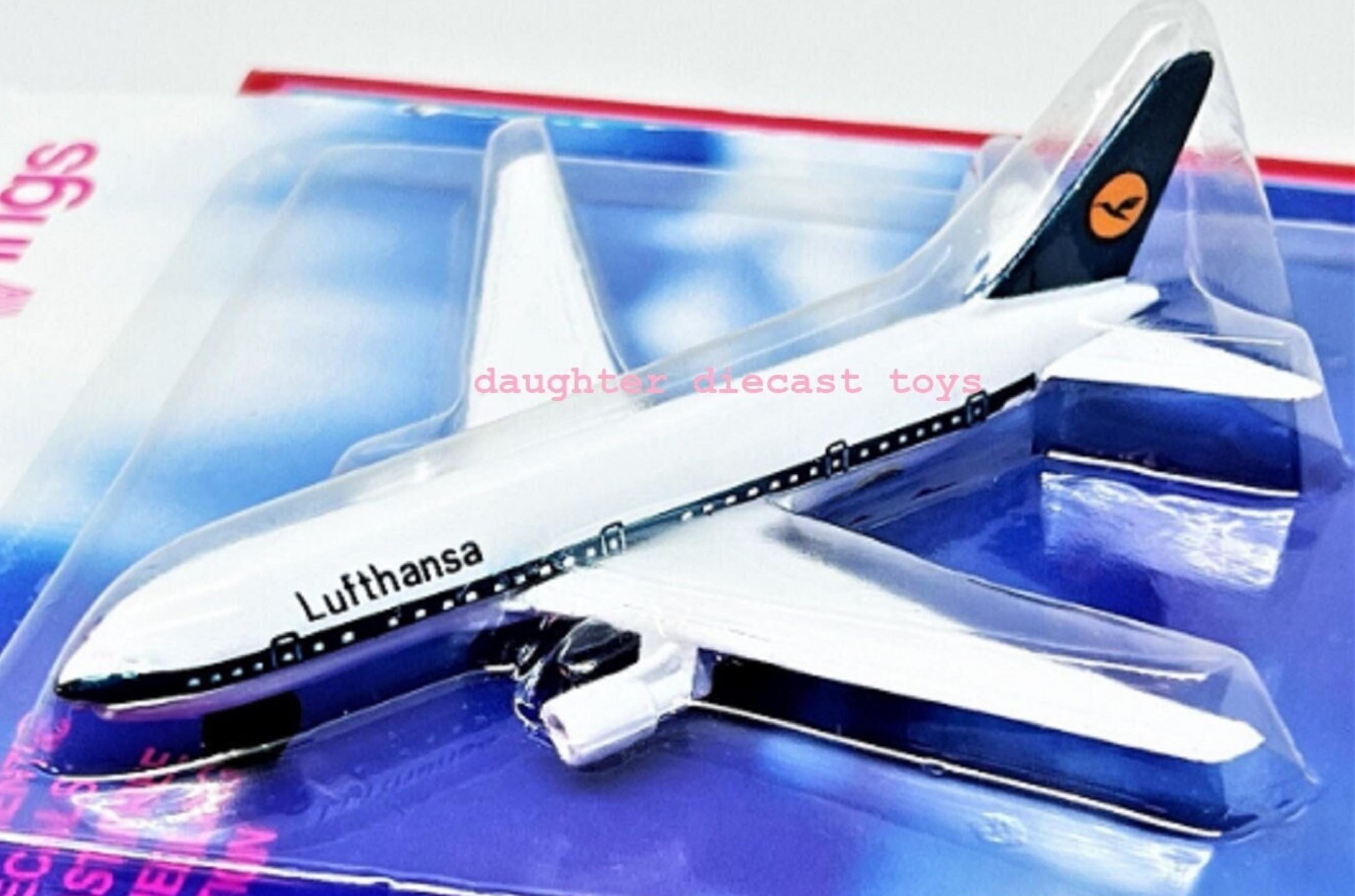
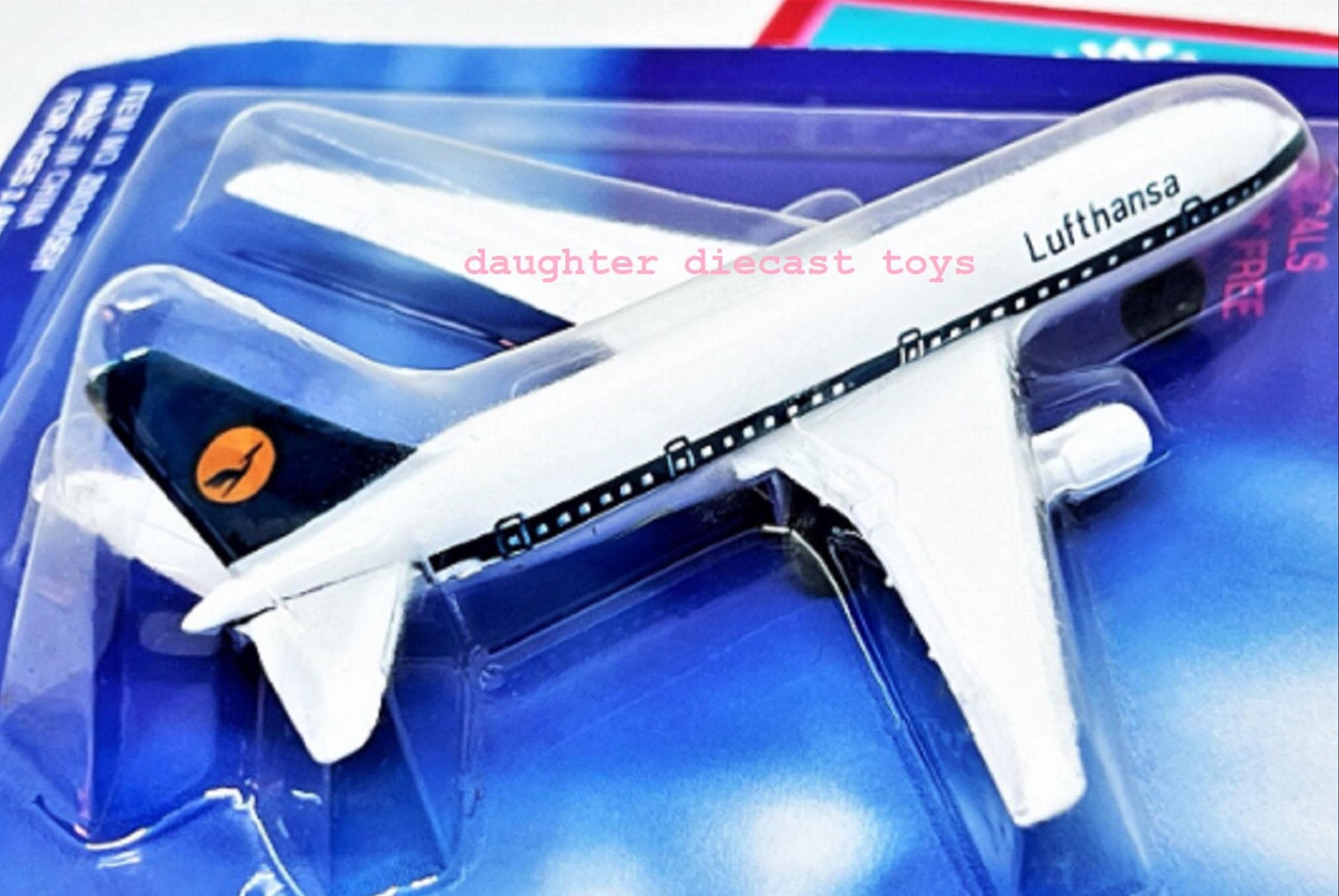
Condition/Factory-Sealed-Sky Wings Toy-Perfect Gift for Commercial Aviation Buffs!Awesome! LUFTHANSA 767. Highly sought after-diecast metal model-made by Sky Wings. Measures 4"L x 4"W x 1 1/2"H. Beautiful jet in pristine condition-never removed from its factory-sealed card. Perfect gift for Lufthansa employees, aviation history buffs and vintage toy collectors! We ship fast & safe worldwide every day! See aircraft bio (below).Note: My dad owned a Diecast toy store for 30 years. I inherited the store inventory when he passed away several years ago. I am (just now) able to bring myself to begin selling his cars-so they can be shared with the world. All pristine and mint condition vintage models will (eventually) be listed here on ETSY. All the inventory is NEW (vintage) merchandise-which was intended for retail sale. Please know-our diecast toys have NEVER been "played-with” we do not sell used, or damaged toys.
•
•
•FOR A LIMITED TIME
•
•
•Purchases totaling $35 and above qualify for FREE shipping to USA! Add more items to your Etsy shopping cart to save $$$.AIRCRAFT BIOThe Boeing 767 is an Lufthansa wide-body aircraft developed and manufactured by Boeing Commercial Airplanes. The aircraft was launched as the 7X7 program on July 14, 1978, the prototype first flew on September 26, 1981, and it was certified on July 30, 1982. The original 767-200 entered service on September 8, 1982, with United Airlines, and the extended-range 767-200ER in 1984. It was stretched into the 767-300 in October 1986, followed by the 767-300ER in 1988, the most popular variant. The 767-300F, a production freighter version, debuted in October 1995. It was stretched again into the 767-400ER from September 2000.To complement the larger 747, it has a seven-abreast cross-section, accommodating smaller LD2 ULD cargo containers. The 767 is Boeing's first wide-body twinjet, powered by General Electric CF6, Rolls-Royce RB211, or Pratt & Whitney JT9D turbofans. JT9D engines were eventually replaced by PW4000 engines. The aircraft has a conventional tail and a supercritical wing for reduced aerodynamic drag. Its two-crew glass cockpit, a first for a Boeing airliner, was developed jointly for the 757 − a narrow-body aircraft, allowing a common pilot type rating. Studies for a higher-capacity 767 in 1986 led Boeing to develop the larger 777 twinjet, introduced in June 1995.The 159-foot-long (48.5 m) 767-200 typically seats 216 passengers over 3,900 nmi (7,200 km), while the 767-200ER seats 181 over a 6,590 nautical mile (12,200 km) range. The 180-foot-long (54.9 m) 767-300 typically seats 269 passengers over 3,900 nmi (7,200 km), while the 767-300ER seats 218 over 5,980 nmi (11,070 km). The 767-300F can haul 116,000 lb (52.7 t) over 3,225 nmi (6,025 km), and the 201.3-foot-long (61.37 m) 767-400ER typically seats 245 passengers over 5,625 nmi (10,415 km). Military derivatives include the E-767 for surveillance and the KC-767 and KC-46 aerial tankers.After being initially used on U.S. transcontinental routes, that was extended with ETOPS regulations from 1985, it was then frequently used on transatlantic flights. A total of 742 of these aircraft were in service in July 2018, with Delta Air Lines being the largest operator with 77 aircraft in its fleet. As of September 2022, Boeing has received 1,373 orders from 74 customers, of which 1,259 airplanes have been delivered, while the remaining orders are for cargo or tanker variants. Competitors have included the Airbus A300, A310, and A330-200. Its successor, the 787 Dreamliner, entered service in 2011.Operational historyIn the mid-1980s, the 767 spearheaded the growth of twinjet flights across the northern Atlantic under extended-range twin-engine operational performance standards (ETOPS) regulations, the FAA's safety rules governing transoceanic flights by aircraft with two engines.[41] Before the 767, overwater flight paths of twinjets could be no more than 90 minutes away from diversion airports.[127] In May 1985, the FAA granted its first approval for 120-minute ETOPS flights to 767 operators, on an individual airline basis starting with TWA, provided that the operator met flight safety criteria.[127] This allowed the aircraft to fly overseas routes at up to two hours' distance from land.[127] The larger safety margins were permitted because of the improved reliability demonstrated by the twinjet and its turbofan engines.[127] The FAA lengthened the ETOPS time to 180 minutes for CF6-powered 767s in 1989, making the type the first to be certified under the longer duration,[38] and all available engines received approval by 1993.[128] Regulatory approval spurred the expansion of transoceanic 767 flights and boosted the aircraft's sales.[41][47]Accidents and incidentsSide view of a parked Air Canada twin-engine jet in the desert, with stairs mounted next to the aircraft's forward door The "Gimli Glider" (C-GAUN) parked at Mojave Air and Space Port in February 2008 As of February 2019, the Boeing 767 has been in 60 aviation occurrences,[183] including 19 hull-loss accidents.[184] Seven fatal crashes, including three hijackings, have resulted in a total of 854 occupant fatalities.[184][185]Fatal accidents The airliner's first fatal crash, Lauda Air Flight 004, occurred near Bangkok on May 26, 1991, following the in-flight deployment of the left engine thrust reverser on a 767-300ER; none of the 223 aboard survived; as a result of this accident all 767 thrust reversers were deactivated until a redesign was implemented.[186] Investigators determined that an electronically controlled valve, common to late-model Boeing aircraft, was to blame.[187] A new locking device was installed on all affected jetliners, including 767s.[188]On October 31, 1999, EgyptAir Flight 990, a 767-300ER, crashed off Nantucket, Massachusetts, in international waters killing all 217 people on board.[189] The United States National Transportation Safety Board (NTSB) concluded "not determined", but determined the probable cause to be a deliberate action by the first officer; Egypt disputed this conclusion.[190]On April 15, 2002, Air China Flight 129, a 767-200ER, crashed into a hill amid inclement weather while trying to land at Gimhae International Airport in Busan, South Korea. The crash resulted in the death of 129 of the 166 people on board, and the cause was attributed to pilot error.[191]On February 23, 2019, Atlas Air Flight 3591, a Boeing 767-300ERF air freighter operating for Amazon Air, crashed into Trinity Bay near Houston, Texas, while on descent into George Bush Intercontinental Airport; both pilots and the single passenger were killed. The cause was attributed to pilot error and spatial disorientation.[192]Hijackings The 767 has been involved in six hijackings, three resulting in loss of life,[183] for a combined total of 282 occupant fatalities.[185] On November 23, 1996, Ethiopian Airlines Flight 961, a 767-200ER, was hijacked and crash-landed in the Indian Ocean near the Comoro Islands after running out of fuel, killing 125 out of the 175 persons on board;[193] this was a rare example of occupants surviving a land-based aircraft ditching on water.[194][195] Two 767s were involved in the September 11 attacks on the World Trade Center in 2001, resulting in the collapse of its two main towers. American Airlines Flight 11, a 767-200ER, crashed into the North Tower, killing all 92 people on board, and United Airlines Flight 175, a 767-200, crashed into the South Tower, with the death of all 65 on board. In addition, more than 2,600 people were killed in the towers or on the ground.[196] A foiled 2001 shoe bomb attempt that December involved an American Airlines 767-300ER.[197][198]Hull losses On November 1, 2011, LOT Polish Airlines Flight 16, a 767-300ER, safely landed at Warsaw Chopin Airport in Warsaw, Poland after a mechanical failure of the landing gear forced an emergency landing with the landing gear retracted. There were no injuries, but the aircraft involved was damaged and subsequently written off.[199][200][201] At the time of the incident, aviation analysts speculated that it may have been the first instance of a complete landing gear failure in the 767's service history.[202] Subsequent investigation determined that while a damaged hose had disabled the aircraft's primary landing gear extension system, an otherwise functional backup system was inoperative due to an accidentally deactivated circuit breaker.[200][201]On October 28, 2016, American Airlines Flight 383, a 767-300ER with 161 passengers and 9 crew members, aborted takeoff at Chicago O'Hare Airport following an uncontained failure of the right GE CF6-80C2 engine.[203] The engine failure, which hurled fragments over a considerable distance, caused a fuel leak, resulting in a fire under the right wing.[204] Fire and smoke entered the cabin. All passengers and crew evacuated the aircraft, with 20 passengers and one flight attendant sustaining minor injuries using the evacuation slides.[205][206]Other incidents The 767's first incident was Air Canada Flight 143, a 767-200, on July 23, 1983. The airplane ran out of fuel in-flight and had to glide with both engines out for almost 43 nautical miles (80 km) to an emergency landing at Gimli, Manitoba, Canada. The pilots used the aircraft's ram air turbine to power the hydraulic systems for aerodynamic control. There were no fatalities and only minor injuries.[207] This aircraft was nicknamed "Gimli Glider" after its landing site. The aircraft, registered C-GAUN, continued flying for Air Canada until its retirement in January 2008.[208]In January 2014, the U.S. Federal Aviation Administration issued a directive that ordered inspections of the elevators on more than 400 767s beginning in March 2014; the focus was on fasteners and other parts that can fail and cause the elevators to jam. The issue was first identified in 2000 and has been the subject of several Boeing service bulletins. The inspections and repairs are required to be completed within six years.[209] The aircraft has also had multiple occurrences of "uncommanded escape slide inflation" during maintenance or operations,[210] and during flight.[211][212] In late 2015, the FAA issued a preliminary directive to address the issue.
Condition/Factory-Sealed-Sky Wings Toy-Perfect Gift for Commercial Aviation Buffs!Awesome! LUFTHANSA 767. Highly sought after-diecast metal model-made by Sky Wings. Measures 4"L x 4"W x 1 1/2"H. Beautiful jet in pristine condition-never removed from its factory-sealed card. Perfect gift for Lufthansa employees, aviation history buffs and vintage toy collectors! We ship fast & safe worldwide every day! See aircraft bio (below).Note: My dad owned a Diecast toy store for 30 years. I inherited the store inventory when he passed away several years ago. I am (just now) able to bring myself to begin selling his cars-so they can be shared with the world. All pristine and mint condition vintage models will (eventually) be listed here on ETSY. All the inventory is NEW (vintage) merchandise-which was intended for retail sale. Please know-our diecast toys have NEVER been "played-with” we do not sell used, or damaged toys.
•
•
•FOR A LIMITED TIME
•
•
•Purchases totaling $35 and above qualify for FREE shipping to USA! Add more items to your Etsy shopping cart to save $$$.AIRCRAFT BIOThe Boeing 767 is an Lufthansa wide-body aircraft developed and manufactured by Boeing Commercial Airplanes. The aircraft was launched as the 7X7 program on July 14, 1978, the prototype first flew on September 26, 1981, and it was certified on July 30, 1982. The original 767-200 entered service on September 8, 1982, with United Airlines, and the extended-range 767-200ER in 1984. It was stretched into the 767-300 in October 1986, followed by the 767-300ER in 1988, the most popular variant. The 767-300F, a production freighter version, debuted in October 1995. It was stretched again into the 767-400ER from September 2000.To complement the larger 747, it has a seven-abreast cross-section, accommodating smaller LD2 ULD cargo containers. The 767 is Boeing's first wide-body twinjet, powered by General Electric CF6, Rolls-Royce RB211, or Pratt & Whitney JT9D turbofans. JT9D engines were eventually replaced by PW4000 engines. The aircraft has a conventional tail and a supercritical wing for reduced aerodynamic drag. Its two-crew glass cockpit, a first for a Boeing airliner, was developed jointly for the 757 − a narrow-body aircraft, allowing a common pilot type rating. Studies for a higher-capacity 767 in 1986 led Boeing to develop the larger 777 twinjet, introduced in June 1995.The 159-foot-long (48.5 m) 767-200 typically seats 216 passengers over 3,900 nmi (7,200 km), while the 767-200ER seats 181 over a 6,590 nautical mile (12,200 km) range. The 180-foot-long (54.9 m) 767-300 typically seats 269 passengers over 3,900 nmi (7,200 km), while the 767-300ER seats 218 over 5,980 nmi (11,070 km). The 767-300F can haul 116,000 lb (52.7 t) over 3,225 nmi (6,025 km), and the 201.3-foot-long (61.37 m) 767-400ER typically seats 245 passengers over 5,625 nmi (10,415 km). Military derivatives include the E-767 for surveillance and the KC-767 and KC-46 aerial tankers.After being initially used on U.S. transcontinental routes, that was extended with ETOPS regulations from 1985, it was then frequently used on transatlantic flights. A total of 742 of these aircraft were in service in July 2018, with Delta Air Lines being the largest operator with 77 aircraft in its fleet. As of September 2022, Boeing has received 1,373 orders from 74 customers, of which 1,259 airplanes have been delivered, while the remaining orders are for cargo or tanker variants. Competitors have included the Airbus A300, A310, and A330-200. Its successor, the 787 Dreamliner, entered service in 2011.Operational historyIn the mid-1980s, the 767 spearheaded the growth of twinjet flights across the northern Atlantic under extended-range twin-engine operational performance standards (ETOPS) regulations, the FAA's safety rules governing transoceanic flights by aircraft with two engines.[41] Before the 767, overwater flight paths of twinjets could be no more than 90 minutes away from diversion airports.[127] In May 1985, the FAA granted its first approval for 120-minute ETOPS flights to 767 operators, on an individual airline basis starting with TWA, provided that the operator met flight safety criteria.[127] This allowed the aircraft to fly overseas routes at up to two hours' distance from land.[127] The larger safety margins were permitted because of the improved reliability demonstrated by the twinjet and its turbofan engines.[127] The FAA lengthened the ETOPS time to 180 minutes for CF6-powered 767s in 1989, making the type the first to be certified under the longer duration,[38] and all available engines received approval by 1993.[128] Regulatory approval spurred the expansion of transoceanic 767 flights and boosted the aircraft's sales.[41][47]Accidents and incidentsSide view of a parked Air Canada twin-engine jet in the desert, with stairs mounted next to the aircraft's forward door The "Gimli Glider" (C-GAUN) parked at Mojave Air and Space Port in February 2008 As of February 2019, the Boeing 767 has been in 60 aviation occurrences,[183] including 19 hull-loss accidents.[184] Seven fatal crashes, including three hijackings, have resulted in a total of 854 occupant fatalities.[184][185]Fatal accidents The airliner's first fatal crash, Lauda Air Flight 004, occurred near Bangkok on May 26, 1991, following the in-flight deployment of the left engine thrust reverser on a 767-300ER; none of the 223 aboard survived; as a result of this accident all 767 thrust reversers were deactivated until a redesign was implemented.[186] Investigators determined that an electronically controlled valve, common to late-model Boeing aircraft, was to blame.[187] A new locking device was installed on all affected jetliners, including 767s.[188]On October 31, 1999, EgyptAir Flight 990, a 767-300ER, crashed off Nantucket, Massachusetts, in international waters killing all 217 people on board.[189] The United States National Transportation Safety Board (NTSB) concluded "not determined", but determined the probable cause to be a deliberate action by the first officer; Egypt disputed this conclusion.[190]On April 15, 2002, Air China Flight 129, a 767-200ER, crashed into a hill amid inclement weather while trying to land at Gimhae International Airport in Busan, South Korea. The crash resulted in the death of 129 of the 166 people on board, and the cause was attributed to pilot error.[191]On February 23, 2019, Atlas Air Flight 3591, a Boeing 767-300ERF air freighter operating for Amazon Air, crashed into Trinity Bay near Houston, Texas, while on descent into George Bush Intercontinental Airport; both pilots and the single passenger were killed. The cause was attributed to pilot error and spatial disorientation.[192]Hijackings The 767 has been involved in six hijackings, three resulting in loss of life,[183] for a combined total of 282 occupant fatalities.[185] On November 23, 1996, Ethiopian Airlines Flight 961, a 767-200ER, was hijacked and crash-landed in the Indian Ocean near the Comoro Islands after running out of fuel, killing 125 out of the 175 persons on board;[193] this was a rare example of occupants surviving a land-based aircraft ditching on water.[194][195] Two 767s were involved in the September 11 attacks on the World Trade Center in 2001, resulting in the collapse of its two main towers. American Airlines Flight 11, a 767-200ER, crashed into the North Tower, killing all 92 people on board, and United Airlines Flight 175, a 767-200, crashed into the South Tower, with the death of all 65 on board. In addition, more than 2,600 people were killed in the towers or on the ground.[196] A foiled 2001 shoe bomb attempt that December involved an American Airlines 767-300ER.[197][198]Hull losses On November 1, 2011, LOT Polish Airlines Flight 16, a 767-300ER, safely landed at Warsaw Chopin Airport in Warsaw, Poland after a mechanical failure of the landing gear forced an emergency landing with the landing gear retracted. There were no injuries, but the aircraft involved was damaged and subsequently written off.[199][200][201] At the time of the incident, aviation analysts speculated that it may have been the first instance of a complete landing gear failure in the 767's service history.[202] Subsequent investigation determined that while a damaged hose had disabled the aircraft's primary landing gear extension system, an otherwise functional backup system was inoperative due to an accidentally deactivated circuit breaker.[200][201]On October 28, 2016, American Airlines Flight 383, a 767-300ER with 161 passengers and 9 crew members, aborted takeoff at Chicago O'Hare Airport following an uncontained failure of the right GE CF6-80C2 engine.[203] The engine failure, which hurled fragments over a considerable distance, caused a fuel leak, resulting in a fire under the right wing.[204] Fire and smoke entered the cabin. All passengers and crew evacuated the aircraft, with 20 passengers and one flight attendant sustaining minor injuries using the evacuation slides.[205][206]Other incidents The 767's first incident was Air Canada Flight 143, a 767-200, on July 23, 1983. The airplane ran out of fuel in-flight and had to glide with both engines out for almost 43 nautical miles (80 km) to an emergency landing at Gimli, Manitoba, Canada. The pilots used the aircraft's ram air turbine to power the hydraulic systems for aerodynamic control. There were no fatalities and only minor injuries.[207] This aircraft was nicknamed "Gimli Glider" after its landing site. The aircraft, registered C-GAUN, continued flying for Air Canada until its retirement in January 2008.[208]In January 2014, the U.S. Federal Aviation Administration issued a directive that ordered inspections of the elevators on more than 400 767s beginning in March 2014; the focus was on fasteners and other parts that can fail and cause the elevators to jam. The issue was first identified in 2000 and has been the subject of several Boeing service bulletins. The inspections and repairs are required to be completed within six years.[209] The aircraft has also had multiple occurrences of "uncommanded escape slide inflation" during maintenance or operations,[210] and during flight.[211][212] In late 2015, the FAA issued a preliminary directive to address the issue.
Other Products