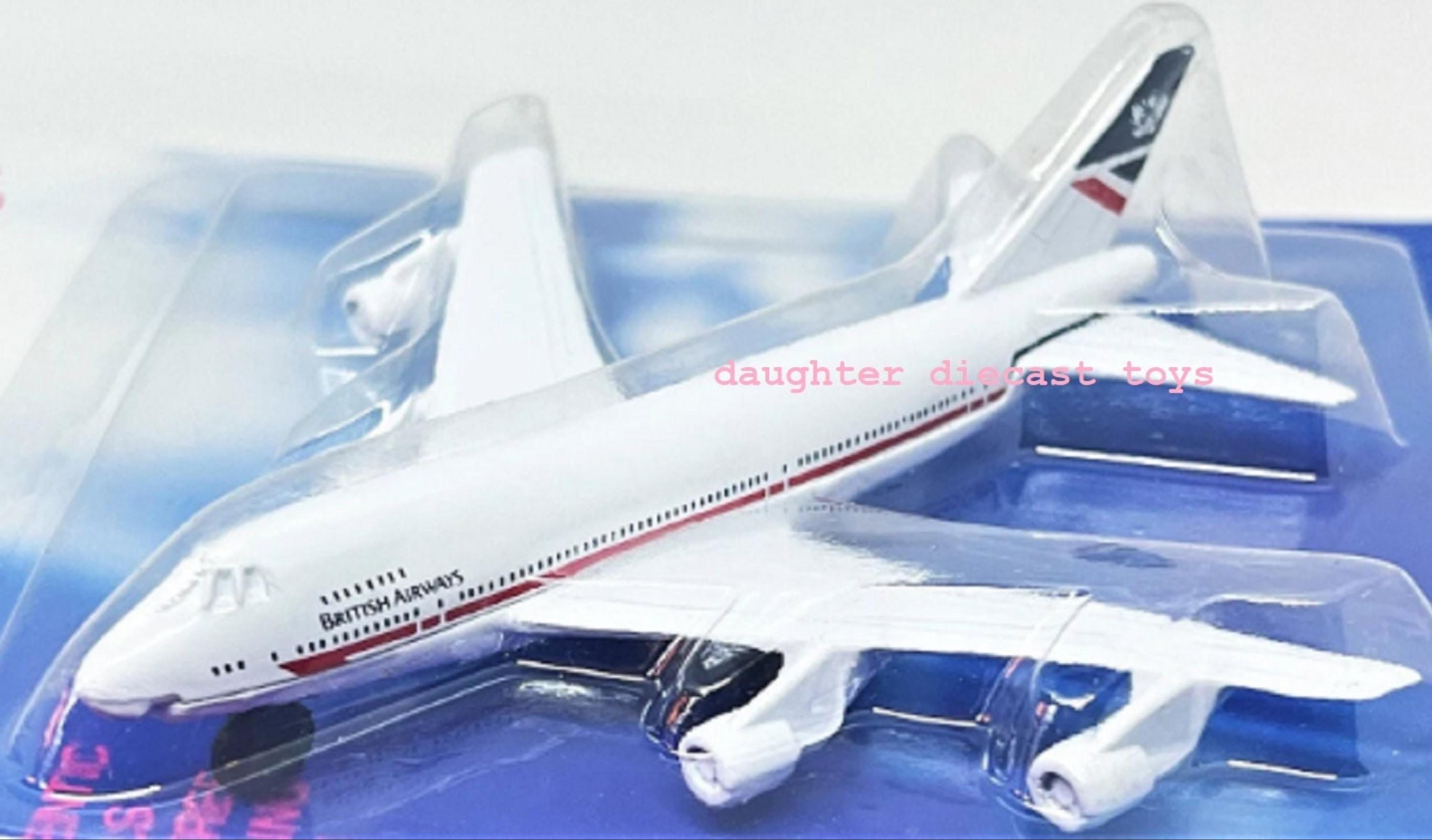
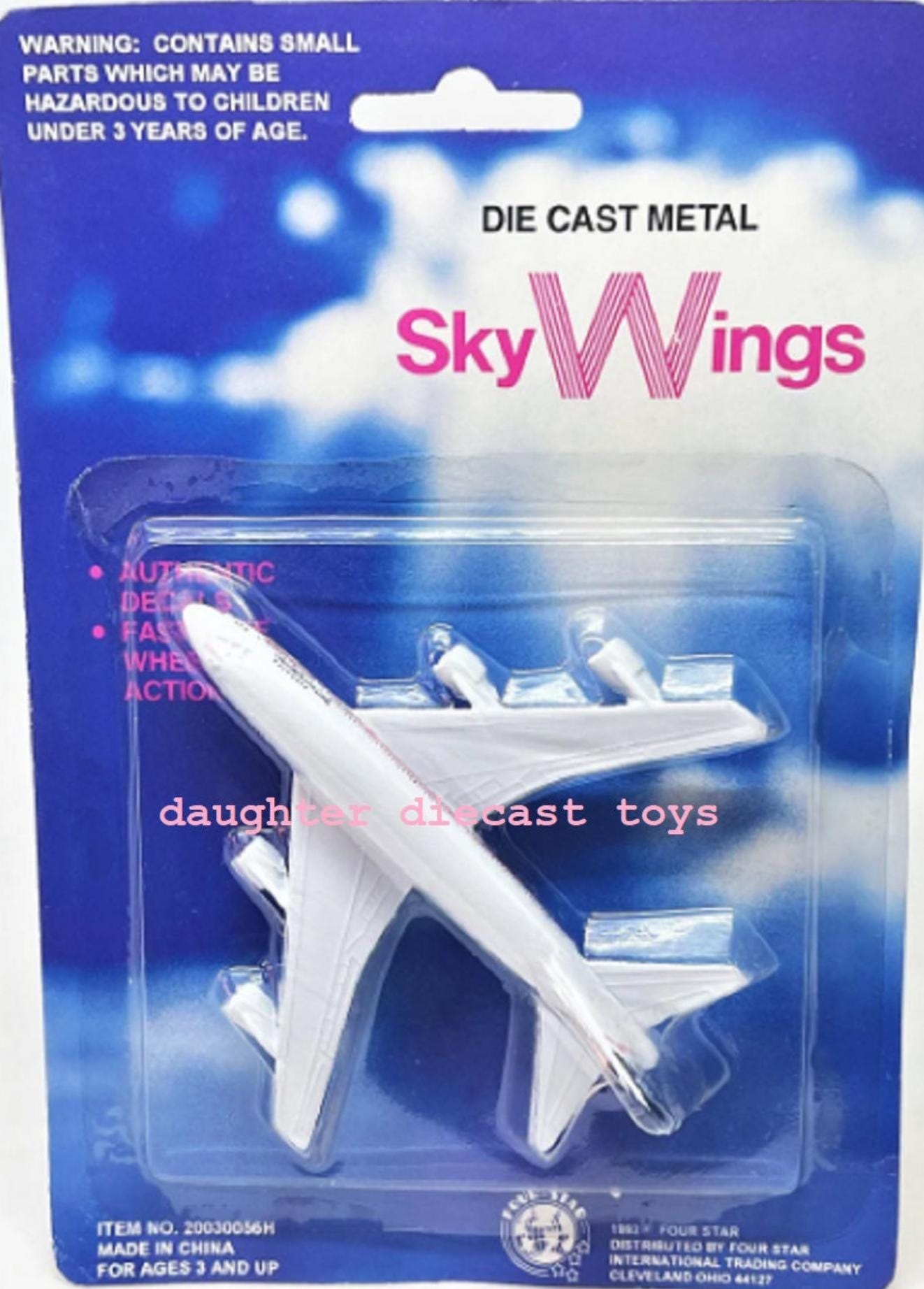
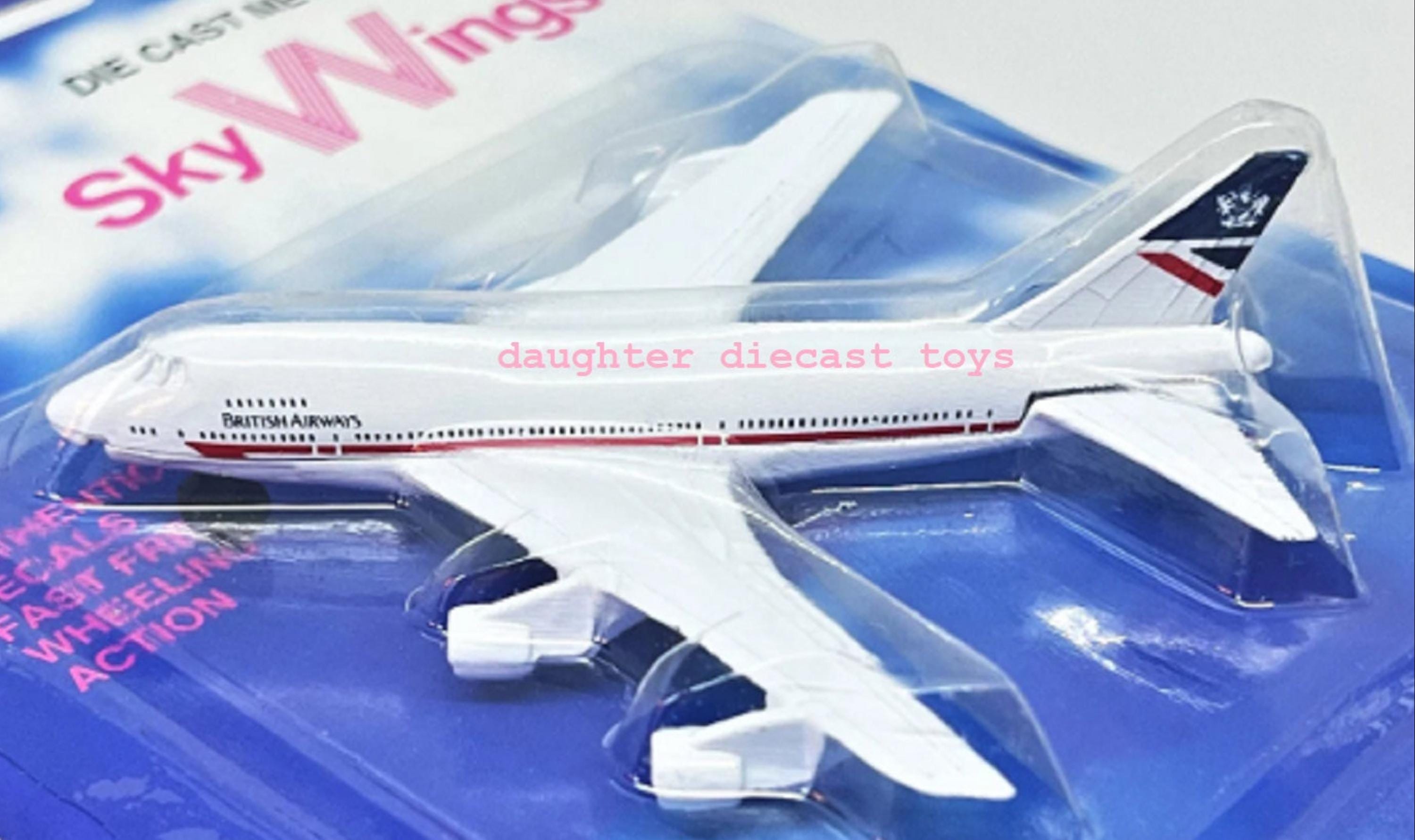
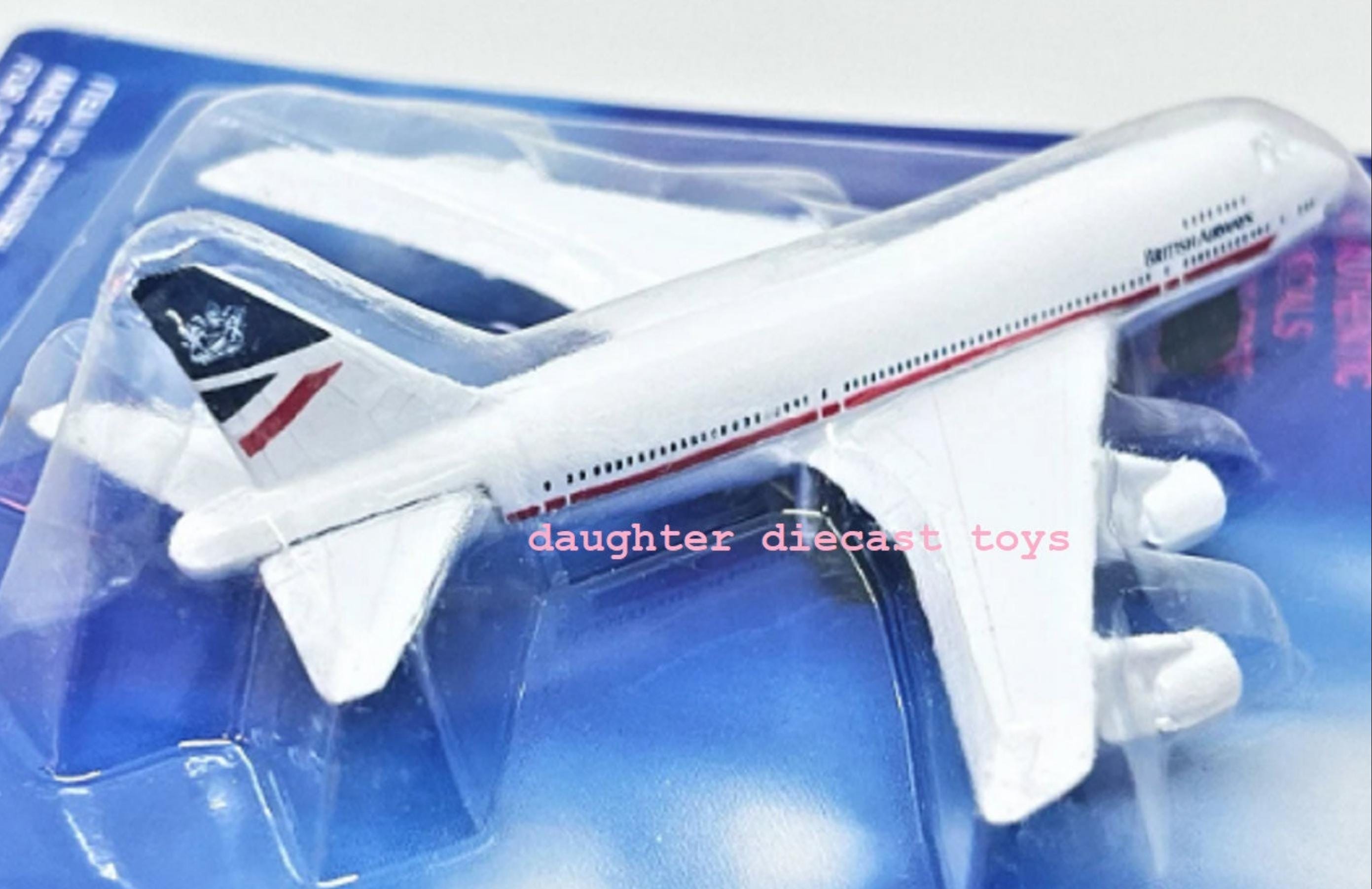

Vintage BRITISH AIRWAYS AIRBUS 380 Diecast Metal Airplane Mint Condition/Sky Wings Toy-Perfect Gift for Commercial Aviation Buffs!
$ 29.99

Vintage BRITISH AIRWAYS AIRBUS 380 Diecast Metal Airplane Mint Condition/Sky
Wings Toy-Perfect Gift for Commercial Aviation Buffs!Awesome! BRITISH AIRWAYS AIRBUS 380. Diecast Metal Airplane Mint Condition/Sky Wings Toy-Perfect Gift for Commercial Aviation Buffs! DC-10. Made by Sky Wings. Constructed of die cast metal. Rare and highly sought-after, vintage model! Measures 4"L x 3 7/8"W x 1 1/2"H. Beautiful model in pristine condition-never removed from its factory-sealed card. Perfect gift for British Airways employees, aviation history buffs and vintage toy collectors! See aircraft bio (below). We ship fast & safe worldwide every day!Note: My dad owned a Diecast toy store for 30 years. I inherited the store inventory when he passed away several years ago. I am (just now) able to bring myself to begin selling his cars-so they can be shared with the world. All pristine and mint condition vintage models will (eventually) be listed here on ETSY. All the inventory is NEW (vintage) merchandise-which was intended for retail sale. Please know-our diecast toys have NEVER been "played-with” we do not sell used, or damaged toys.
•
•
•FOR A LIMITED TIME
•
•
•Purchases totaling $35 and above qualify for FREE shipping to USA! Add more items to your Etsy shopping cart to save $$$.About the Aircraft:The Airbus A380 is a large wide-body airliner that was developed and produced by Airbus. It is the world's largest passenger airliner and only full-length double-deck jet airliner. Airbus studies started in 1988, and the project was announced in 1990 to challenge the dominance of the Boeing 747 in the long-haul market. The then-designated A3XX project was presented in 1994; Airbus launched the €9.5 billion ($10.7 billion) A380 program on 19 December 2000. The first prototype was unveiled in Toulouse on 18 January 2005, with its first flight on 27 April 2005. It then obtained its type certificate from the European Aviation Safety Agency (EASA) and the US Federal Aviation Administration (FAA) on 12 December 2006. Due to difficulties with the electrical wiring, the initial production was delayed by two years and the development costs almost doubled.It was first delivered to Singapore Airlines on 15 October 2007 and entered service on 25 October. Production peaked at 30 per year in 2012 and 2014. However, after the largest customer, Emirates, reduced its last order in February 2019, Airbus announced that A380 production would end in 2021. On 16 December 2021, Emirates received its 123rd A380, which was the 251st and last delivered by Airbus. The $25 billion investment was not recouped.The full-length double-deck aircraft has a typical seating for 525 passengers, with a maximum certified capacity for 853 passengers. The quad-jet is powered by Engine Alliance GP7200 or Rolls-Royce Trent 900 turbofans providing a range of 8,000 nmi (14,800 km). As of December 2021, the global A380 fleet had completed more than 800,000 flights over 7.3 million block hours with no fatalities and no hull losses. As of June 2022, there were 239 aircraft in service with 16 operators worldwide.OverviewThe A380 was initially offered in two models: the A380-800 and the A380F.The A380-800's original configuration carried 555 passengers in a three-class configuration[150] or 853 passengers (538 on the main deck and 315 on the upper deck) in a single-class economy configuration. Then in May 2007, Airbus began marketing a configuration with 30 fewer passengers (525 total in three classes)—traded for 200 nmi (370 km) more range—to better reflect trends in premium-class accommodation.[151] The design range for the A380−800 model is 8,500 nmi (15,700 km);[152] capable of flying from Hong Kong to New York or from Sydney to Istanbul non-stop. The A380 is designed for 19,000 cycles.[153]The second model, the A380F freighter, would have carried 150 t (330,000 lb) of cargo over a range of 5,600 nmi (10,400 km).[154] Freighter development was put on hold as Airbus prioritised the passenger version, and all orders for freighters were cancelled.Other proposed variants included an A380-900 stretch – seating about 656 passengers (or up to 960 passengers in an all-economy configuration) – and an extended-range version with the same passenger capacity as the A380-800.[3]EnginesEngine Alliance GP7200 engine waiting for installation The A380 is offered with the Rolls-Royce Trent 900 (A380-841/-842) or the Engine Alliance GP7000 (A380-861) turbofan engines.[155] The Trent 900 is a combination of the 3 m (118 in) fan and scaled IP compressor of the 777-200X/300X Trent 8104 technology demonstrator derived from the Boeing 777's Trent 800, and the Airbus A340-500/600's Trent 500 core. The GP7200 HP core technology is derived from GE's GE90 and its LP sections are based on the PW4000 expertise.[156] At its launch in 2000, engine makers assured Airbus it was getting the best level of technology and they would be state-of-the-art for the next decade, but three years later Boeing launched the 787 Dreamliner with game-changing technology and 10% lower fuel burn than the previous generation, to the dismay of John Leahy.[157]Due to its modern engines and aerodynamic improvements, Lufthansa's A380s produce half the noise of the Boeing 747-200 while carrying 160 more passengers.[158] In 2012, the A380 received an award from the Noise Abatement Society.[159]London Heathrow is a key destination for the A380.[3] The aircraft is below the QC/2 departure and QC/0.5 arrival noise limits under the Quota Count system set by the airport.[160] Field measurements suggest the approach quota allocation for the A380 may be overly generous compared to the older Boeing 747, but still quieter.[161][162] Rolls-Royce is supporting the CAA in understanding the relatively high A380/Trent 900 monitored noise levels.[163] Heathrow's landing charges having a noise component, the A380 is cheaper to land there than a Boeing 777-200 and -300 and it saves $4,300 to $5,200 per landing, or $15.3M to $18.8M of present value over 15 years. Tokyo Narita has a similar noise charge.[164]Sufficient braking capacity allowed for thrust reversers to be installed on only the inboard engines.[165][166] The outboard engines lack them, reducing the amount of debris stirred up during landing.[167] The reversers are electrically actuated to save weight, and for greater reliability than pneumatic or hydraulic equivalents.[168]WingsPlanform view showing moderate wing aspect ratio and the undercarriageComposite photo of a structural loading test on the left wing box The A380's wings are sized for a maximum takeoff weight (MTOW) over 650 tonnes to accommodate these future versions, albeit with some internal strengthening required on the A380F freighter.[3][169] The optimal wingspan for this weight is about 90 m (300 ft), but airport restrictions have limited it to less than 80 m (260 ft), thereby lowering the aspect ratio to 7.8 which reduces fuel efficiency[104] by about 10% and increases operating costs a few percent,[170] given that fuel costs constitute about 50% of the cost of long-haul aeroplane operation.[171]The common wing design approach sacrifices fuel efficiency on the A380-800 passenger model because of its weight, but Airbus estimates that the aircraft's size and advanced technology will provide lower operating costs per passenger than the 747-400. The wings incorporate wingtip fences that extend above and below the wing surface, similar to those on the A310 and A320. These increase fuel efficiency and range by reducing induced drag.[172] The wingtip fences also reduce wake turbulence, which endangers following aircraft.[173] The wings of the A380 were designed in Filton and manufactured in Broughton in the United Kingdom. The wings are then transported to the harbour of Mostyn, where they are transported by barge to Toulouse, France, for integration and final assembly with the rest of the aircraft and its components.[174]Materials While most of the fuselage is made of aluminium alloys, composite materials comprise more than 20% of the A380's airframe.[175] Carbon-fibre reinforced plastic, glass-fibre reinforced plastic and quartz-fibre reinforced plastic are used extensively in wings, fuselage sections (such as the undercarriage and rear end of fuselage), tail surfaces, and doors.[176][177][178] The A380 is the first commercial airliner to have a central wing box made of carbon–fibre reinforced plastic. It is also the first to have a smoothly contoured wing cross–section. The wings of other commercial airliners are partitioned span-wise into sections. This flowing continuous cross section reduces aerodynamic drag. Thermoplastics are used in the leading edges of the slats.[179]The hybrid fibre metal laminate material GLARE (glass laminate aluminium reinforced epoxy) is used in the upper fuselage and on the stabilisers' leading edges.[180] This aluminium-glass-fibre laminate is lighter and has better corrosion and impact resistance than conventional aluminium alloys used in aviation.[181] Unlike earlier composite materials, GLARE can be repaired using conventional aluminium repair techniques.[citation needed]Newer weldable aluminium alloys are used in the A380's airframe. This enables the widespread use of laser beam welding manufacturing techniques, eliminating rows of rivets and resulting in a lighter, stronger structure.[182] High-strength aluminium (type 7449)[183] reinforced with carbon fibre was used in the wing brackets of the first 120 A380s to reduce weight, but cracks have been discovered and new sets of the more critical brackets will be made of standard aluminium 7010, increasing weight by 90 kg (198 lb).[184] Repair costs for earlier aircraft are expected to be around €500 million (US$629 million).[185]It takes 3,600 L (950 US gal) of paint to cover the 3,100 m2 (33,000 sq ft) exterior of an A380.[186] The paint is five layers thick and weighs about 650 kg (1,433 lb) when dry.[187]Avionics The A380 employs an integrated modular avionics (IMA) architecture, first used in advanced military aircraft, such as the Lockheed Martin F-22 Raptor, Lockheed Martin F-35 Lightning II,[188] and Dassault Rafale.[189] The main IMA systems on the A380 were developed by the Thales Group.[190] Designed and developed by Airbus, Thales and Diehl Aerospace, the IMA suite was first used on the A380. The suite is a technological innovation, with networked computing modules to support different applications.[190] The data networks use Avionics Full-Duplex Switched Ethernet, an implementation of ARINC 664. These are switched, full-duplex, star-topology and based on 100baseTX fast-Ethernet.[191] This reduces the amount of wiring required and minimises latency.[192] A380 flight deck Airbus used similar cockpit layout, procedures and handling characteristics to other Airbus aircraft, reducing crew training costs. The A380 has an improved glass cockpit, using fly-by-wire flight controls linked to side-sticks.[193][194] The cockpit has eight 15 by 20 cm (5.9 by 7.9 in) liquid crystal displays, all physically identical and interchangeable; comprising two primary flight displays, two navigation displays, one engine parameter display, one system display and two multi-function displays. The MFDs were introduced on the A380 to provide an easy-to-use interface to the flight management system—replacing three multifunction control and display units.[195] They include QWERTY keyboards and trackballs, interfacing with a graphical "point-and-click" display system.[196][197]The Network Systems Server (NSS) is the heart of A380s paperless cockpit; it eliminates bulky manuals and traditional charts.[198][199] The NSS has enough inbuilt robustness to eliminate onboard backup paper documents. The A380s network and server system stores data and offers electronic documentation, providing a required equipment list, navigation charts, performance calculations, and an aircraft logbook. This is accessed through the MFDs and controlled via the keyboard interface.[192]SystemsA380 20-wheel main landing gear Power-by-wire flight control actuators have been used for the first time in civil aviation to back up primary hydraulic actuators. Also, during certain manoeuvres they augment the primary actuators.[200] They have self-contained hydraulic and electrical power supplies. Electro-hydrostatic actuators (EHA) are used in the aileron and elevator, electric and hydraulic motors to drive the slats as well as electrical backup hydrostatic actuators (EBHA) for the rudder and some spoilers.[201]The A380's 350 bar (35 MPa or 5,000 psi) hydraulic system is a significant difference from the typical 210 bar (21 MPa or 3,000 psi) hydraulics used on most commercial aircraft since the 1940s.[202][203] First used in military aircraft, high-pressure hydraulics reduce the weight and size of pipelines, actuators and related components. The 350 bar pressure is generated by eight de-clutchable hydraulic pumps.[203][204] The hydraulic lines are typically made from titanium; the system features both fuel- and air-cooled heat exchangers. Self-contained electrically powered hydraulic power packs serve as backups for the primary systems, instead of a secondary hydraulic system, saving weight and reducing maintenance.[205]The A380 uses four 150 kVA variable-frequency electrical generators,[206] eliminating constant-speed drives and improving reliability.[207] The A380 uses aluminium power cables instead of copper for weight reduction. The electrical power system is fully computerised and many contactors and breakers have been replaced by solid-state devices for better performance and increased reliability.[201]The auxiliary power comprises the Auxiliary Power Unit (APU), the electronic control box (ECB), and mounting hardware. The APU in use on the A380 is the 1,300 kW PW 980A APU. The APU primarily provides air to power the Analysis Ground Station (AGS) on the ground and to start the engines. The AGS is a semi-automatic analysis system of flight data that helps to optimise management of maintenance and reduce costs. The APU also powers two 120 kVA electric generators that provide auxiliary electric power to the aircraft. There is also a ram air turbine (RAT) with a 70 kVA generator.[208]Passenger provisions Main article: Seat configurations of Airbus A380Ten-abreast old economy class seating on the main deck on an Emirates A380 The A380-800's cabin has 550 square metres (5,920 sq ft) of usable floor space,[209] 40% more than the next largest airliner, the Boeing 747-8.[210]The cabin has features to reduce traveller fatigue such as a quieter interior and higher pressurisation than previous generations of aircraft; the A380 is pressurised to the equivalent altitude of 1,520 m (5,000 ft) up to 12,000 m (39,000 ft).[211][3]: 129 It has 50% less cabin noise, 50% more cabin area and volume, larger windows, bigger overhead bins, and 60 cm (2.0 ft) more headroom than the 747-400.[212][213] Seating options range from 3-room 12 m2 (130 sq ft) "residence" in first class to 11-across in economy.[214] A380 economy seats are up to 48 cm (19 in) wide in a 10-abreast configuration,[215] compared with the 10-abreast configuration on the 747-400 that typically has seats 44.5 cm (17.5 in) wide.[216] On other aircraft, economy seats range from 41.5 to 52.3 cm (16.3 to 20.6 in) in width.[217]The A380's upper and lower decks are connected by two stairways, one fore and one aft, with both being wide enough to accommodate two passengers side by side; this cabin arrangement allows multiple seat configurations. The maximum certified carrying capacity is 853 passengers in an all-economy-class layout,[49] Airbus lists the "typical" three-class layout as accommodating 525 passengers, with 10 first, 76 business, and 439 economy class seats.[151] Airline configurations range from Korean Air's 407 passengers to Emirates' two-class 615 seats[218] and average around 480–490 seats.[219][220] The Air Austral's proposed 840 passenger layout has not come to fruition. The A380's interior illumination system uses bulbless LEDs in the cabin, cockpit, and cargo decks. The LEDs in the cabin can be altered to create an ambience simulating daylight, night, or intermediate levels.[221] On the outside of the aircraft, HID lighting is used for brighter illumination.Airbus's publicity has stressed the comfort and space of the A380 cabin,[222] and advertised onboard relaxation areas such as bars, beauty salons, duty-free shops, and restaurants.[223][224] Proposed amenities resembled those installed on earlier airliners, particularly 1970s wide-body jets,[225] which largely gave way to regular seats for more passenger capacity.[225] Airbus has acknowledged that some cabin proposals were unlikely to be installed,[224] and that it was ultimately the airlines' decision how to configure the interior.[225] Industry analysts suggested that implementing customisation has slowed the production speeds, and raised costs.[226] Due to delivery delays, Singapore Airlines and Air France debuted their seat designs on different aircraft prior to the A380.[227][228]Initial operators typically configured their A380s for three-class service, while adding extra features for passengers in premium cabins. Launch customer Singapore Airlines introduced partly enclosed first class suites on its A380s in 2007, each featuring a leather seat with a separate bed; center suites could be joined to create a double bed.[229][230][231] A year later, Qantas debuted a new first class seat-bed and a sofa lounge at the front of the upper deck on its A380s,[232][233] and in 2009 Air France unveiled an upper deck electronic art gallery.[234] In late 2008, Emirates introduced "shower spas" in first class on its A380s allowing each first class passenger five minutes of hot water,[235][236] drawing on 2.5 tonnes of water, although only 60% of it was used.[237]Etihad Airways and Qatar Airways also have a bar lounge and seating area on the upper deck, while Etihad has enclosed areas for two people each.[238] In addition to lounge areas, some A380 operators have installed amenities consistent with other aircraft in their respective fleets, including self-serve snack bars,[239] premium economy sections,[228] and redesigned business class seating.[227]The Hamburg Aircraft Interiors Expo in April 2015 saw the presentation of an 11-seat row economy cabin for the A380. Airbus is reacting to a changing economy; the recession which began in 2008 saw a drop in market percentage of first class and business seats to six percent and an increase in budget economy travellers. Among other causes is the reluctance of employers to pay for executives to travel in First or Business Class. Airbus' chief of cabin marketing, Ingo Wuggestzer, told Aviation Week and Space Technology that the standard three class cabin no longer reflected market conditions. The 11 seat row on the A380 is accompanied by similar options on other widebodies: nine across on the Airbus A330 and ten across on the A350.[240]General characteristicsCrew: 2 (cockpit) Capacity: Passengers: 575 typical, 853 max[426] Cargo: 175.2 m3 (6,190 cu ft) Maximum payload 84 t (185,000 lb) Length: 72.72 m (238 ft 7 in) Wingspan: 79.75 m (261 ft 8 in) Width: 7.14 m (23 ft 5 in) Height: 24.09 m (79 ft 0 in) Wing area: 845 m2 (9,100 sq ft) [427] Empty weight: 285,000 kg (628,317 lb) Max takeoff weight: 575,000 kg (1,267,658 lb) Fuel capacity: 253,983 kg (559,937 lb), 323,546 litres (85,472 US gal, 71,173 imp gal)[242] Powerplant: 4 × Trent 970-84/970B-84 turbofan, 348 kN (78,000 lbf) thrust each 332.44–356.81 kN (74,740–80,210 lbf)[155] PerformanceCruise speed: 903 km/h (561 mph, 488 kn) Mach 0.85[167] Range: 14,800 km (9,200 mi, 8,000 nmi) [426] Service ceiling: 13,000 m (43,000 ft) [428] VMO: Mach 0.89 (945 km/h; 511 kn)[b][430] Landing speed: 138 kn (256 km/h) Takeoff: 3,000 m (9,800 ft) at MTOW, SL, ISA
Wings Toy-Perfect Gift for Commercial Aviation Buffs!Awesome! BRITISH AIRWAYS AIRBUS 380. Diecast Metal Airplane Mint Condition/Sky Wings Toy-Perfect Gift for Commercial Aviation Buffs! DC-10. Made by Sky Wings. Constructed of die cast metal. Rare and highly sought-after, vintage model! Measures 4"L x 3 7/8"W x 1 1/2"H. Beautiful model in pristine condition-never removed from its factory-sealed card. Perfect gift for British Airways employees, aviation history buffs and vintage toy collectors! See aircraft bio (below). We ship fast & safe worldwide every day!Note: My dad owned a Diecast toy store for 30 years. I inherited the store inventory when he passed away several years ago. I am (just now) able to bring myself to begin selling his cars-so they can be shared with the world. All pristine and mint condition vintage models will (eventually) be listed here on ETSY. All the inventory is NEW (vintage) merchandise-which was intended for retail sale. Please know-our diecast toys have NEVER been "played-with” we do not sell used, or damaged toys.
•
•
•FOR A LIMITED TIME
•
•
•Purchases totaling $35 and above qualify for FREE shipping to USA! Add more items to your Etsy shopping cart to save $$$.About the Aircraft:The Airbus A380 is a large wide-body airliner that was developed and produced by Airbus. It is the world's largest passenger airliner and only full-length double-deck jet airliner. Airbus studies started in 1988, and the project was announced in 1990 to challenge the dominance of the Boeing 747 in the long-haul market. The then-designated A3XX project was presented in 1994; Airbus launched the €9.5 billion ($10.7 billion) A380 program on 19 December 2000. The first prototype was unveiled in Toulouse on 18 January 2005, with its first flight on 27 April 2005. It then obtained its type certificate from the European Aviation Safety Agency (EASA) and the US Federal Aviation Administration (FAA) on 12 December 2006. Due to difficulties with the electrical wiring, the initial production was delayed by two years and the development costs almost doubled.It was first delivered to Singapore Airlines on 15 October 2007 and entered service on 25 October. Production peaked at 30 per year in 2012 and 2014. However, after the largest customer, Emirates, reduced its last order in February 2019, Airbus announced that A380 production would end in 2021. On 16 December 2021, Emirates received its 123rd A380, which was the 251st and last delivered by Airbus. The $25 billion investment was not recouped.The full-length double-deck aircraft has a typical seating for 525 passengers, with a maximum certified capacity for 853 passengers. The quad-jet is powered by Engine Alliance GP7200 or Rolls-Royce Trent 900 turbofans providing a range of 8,000 nmi (14,800 km). As of December 2021, the global A380 fleet had completed more than 800,000 flights over 7.3 million block hours with no fatalities and no hull losses. As of June 2022, there were 239 aircraft in service with 16 operators worldwide.OverviewThe A380 was initially offered in two models: the A380-800 and the A380F.The A380-800's original configuration carried 555 passengers in a three-class configuration[150] or 853 passengers (538 on the main deck and 315 on the upper deck) in a single-class economy configuration. Then in May 2007, Airbus began marketing a configuration with 30 fewer passengers (525 total in three classes)—traded for 200 nmi (370 km) more range—to better reflect trends in premium-class accommodation.[151] The design range for the A380−800 model is 8,500 nmi (15,700 km);[152] capable of flying from Hong Kong to New York or from Sydney to Istanbul non-stop. The A380 is designed for 19,000 cycles.[153]The second model, the A380F freighter, would have carried 150 t (330,000 lb) of cargo over a range of 5,600 nmi (10,400 km).[154] Freighter development was put on hold as Airbus prioritised the passenger version, and all orders for freighters were cancelled.Other proposed variants included an A380-900 stretch – seating about 656 passengers (or up to 960 passengers in an all-economy configuration) – and an extended-range version with the same passenger capacity as the A380-800.[3]EnginesEngine Alliance GP7200 engine waiting for installation The A380 is offered with the Rolls-Royce Trent 900 (A380-841/-842) or the Engine Alliance GP7000 (A380-861) turbofan engines.[155] The Trent 900 is a combination of the 3 m (118 in) fan and scaled IP compressor of the 777-200X/300X Trent 8104 technology demonstrator derived from the Boeing 777's Trent 800, and the Airbus A340-500/600's Trent 500 core. The GP7200 HP core technology is derived from GE's GE90 and its LP sections are based on the PW4000 expertise.[156] At its launch in 2000, engine makers assured Airbus it was getting the best level of technology and they would be state-of-the-art for the next decade, but three years later Boeing launched the 787 Dreamliner with game-changing technology and 10% lower fuel burn than the previous generation, to the dismay of John Leahy.[157]Due to its modern engines and aerodynamic improvements, Lufthansa's A380s produce half the noise of the Boeing 747-200 while carrying 160 more passengers.[158] In 2012, the A380 received an award from the Noise Abatement Society.[159]London Heathrow is a key destination for the A380.[3] The aircraft is below the QC/2 departure and QC/0.5 arrival noise limits under the Quota Count system set by the airport.[160] Field measurements suggest the approach quota allocation for the A380 may be overly generous compared to the older Boeing 747, but still quieter.[161][162] Rolls-Royce is supporting the CAA in understanding the relatively high A380/Trent 900 monitored noise levels.[163] Heathrow's landing charges having a noise component, the A380 is cheaper to land there than a Boeing 777-200 and -300 and it saves $4,300 to $5,200 per landing, or $15.3M to $18.8M of present value over 15 years. Tokyo Narita has a similar noise charge.[164]Sufficient braking capacity allowed for thrust reversers to be installed on only the inboard engines.[165][166] The outboard engines lack them, reducing the amount of debris stirred up during landing.[167] The reversers are electrically actuated to save weight, and for greater reliability than pneumatic or hydraulic equivalents.[168]WingsPlanform view showing moderate wing aspect ratio and the undercarriageComposite photo of a structural loading test on the left wing box The A380's wings are sized for a maximum takeoff weight (MTOW) over 650 tonnes to accommodate these future versions, albeit with some internal strengthening required on the A380F freighter.[3][169] The optimal wingspan for this weight is about 90 m (300 ft), but airport restrictions have limited it to less than 80 m (260 ft), thereby lowering the aspect ratio to 7.8 which reduces fuel efficiency[104] by about 10% and increases operating costs a few percent,[170] given that fuel costs constitute about 50% of the cost of long-haul aeroplane operation.[171]The common wing design approach sacrifices fuel efficiency on the A380-800 passenger model because of its weight, but Airbus estimates that the aircraft's size and advanced technology will provide lower operating costs per passenger than the 747-400. The wings incorporate wingtip fences that extend above and below the wing surface, similar to those on the A310 and A320. These increase fuel efficiency and range by reducing induced drag.[172] The wingtip fences also reduce wake turbulence, which endangers following aircraft.[173] The wings of the A380 were designed in Filton and manufactured in Broughton in the United Kingdom. The wings are then transported to the harbour of Mostyn, where they are transported by barge to Toulouse, France, for integration and final assembly with the rest of the aircraft and its components.[174]Materials While most of the fuselage is made of aluminium alloys, composite materials comprise more than 20% of the A380's airframe.[175] Carbon-fibre reinforced plastic, glass-fibre reinforced plastic and quartz-fibre reinforced plastic are used extensively in wings, fuselage sections (such as the undercarriage and rear end of fuselage), tail surfaces, and doors.[176][177][178] The A380 is the first commercial airliner to have a central wing box made of carbon–fibre reinforced plastic. It is also the first to have a smoothly contoured wing cross–section. The wings of other commercial airliners are partitioned span-wise into sections. This flowing continuous cross section reduces aerodynamic drag. Thermoplastics are used in the leading edges of the slats.[179]The hybrid fibre metal laminate material GLARE (glass laminate aluminium reinforced epoxy) is used in the upper fuselage and on the stabilisers' leading edges.[180] This aluminium-glass-fibre laminate is lighter and has better corrosion and impact resistance than conventional aluminium alloys used in aviation.[181] Unlike earlier composite materials, GLARE can be repaired using conventional aluminium repair techniques.[citation needed]Newer weldable aluminium alloys are used in the A380's airframe. This enables the widespread use of laser beam welding manufacturing techniques, eliminating rows of rivets and resulting in a lighter, stronger structure.[182] High-strength aluminium (type 7449)[183] reinforced with carbon fibre was used in the wing brackets of the first 120 A380s to reduce weight, but cracks have been discovered and new sets of the more critical brackets will be made of standard aluminium 7010, increasing weight by 90 kg (198 lb).[184] Repair costs for earlier aircraft are expected to be around €500 million (US$629 million).[185]It takes 3,600 L (950 US gal) of paint to cover the 3,100 m2 (33,000 sq ft) exterior of an A380.[186] The paint is five layers thick and weighs about 650 kg (1,433 lb) when dry.[187]Avionics The A380 employs an integrated modular avionics (IMA) architecture, first used in advanced military aircraft, such as the Lockheed Martin F-22 Raptor, Lockheed Martin F-35 Lightning II,[188] and Dassault Rafale.[189] The main IMA systems on the A380 were developed by the Thales Group.[190] Designed and developed by Airbus, Thales and Diehl Aerospace, the IMA suite was first used on the A380. The suite is a technological innovation, with networked computing modules to support different applications.[190] The data networks use Avionics Full-Duplex Switched Ethernet, an implementation of ARINC 664. These are switched, full-duplex, star-topology and based on 100baseTX fast-Ethernet.[191] This reduces the amount of wiring required and minimises latency.[192] A380 flight deck Airbus used similar cockpit layout, procedures and handling characteristics to other Airbus aircraft, reducing crew training costs. The A380 has an improved glass cockpit, using fly-by-wire flight controls linked to side-sticks.[193][194] The cockpit has eight 15 by 20 cm (5.9 by 7.9 in) liquid crystal displays, all physically identical and interchangeable; comprising two primary flight displays, two navigation displays, one engine parameter display, one system display and two multi-function displays. The MFDs were introduced on the A380 to provide an easy-to-use interface to the flight management system—replacing three multifunction control and display units.[195] They include QWERTY keyboards and trackballs, interfacing with a graphical "point-and-click" display system.[196][197]The Network Systems Server (NSS) is the heart of A380s paperless cockpit; it eliminates bulky manuals and traditional charts.[198][199] The NSS has enough inbuilt robustness to eliminate onboard backup paper documents. The A380s network and server system stores data and offers electronic documentation, providing a required equipment list, navigation charts, performance calculations, and an aircraft logbook. This is accessed through the MFDs and controlled via the keyboard interface.[192]SystemsA380 20-wheel main landing gear Power-by-wire flight control actuators have been used for the first time in civil aviation to back up primary hydraulic actuators. Also, during certain manoeuvres they augment the primary actuators.[200] They have self-contained hydraulic and electrical power supplies. Electro-hydrostatic actuators (EHA) are used in the aileron and elevator, electric and hydraulic motors to drive the slats as well as electrical backup hydrostatic actuators (EBHA) for the rudder and some spoilers.[201]The A380's 350 bar (35 MPa or 5,000 psi) hydraulic system is a significant difference from the typical 210 bar (21 MPa or 3,000 psi) hydraulics used on most commercial aircraft since the 1940s.[202][203] First used in military aircraft, high-pressure hydraulics reduce the weight and size of pipelines, actuators and related components. The 350 bar pressure is generated by eight de-clutchable hydraulic pumps.[203][204] The hydraulic lines are typically made from titanium; the system features both fuel- and air-cooled heat exchangers. Self-contained electrically powered hydraulic power packs serve as backups for the primary systems, instead of a secondary hydraulic system, saving weight and reducing maintenance.[205]The A380 uses four 150 kVA variable-frequency electrical generators,[206] eliminating constant-speed drives and improving reliability.[207] The A380 uses aluminium power cables instead of copper for weight reduction. The electrical power system is fully computerised and many contactors and breakers have been replaced by solid-state devices for better performance and increased reliability.[201]The auxiliary power comprises the Auxiliary Power Unit (APU), the electronic control box (ECB), and mounting hardware. The APU in use on the A380 is the 1,300 kW PW 980A APU. The APU primarily provides air to power the Analysis Ground Station (AGS) on the ground and to start the engines. The AGS is a semi-automatic analysis system of flight data that helps to optimise management of maintenance and reduce costs. The APU also powers two 120 kVA electric generators that provide auxiliary electric power to the aircraft. There is also a ram air turbine (RAT) with a 70 kVA generator.[208]Passenger provisions Main article: Seat configurations of Airbus A380Ten-abreast old economy class seating on the main deck on an Emirates A380 The A380-800's cabin has 550 square metres (5,920 sq ft) of usable floor space,[209] 40% more than the next largest airliner, the Boeing 747-8.[210]The cabin has features to reduce traveller fatigue such as a quieter interior and higher pressurisation than previous generations of aircraft; the A380 is pressurised to the equivalent altitude of 1,520 m (5,000 ft) up to 12,000 m (39,000 ft).[211][3]: 129 It has 50% less cabin noise, 50% more cabin area and volume, larger windows, bigger overhead bins, and 60 cm (2.0 ft) more headroom than the 747-400.[212][213] Seating options range from 3-room 12 m2 (130 sq ft) "residence" in first class to 11-across in economy.[214] A380 economy seats are up to 48 cm (19 in) wide in a 10-abreast configuration,[215] compared with the 10-abreast configuration on the 747-400 that typically has seats 44.5 cm (17.5 in) wide.[216] On other aircraft, economy seats range from 41.5 to 52.3 cm (16.3 to 20.6 in) in width.[217]The A380's upper and lower decks are connected by two stairways, one fore and one aft, with both being wide enough to accommodate two passengers side by side; this cabin arrangement allows multiple seat configurations. The maximum certified carrying capacity is 853 passengers in an all-economy-class layout,[49] Airbus lists the "typical" three-class layout as accommodating 525 passengers, with 10 first, 76 business, and 439 economy class seats.[151] Airline configurations range from Korean Air's 407 passengers to Emirates' two-class 615 seats[218] and average around 480–490 seats.[219][220] The Air Austral's proposed 840 passenger layout has not come to fruition. The A380's interior illumination system uses bulbless LEDs in the cabin, cockpit, and cargo decks. The LEDs in the cabin can be altered to create an ambience simulating daylight, night, or intermediate levels.[221] On the outside of the aircraft, HID lighting is used for brighter illumination.Airbus's publicity has stressed the comfort and space of the A380 cabin,[222] and advertised onboard relaxation areas such as bars, beauty salons, duty-free shops, and restaurants.[223][224] Proposed amenities resembled those installed on earlier airliners, particularly 1970s wide-body jets,[225] which largely gave way to regular seats for more passenger capacity.[225] Airbus has acknowledged that some cabin proposals were unlikely to be installed,[224] and that it was ultimately the airlines' decision how to configure the interior.[225] Industry analysts suggested that implementing customisation has slowed the production speeds, and raised costs.[226] Due to delivery delays, Singapore Airlines and Air France debuted their seat designs on different aircraft prior to the A380.[227][228]Initial operators typically configured their A380s for three-class service, while adding extra features for passengers in premium cabins. Launch customer Singapore Airlines introduced partly enclosed first class suites on its A380s in 2007, each featuring a leather seat with a separate bed; center suites could be joined to create a double bed.[229][230][231] A year later, Qantas debuted a new first class seat-bed and a sofa lounge at the front of the upper deck on its A380s,[232][233] and in 2009 Air France unveiled an upper deck electronic art gallery.[234] In late 2008, Emirates introduced "shower spas" in first class on its A380s allowing each first class passenger five minutes of hot water,[235][236] drawing on 2.5 tonnes of water, although only 60% of it was used.[237]Etihad Airways and Qatar Airways also have a bar lounge and seating area on the upper deck, while Etihad has enclosed areas for two people each.[238] In addition to lounge areas, some A380 operators have installed amenities consistent with other aircraft in their respective fleets, including self-serve snack bars,[239] premium economy sections,[228] and redesigned business class seating.[227]The Hamburg Aircraft Interiors Expo in April 2015 saw the presentation of an 11-seat row economy cabin for the A380. Airbus is reacting to a changing economy; the recession which began in 2008 saw a drop in market percentage of first class and business seats to six percent and an increase in budget economy travellers. Among other causes is the reluctance of employers to pay for executives to travel in First or Business Class. Airbus' chief of cabin marketing, Ingo Wuggestzer, told Aviation Week and Space Technology that the standard three class cabin no longer reflected market conditions. The 11 seat row on the A380 is accompanied by similar options on other widebodies: nine across on the Airbus A330 and ten across on the A350.[240]General characteristicsCrew: 2 (cockpit) Capacity: Passengers: 575 typical, 853 max[426] Cargo: 175.2 m3 (6,190 cu ft) Maximum payload 84 t (185,000 lb) Length: 72.72 m (238 ft 7 in) Wingspan: 79.75 m (261 ft 8 in) Width: 7.14 m (23 ft 5 in) Height: 24.09 m (79 ft 0 in) Wing area: 845 m2 (9,100 sq ft) [427] Empty weight: 285,000 kg (628,317 lb) Max takeoff weight: 575,000 kg (1,267,658 lb) Fuel capacity: 253,983 kg (559,937 lb), 323,546 litres (85,472 US gal, 71,173 imp gal)[242] Powerplant: 4 × Trent 970-84/970B-84 turbofan, 348 kN (78,000 lbf) thrust each 332.44–356.81 kN (74,740–80,210 lbf)[155] PerformanceCruise speed: 903 km/h (561 mph, 488 kn) Mach 0.85[167] Range: 14,800 km (9,200 mi, 8,000 nmi) [426] Service ceiling: 13,000 m (43,000 ft) [428] VMO: Mach 0.89 (945 km/h; 511 kn)[b][430] Landing speed: 138 kn (256 km/h) Takeoff: 3,000 m (9,800 ft) at MTOW, SL, ISA
Other Products