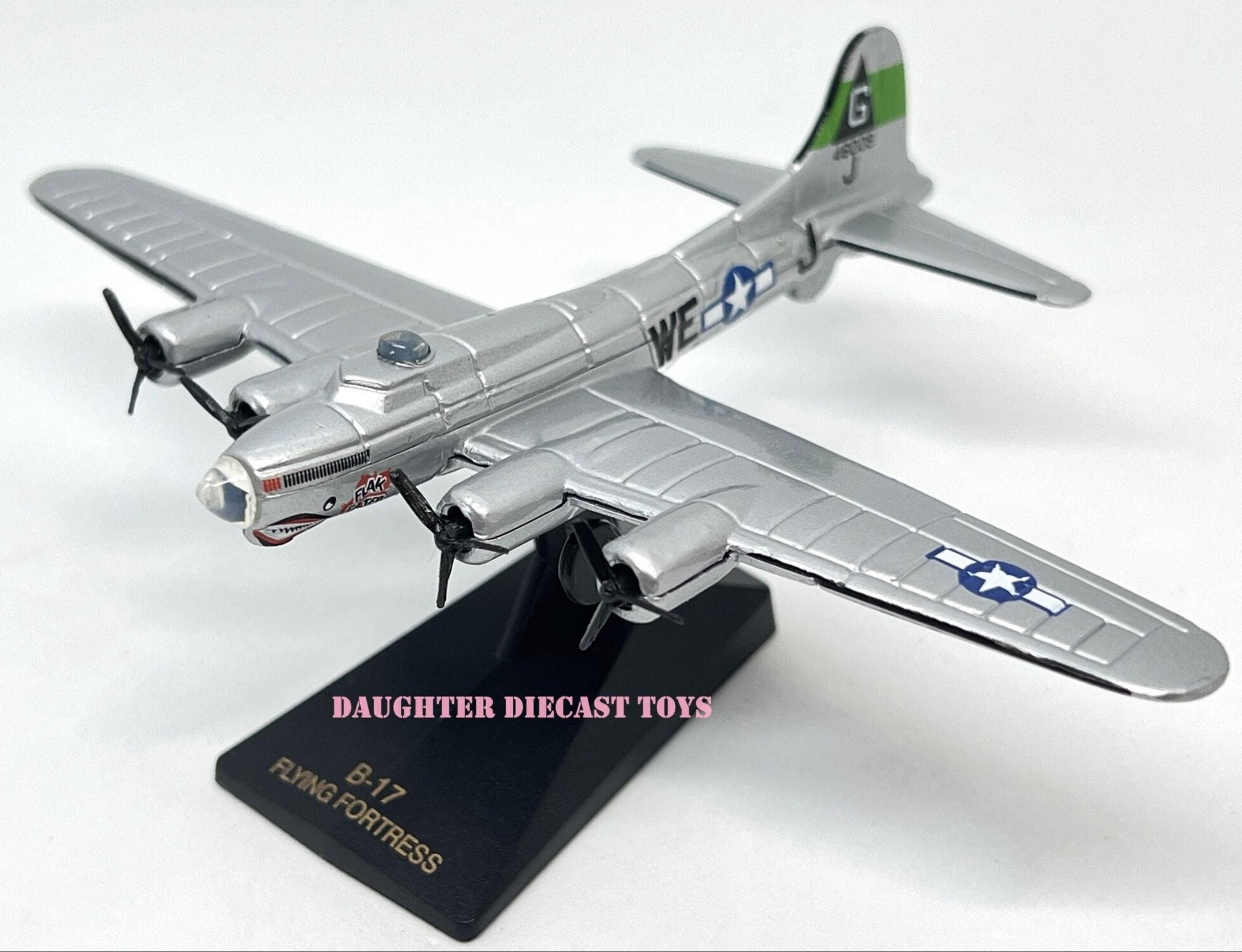
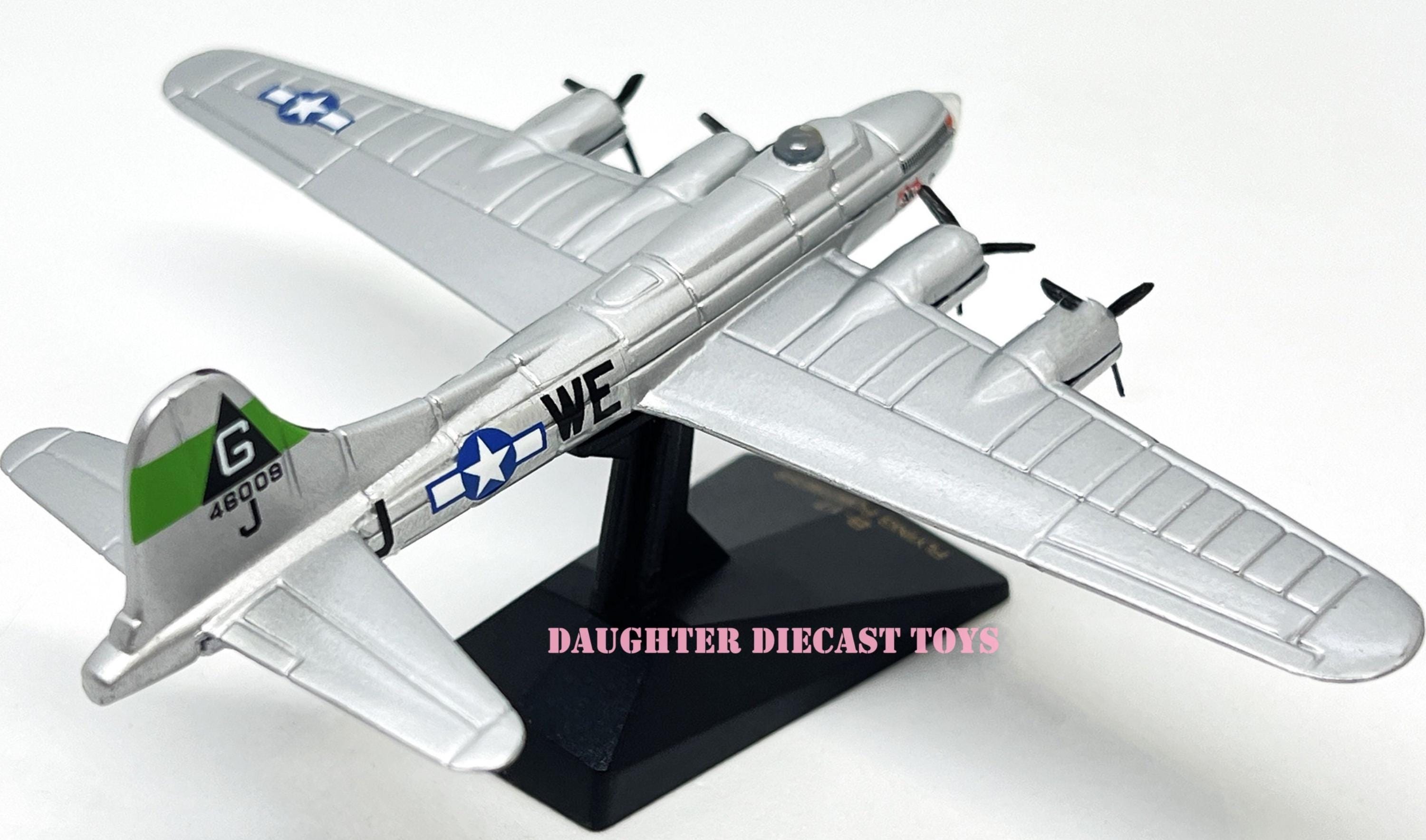
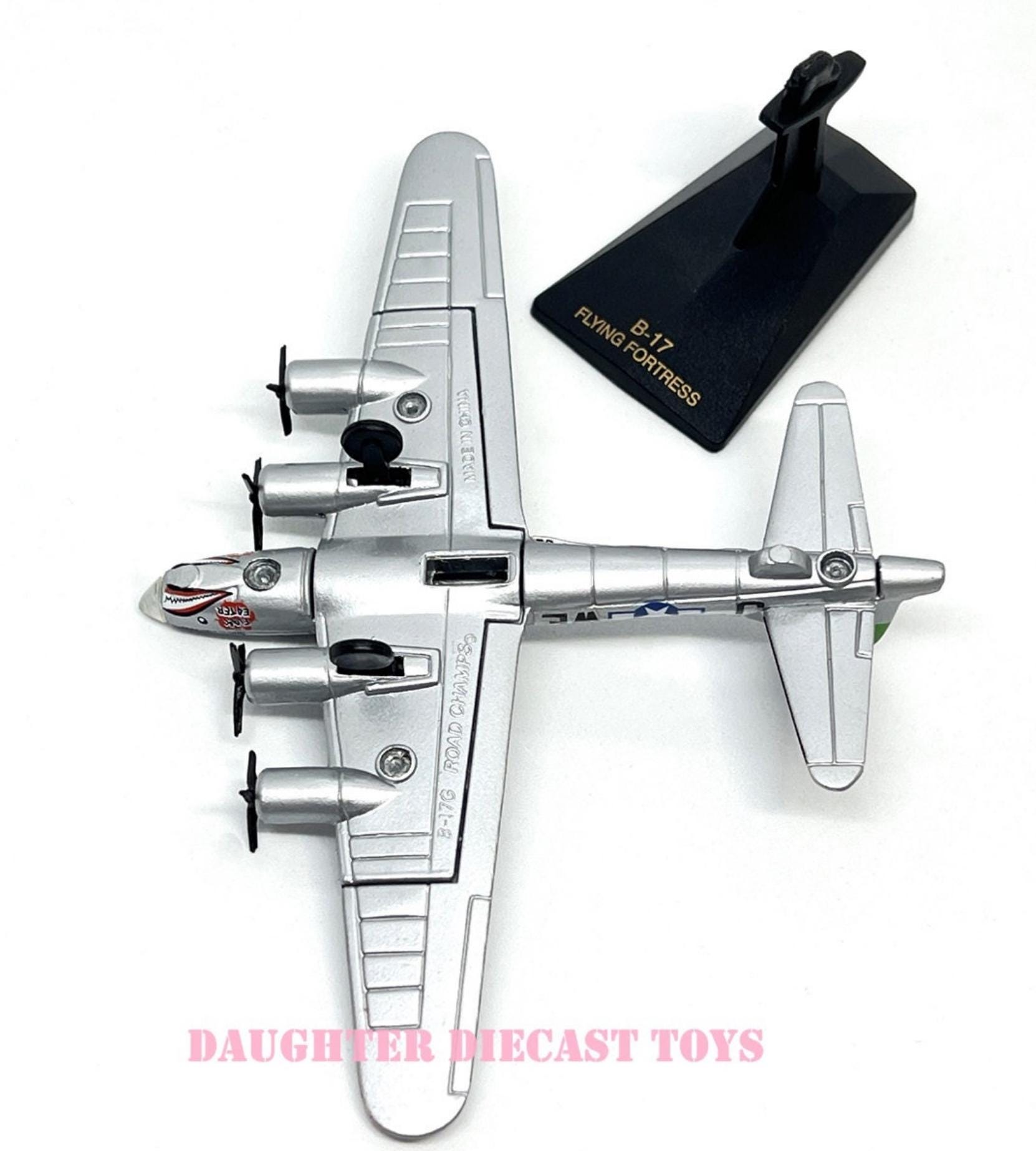

WWII B-17 G BOMBER Diecast Metal Airplane w/Stand! Pristine Condition-Perfect Gift fans of Military Aircraft & Collectors!
$ 45.00

Vintage BOEING B-17G BOMBER WWII "The Flak Eater" Diecast Metal Airplane
w/Stand! Pristine Condition-Perfect Gift fans of Military Aircraft & Collectors!Amazing!... WWII BOEING B-17G BOMBER AIRPLANE--christened "The Flak Eater". (see bio below). Adult collector model-made of heavy diecast metal by Road Champs. Highly sought-after model! 1/72 scale prox. Measures 4"L x 5 1/2"W x 2"H (mounted). Beautiful/pristine condition model. Never displayed or handled (until today for our photos). Sold loose in collectors' bag. Comes with sturdy desk-top mounting stand. Perfect gift for Military aircraft/ vintage toy collectors and fans of Aviation history (like me)! We ship fast & safe worldwide every day!
•
•
•FOR A LIMITED TIME
•
•
•Purchases totaling $35 and above qualify for FREE shipping to USA! Add more items to your Etsy shopping cart to save $$$.NOTE: My dad owned a Diecast toy store for 30 years. I inherited the store inventory when he passed away many years ago. I am just now, beginning to sell the mint condition vintage models. All are store-inventory is new-old-stock, models have never been "played with". Please visit often-as I am adding more cool stuff every day!AIRCRAFT BIO:The Boeing B-17 Flying Fortress is a four-engined heavy bomber developed in the 1930s for the United States Army Air Corps (USAAC). Competing against Douglas and Martin for a contract to build 200 bombers, the Boeing entry (prototype Model 299/XB-17) outperformed both competitors and exceeded the Air Corps' performance specifications. Although Boeing lost the contract (to the Douglas B-18 Bolo) because the prototype crashed, the Air Corps ordered 13 more B-17s for further evaluation. From its introduction in 1938, the B-17 Flying Fortress evolved through numerous design advances,[4][5] becoming the third-most produced bomber of all time, behind the four-engined Consolidated B-24 Liberator and the multirole, twin-engined Junkers Ju 88.The B-17 was primarily employed by the USAAF in the daylight strategic bombing campaign of World War II against German industrial, military and civilian targets. The United States Eighth Air Force, based at many airfields in central, eastern and southern England, and the Fifteenth Air Force, based in Italy, complemented the RAF Bomber Command's night-time area bombing in the Combined Bomber Offensive to help secure air superiority over the cities, factories and battlefields of Western Europe in preparation for the invasion of France in 1944.[6] The B-17 also participated to a lesser extent in the Pacific War, early in World War II, where it conducted raids against Japanese shipping and airfields.[7]From its prewar inception, the USAAC (by June 1941, the USAAF) promoted the aircraft as a strategic weapon; it was a relatively fast, high-flying, long-range bomber with heavy defensive armament at the expense of bombload. It developed a reputation for toughness based upon stories and photos of badly damaged B-17s safely returning to base. The B-17 dropped more bombs than any other U.S. aircraft in World War II. Of approximately 1.5 million tons of bombs dropped on Nazi Germany and its occupied territories by U.S. aircraft, over 640 000 tons (42.6%) were dropped from B-17s.[8] In addition to its role as a bomber, the B-17 was also employed as a transport, antisubmarine aircraft, drone controller, and search-and-rescue aircraft.Operational historyBoeing B-17E Flying Fortress of the 19th Bombardment Group USAAF, summer 1942 B-17 Flying Fortresses from the 398th Bombardment Group flying a bombing mission to Neumünster, Germany, on 13 April 1945.The B-17 began operations in World War II with the Royal Air Force (RAF) in 1941, and in the Southwest Pacific with the U.S. Army. The 19th Bombardment Group had deployed to Clark Field in the Philippines a few weeks before the Japanese attack on Pearl Harbor as the first of a planned heavy bomber buildup in the Pacific. Half of the group's B-17s were wiped out on 8 December 1941 when they were caught on the ground during refueling and rearming for a planned attack on Japanese airfields on Formosa. The small force of B-17s operated against the Japanese invasion force until they were withdrawn to Darwin, in Australia's Northern Territory. In early 1942, the 7th Bombardment Group began arriving in Java with a mixed force of B-17s and LB-30/B-24s.[72] A squadron of B-17s from this force detached to the Middle East to join the First Provisional Bombardment Group, thus becoming the first American B-17 squadron to go to war against the Germans.[citation needed] After the defeat in Java, the 19th withdrew to Australia, where it continued in combat until it was sent home by General George C. Kenney when he arrived in Australia in mid-1942.[73] In July 1942, the first USAAF B-17s were sent to England to join the Eighth Air Force. Later that year, two groups moved to Algeria to join Twelfth Air Force for operations in North Africa. The B-17s were primarily involved in the daylight precision strategic bombing campaign against German targets ranging from U-boat pens, docks, warehouses, and airfields to industrial targets such as aircraft factories.[74] In the campaign against German aircraft forces in preparation for the invasion of France, B-17 and B-24 raids were directed against German aircraft production while their presence drew the Luftwaffe fighters into battle with Allied fighters.[6]During World War II, the B-17 equipped 32 overseas combat groups, inventory peaking in August 1944 at 4,574 USAAF aircraft worldwide.[75] The British heavy bombers, the Avro Lancaster and Handley Page Halifax, dropped 608,612 long tons (681,645 short tons) and 224,207 long tons (251,112 short tons)[76] respectively. RAF use RAF Fortress I serial AN529, with He 111H-style "bathtub" ventral gondolaThe RAF entered World War II with no heavy bomber of its own in service; the biggest available were long-range medium bombers such as the Vickers Wellington, which could carry up to 4,500 pounds (2,000 kg) of bombs.[77] While the Short Stirling and Handley Page Halifax became its primary bombers by 1941, in early 1940, the RAF entered into an agreement with the U.S. Army Air Corps to acquire 20 B-17Cs, which were given the service name Fortress I. Their first operation, against Wilhelmshaven on 8 July 1941 was unsuccessful.[78][79] On 24 July three B-17s of 90 Squadron took part in a raid on the German capital ship Gneisenau and Prinz Eugen anchored in Brest from 30,000 ft (9,100 m), with the objective of drawing German fighters away from 18 Handley Page Hampdens attacking at lower altitudes, and in time for 79 Vickers Wellingtons to attack later with the German fighters refuelling. The operation did not work as expected, with 90 Squadron's Fortresses being unopposed.[80][81][82]By September, the RAF had lost eight B-17Cs in combat and had experienced numerous mechanical problems, and Bomber Command abandoned daylight bombing raids using the Fortress I because of the aircraft's poor performance. The experience showed both the RAF and USAAF that the B-17C was not ready for combat, and that improved defenses, larger bomb loads and more accurate bombing methods were required. However, the USAAF continued using the B-17 as a day bomber, despite misgivings by the RAF that attempts at daylight bombing would be ineffective.[83]As use by Bomber Command had been curtailed, the RAF transferred its remaining Fortress I aircraft to Coastal Command for use as a long-range maritime patrol aircraft, instead.[84] These were augmented starting in July 1942 by 45 Fortress Mk IIA (B-17E) followed by 19 Fortress Mk II (B-17F) and three Fortress Mk III (B-17G). A Fortress IIA from No. 206 Squadron RAF sank U-627 on 27 October 1942, the first of 11 U-boat kills credited to RAF Fortress bombers during the war.[85]As sufficient Consolidated Liberators finally became available, Coastal Command withdrew the Fortress from the Azores, transferring the type to the meteorological reconnaissance role. Three squadrons undertook Met profiles from airfields in Iceland, Scotland and England, gathering data for vital weather forecasting purposes.The RAF's No. 223 Squadron, as part of 100 Group, operated a number of Fortresses equipped with an electronic warfare system known as "Airborne Cigar" (ABC). This was operated by German-speaking radio operators who were to identify and jam German ground controllers' broadcasts to their nightfighters. They could also pose as ground controllers themselves with the intention of steering nightfighters away from the bomber streams.[86] Initial USAAF operations over Europe Marks and letters on the tails of B-17 during WWII in EuropeThe air corps – renamed United States Army Air Forces (USAAF) on 20 June 1941 – used the B-17 and other bombers to bomb from high altitudes with the aid of the then-secret Norden bombsight, known as the "Blue Ox",[87][88] which was an optical electromechanical gyrostabilized analog computer.[89] The device was able to determine, from variables put in by the bombardier, the point at which the aircraft's bombs should be released to hit the target. The bombardier essentially took over flight control of the aircraft during the bomb run, maintaining a level altitude during the final moments before release.[90]The USAAF began building up its air forces in Europe using B-17Es soon after entering the war. The first Eighth Air Force units arrived in High Wycombe, England, on 12 May 1942, to form the 97th Bomb Group.[91] On 17 August 1942, 12 B-17Es of the 97th, with the lead aircraft piloted by Major Paul Tibbets and carrying Brigadier General Ira Eaker as an observer, were close escorted by four squadrons of RAF Spitfire IXs (and a further five squadrons of Spitfire Vs to cover the withdrawal) on the first USAAF heavy bomber raid over Europe, against the large railroad marshalling yards at Rouen-Sotteville in France, while a further six aircraft flew a diversionary raid along the French coast.[92][93] The operation, carried out in good visibility, was a success, with only minor damage to one aircraft, unrelated to enemy action, and half the bombs landing in the target area.[94] The raid helped allay British doubts about the capabilities of American heavy bombers in operations over Europe.[citation needed]Two additional groups arrived in Britain at the same time, bringing with them the first B-17Fs, which served as the primary AAF heavy bomber fighting the Germans until September 1943. As the raids of the American bombing campaign grew in numbers and frequency, German interception efforts grew in strength (such as during the attempted bombing of Kiel on 13 June 1943[95]), such that unescorted bombing missions came to be discouraged.[96] Combined offensiveThe two different strategies of the American and British bomber commands were organized at the Casablanca Conference in January 1943. The resulting "Combined Bomber Offensive" weakened the Wehrmacht, destroyed German morale, and established air superiority through Operation Pointblank's destruction of German fighter strength in preparation for a ground offensive.[6] The USAAF bombers attacked by day, with British operations – chiefly against industrial cities – by night.[97] B-17F formation over Schweinfurt, Germany, 17 August 1943 Boeing B-17F radar bombing through clouds: Bremen, Germany, on 13 November 1943Operation Pointblank opened with attacks on targets in Western Europe. General Ira C. Eaker and the Eighth Air Force placed highest priority on attacks on the German aircraft industry, especially fighter assembly plants, engine factories, and ball-bearing manufacturers.[6] Attacks began in April 1943 on heavily fortified key industrial plants in Bremen and Recklinghausen.[98]Since the airfield bombings were not appreciably reducing German fighter strength, additional B-17 groups were formed, and Eaker ordered major missions deeper into Germany against important industrial targets. The 8th Air Force then targeted the ball-bearing factories in Schweinfurt, hoping to cripple the war effort there. The first raid on 17 August 1943 did not result in critical damage to the factories, with the 230 attacking B-17s being intercepted by an estimated 300 Luftwaffe fighters. The Germans shot down 36 aircraft with the loss of 200 men, and coupled with a raid earlier in the day against Regensburg, a total of 60 B-17s was lost that day.[99]A second attempt on Schweinfurt on 14 October 1943 later came to be known as "Black Thursday".[100] While the attack was successful at disrupting the entire works, severely curtailing work there for the remainder of the war, it was at an extreme cost.[101] Of the 291 attacking Fortresses, 60 were shot down over Germany, five crashed on approach to Britain, and 12 more were scrapped due to damage – a loss of 77 B-17s.[102] Additionally, 122 bombers were damaged and needed repairs before their next flights. Of 2,900 men in the crews, about 650 did not return, although some survived as prisoners of war. Only 33 bombers landed without damage. These losses were a result of concentrated attacks by over 300 German fighters.[103] B-17G of the 384th Bomb Group on the bomb runSuch high losses of aircrews could not be sustained, and the USAAF, recognizing the vulnerability of heavy bombers to interceptors when operating alone, suspended daylight bomber raids deep into Germany until the development of an escort fighter that could protect the bombers all the way from the United Kingdom to Germany and back. At the same time, the German night fighting ability noticeably improved to counter the nighttime strikes, challenging the conventional faith in the cover of darkness.[104] The 8th Air Force alone lost 176 bombers in October 1943,[105] and was to suffer similar casualties on 11 January 1944 on missions to Oschersleben, Halberstadt, and Brunswick. Lieutenant General James Doolittle, commander of the 8th, had ordered the second Schweinfurt mission to be cancelled as the weather deteriorated, but the lead units had already entered hostile air space and continued with the mission. Most of the escorts turned back or missed the rendezvous, and as a result, 60 B-17s were destroyed.[106][107]A third raid on Schweinfurt on 24 February 1944 highlighted what came to be known as "Big Week",[108] during which the bombing missions were directed against German aircraft production.[104] German fighters needed to respond, and the North American P-51 Mustang and Republic P-47 Thunderbolt fighters (equipped with improved drop tanks to extend their range) accompanying the American heavies all the way to and from the targets engaged them.[109] The escort fighters reduced the loss rate to below 7%, with a total of 247 B-17s lost in 3,500 sorties while taking part in the Big Week raids.[110]By September 1944, 27 of the 42 bomb groups of the 8th Air Force and six of the 21 groups of the 15th Air Force used B-17s. Losses to flak continued to take a high toll of heavy bombers through 1944, but the war in Europe was being won by the Allies. And by 27 April 1945, 2 days after the last heavy bombing mission in Europe, the rate of aircraft loss was so low that replacement aircraft were no longer arriving and the number of bombers per bomb group was reduced. The Combined Bomber Offensive was effectively complete.[111] Pacific Theater B-17C AAF S/N 40-2074 at Hickam Field: An onboard fire burnt the aircraft in two shortly after landing on 7 December 1941. One crewman was killed by a Zero attack.[112]On 7 December 1941, a group of 12 B-17s of the 38th (four B-17C) and 88th (eight B-17E) Reconnaissance Squadrons, en route to reinforce the Philippines, was flown into Pearl Harbor from Hamilton Field, California, arriving while the surprise attack on Pearl Harbor was going on. Leonard "Smitty" Smith Humiston, co-pilot on First Lieutenant Robert H. Richards' B-17C, AAF S/N 40-2049, reported that he thought the U.S. Navy was giving the flight a 21-gun salute to celebrate the arrival of the bombers, after which he realized that Pearl Harbor was under attack. The Fortress came under fire from Japanese fighter aircraft, though the crew was unharmed with the exception of one member who suffered an abrasion on his hand. Japanese activity forced them to divert from Hickam Field to Bellows Field. On landing, the aircraft overran the runway and ran into a ditch, where it was then strafed. Although initially deemed repairable, 40-2049 (11th BG / 38th RS) received more than 200 bullet holes and never flew again. Ten of the 12 Fortresses survived the attack.[113] B-17E BO AAF S/N 41-9211 Typhoon McGoon II of the 11th BG / 98th BS, taken in January 1943 in New Caledonia: The antennae mounted upon the nose were used for radar tracking surface vessels.By 1941, the Far East Air Force (FEAF) based at Clark Field in the Philippines had 35 B-17s, with the War Department eventually planning to raise that to 165.[114] When the FEAF received word of the attack on Pearl Harbor, General Lewis H. Brereton sent his bombers and fighters on various patrol missions to prevent them from being caught on the ground. Brereton planned B-17 raids on Japanese air fields in Formosa, in accordance with Rainbow 5 war plan directives, but this was overruled by General Douglas MacArthur.[115] A series of disputed discussions and decisions, followed by several confusing and false reports of air attacks, delayed the authorization of the sortie. By the time the B-17s and escorting Curtiss P-40 Warhawk fighters were about to get airborne, they were destroyed by Japanese bombers of the 11th Air Fleet. The FEAF lost half its aircraft during the first strike,[116] and was all but destroyed over the next few days.[citation needed]Another early World War II Pacific engagement, on 10 December 1941, involved Colin Kelly, who reportedly crashed his B-17 into the Japanese battleship Haruna, which was later acknowledged as a near bomb miss on the heavy cruiser Ashigara. Nonetheless, this deed made him a celebrated war hero. Kelly's B-17C AAF S/N 40-2045 (19th BG / 30th BS) crashed about 6 mi (10 km) from Clark Field after he held the burning Fortress steady long enough for the surviving crew to bail out. Kelly was posthumously awarded the Distinguished Service Cross.[117] Noted Japanese ace Saburō Sakai is credited with this kill, and in the process, came to respect the ability of the Fortress to absorb punishment.[118]B-17s were used in early battles of the Pacific with little success, notably the Battle of Coral Sea[119] and Battle of Midway.[120] While there, the Fifth Air Force B-17s were tasked with disrupting the Japanese sea lanes. Air Corps doctrine dictated bombing runs from high altitude, but they soon found only 1% of their bombs hit targets. However, B-17s were operating at heights too great for most A6M Zero fighters to reach.The B-17's greatest success in the Pacific was in the Battle of the Bismarck Sea, in which aircraft of this type were responsible for damaging and sinking several Japanese transport ships. On 2 March 1943, six B-17s of the 64th Squadron flying at 10,000 ft (3,000 m) attacked a major Japanese troop convoy off New Guinea, using skip bombing to sink Kyokusei Maru, which carried 1,200 army troops, and damage two other transports, Teiyo Maru and Nojima. On 3 March 1943, 13 B-17s flying at 7,000 ft (2,000 m) bombed the convoy, forcing the convoy to disperse and reducing the concentration of their anti-aircraft defenses. The B-17s attracted a number of Mitsubishi A6M Zero fighters, which were in turn attacked by the P-38 Lightning escorts. One B-17 broke up in the air, and its crew was forced to take to their parachutes. Japanese fighter pilots machine-gunned some of the B-17 crew members as they descended and attacked others in the water after they landed.[121] Five of the Japanese fighters strafing the B-17 aircrew were promptly engaged and shot down by three Lightnings, though these were also then lost.[122] The allied fighter pilots claimed 15 Zeros destroyed, while the B-17 crews claimed five more.[121][123] Actual Japanese fighter losses for the day were seven destroyed and three damaged.[124][125] The remaining seven transports and three of the eight destroyers were then sunk by a combination of low level strafing runs by Royal Australian Air Force Beaufighters, and skip bombing by USAAF North American B-25 Mitchells at 100 ft (30 m), while B-17s claimed five hits from higher altitudes.[126] On the morning of 4 March 1943, a B-17 sank the destroyer Asashio with a 500 lb (230 kg) bomb while she was picking up survivors from Arashio.[127]At their peak, 168 B-17 bombers were in the Pacific theater in September 1942, but already in mid-1942 Gen. Arnold had decided that the B-17 was unsuitable for the kind of operations required in the Pacific and made plans to replace all of the B-17s in the theater with B-24s (and later, B-29s) as soon as they became available. Although the conversion was not complete until mid-1943, B-17 combat operations in the Pacific theater came to an end after a little over a year.[128] Surviving aircraft were reassigned to the 54th Troop Carrier Wing's special airdrop section, and were used to drop supplies to ground forces operating in close contact with the enemy. Special airdrop B-17s supported Australian commandos operating near the Japanese stronghold at Rabaul, which had been the primary B-17 target in 1942 and early 1943.[129]
w/Stand! Pristine Condition-Perfect Gift fans of Military Aircraft & Collectors!Amazing!... WWII BOEING B-17G BOMBER AIRPLANE--christened "The Flak Eater". (see bio below). Adult collector model-made of heavy diecast metal by Road Champs. Highly sought-after model! 1/72 scale prox. Measures 4"L x 5 1/2"W x 2"H (mounted). Beautiful/pristine condition model. Never displayed or handled (until today for our photos). Sold loose in collectors' bag. Comes with sturdy desk-top mounting stand. Perfect gift for Military aircraft/ vintage toy collectors and fans of Aviation history (like me)! We ship fast & safe worldwide every day!
•
•
•FOR A LIMITED TIME
•
•
•Purchases totaling $35 and above qualify for FREE shipping to USA! Add more items to your Etsy shopping cart to save $$$.NOTE: My dad owned a Diecast toy store for 30 years. I inherited the store inventory when he passed away many years ago. I am just now, beginning to sell the mint condition vintage models. All are store-inventory is new-old-stock, models have never been "played with". Please visit often-as I am adding more cool stuff every day!AIRCRAFT BIO:The Boeing B-17 Flying Fortress is a four-engined heavy bomber developed in the 1930s for the United States Army Air Corps (USAAC). Competing against Douglas and Martin for a contract to build 200 bombers, the Boeing entry (prototype Model 299/XB-17) outperformed both competitors and exceeded the Air Corps' performance specifications. Although Boeing lost the contract (to the Douglas B-18 Bolo) because the prototype crashed, the Air Corps ordered 13 more B-17s for further evaluation. From its introduction in 1938, the B-17 Flying Fortress evolved through numerous design advances,[4][5] becoming the third-most produced bomber of all time, behind the four-engined Consolidated B-24 Liberator and the multirole, twin-engined Junkers Ju 88.The B-17 was primarily employed by the USAAF in the daylight strategic bombing campaign of World War II against German industrial, military and civilian targets. The United States Eighth Air Force, based at many airfields in central, eastern and southern England, and the Fifteenth Air Force, based in Italy, complemented the RAF Bomber Command's night-time area bombing in the Combined Bomber Offensive to help secure air superiority over the cities, factories and battlefields of Western Europe in preparation for the invasion of France in 1944.[6] The B-17 also participated to a lesser extent in the Pacific War, early in World War II, where it conducted raids against Japanese shipping and airfields.[7]From its prewar inception, the USAAC (by June 1941, the USAAF) promoted the aircraft as a strategic weapon; it was a relatively fast, high-flying, long-range bomber with heavy defensive armament at the expense of bombload. It developed a reputation for toughness based upon stories and photos of badly damaged B-17s safely returning to base. The B-17 dropped more bombs than any other U.S. aircraft in World War II. Of approximately 1.5 million tons of bombs dropped on Nazi Germany and its occupied territories by U.S. aircraft, over 640 000 tons (42.6%) were dropped from B-17s.[8] In addition to its role as a bomber, the B-17 was also employed as a transport, antisubmarine aircraft, drone controller, and search-and-rescue aircraft.Operational historyBoeing B-17E Flying Fortress of the 19th Bombardment Group USAAF, summer 1942 B-17 Flying Fortresses from the 398th Bombardment Group flying a bombing mission to Neumünster, Germany, on 13 April 1945.The B-17 began operations in World War II with the Royal Air Force (RAF) in 1941, and in the Southwest Pacific with the U.S. Army. The 19th Bombardment Group had deployed to Clark Field in the Philippines a few weeks before the Japanese attack on Pearl Harbor as the first of a planned heavy bomber buildup in the Pacific. Half of the group's B-17s were wiped out on 8 December 1941 when they were caught on the ground during refueling and rearming for a planned attack on Japanese airfields on Formosa. The small force of B-17s operated against the Japanese invasion force until they were withdrawn to Darwin, in Australia's Northern Territory. In early 1942, the 7th Bombardment Group began arriving in Java with a mixed force of B-17s and LB-30/B-24s.[72] A squadron of B-17s from this force detached to the Middle East to join the First Provisional Bombardment Group, thus becoming the first American B-17 squadron to go to war against the Germans.[citation needed] After the defeat in Java, the 19th withdrew to Australia, where it continued in combat until it was sent home by General George C. Kenney when he arrived in Australia in mid-1942.[73] In July 1942, the first USAAF B-17s were sent to England to join the Eighth Air Force. Later that year, two groups moved to Algeria to join Twelfth Air Force for operations in North Africa. The B-17s were primarily involved in the daylight precision strategic bombing campaign against German targets ranging from U-boat pens, docks, warehouses, and airfields to industrial targets such as aircraft factories.[74] In the campaign against German aircraft forces in preparation for the invasion of France, B-17 and B-24 raids were directed against German aircraft production while their presence drew the Luftwaffe fighters into battle with Allied fighters.[6]During World War II, the B-17 equipped 32 overseas combat groups, inventory peaking in August 1944 at 4,574 USAAF aircraft worldwide.[75] The British heavy bombers, the Avro Lancaster and Handley Page Halifax, dropped 608,612 long tons (681,645 short tons) and 224,207 long tons (251,112 short tons)[76] respectively. RAF use RAF Fortress I serial AN529, with He 111H-style "bathtub" ventral gondolaThe RAF entered World War II with no heavy bomber of its own in service; the biggest available were long-range medium bombers such as the Vickers Wellington, which could carry up to 4,500 pounds (2,000 kg) of bombs.[77] While the Short Stirling and Handley Page Halifax became its primary bombers by 1941, in early 1940, the RAF entered into an agreement with the U.S. Army Air Corps to acquire 20 B-17Cs, which were given the service name Fortress I. Their first operation, against Wilhelmshaven on 8 July 1941 was unsuccessful.[78][79] On 24 July three B-17s of 90 Squadron took part in a raid on the German capital ship Gneisenau and Prinz Eugen anchored in Brest from 30,000 ft (9,100 m), with the objective of drawing German fighters away from 18 Handley Page Hampdens attacking at lower altitudes, and in time for 79 Vickers Wellingtons to attack later with the German fighters refuelling. The operation did not work as expected, with 90 Squadron's Fortresses being unopposed.[80][81][82]By September, the RAF had lost eight B-17Cs in combat and had experienced numerous mechanical problems, and Bomber Command abandoned daylight bombing raids using the Fortress I because of the aircraft's poor performance. The experience showed both the RAF and USAAF that the B-17C was not ready for combat, and that improved defenses, larger bomb loads and more accurate bombing methods were required. However, the USAAF continued using the B-17 as a day bomber, despite misgivings by the RAF that attempts at daylight bombing would be ineffective.[83]As use by Bomber Command had been curtailed, the RAF transferred its remaining Fortress I aircraft to Coastal Command for use as a long-range maritime patrol aircraft, instead.[84] These were augmented starting in July 1942 by 45 Fortress Mk IIA (B-17E) followed by 19 Fortress Mk II (B-17F) and three Fortress Mk III (B-17G). A Fortress IIA from No. 206 Squadron RAF sank U-627 on 27 October 1942, the first of 11 U-boat kills credited to RAF Fortress bombers during the war.[85]As sufficient Consolidated Liberators finally became available, Coastal Command withdrew the Fortress from the Azores, transferring the type to the meteorological reconnaissance role. Three squadrons undertook Met profiles from airfields in Iceland, Scotland and England, gathering data for vital weather forecasting purposes.The RAF's No. 223 Squadron, as part of 100 Group, operated a number of Fortresses equipped with an electronic warfare system known as "Airborne Cigar" (ABC). This was operated by German-speaking radio operators who were to identify and jam German ground controllers' broadcasts to their nightfighters. They could also pose as ground controllers themselves with the intention of steering nightfighters away from the bomber streams.[86] Initial USAAF operations over Europe Marks and letters on the tails of B-17 during WWII in EuropeThe air corps – renamed United States Army Air Forces (USAAF) on 20 June 1941 – used the B-17 and other bombers to bomb from high altitudes with the aid of the then-secret Norden bombsight, known as the "Blue Ox",[87][88] which was an optical electromechanical gyrostabilized analog computer.[89] The device was able to determine, from variables put in by the bombardier, the point at which the aircraft's bombs should be released to hit the target. The bombardier essentially took over flight control of the aircraft during the bomb run, maintaining a level altitude during the final moments before release.[90]The USAAF began building up its air forces in Europe using B-17Es soon after entering the war. The first Eighth Air Force units arrived in High Wycombe, England, on 12 May 1942, to form the 97th Bomb Group.[91] On 17 August 1942, 12 B-17Es of the 97th, with the lead aircraft piloted by Major Paul Tibbets and carrying Brigadier General Ira Eaker as an observer, were close escorted by four squadrons of RAF Spitfire IXs (and a further five squadrons of Spitfire Vs to cover the withdrawal) on the first USAAF heavy bomber raid over Europe, against the large railroad marshalling yards at Rouen-Sotteville in France, while a further six aircraft flew a diversionary raid along the French coast.[92][93] The operation, carried out in good visibility, was a success, with only minor damage to one aircraft, unrelated to enemy action, and half the bombs landing in the target area.[94] The raid helped allay British doubts about the capabilities of American heavy bombers in operations over Europe.[citation needed]Two additional groups arrived in Britain at the same time, bringing with them the first B-17Fs, which served as the primary AAF heavy bomber fighting the Germans until September 1943. As the raids of the American bombing campaign grew in numbers and frequency, German interception efforts grew in strength (such as during the attempted bombing of Kiel on 13 June 1943[95]), such that unescorted bombing missions came to be discouraged.[96] Combined offensiveThe two different strategies of the American and British bomber commands were organized at the Casablanca Conference in January 1943. The resulting "Combined Bomber Offensive" weakened the Wehrmacht, destroyed German morale, and established air superiority through Operation Pointblank's destruction of German fighter strength in preparation for a ground offensive.[6] The USAAF bombers attacked by day, with British operations – chiefly against industrial cities – by night.[97] B-17F formation over Schweinfurt, Germany, 17 August 1943 Boeing B-17F radar bombing through clouds: Bremen, Germany, on 13 November 1943Operation Pointblank opened with attacks on targets in Western Europe. General Ira C. Eaker and the Eighth Air Force placed highest priority on attacks on the German aircraft industry, especially fighter assembly plants, engine factories, and ball-bearing manufacturers.[6] Attacks began in April 1943 on heavily fortified key industrial plants in Bremen and Recklinghausen.[98]Since the airfield bombings were not appreciably reducing German fighter strength, additional B-17 groups were formed, and Eaker ordered major missions deeper into Germany against important industrial targets. The 8th Air Force then targeted the ball-bearing factories in Schweinfurt, hoping to cripple the war effort there. The first raid on 17 August 1943 did not result in critical damage to the factories, with the 230 attacking B-17s being intercepted by an estimated 300 Luftwaffe fighters. The Germans shot down 36 aircraft with the loss of 200 men, and coupled with a raid earlier in the day against Regensburg, a total of 60 B-17s was lost that day.[99]A second attempt on Schweinfurt on 14 October 1943 later came to be known as "Black Thursday".[100] While the attack was successful at disrupting the entire works, severely curtailing work there for the remainder of the war, it was at an extreme cost.[101] Of the 291 attacking Fortresses, 60 were shot down over Germany, five crashed on approach to Britain, and 12 more were scrapped due to damage – a loss of 77 B-17s.[102] Additionally, 122 bombers were damaged and needed repairs before their next flights. Of 2,900 men in the crews, about 650 did not return, although some survived as prisoners of war. Only 33 bombers landed without damage. These losses were a result of concentrated attacks by over 300 German fighters.[103] B-17G of the 384th Bomb Group on the bomb runSuch high losses of aircrews could not be sustained, and the USAAF, recognizing the vulnerability of heavy bombers to interceptors when operating alone, suspended daylight bomber raids deep into Germany until the development of an escort fighter that could protect the bombers all the way from the United Kingdom to Germany and back. At the same time, the German night fighting ability noticeably improved to counter the nighttime strikes, challenging the conventional faith in the cover of darkness.[104] The 8th Air Force alone lost 176 bombers in October 1943,[105] and was to suffer similar casualties on 11 January 1944 on missions to Oschersleben, Halberstadt, and Brunswick. Lieutenant General James Doolittle, commander of the 8th, had ordered the second Schweinfurt mission to be cancelled as the weather deteriorated, but the lead units had already entered hostile air space and continued with the mission. Most of the escorts turned back or missed the rendezvous, and as a result, 60 B-17s were destroyed.[106][107]A third raid on Schweinfurt on 24 February 1944 highlighted what came to be known as "Big Week",[108] during which the bombing missions were directed against German aircraft production.[104] German fighters needed to respond, and the North American P-51 Mustang and Republic P-47 Thunderbolt fighters (equipped with improved drop tanks to extend their range) accompanying the American heavies all the way to and from the targets engaged them.[109] The escort fighters reduced the loss rate to below 7%, with a total of 247 B-17s lost in 3,500 sorties while taking part in the Big Week raids.[110]By September 1944, 27 of the 42 bomb groups of the 8th Air Force and six of the 21 groups of the 15th Air Force used B-17s. Losses to flak continued to take a high toll of heavy bombers through 1944, but the war in Europe was being won by the Allies. And by 27 April 1945, 2 days after the last heavy bombing mission in Europe, the rate of aircraft loss was so low that replacement aircraft were no longer arriving and the number of bombers per bomb group was reduced. The Combined Bomber Offensive was effectively complete.[111] Pacific Theater B-17C AAF S/N 40-2074 at Hickam Field: An onboard fire burnt the aircraft in two shortly after landing on 7 December 1941. One crewman was killed by a Zero attack.[112]On 7 December 1941, a group of 12 B-17s of the 38th (four B-17C) and 88th (eight B-17E) Reconnaissance Squadrons, en route to reinforce the Philippines, was flown into Pearl Harbor from Hamilton Field, California, arriving while the surprise attack on Pearl Harbor was going on. Leonard "Smitty" Smith Humiston, co-pilot on First Lieutenant Robert H. Richards' B-17C, AAF S/N 40-2049, reported that he thought the U.S. Navy was giving the flight a 21-gun salute to celebrate the arrival of the bombers, after which he realized that Pearl Harbor was under attack. The Fortress came under fire from Japanese fighter aircraft, though the crew was unharmed with the exception of one member who suffered an abrasion on his hand. Japanese activity forced them to divert from Hickam Field to Bellows Field. On landing, the aircraft overran the runway and ran into a ditch, where it was then strafed. Although initially deemed repairable, 40-2049 (11th BG / 38th RS) received more than 200 bullet holes and never flew again. Ten of the 12 Fortresses survived the attack.[113] B-17E BO AAF S/N 41-9211 Typhoon McGoon II of the 11th BG / 98th BS, taken in January 1943 in New Caledonia: The antennae mounted upon the nose were used for radar tracking surface vessels.By 1941, the Far East Air Force (FEAF) based at Clark Field in the Philippines had 35 B-17s, with the War Department eventually planning to raise that to 165.[114] When the FEAF received word of the attack on Pearl Harbor, General Lewis H. Brereton sent his bombers and fighters on various patrol missions to prevent them from being caught on the ground. Brereton planned B-17 raids on Japanese air fields in Formosa, in accordance with Rainbow 5 war plan directives, but this was overruled by General Douglas MacArthur.[115] A series of disputed discussions and decisions, followed by several confusing and false reports of air attacks, delayed the authorization of the sortie. By the time the B-17s and escorting Curtiss P-40 Warhawk fighters were about to get airborne, they were destroyed by Japanese bombers of the 11th Air Fleet. The FEAF lost half its aircraft during the first strike,[116] and was all but destroyed over the next few days.[citation needed]Another early World War II Pacific engagement, on 10 December 1941, involved Colin Kelly, who reportedly crashed his B-17 into the Japanese battleship Haruna, which was later acknowledged as a near bomb miss on the heavy cruiser Ashigara. Nonetheless, this deed made him a celebrated war hero. Kelly's B-17C AAF S/N 40-2045 (19th BG / 30th BS) crashed about 6 mi (10 km) from Clark Field after he held the burning Fortress steady long enough for the surviving crew to bail out. Kelly was posthumously awarded the Distinguished Service Cross.[117] Noted Japanese ace Saburō Sakai is credited with this kill, and in the process, came to respect the ability of the Fortress to absorb punishment.[118]B-17s were used in early battles of the Pacific with little success, notably the Battle of Coral Sea[119] and Battle of Midway.[120] While there, the Fifth Air Force B-17s were tasked with disrupting the Japanese sea lanes. Air Corps doctrine dictated bombing runs from high altitude, but they soon found only 1% of their bombs hit targets. However, B-17s were operating at heights too great for most A6M Zero fighters to reach.The B-17's greatest success in the Pacific was in the Battle of the Bismarck Sea, in which aircraft of this type were responsible for damaging and sinking several Japanese transport ships. On 2 March 1943, six B-17s of the 64th Squadron flying at 10,000 ft (3,000 m) attacked a major Japanese troop convoy off New Guinea, using skip bombing to sink Kyokusei Maru, which carried 1,200 army troops, and damage two other transports, Teiyo Maru and Nojima. On 3 March 1943, 13 B-17s flying at 7,000 ft (2,000 m) bombed the convoy, forcing the convoy to disperse and reducing the concentration of their anti-aircraft defenses. The B-17s attracted a number of Mitsubishi A6M Zero fighters, which were in turn attacked by the P-38 Lightning escorts. One B-17 broke up in the air, and its crew was forced to take to their parachutes. Japanese fighter pilots machine-gunned some of the B-17 crew members as they descended and attacked others in the water after they landed.[121] Five of the Japanese fighters strafing the B-17 aircrew were promptly engaged and shot down by three Lightnings, though these were also then lost.[122] The allied fighter pilots claimed 15 Zeros destroyed, while the B-17 crews claimed five more.[121][123] Actual Japanese fighter losses for the day were seven destroyed and three damaged.[124][125] The remaining seven transports and three of the eight destroyers were then sunk by a combination of low level strafing runs by Royal Australian Air Force Beaufighters, and skip bombing by USAAF North American B-25 Mitchells at 100 ft (30 m), while B-17s claimed five hits from higher altitudes.[126] On the morning of 4 March 1943, a B-17 sank the destroyer Asashio with a 500 lb (230 kg) bomb while she was picking up survivors from Arashio.[127]At their peak, 168 B-17 bombers were in the Pacific theater in September 1942, but already in mid-1942 Gen. Arnold had decided that the B-17 was unsuitable for the kind of operations required in the Pacific and made plans to replace all of the B-17s in the theater with B-24s (and later, B-29s) as soon as they became available. Although the conversion was not complete until mid-1943, B-17 combat operations in the Pacific theater came to an end after a little over a year.[128] Surviving aircraft were reassigned to the 54th Troop Carrier Wing's special airdrop section, and were used to drop supplies to ground forces operating in close contact with the enemy. Special airdrop B-17s supported Australian commandos operating near the Japanese stronghold at Rabaul, which had been the primary B-17 target in 1942 and early 1943.[129]
Other Products