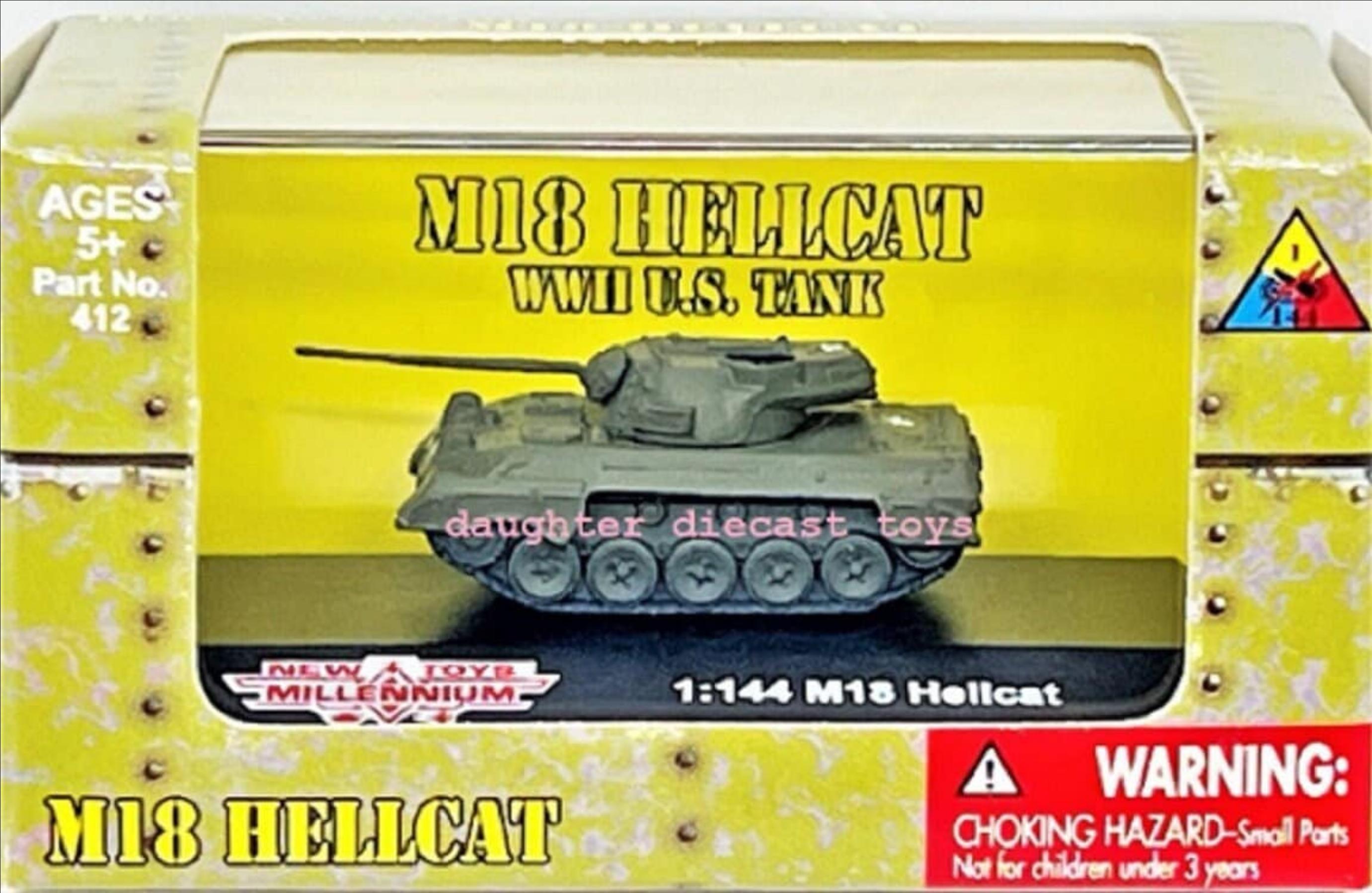
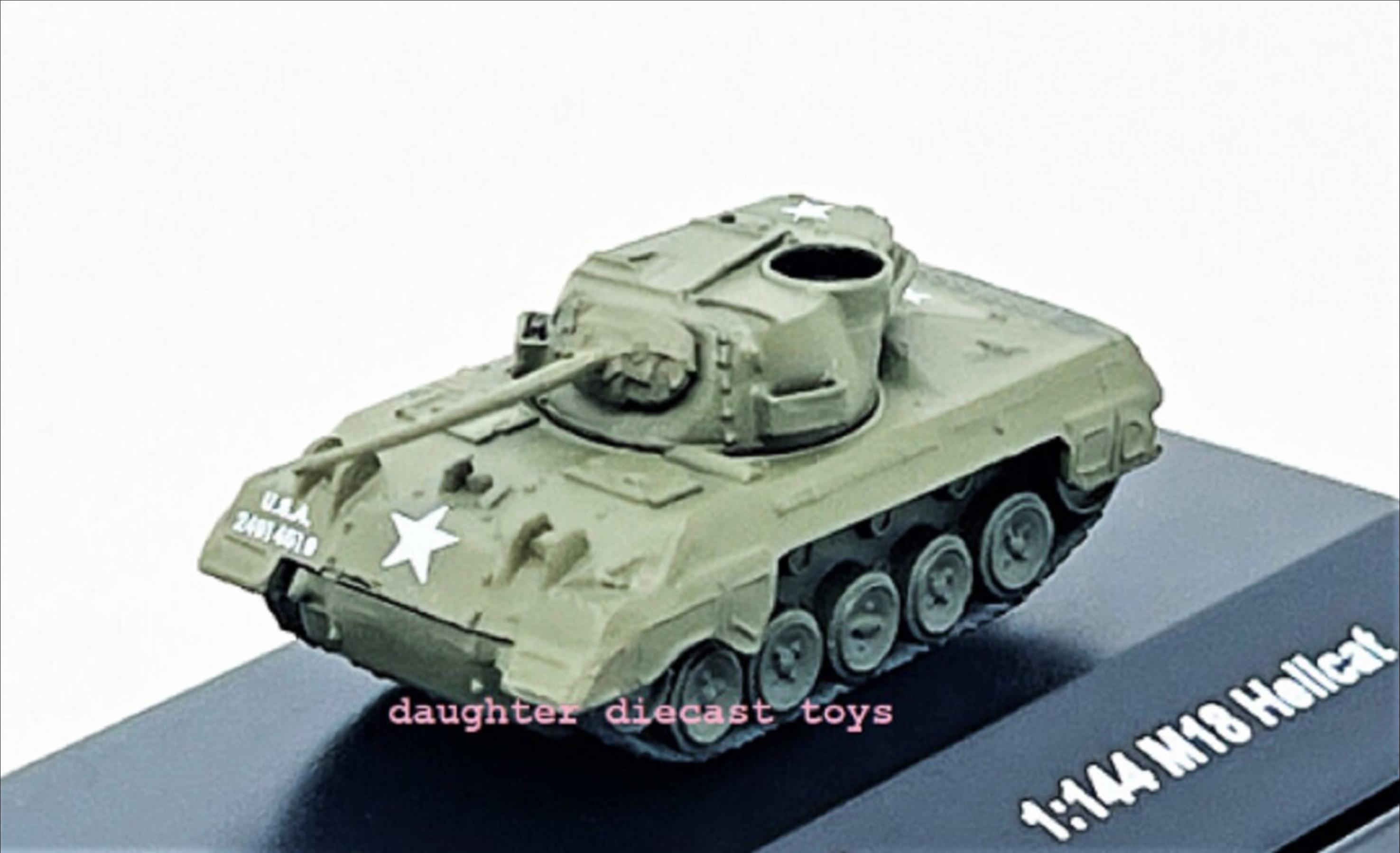
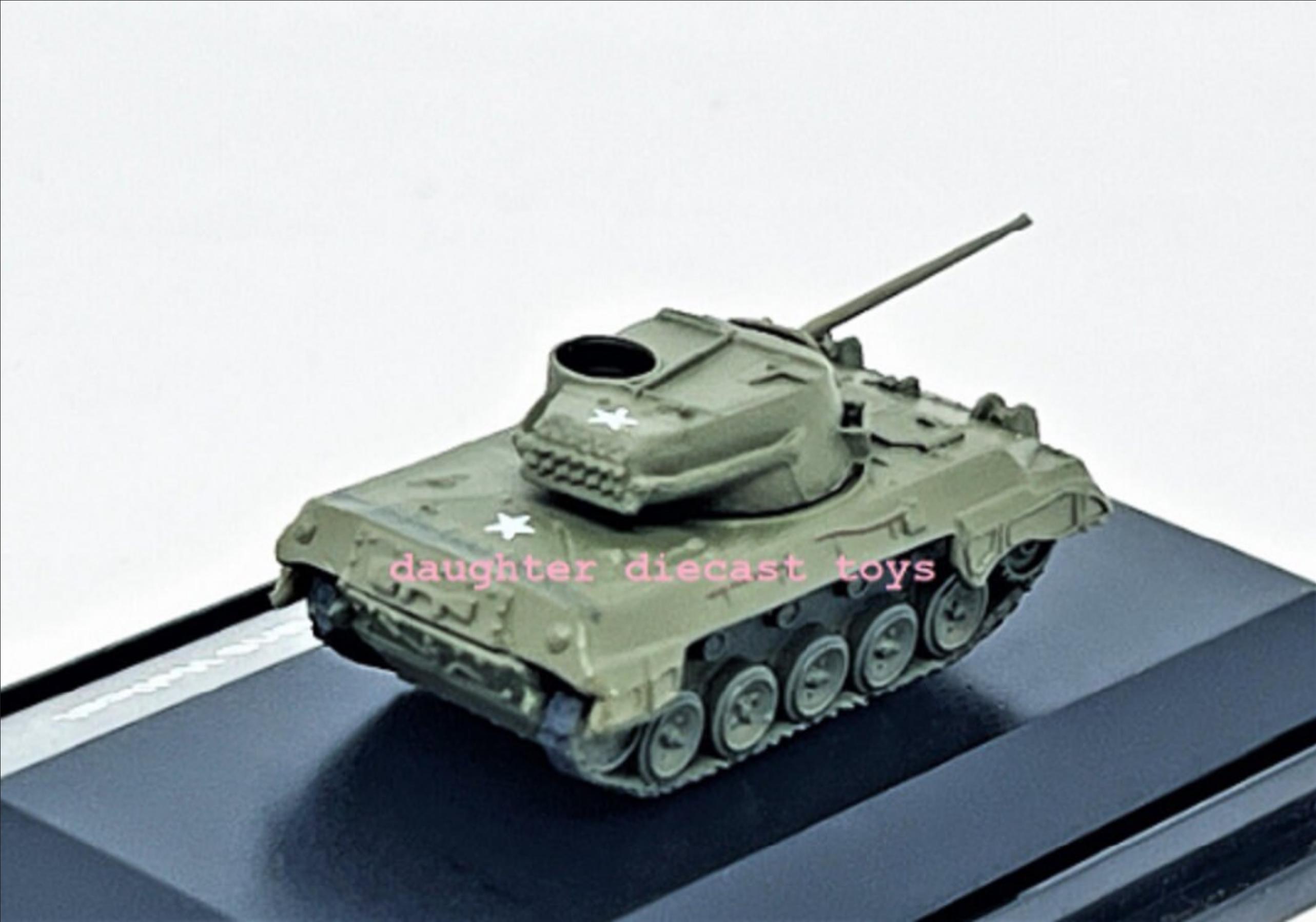

WWII Army M18 TANK 1:144 Scale-Intricate mini-replica in Pristine Condition! Perfect Gift for Military Diorama Artists & War History Buffs!
$ 9.99

WWII U.S. ARMY M18 HELLCAT TANK 1:144 Scale-Intricate mini-replica-Pristine
Condition! Perfect Gift for Military Diorama Artists/War History Buffs!Awesome! WWII U.S. ARMY M18 HELLCAT TANK. Intricately detailed hard plastic model made by New Millennium Toys. Scale-1:44. Measures 1 1/2"L x 3/4"W x 3 /4"H. Pristine condition never handled or displayed (until today for our listing photos). Comes in factory-sealed box, mounted on display base with clear plastic showcase. Perfect gift for toy/tank collectors, Military diorama artists, war history buffs, and veterans! 100% happiness guaranteed. We ship fast & safe worldwide every day! Read car bio below....
•
•
•FOR A LIMITED TIME
•
•
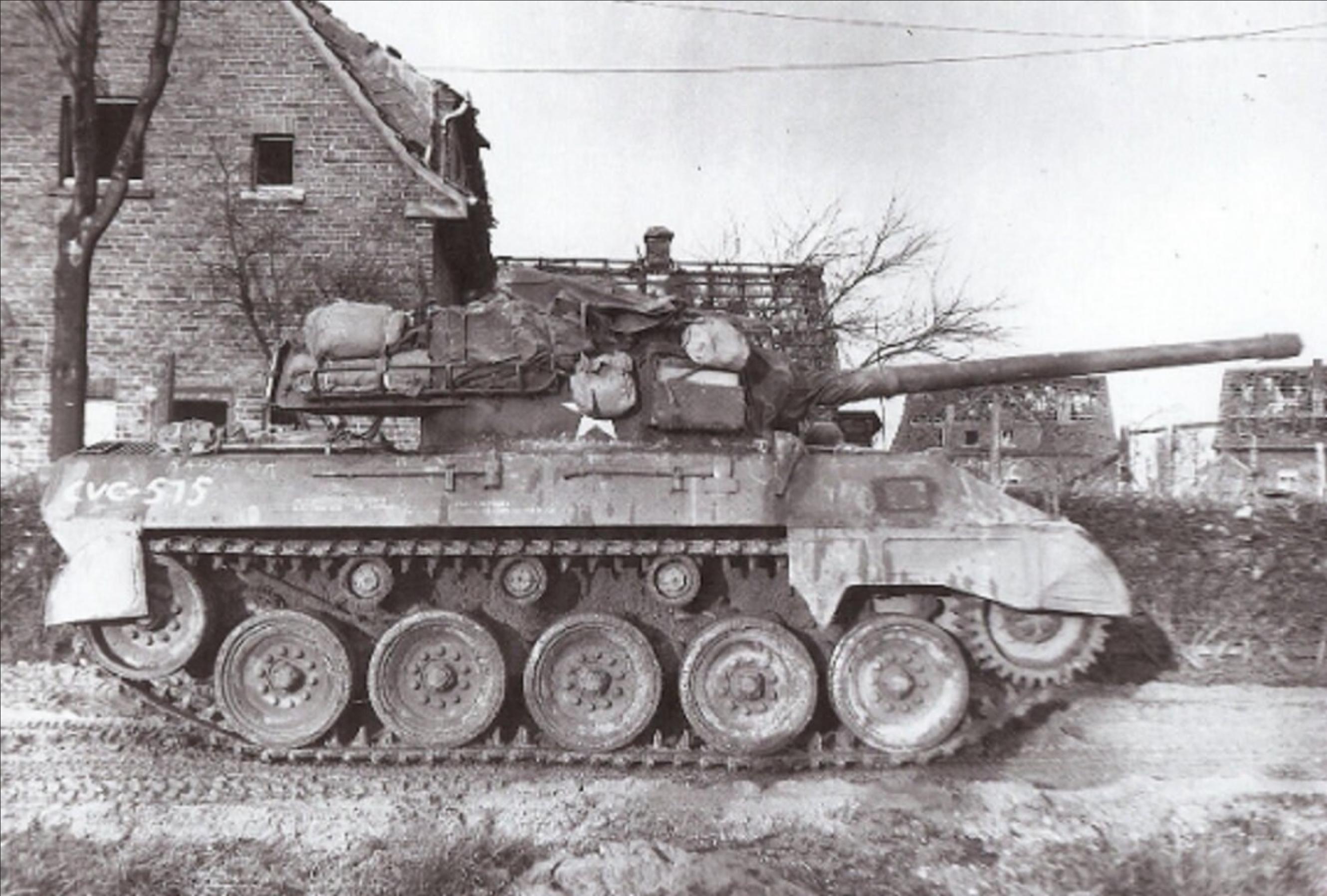
•Purchases totaling $35 and above qualify for FREE shipping to USA! Add more items to your Etsy shopping cart to save $$$.NOTE: My dad owned a Diecast toy store for 30 years. I inherited the store inventory when he passed away many years ago. I am just now, beginning to sell the mint condition vintage models. All are store-inventory is new-old-stock, models have never been "played with". Please visit often-as I adding more cool stuff every day!TANK BIO: WWII U.S. ARMY M18 HELLCATThe M18 Hellcat (officially designated the 76 mm Gun Motor Carriage M18 or M18 GMC) is a tank destroyer that was used by the United States Army in World War II and the Korean War. Despite being equipped with the same main gun as some variants of the much larger Sherman tank, the M18 attained a much higher top speed of up to 55 mph (89 km/h) by keeping armor to a minimum, and using the innovative Torqmatic automatic transmission.The M18 Hellcat was the culmination of the development of various prototypes of fast tank destroyers dating back to 1941. Entering production in summer 1943, the M18 first saw combat service in spring 1944. The M18 served primarily in Western Europe, but was also present in smaller numbers in Italy and the Pacific. Production continued until October 1944, with 2,507 built.The Hellcat was the most effective U.S. tank destroyer of World War II. It had a higher kill-to-loss ratio than any other tank or tank destroyer fielded by U.S. forces in World War II.[8][9] Kills claimed were 526 in total: 498 in Europe, 17 in Italy, and 11 in the Pacific. The kills-to-losses ratio for Europe was 2.3 to 1, and the overall kill to loss ratio was 2.4 to 1.[10] M18s were "...not primarily used for tank fighting, but were committed more often to improvised roles, usually direct fire support for infantry."[11] Although the M18 was retired from U.S. service immediately after the end of World War II, a variant, the M39 Armored Utility Vehicle, served in the Korean War, and M18s continued in service with some countries until 1995.The M18 Hellcat was an example of the balancing act between firepower, armor, and mobility in armored fighting vehicle design. Despite its excellent mobility and reasonably powerful main gun, the M18 Hellcat also had drawbacks, including thin armor and a poor high explosive shell for its main gun. Historian Steven J. Zaloga characterized the overall design of the M18 as "poorly balanced" and stated that "the Hellcat's combat record is attributable to the training and dedication of its crews, not to its ill-conceived design."OPERATIONAL HISTORY: European TheaterInitial combat in Italy. Five T70 prototypes were sent to Italy in the spring of 1944 for testing and saw combat during the breakout from the Anzio beachhead with the 601st (two) and 894th Tank Destroyer Battalions (three). The 894th employed them in the battalion's Reconnaissance Company because of their high speed. In addition to the vehicle's speed, battalion members were also impressed with the power of the 76 mm gun, but were less complimentary of the T70's thin armor and small internal volume, which they felt affected crew confidence in battle, and made living inside the vehicle and handling main gun ammunition awkward, respectively.[42] The 805th Tank Destroyer Battalion, originally a towed gun unit, re-equipped with the M18 during the summer of 1944; it was the only battalion in the Italian campaign to be fully equipped with the M18.Combat in Europe In January 1944, General Omar Bradley, commander of the First U.S. Army, refused the new M18s when he was first offered them; his older tank destroyer battalions in England had been equipped with the M10 tank destroyer for some time, and he was more interested in the development of the M36 tank destroyer than he was in the M18. As a result, the three M18 battalions initially shipped to England (the 603rd, 704th, and 705th) were assigned to General George S. Patton's Third U.S. Army.[43]On 19 September 1944, near Arracourt, France, across the Moselle from Nancy, the 704th Tank Destroyer Battalion was attached to the 4th Armored Division. Lieutenant Edwin Leiper led an M18 platoon of Company C to Réchicourt-la-Petite, on the way to Moncourt. He saw a German tank gun muzzle appearing out of the fog 30 feet away, and deployed his platoon. In a five-minute period, five German tanks of the 113th Panzer Brigade were knocked out for the loss of one M18. The platoon continued to fire and destroyed ten more German tanks while losing another two M18s. One of the platoon's M18s commanded by Sgt. Henry R. Hartman knocked out six of the German tanks, most of which were the much-feared Panther.[44] By the time the Battle of Arracourt ended three days later, the 704th Tank Destroyer Battalion had knocked out 39 German tanks, for the loss of four M18s destroyed and three more damaged.[45]The M18 Hellcat was a key element during the Battle of the Bulge.[46] On December 19–20, Team Desobry, a battalion-sized tank-infantry task force of the 10th Armored Division was assigned to defend Noville located north-northeast of both Foy and of Bastogne, just 4.36 mi (7.02 km) away. With just four[8] M18 tank destroyers of the 705th Tank Destroyer Battalion to assist, the paratroopers of 1st Battalion of the 506th Parachute Infantry Regiment attacked units of the 2nd Panzer Division, whose mission was to proceed by secondary roads via Monaville (just northwest of Bastogne) to seize a key highway and capture, among other objectives, fuel dumps—for the lack of which the overall German counter-offensive faltered and failed. Worried about the threat to their left flank in Bastogne, the Americans organized a major joint arms attack to seize Noville. Team Desobry's high-speed highway journey to reach the blocking position is one of the few documented cases[8] in which the top speed of the M18 Hellcat, 55 mph (89 km/h), was actually used to get ahead of an enemy force.[8]The attack of 1st Battalion and the M18 Hellcat tank destroyers of the 705th TD Battalion near Noville together destroyed at least 30 German tanks and inflicted 500 to 1,000 casualties on the attacking forces, in what amounted to a spoiling attack. A Military Channel historian credited the M18 tank destroyers with 24 kills, including several Tiger tanks, and believes that in part, their ability to "shoot and scoot" at high speed and then reappear elsewhere on the battlefield, confused and slowed the German attack, which finally stalled, leaving the Americans in control of the town overnight.[8]After the Battle of the Bulge, since numbers of the M36 tank destroyer were slow in arriving to the European Theater and towed tank destroyer battalions equipped with the 3-inch Gun M5 had uniformly performed very poorly in the battle when compared to self-propelled units,[47][48] it was decided to re-equip many of them with the "surplus" of M18s that were then in the theater, with the new M36s mostly re-equipping former M10 units.M18 strength in the European Theatre of Operations varied from 146 in June 1944 to a high of 540 in March 1945. Losses totaled 216.Type: Tank destroyer Place of origin: United States Service history In service: 1943–present Wars: World War II,Yugoslav Wars Production history Designer United States Designed 1943 Manufacturer Buick Motor Division of General Motors Unit cost US$55,230 (equivalent to $918,133 in 2022)[2] Produced July 1943—October 1944 No. built 2,507 Specifications ([7]) Mass 37,557 lb (18.779 short tons; 17.036 t) fighting weight, with crew[3] Length 17 ft 4 in (5.28 m) hull only 21 ft 10 in (6.65 m) including gun barrel overhang Width 9 ft 5 in (2.87 m) Height 8 ft 5 in (2.57 m) over antiaircraft machine gun Crew 5 (Commander, gunner, loader, driver, assistant driver) Armor 4.8–25.4 mm (0.19–1.00 in) Main armament 76 mm gun M1A1, M1A1C, or M1A2 in Mount M1 45 rounds[4] Secondary armament .50 caliber (12.7 mm) Browning M2HB machine gun 800 rounds[4] Engine Continental R975-C1 350 hp (260 kW) at 2,400 rpm[5] Continental R975-C4 400 hp (300 kW) at 2,400 rpm[5] Power/weight 19.8–22.6 hp (14.8–16.9 kW)/tonne Transmission 900T Torqmatic automatic transmission 3 speeds forward, 1 reverse Suspension Torsion bar Fuel capacity 165 US gal (620 L)[4] Operational range 100 mi (160 km) on road Maximum speed 55 mph (89 km/h) on road[6] 26 mph (42 km/h) off road
Condition! Perfect Gift for Military Diorama Artists/War History Buffs!Awesome! WWII U.S. ARMY M18 HELLCAT TANK. Intricately detailed hard plastic model made by New Millennium Toys. Scale-1:44. Measures 1 1/2"L x 3/4"W x 3 /4"H. Pristine condition never handled or displayed (until today for our listing photos). Comes in factory-sealed box, mounted on display base with clear plastic showcase. Perfect gift for toy/tank collectors, Military diorama artists, war history buffs, and veterans! 100% happiness guaranteed. We ship fast & safe worldwide every day! Read car bio below....
•
•
•FOR A LIMITED TIME
•
•
•Purchases totaling $35 and above qualify for FREE shipping to USA! Add more items to your Etsy shopping cart to save $$$.NOTE: My dad owned a Diecast toy store for 30 years. I inherited the store inventory when he passed away many years ago. I am just now, beginning to sell the mint condition vintage models. All are store-inventory is new-old-stock, models have never been "played with". Please visit often-as I adding more cool stuff every day!TANK BIO: WWII U.S. ARMY M18 HELLCATThe M18 Hellcat (officially designated the 76 mm Gun Motor Carriage M18 or M18 GMC) is a tank destroyer that was used by the United States Army in World War II and the Korean War. Despite being equipped with the same main gun as some variants of the much larger Sherman tank, the M18 attained a much higher top speed of up to 55 mph (89 km/h) by keeping armor to a minimum, and using the innovative Torqmatic automatic transmission.The M18 Hellcat was the culmination of the development of various prototypes of fast tank destroyers dating back to 1941. Entering production in summer 1943, the M18 first saw combat service in spring 1944. The M18 served primarily in Western Europe, but was also present in smaller numbers in Italy and the Pacific. Production continued until October 1944, with 2,507 built.The Hellcat was the most effective U.S. tank destroyer of World War II. It had a higher kill-to-loss ratio than any other tank or tank destroyer fielded by U.S. forces in World War II.[8][9] Kills claimed were 526 in total: 498 in Europe, 17 in Italy, and 11 in the Pacific. The kills-to-losses ratio for Europe was 2.3 to 1, and the overall kill to loss ratio was 2.4 to 1.[10] M18s were "...not primarily used for tank fighting, but were committed more often to improvised roles, usually direct fire support for infantry."[11] Although the M18 was retired from U.S. service immediately after the end of World War II, a variant, the M39 Armored Utility Vehicle, served in the Korean War, and M18s continued in service with some countries until 1995.The M18 Hellcat was an example of the balancing act between firepower, armor, and mobility in armored fighting vehicle design. Despite its excellent mobility and reasonably powerful main gun, the M18 Hellcat also had drawbacks, including thin armor and a poor high explosive shell for its main gun. Historian Steven J. Zaloga characterized the overall design of the M18 as "poorly balanced" and stated that "the Hellcat's combat record is attributable to the training and dedication of its crews, not to its ill-conceived design."OPERATIONAL HISTORY: European TheaterInitial combat in Italy. Five T70 prototypes were sent to Italy in the spring of 1944 for testing and saw combat during the breakout from the Anzio beachhead with the 601st (two) and 894th Tank Destroyer Battalions (three). The 894th employed them in the battalion's Reconnaissance Company because of their high speed. In addition to the vehicle's speed, battalion members were also impressed with the power of the 76 mm gun, but were less complimentary of the T70's thin armor and small internal volume, which they felt affected crew confidence in battle, and made living inside the vehicle and handling main gun ammunition awkward, respectively.[42] The 805th Tank Destroyer Battalion, originally a towed gun unit, re-equipped with the M18 during the summer of 1944; it was the only battalion in the Italian campaign to be fully equipped with the M18.Combat in Europe In January 1944, General Omar Bradley, commander of the First U.S. Army, refused the new M18s when he was first offered them; his older tank destroyer battalions in England had been equipped with the M10 tank destroyer for some time, and he was more interested in the development of the M36 tank destroyer than he was in the M18. As a result, the three M18 battalions initially shipped to England (the 603rd, 704th, and 705th) were assigned to General George S. Patton's Third U.S. Army.[43]On 19 September 1944, near Arracourt, France, across the Moselle from Nancy, the 704th Tank Destroyer Battalion was attached to the 4th Armored Division. Lieutenant Edwin Leiper led an M18 platoon of Company C to Réchicourt-la-Petite, on the way to Moncourt. He saw a German tank gun muzzle appearing out of the fog 30 feet away, and deployed his platoon. In a five-minute period, five German tanks of the 113th Panzer Brigade were knocked out for the loss of one M18. The platoon continued to fire and destroyed ten more German tanks while losing another two M18s. One of the platoon's M18s commanded by Sgt. Henry R. Hartman knocked out six of the German tanks, most of which were the much-feared Panther.[44] By the time the Battle of Arracourt ended three days later, the 704th Tank Destroyer Battalion had knocked out 39 German tanks, for the loss of four M18s destroyed and three more damaged.[45]The M18 Hellcat was a key element during the Battle of the Bulge.[46] On December 19–20, Team Desobry, a battalion-sized tank-infantry task force of the 10th Armored Division was assigned to defend Noville located north-northeast of both Foy and of Bastogne, just 4.36 mi (7.02 km) away. With just four[8] M18 tank destroyers of the 705th Tank Destroyer Battalion to assist, the paratroopers of 1st Battalion of the 506th Parachute Infantry Regiment attacked units of the 2nd Panzer Division, whose mission was to proceed by secondary roads via Monaville (just northwest of Bastogne) to seize a key highway and capture, among other objectives, fuel dumps—for the lack of which the overall German counter-offensive faltered and failed. Worried about the threat to their left flank in Bastogne, the Americans organized a major joint arms attack to seize Noville. Team Desobry's high-speed highway journey to reach the blocking position is one of the few documented cases[8] in which the top speed of the M18 Hellcat, 55 mph (89 km/h), was actually used to get ahead of an enemy force.[8]The attack of 1st Battalion and the M18 Hellcat tank destroyers of the 705th TD Battalion near Noville together destroyed at least 30 German tanks and inflicted 500 to 1,000 casualties on the attacking forces, in what amounted to a spoiling attack. A Military Channel historian credited the M18 tank destroyers with 24 kills, including several Tiger tanks, and believes that in part, their ability to "shoot and scoot" at high speed and then reappear elsewhere on the battlefield, confused and slowed the German attack, which finally stalled, leaving the Americans in control of the town overnight.[8]After the Battle of the Bulge, since numbers of the M36 tank destroyer were slow in arriving to the European Theater and towed tank destroyer battalions equipped with the 3-inch Gun M5 had uniformly performed very poorly in the battle when compared to self-propelled units,[47][48] it was decided to re-equip many of them with the "surplus" of M18s that were then in the theater, with the new M36s mostly re-equipping former M10 units.M18 strength in the European Theatre of Operations varied from 146 in June 1944 to a high of 540 in March 1945. Losses totaled 216.Type: Tank destroyer Place of origin: United States Service history In service: 1943–present Wars: World War II,Yugoslav Wars Production history Designer United States Designed 1943 Manufacturer Buick Motor Division of General Motors Unit cost US$55,230 (equivalent to $918,133 in 2022)[2] Produced July 1943—October 1944 No. built 2,507 Specifications ([7]) Mass 37,557 lb (18.779 short tons; 17.036 t) fighting weight, with crew[3] Length 17 ft 4 in (5.28 m) hull only 21 ft 10 in (6.65 m) including gun barrel overhang Width 9 ft 5 in (2.87 m) Height 8 ft 5 in (2.57 m) over antiaircraft machine gun Crew 5 (Commander, gunner, loader, driver, assistant driver) Armor 4.8–25.4 mm (0.19–1.00 in) Main armament 76 mm gun M1A1, M1A1C, or M1A2 in Mount M1 45 rounds[4] Secondary armament .50 caliber (12.7 mm) Browning M2HB machine gun 800 rounds[4] Engine Continental R975-C1 350 hp (260 kW) at 2,400 rpm[5] Continental R975-C4 400 hp (300 kW) at 2,400 rpm[5] Power/weight 19.8–22.6 hp (14.8–16.9 kW)/tonne Transmission 900T Torqmatic automatic transmission 3 speeds forward, 1 reverse Suspension Torsion bar Fuel capacity 165 US gal (620 L)[4] Operational range 100 mi (160 km) on road Maximum speed 55 mph (89 km/h) on road[6] 26 mph (42 km/h) off road
Other Products