
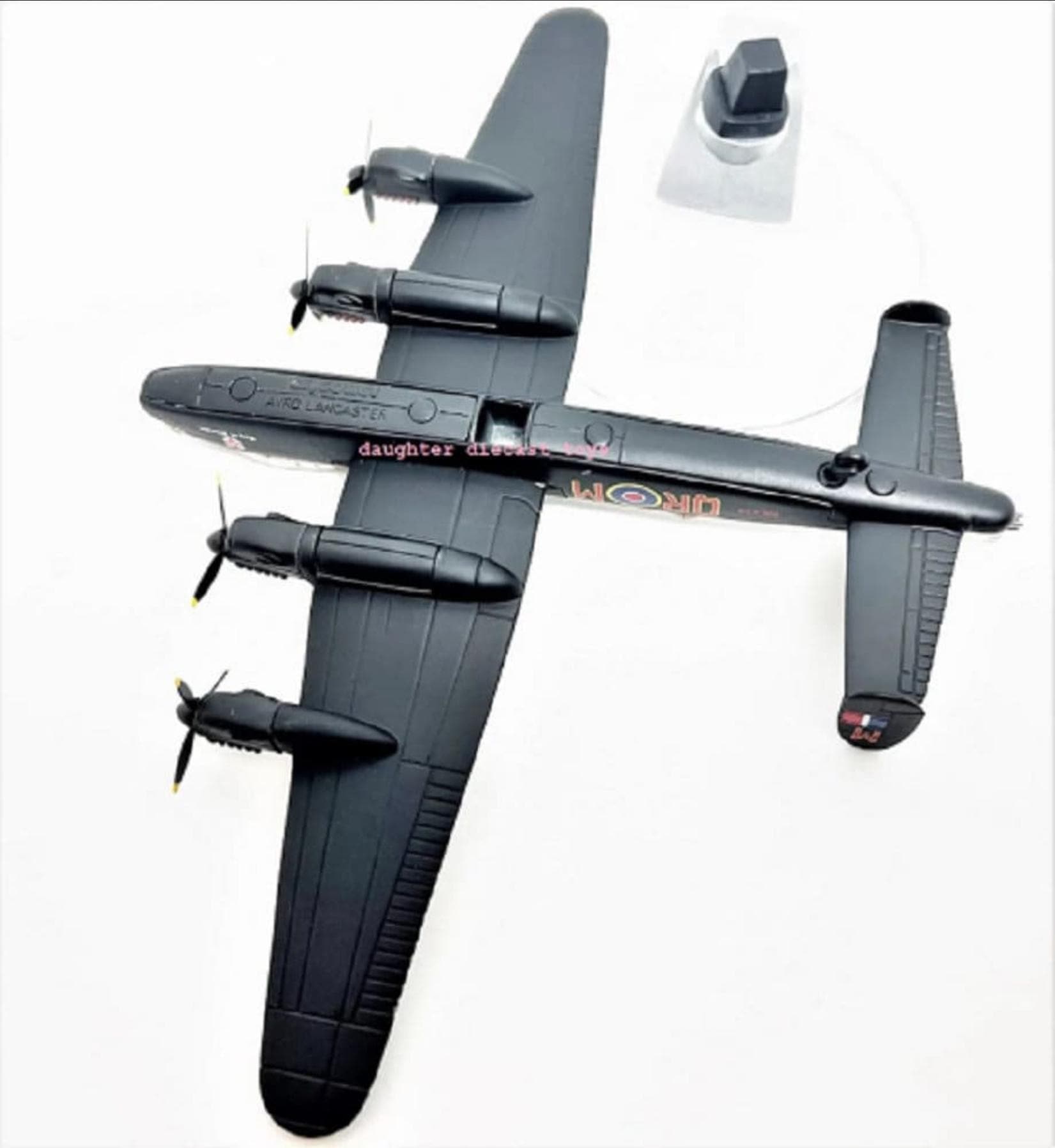

W.W.II BOMBER-LARGE 8.5" Wingspan-Adult Collector/Diecast Metal Airplane w/Stand-Pristine Condition! Corgi Toys-Perfect Gift for Collectors!
$ 149.99

W.W.II BOMBER-LARGE 8.5" Wingspan-Adult Collector/Diecast Metal Airplane
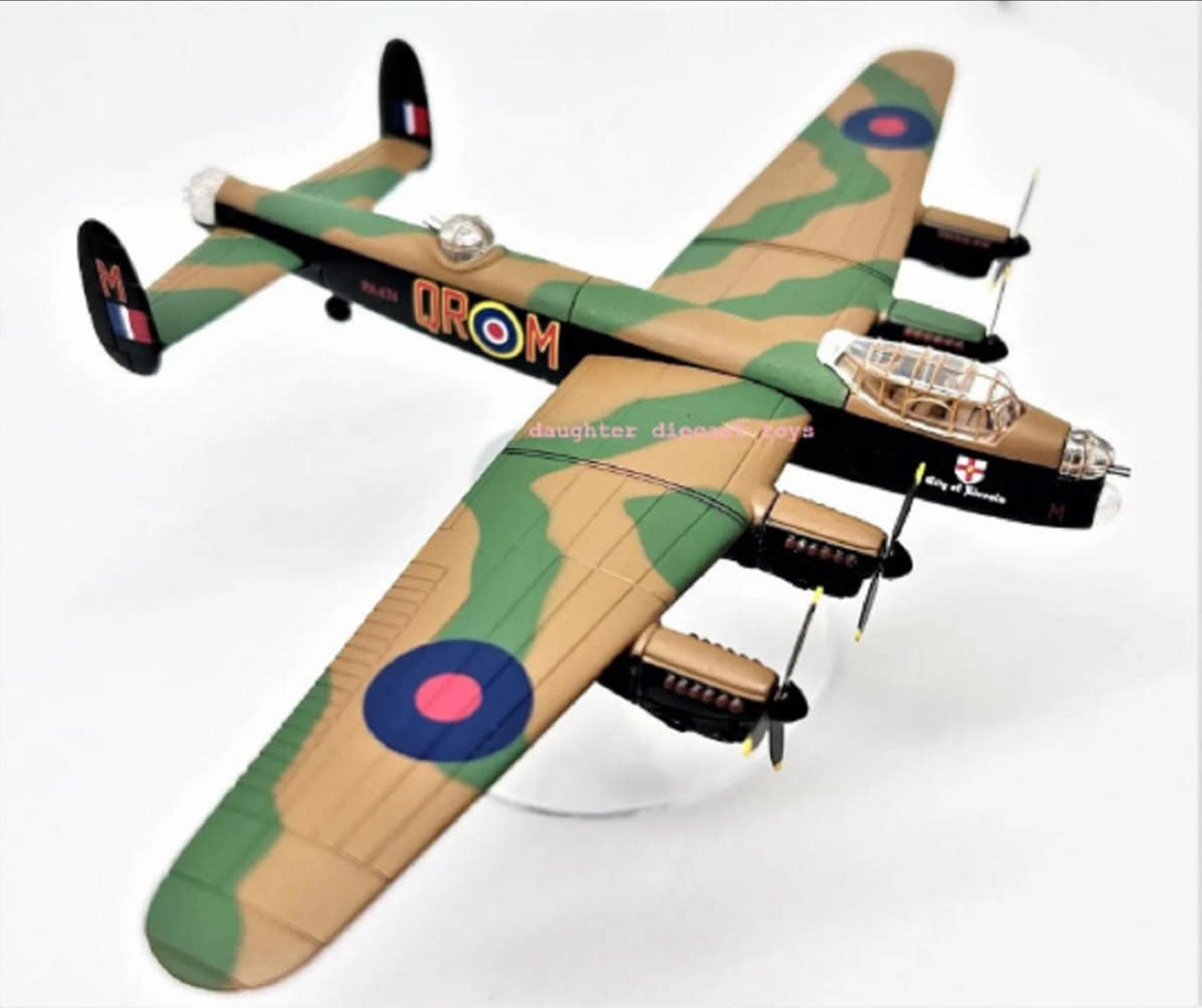
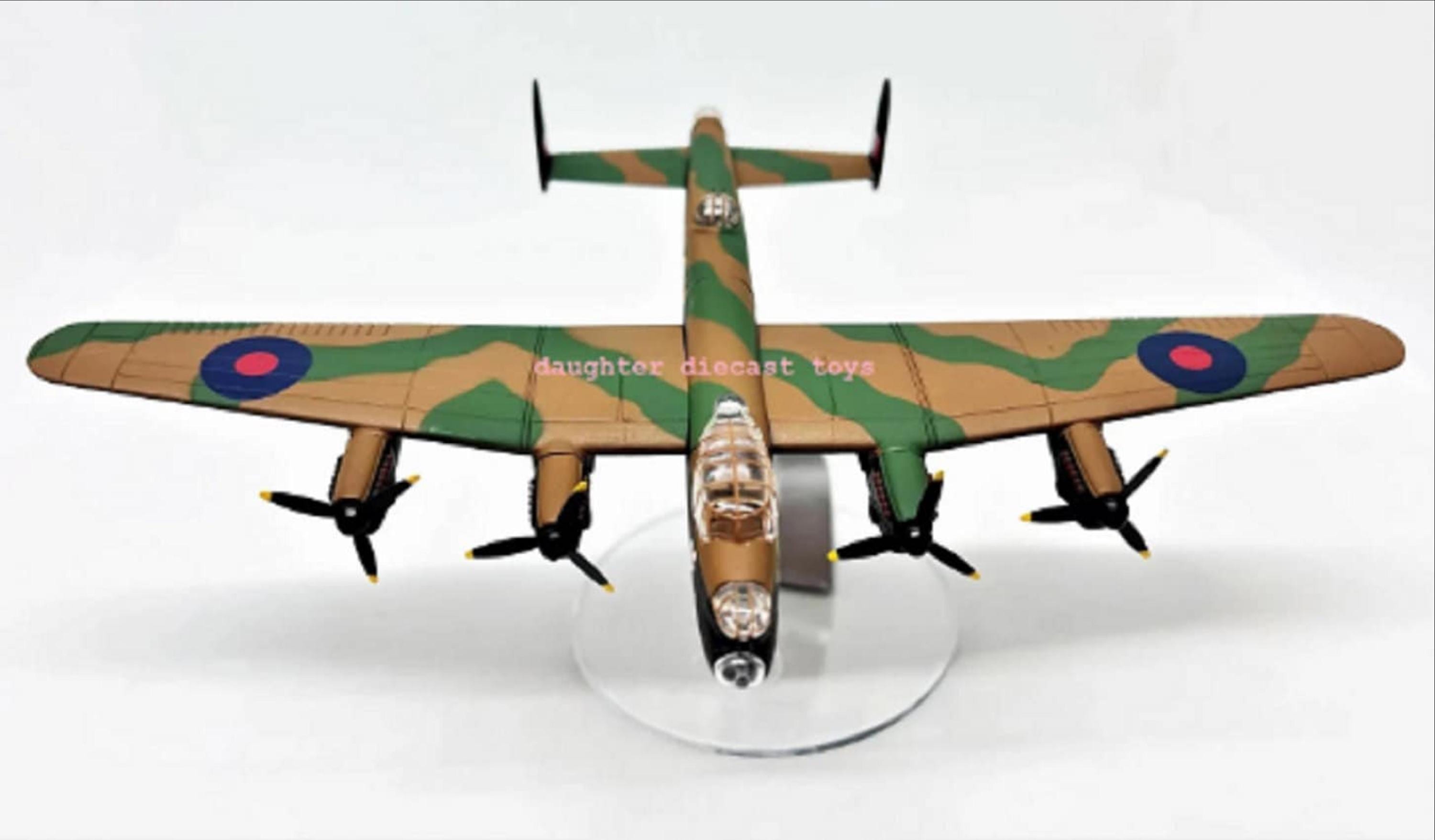
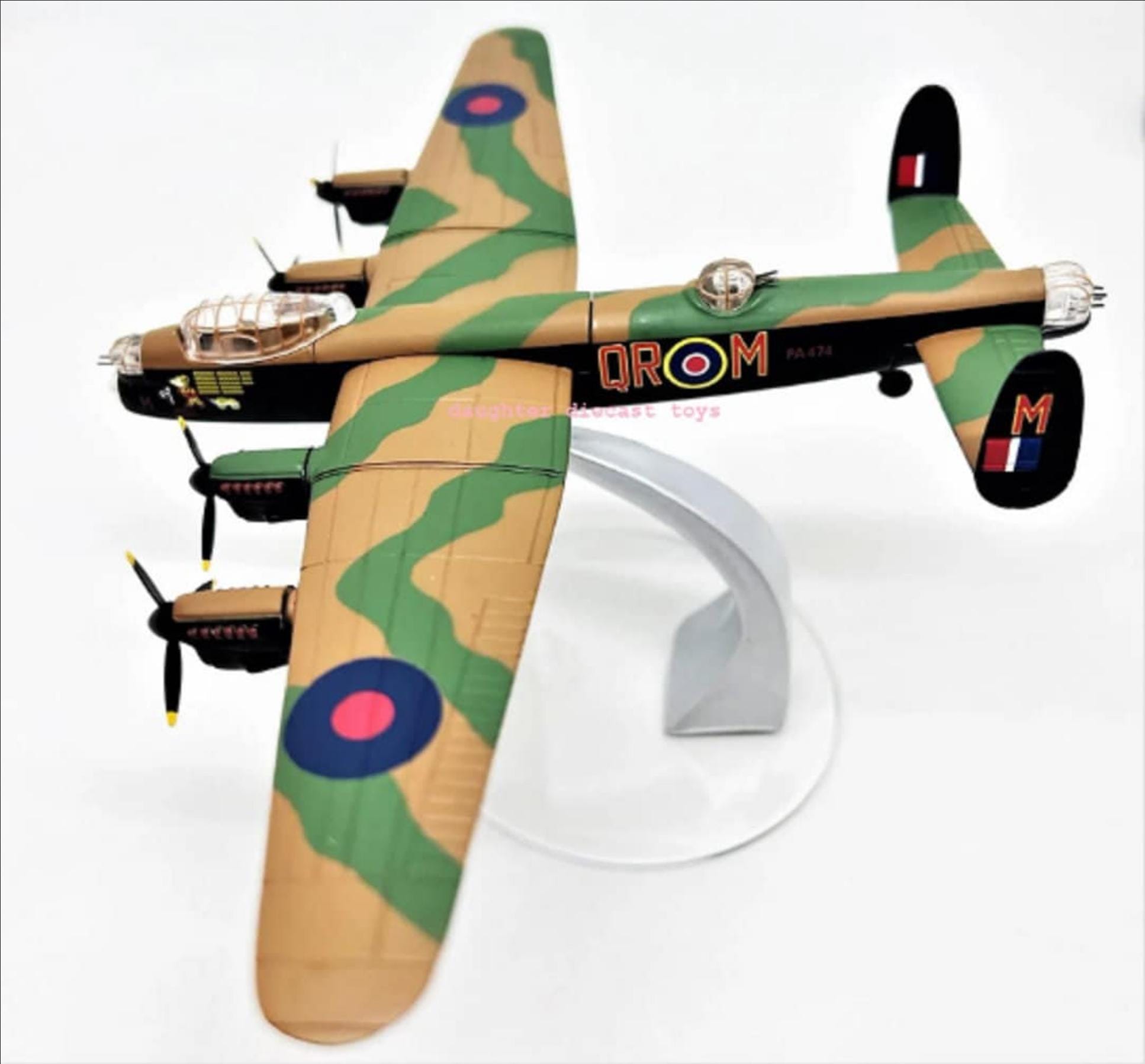
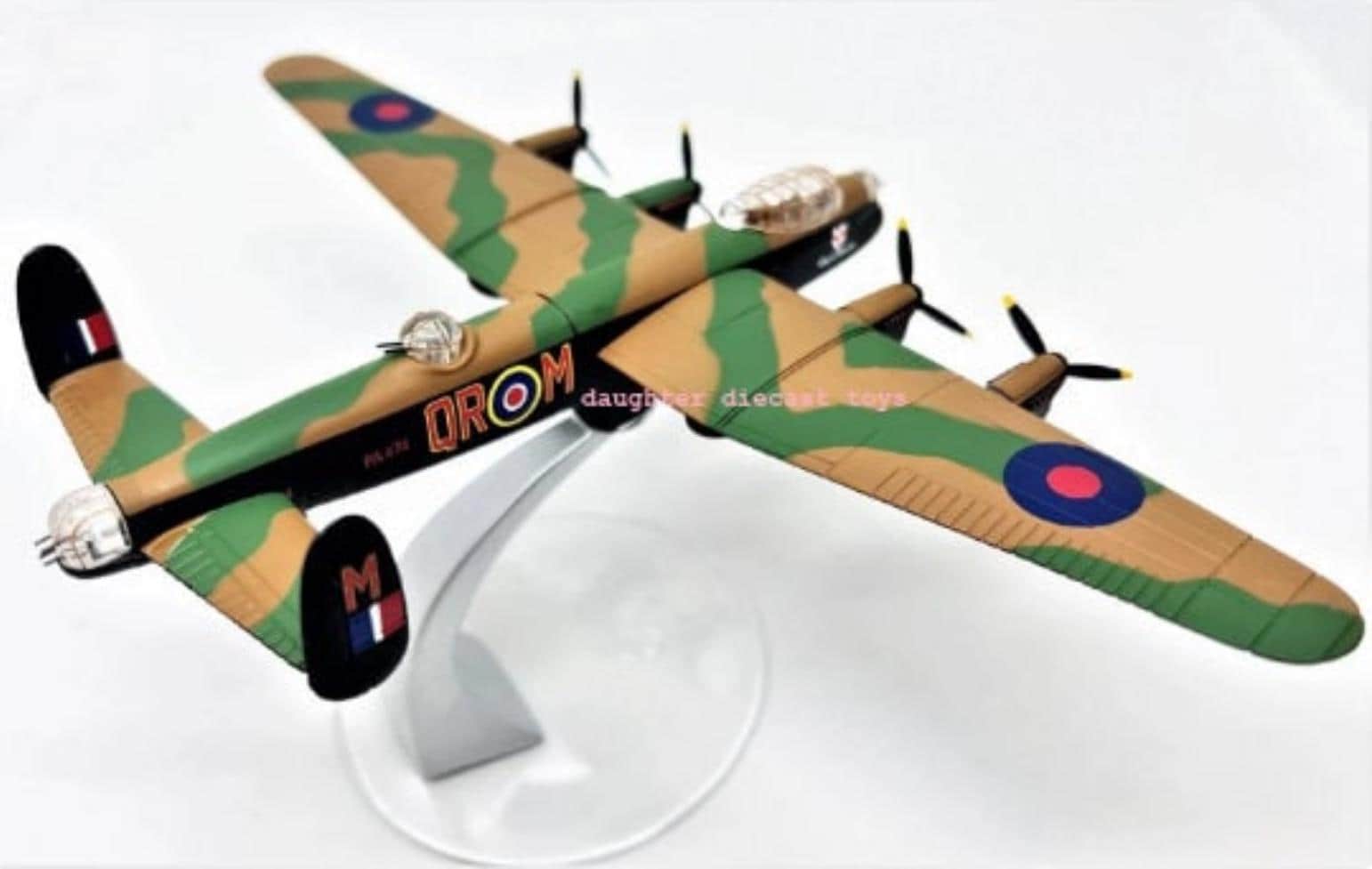
w/Stand-Pristine Condition! Corgi Toys-Perfect Gift for Collectors!Gorgeous! AVRO LANCASTER HEAVY BOMBER , WWII AIRPLANE with Stand. Premium quality/Adult Collector, highly-detailed, hard to find model! Heavy (weighty) constructed of die cast metal. Measures 6"L x 8 1/2"W x 4 1/2 "H (mounted). Pristine condition-sold loose in protective clamshell. The ultimate gift for Corgi, vintage aircraft lovers, and vintage toy collectors! FREE shipping to anywhere in the continental USA. 100% happiness guaranteed. Read plane bio below....Note: My dad owned a Diecast toy store for 30 years. I inherited the store inventory when he passed away several years ago. I am (just now) able to bring myself to begin selling his cars-so they can be shared with the world. All pristine and mint condition vintage models will (eventually) be listed here on ETSY. All the inventory is NEW (vintage) merchandise-which was intended for retail sale. Please know-our diecast toys have NEVER been "played-with” we do not sell used, or damaged toys.
•
•
•FOR A LIMITED TIME
•
•
•Purchases totaling $35 and above qualify for FREE shipping to USA! Add more items to your Etsy shopping cart to save $$$.AIRCRAFT BIO:The Avro Lancaster is a British Second World War heavy bomber. It was designed and manufactured by Avro as a contemporary of the Handley Page Halifax, both bombers having been developed to the same specification, as well as the Short Stirling, all three aircraft being four-engined heavy bombers adopted by the Royal Air Force (RAF) during the same wartime era.The Lancaster has its origins in the twin-engine Avro Manchester which had been developed during the late 1930s in response to the Air Ministry Specification P.13/36 for a medium bomber for "world-wide use" which could carry a torpedo internally, and make shallow dive bombing attacks. Originally developed as an evolution of the Manchester (which had proved troublesome in service and was retired in 1942), the Lancaster was designed by Roy Chadwick and powered by four Rolls-Royce Merlins and in one of the versions, Bristol Hercules engines. It first saw service with RAF Bomber Command in 1942 and as the strategic bombing offensive over Europe gathered momentum, it was the main aircraft for the night-time bombing campaigns that followed. As increasing numbers of the type were produced, it became the principal heavy bomber used by the RAF, the Royal Canadian Air Force (RCAF) and squadrons from other Commonwealth and European countries serving within the RAF, overshadowing the Halifax and Stirling, two other commonly used bombers[2]A long, unobstructed bomb bay meant that the Lancaster could take the largest bombs used by the RAF, including the 4,000 lb (1,800 kg), 8,000 lb (3,600 kg) and 12,000 lb (5,400 kg) blockbusters, loads often supplemented with smaller bombs or incendiaries. The "Lanc", as it was known colloquially,[3] became one of the most heavily used of the Second World War night bombers, "delivering 608,612 long tons (618,378,000 kg) of bombs in 156,000 sorties".[4] The versatility of the Lancaster was such that it was chosen to equip 617 Squadron and was modified to carry the Upkeep "bouncing bomb" designed by Barnes Wallis for Operation Chastise, the attack on German Ruhr valley dams. Although the Lancaster was primarily a night bomber, it excelled in many other roles, including daylight precision bombing, for which some Lancasters were adapted to carry the 12,000 lb (5,400 kg) Tallboy and then the 22,000 lb (10,000 kg) Grand Slam earthquake bombs (also designed by Wallis).[5] This was the largest payload of any bomber in the war.In 1943, a Lancaster was converted to become an engine test bed for the Metropolitan-Vickers F.2 turbojet. Lancasters were later used to test other engines, including the Armstrong Siddeley Mamba and Rolls-Royce Dart turboprops and the Avro Canada Orenda and STAL Dovern turbojets. Postwar, the Lancaster was supplanted as the main strategic bomber of the RAF by the Avro Lincoln, a larger version of the Lancaster. The Lancaster took on the role of long range anti-submarine patrol aircraft (later supplanted by the Avro Shackleton) and air-sea rescue. It was also used for photo-reconnaissance and aerial mapping, as a flying tanker for aerial refuelling and as the Avro Lancastrian, a long-range, high-speed, transatlantic passenger and postal delivery airliner. In March 1946, a Lancastrian of BSAA flew the first scheduled flight from the new London Heathrow Airport.[6]Armament Defensive armament The Avro Lancaster was initially equipped with four Nash & Thompson Frazer Nash hydraulically operated turrets mounted in the nose, tail, mid-upper and underside. The original tail turret was equipped with four Browning .303 Mark II machine guns and all other turrets with two such machine guns.[34][35][36]Late on in the war, Freeman Dyson (as a 19 year old who had yet to win a degree) put forward a case for the removal of the majority of the Lancaster's defensive armament. He argued that this would reduce the loss rate by increasing the Lancaster's cruising speed by up to 50 mph (80 km/h) (assuming the bomb load was not increased), making the bomber harder to intercept.[37] He also claimed reducing defensive air gunners would reduce human losses incurred with each aircraft lost.[38] However this neglects the fact that the two main Luftwaffe night fighters of the time, the Messerschmitt Bf 110 and the Junkers Ju 88 night fighters were capable of over 300 mph (480 km/h), thus a 50 mph (80 km/h) increase over the Lancaster's normal cruising speed of around 180 mph (290 km/h), giving a speed of 230 mph (370 km/h), still left the Lancaster vulnerable to interception. The introduction of the Heinkel He 219 and Messerschmitt Me 262 night fighters erased any speed advantage and would have left the aircraft undefended. Consequently Dyson's proposal was not adopted. Nose turret Mk.X nose with twin .303 Brownings in turret over bomb-aimer's position Nose turret from above, and bomber aimer's stationOnly the FN-5A[34] nose turret which was similar to the FN-5 used on the preceding Avro Manchester, the Vickers Wellington and the Short Stirling remained unchanged during the life of the design, except in instances where it was removed entirely. Ventral turretThe ventral (underside) FN-64 turret quickly proved to be dead weight, being both difficult to sight because it relied on a periscope which limited the gunner's view to a 20-degree arc,[34] and too slow to keep a target within its sights.[note 3] Aside from early B.Is and the prototype B.IIs, the FN-64 was almost never used. When the Luftwaffe began using Schräge Musik to make attacks from below in the winter of 1943/1944, modifications were made, including downward observation blisters mounted behind the bomb aimer's blister[39] and official[40] and unofficial mounts for .50 in (12.7 mm) machine guns or even 20 mm (0.79 in) cannon, firing through the ventral holes of the removed FN-64. The fitting of these guns was hampered as the same ventral position was used for mounting the H2S blister, which limited installations to those aircraft fitted with bulged bomb bays which interfered with the H2S.[34] Mid-upper turret Gunner in Fraser Nash FN50 mid-upper turret with twin .303 Brownings, February 1943The mid-upper (dorsal or top) turret was an FN-50[34][35] on early examples and the very similar FN-150 with improved sights and controls[34] on later examples. On all but the earliest examples this turret was surrounded by a coaming which provided a track for a cam-operated interruptor device which prevented the gunner from shooting the tail of his own aircraft.[34] The Mk.VII and late Mk.X Lancasters used the heavier, electrically-controlled Martin 250 CE 23A turret equipped with two .50 in (13 mm) machine guns[34] which was mounted further forward to preserve the aircraft's longitudinal balance, and because it had an internal mechanism to prevent firing on the aircraft itself, it did not require a coaming.[note 4][34] Other experimental turrets were tried out, including the FN-79 and the Boulton-Paul Type H barbette system.[34] Tail turret Gunner in the Nash & Thompson FN20 tail turret The Rose turretThe tail turret was the most important defensive position and carried the heaviest armament. Despite this, the turrets used, starting with the FN-20, were never entirely satisfactory and numerous designs were tried. The FN-20 was replaced by the very similar FN-120 which used an improved gyroscopic gun sight (GGS).[34] Many rear gunners insisted on having the centre section of perspex removed from the turret to improve visibility. The transparencies were difficult to see through at night, particularly when trying to keep watch for enemy night fighters that appeared without notice astern and below the aircraft when getting into position to open fire. This removal of perspex from the turret was called the "Gransden Lodge" modification. Ammunition for the tail turret was 2,500 rounds per gun. Due to the weight, the ammunition was stored in tanks situated near the mid-upper turret's position and fed rearward in runways down the back of the fuselage to the turret.[41]Gunners using both the FN-20 and 120 removed perspex and armour from the turret to improve visibility, but trials by the RAF showed that a Mosquito night fighter was still able to get within a very short distance of the tail gunner without being spotted, confirming what the Luftwaffe had already realised. The Rose turret attempted to improve on the FN turrets by being completely open to the rear (improving visibility and allowing easier emergency egress) and by being fitted with two .50 in (13 mm) machine guns. It was installed in a small number of Lancasters but never became common.[34]Ultimately radar, rather than improved visibility, made the turret more effective. The FN-121 was the Automatic Gun Laying Turret (AGLT), an FN-120 fitted with Village Inn gun-laying radar.[34] Aircraft fitted with Village Inn were used as bait, flying behind the main formations to confront the night fighters that followed the formations and shot down stragglers. This significantly reduced operational losses; and gun-laying radar was added to the last versions of the turret. Before the end of the war Lancasters built in the UK standardised on the FN-82 fitted with two .50 in (13 mm) machine guns and fitted with gun-laying radar as production allowed, which was also used on early models of the Avro Lincoln. The disadvantage of all radar and radio transmitting systems is that attacking forces can locate aircraft by picking up transmissions.[citation needed] Bombs "Abnormal" industrial demolition load of 14 1,000-pound MC (medium capacity) high-explosive bombs "Usual" area bombardment load – a 4,000-pound "Cookie" blast bomb with 12 Small Bomb Containers, each with 236 4-lb incendiary bombs[42]An important feature of the Lancaster was its unobstructed 33 ft (10 m) long bomb bay. At first, the heaviest bomb carried was the 4,000 lb (1,800 kg) high capacity HC "Cookie".[43] Bulged doors were added to 30 per cent of B.Is to allow the aircraft to carry 8,000 lb (3,600 kg) and later 12,000 lb (5,400 kg) "Cookies". The Lancaster also carried a variety of smaller weapons, including the Small Bomb Container (SBC) which held 236 4 lb (1.8 kg) or 24 30 lb (14 kg) incendiary and explosive incendiary bomblets; 500 lb (230 kg) and 1,000 lb (450 kg) General Purpose High Explosive (GP/HE) bombs (these came in a variety of designs); 1,850 lb (840 kg) parachute deployed magnetic or acoustic mines, or 2,000 lb (910 kg) armour-piercing (AP) bombs; 250 lb (110 kg) Semi-Armour-Piercing (SAP) bombs, used up to 1942 against submarines; post 1942: 250 lb (110 kg) or 500 lb (230 kg) anti-submarine depth charges.[citation needed]In 1943, 617 Squadron was created to carry out Operation Chastise, the raid against the Ruhr dams. This unit was equipped with B.III (Specials), officially designated the "Type 464 (Provisioning)", modified to carry the 9,250 lb (4,200 kg) "Upkeep" bouncing bomb.[44][note 5] The bomb bay doors were removed and the ends of the bomb bay were covered with fairings. "Upkeep" was suspended on laterally pivoted, vee-shaped struts which sprang apart beamwise when the bomb-release button was pressed. A drive belt and pulley to rotate the bomb at 500 rpm was mounted on the starboard strut and driven by a hydraulic motor housed in the forward fairing. The mid-upper turret was removed and a more bulbous bomb aimer's blister was fitted; this, as "Mod. 780", later becoming standard on all Lancasters, while the bombsight was replaced by a simple aiming device that consisted of a simple triangle of wood with a peephole at one corner and a nail in each of the other corners such that at the correct distance the nails coincided with the towers on the dams. Because each dam was a different width between the towers, each plane carried two or three different sights.[45][46] Two Aldis lights were fitted in the rear bomb bay fairing, aimed forward so the bomb aimer could see the converging lights below his blister in the nose; the optimum height for dropping "Upkeep" was 60 ft (18 m) and, when shone on the relatively smooth waters of the dam's reservoirs, the light beams converged into a figure 8 when the Lancaster was flying at the correct height.[47][48]After the 'Dam Busters' raid 617 Squadron was converted to a high altitude precision bombing squadron in preparation for the arrival of Barnes Wallis's forthcoming Earthquake bombs for attacking special and hardened targets, and while they were training for this the bouncing bomb variants of B.I Specials had the spars and equipment removed and were then modified to carry the 21 ft (6.4 m) long 12,000 lb (5,400 kg) "Tallboy" bomb, a scaled down version of the upcoming 25.5 ft (7.8 m) long 22,000 lb (10,000 kg) "Grand Slam" "earthquake" bombs which were still being built. Aircraft intended to carry the "Grand Slam" required extensive modifications. These included the removal of the dorsal turret and of two guns from the rear turret, removal of the cockpit armour plating (the pilot's seatback), and installation of Rolls-Royce Merlin Mk 24 engines for better take-off performance. The bomb bay doors were removed and the rear end of the bomb bay cut away to clear the tail of the bomb. Later the nose turret was also removed to further improve performance. A strengthened undercarriage and stronger mainwheels, later used by the Avro Lincoln, were fitted.[5][note 6]
w/Stand-Pristine Condition! Corgi Toys-Perfect Gift for Collectors!Gorgeous! AVRO LANCASTER HEAVY BOMBER , WWII AIRPLANE with Stand. Premium quality/Adult Collector, highly-detailed, hard to find model! Heavy (weighty) constructed of die cast metal. Measures 6"L x 8 1/2"W x 4 1/2 "H (mounted). Pristine condition-sold loose in protective clamshell. The ultimate gift for Corgi, vintage aircraft lovers, and vintage toy collectors! FREE shipping to anywhere in the continental USA. 100% happiness guaranteed. Read plane bio below....Note: My dad owned a Diecast toy store for 30 years. I inherited the store inventory when he passed away several years ago. I am (just now) able to bring myself to begin selling his cars-so they can be shared with the world. All pristine and mint condition vintage models will (eventually) be listed here on ETSY. All the inventory is NEW (vintage) merchandise-which was intended for retail sale. Please know-our diecast toys have NEVER been "played-with” we do not sell used, or damaged toys.
•
•
•FOR A LIMITED TIME
•
•
•Purchases totaling $35 and above qualify for FREE shipping to USA! Add more items to your Etsy shopping cart to save $$$.AIRCRAFT BIO:The Avro Lancaster is a British Second World War heavy bomber. It was designed and manufactured by Avro as a contemporary of the Handley Page Halifax, both bombers having been developed to the same specification, as well as the Short Stirling, all three aircraft being four-engined heavy bombers adopted by the Royal Air Force (RAF) during the same wartime era.The Lancaster has its origins in the twin-engine Avro Manchester which had been developed during the late 1930s in response to the Air Ministry Specification P.13/36 for a medium bomber for "world-wide use" which could carry a torpedo internally, and make shallow dive bombing attacks. Originally developed as an evolution of the Manchester (which had proved troublesome in service and was retired in 1942), the Lancaster was designed by Roy Chadwick and powered by four Rolls-Royce Merlins and in one of the versions, Bristol Hercules engines. It first saw service with RAF Bomber Command in 1942 and as the strategic bombing offensive over Europe gathered momentum, it was the main aircraft for the night-time bombing campaigns that followed. As increasing numbers of the type were produced, it became the principal heavy bomber used by the RAF, the Royal Canadian Air Force (RCAF) and squadrons from other Commonwealth and European countries serving within the RAF, overshadowing the Halifax and Stirling, two other commonly used bombers[2]A long, unobstructed bomb bay meant that the Lancaster could take the largest bombs used by the RAF, including the 4,000 lb (1,800 kg), 8,000 lb (3,600 kg) and 12,000 lb (5,400 kg) blockbusters, loads often supplemented with smaller bombs or incendiaries. The "Lanc", as it was known colloquially,[3] became one of the most heavily used of the Second World War night bombers, "delivering 608,612 long tons (618,378,000 kg) of bombs in 156,000 sorties".[4] The versatility of the Lancaster was such that it was chosen to equip 617 Squadron and was modified to carry the Upkeep "bouncing bomb" designed by Barnes Wallis for Operation Chastise, the attack on German Ruhr valley dams. Although the Lancaster was primarily a night bomber, it excelled in many other roles, including daylight precision bombing, for which some Lancasters were adapted to carry the 12,000 lb (5,400 kg) Tallboy and then the 22,000 lb (10,000 kg) Grand Slam earthquake bombs (also designed by Wallis).[5] This was the largest payload of any bomber in the war.In 1943, a Lancaster was converted to become an engine test bed for the Metropolitan-Vickers F.2 turbojet. Lancasters were later used to test other engines, including the Armstrong Siddeley Mamba and Rolls-Royce Dart turboprops and the Avro Canada Orenda and STAL Dovern turbojets. Postwar, the Lancaster was supplanted as the main strategic bomber of the RAF by the Avro Lincoln, a larger version of the Lancaster. The Lancaster took on the role of long range anti-submarine patrol aircraft (later supplanted by the Avro Shackleton) and air-sea rescue. It was also used for photo-reconnaissance and aerial mapping, as a flying tanker for aerial refuelling and as the Avro Lancastrian, a long-range, high-speed, transatlantic passenger and postal delivery airliner. In March 1946, a Lancastrian of BSAA flew the first scheduled flight from the new London Heathrow Airport.[6]Armament Defensive armament The Avro Lancaster was initially equipped with four Nash & Thompson Frazer Nash hydraulically operated turrets mounted in the nose, tail, mid-upper and underside. The original tail turret was equipped with four Browning .303 Mark II machine guns and all other turrets with two such machine guns.[34][35][36]Late on in the war, Freeman Dyson (as a 19 year old who had yet to win a degree) put forward a case for the removal of the majority of the Lancaster's defensive armament. He argued that this would reduce the loss rate by increasing the Lancaster's cruising speed by up to 50 mph (80 km/h) (assuming the bomb load was not increased), making the bomber harder to intercept.[37] He also claimed reducing defensive air gunners would reduce human losses incurred with each aircraft lost.[38] However this neglects the fact that the two main Luftwaffe night fighters of the time, the Messerschmitt Bf 110 and the Junkers Ju 88 night fighters were capable of over 300 mph (480 km/h), thus a 50 mph (80 km/h) increase over the Lancaster's normal cruising speed of around 180 mph (290 km/h), giving a speed of 230 mph (370 km/h), still left the Lancaster vulnerable to interception. The introduction of the Heinkel He 219 and Messerschmitt Me 262 night fighters erased any speed advantage and would have left the aircraft undefended. Consequently Dyson's proposal was not adopted. Nose turret Mk.X nose with twin .303 Brownings in turret over bomb-aimer's position Nose turret from above, and bomber aimer's stationOnly the FN-5A[34] nose turret which was similar to the FN-5 used on the preceding Avro Manchester, the Vickers Wellington and the Short Stirling remained unchanged during the life of the design, except in instances where it was removed entirely. Ventral turretThe ventral (underside) FN-64 turret quickly proved to be dead weight, being both difficult to sight because it relied on a periscope which limited the gunner's view to a 20-degree arc,[34] and too slow to keep a target within its sights.[note 3] Aside from early B.Is and the prototype B.IIs, the FN-64 was almost never used. When the Luftwaffe began using Schräge Musik to make attacks from below in the winter of 1943/1944, modifications were made, including downward observation blisters mounted behind the bomb aimer's blister[39] and official[40] and unofficial mounts for .50 in (12.7 mm) machine guns or even 20 mm (0.79 in) cannon, firing through the ventral holes of the removed FN-64. The fitting of these guns was hampered as the same ventral position was used for mounting the H2S blister, which limited installations to those aircraft fitted with bulged bomb bays which interfered with the H2S.[34] Mid-upper turret Gunner in Fraser Nash FN50 mid-upper turret with twin .303 Brownings, February 1943The mid-upper (dorsal or top) turret was an FN-50[34][35] on early examples and the very similar FN-150 with improved sights and controls[34] on later examples. On all but the earliest examples this turret was surrounded by a coaming which provided a track for a cam-operated interruptor device which prevented the gunner from shooting the tail of his own aircraft.[34] The Mk.VII and late Mk.X Lancasters used the heavier, electrically-controlled Martin 250 CE 23A turret equipped with two .50 in (13 mm) machine guns[34] which was mounted further forward to preserve the aircraft's longitudinal balance, and because it had an internal mechanism to prevent firing on the aircraft itself, it did not require a coaming.[note 4][34] Other experimental turrets were tried out, including the FN-79 and the Boulton-Paul Type H barbette system.[34] Tail turret Gunner in the Nash & Thompson FN20 tail turret The Rose turretThe tail turret was the most important defensive position and carried the heaviest armament. Despite this, the turrets used, starting with the FN-20, were never entirely satisfactory and numerous designs were tried. The FN-20 was replaced by the very similar FN-120 which used an improved gyroscopic gun sight (GGS).[34] Many rear gunners insisted on having the centre section of perspex removed from the turret to improve visibility. The transparencies were difficult to see through at night, particularly when trying to keep watch for enemy night fighters that appeared without notice astern and below the aircraft when getting into position to open fire. This removal of perspex from the turret was called the "Gransden Lodge" modification. Ammunition for the tail turret was 2,500 rounds per gun. Due to the weight, the ammunition was stored in tanks situated near the mid-upper turret's position and fed rearward in runways down the back of the fuselage to the turret.[41]Gunners using both the FN-20 and 120 removed perspex and armour from the turret to improve visibility, but trials by the RAF showed that a Mosquito night fighter was still able to get within a very short distance of the tail gunner without being spotted, confirming what the Luftwaffe had already realised. The Rose turret attempted to improve on the FN turrets by being completely open to the rear (improving visibility and allowing easier emergency egress) and by being fitted with two .50 in (13 mm) machine guns. It was installed in a small number of Lancasters but never became common.[34]Ultimately radar, rather than improved visibility, made the turret more effective. The FN-121 was the Automatic Gun Laying Turret (AGLT), an FN-120 fitted with Village Inn gun-laying radar.[34] Aircraft fitted with Village Inn were used as bait, flying behind the main formations to confront the night fighters that followed the formations and shot down stragglers. This significantly reduced operational losses; and gun-laying radar was added to the last versions of the turret. Before the end of the war Lancasters built in the UK standardised on the FN-82 fitted with two .50 in (13 mm) machine guns and fitted with gun-laying radar as production allowed, which was also used on early models of the Avro Lincoln. The disadvantage of all radar and radio transmitting systems is that attacking forces can locate aircraft by picking up transmissions.[citation needed] Bombs "Abnormal" industrial demolition load of 14 1,000-pound MC (medium capacity) high-explosive bombs "Usual" area bombardment load – a 4,000-pound "Cookie" blast bomb with 12 Small Bomb Containers, each with 236 4-lb incendiary bombs[42]An important feature of the Lancaster was its unobstructed 33 ft (10 m) long bomb bay. At first, the heaviest bomb carried was the 4,000 lb (1,800 kg) high capacity HC "Cookie".[43] Bulged doors were added to 30 per cent of B.Is to allow the aircraft to carry 8,000 lb (3,600 kg) and later 12,000 lb (5,400 kg) "Cookies". The Lancaster also carried a variety of smaller weapons, including the Small Bomb Container (SBC) which held 236 4 lb (1.8 kg) or 24 30 lb (14 kg) incendiary and explosive incendiary bomblets; 500 lb (230 kg) and 1,000 lb (450 kg) General Purpose High Explosive (GP/HE) bombs (these came in a variety of designs); 1,850 lb (840 kg) parachute deployed magnetic or acoustic mines, or 2,000 lb (910 kg) armour-piercing (AP) bombs; 250 lb (110 kg) Semi-Armour-Piercing (SAP) bombs, used up to 1942 against submarines; post 1942: 250 lb (110 kg) or 500 lb (230 kg) anti-submarine depth charges.[citation needed]In 1943, 617 Squadron was created to carry out Operation Chastise, the raid against the Ruhr dams. This unit was equipped with B.III (Specials), officially designated the "Type 464 (Provisioning)", modified to carry the 9,250 lb (4,200 kg) "Upkeep" bouncing bomb.[44][note 5] The bomb bay doors were removed and the ends of the bomb bay were covered with fairings. "Upkeep" was suspended on laterally pivoted, vee-shaped struts which sprang apart beamwise when the bomb-release button was pressed. A drive belt and pulley to rotate the bomb at 500 rpm was mounted on the starboard strut and driven by a hydraulic motor housed in the forward fairing. The mid-upper turret was removed and a more bulbous bomb aimer's blister was fitted; this, as "Mod. 780", later becoming standard on all Lancasters, while the bombsight was replaced by a simple aiming device that consisted of a simple triangle of wood with a peephole at one corner and a nail in each of the other corners such that at the correct distance the nails coincided with the towers on the dams. Because each dam was a different width between the towers, each plane carried two or three different sights.[45][46] Two Aldis lights were fitted in the rear bomb bay fairing, aimed forward so the bomb aimer could see the converging lights below his blister in the nose; the optimum height for dropping "Upkeep" was 60 ft (18 m) and, when shone on the relatively smooth waters of the dam's reservoirs, the light beams converged into a figure 8 when the Lancaster was flying at the correct height.[47][48]After the 'Dam Busters' raid 617 Squadron was converted to a high altitude precision bombing squadron in preparation for the arrival of Barnes Wallis's forthcoming Earthquake bombs for attacking special and hardened targets, and while they were training for this the bouncing bomb variants of B.I Specials had the spars and equipment removed and were then modified to carry the 21 ft (6.4 m) long 12,000 lb (5,400 kg) "Tallboy" bomb, a scaled down version of the upcoming 25.5 ft (7.8 m) long 22,000 lb (10,000 kg) "Grand Slam" "earthquake" bombs which were still being built. Aircraft intended to carry the "Grand Slam" required extensive modifications. These included the removal of the dorsal turret and of two guns from the rear turret, removal of the cockpit armour plating (the pilot's seatback), and installation of Rolls-Royce Merlin Mk 24 engines for better take-off performance. The bomb bay doors were removed and the rear end of the bomb bay cut away to clear the tail of the bomb. Later the nose turret was also removed to further improve performance. A strengthened undercarriage and stronger mainwheels, later used by the Avro Lincoln, were fitted.[5][note 6]
Other Products