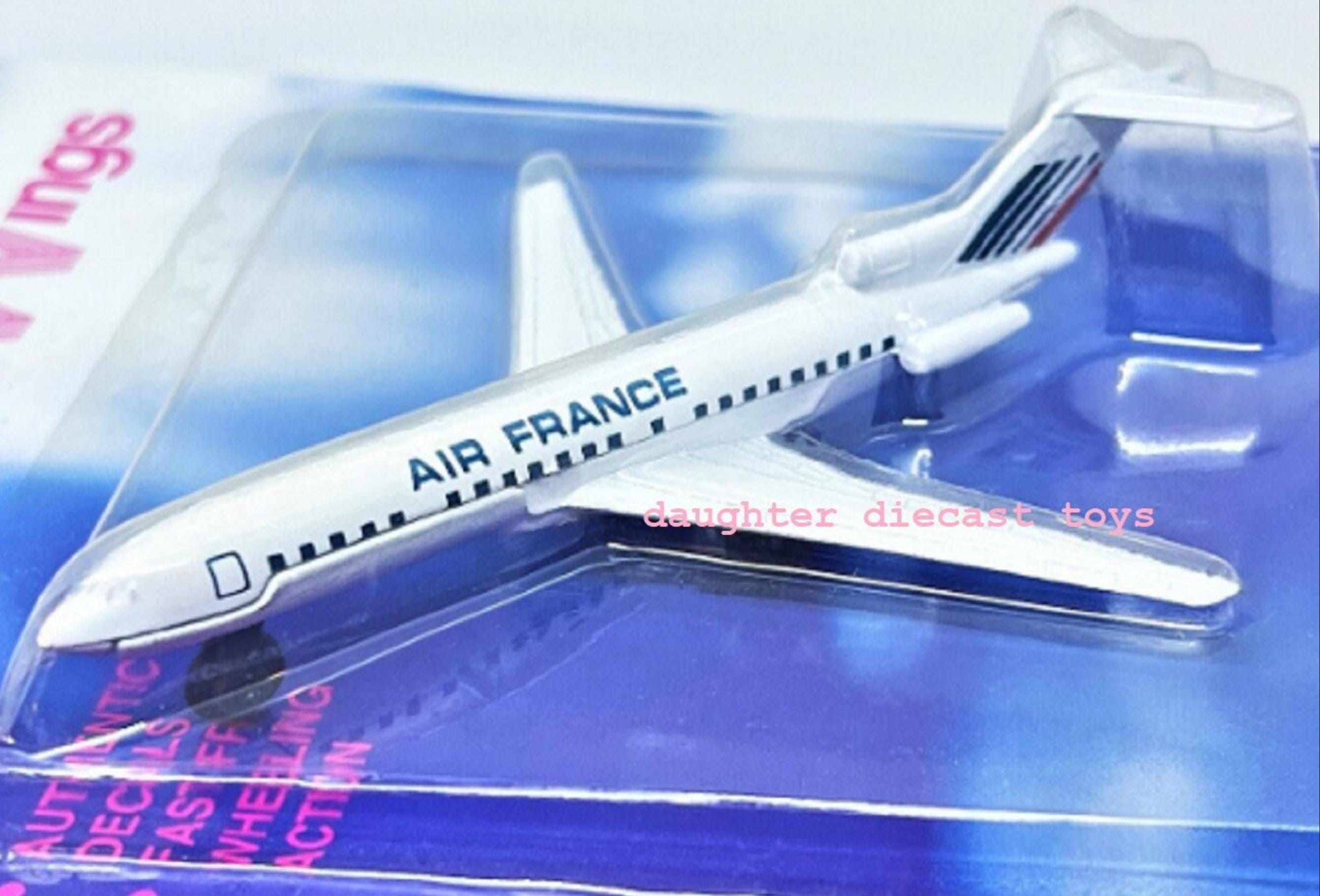
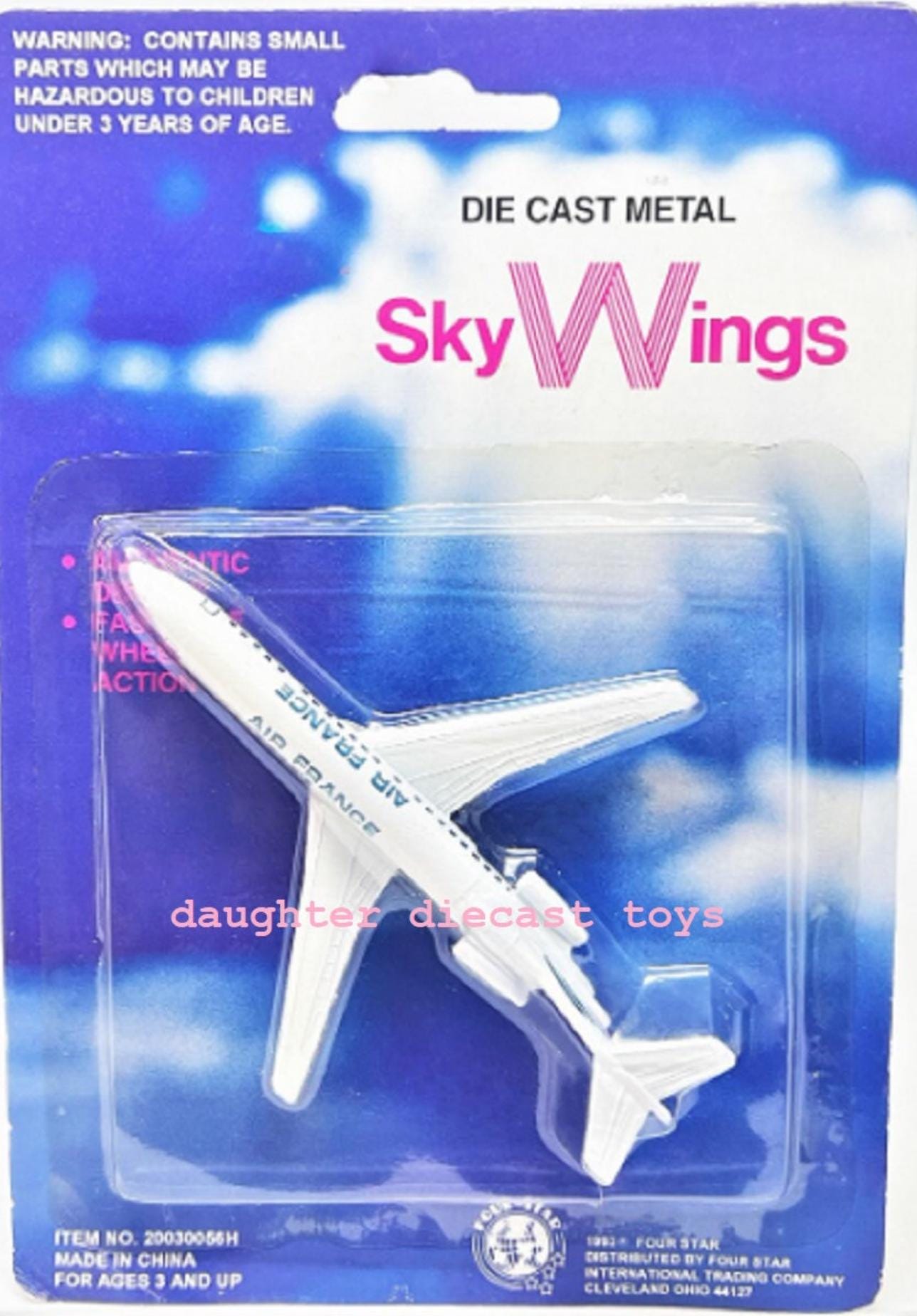
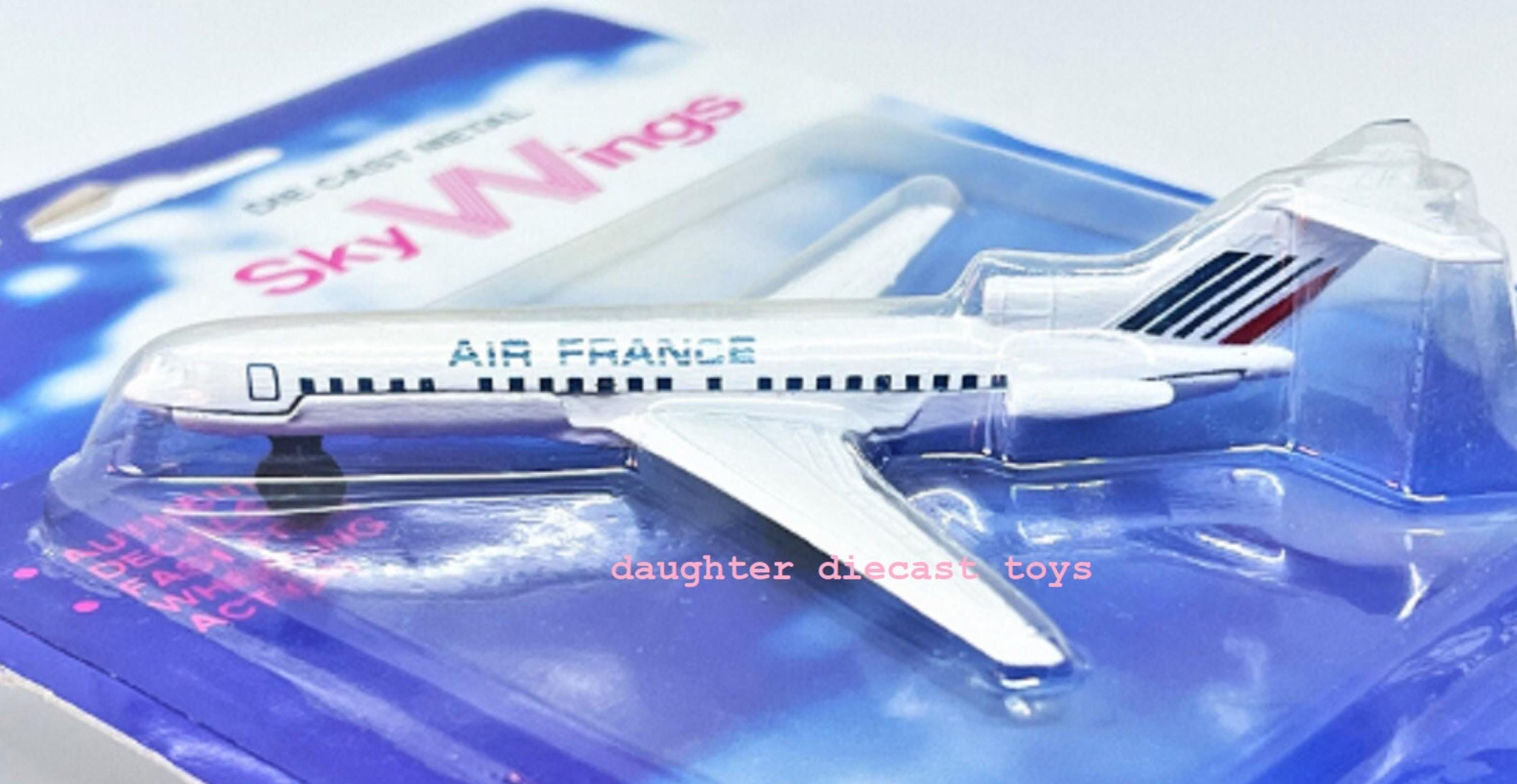
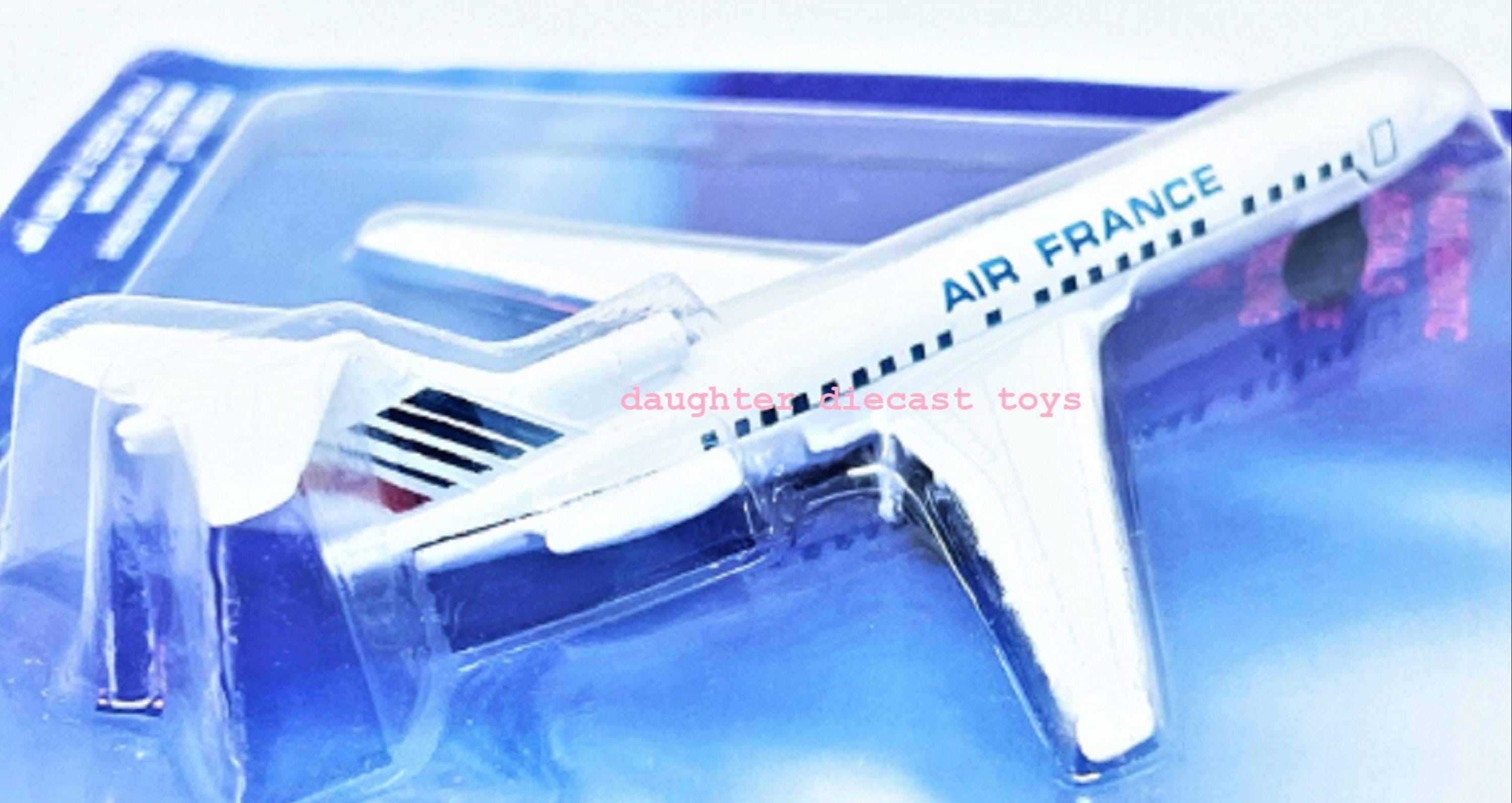

Vintage AIR FRANCE 727 Diecast Metal Airplane Pristine Condition/Factory-Sealed-Sky Wings Toy-Perfect Gift for Commercial Aviation Buffs!
$ 29.99

VINTAGE AIR FRANCE 727 DIECAST METAL AIRPLANE Pristine
Condition/Factory-Sealed-Sky Wings Toy-Perfect Gift for Commercial Aviation Buffs!Awesome! AIR FRANCE 727. Highly sought after-diecast metal model-made by Sky Wings. Measures 4 1/4"L x 3 1/2"W x 1"H. Beautiful jet in pristine condition-never removed from its factory-sealed card. Perfect gift for Air France, aviation history buffs and vintage toy collectors! We ship fast & safe worldwide every day! See aircraft bio (below).Note: My dad owned a Diecast toy store for 30 years. I inherited the store inventory when he passed away several years ago. I am (just now) able to bring myself to begin selling his cars-so they can be shared with the world. All pristine and mint condition vintage models will (eventually) be listed here on ETSY. All the inventory is NEW (vintage) merchandise-which was intended for retail sale. Please know-our diecast toys have NEVER been "played-with” we do not sell used, or damaged toys.
•
•
•FOR A LIMITED TIME
•
•
•Purchases totaling $35 and above qualify for FREE shipping to USA! Add more items to your Etsy shopping cart to save $$$.About the Aircraft:Boeing 727 Characteristics[91] Variant 727-100 727-200 Flight crew[92] three: pilot, copilot, and flight engineer Two-class seats 106: 16F@38", 90Y@34" 134: 20F@38", 114Y@34" One-class seats 125@34" 155@34" Exit limit[92] 131 189 Length 133 ft 2 in / 40.59 m 153 ft 2 in / 46.68 m Height 34 ft 3 in / 10.44 m 34 ft 11 in / 10.65 m Cabin width 140 in / 3.56 m Wingspan 108 ft / 32.92 m Wing[43] 1,650 sq ft (153 m2), 32° sweep MTOW 169,000 lb / 76,700 kg 172,000 lb / 78,100 kg Adv. 209,500 lb / 95,100 kg OEW 87,696 lb / 39,800 kg 97,650 lb / 44,330 kg Adv. 100,700 lb / 45,720 kg Fuel capacity 7,680 gal / 29,069 L 8,090 US gal / 30,620 L Adv. 10,585 US gal / 40,060 L Engines ×3 Pratt & Whitney JT8D-1/7/9 JT8D-7/9/11 (Adv.: -9/15/17/17R) Thrust ×3 14,000–14,500 lbf (62–64 kN) 14,000–15,000 lbf (62–67 kN) Adv. 14,500–17,400 lbf (64–77 kN) Range[c] 2,250 nmi (4,170 km) 1,900 nmi (3,500 km) Adv. 2,550 nmi (4,720 km) Take-off[d] 8,300 ft (2,500 m) 8,400 ft (2,600 m) Adv. 10,100 ft (3,100 m) MMO[92] Mach 0.9 (961 km/h; 519 kn) Cruise 495–518 kn / 917–960 km/h[93] 467–515 kn / 865–953 km/h[94] Ceiling[92] 42,000 ft (13,000 m)The Boeing 727 is an American narrow-body airliner that was developed and produced by Boeing Commercial Airplanes. After the heavy 707 quad-jet was introduced in 1958, Boeing addressed the demand for shorter flight lengths from smaller airports. On December 5, 1960, the 727 was launched with 40 orders each from United Airlines and Eastern Air Lines. The first 727-100 rolled out November 27, 1962, first flew on February 9, 1963, and entered service with Eastern on February 1, 1964.The only trijet aircraft to be produced by Boeing, the 727 is powered by Pratt & Whitney JT8D low-bypass turbofans below a T-tail, one on each side of the rear fuselage and a center one fed through an S-duct. It shares its six-abreast upper fuselage cross-section and cockpit with the 707. The 133 ft (40.5 m) long 727-100 typically carries 106 passengers in two classes over 2,250 nmi (4,170 km), or 129 in a single class. Launched in 1965, the stretched 727-200 flew in July 1967 and entered service with Northeast Airlines that December. The 20 ft (6.1 m) longer variant typically carries 134 passengers in two classes over 2,550 nmi (4,720 km), or 155 in a single class. Besides the airliner accommodation, a freighter and a Quick Change convertible version were offered.The 727 was used for many domestic flights and on many international flights within its range. Airport noise regulations have led to hush kit installations. Its last commercial passenger flight was in January 2019. It was succeeded by the 757-200 and larger variants of the 737. As of February 2022, a total of 38 Boeing 727s were in commercial service. There have been 118 fatal incidents involving the Boeing 727. Production ended in September 1984 with 1,832 having been built.Operational historyNorthwest Airlines retired its last 727 from charter service in June 2003 In addition to domestic flights of medium range, the 727 was popular with international passenger airlines.[14] The range of flights it could cover (and the additional safety added by the third engine) meant that the 727 proved efficient for short- to medium-range international flights in areas around the world.The 727 also proved popular with cargo and charter airlines. FedEx Express introduced 727s in 1978.[28] The 727s were the backbone of its fleet until the 2000s; FedEx began replacing them with Boeing 757s in 2007.[28] Many cargo airlines worldwide employ the 727 as a workhorse, since, as it is being phased out of U.S. domestic service because of noise regulations, it becomes available to overseas users in areas where such noise regulations have not yet been instituted. Charter airlines Sun Country, Champion Air, and Ryan International Airlines all started with 727 aircraft.[citation needed]The 727 had some military uses, as well. Since the aft stair could be opened in flight, the Central Intelligence Agency used them to drop agents and supplies behind enemy lines in Vietnam.[29] In early 1988, The Iraqi Air Force modified a Boeing 727 by fitting it with Thomson-CSF TMV-018 Syrel pods for ESM and Raphael-TH pods with side looking radar. Known as 'Faw-727', it was reportedly used as an ELINT platform in the Invasion of Kuwait in 1990 (during which it was briefly locked on by a Kuwaiti Mirage F1 on August 2) and the subsequent Iraqi monitoring of Coalition forces during Desert Shield.[30][31]The 727 has proven to be popular where the airline serves airports with gravel, or otherwise lightly improved, runways. The Canadian airline First Air, for example, previously used a 727-100C to serve the communities of Resolute Bay and Arctic Bay in Nunavut, whose Resolute Bay Airport and former Nanisivik Airport both have gravel runways. The high-mounted engines greatly reduce the risk of foreign object damage.[citation needed]A military version, the Boeing C-22, was operated as a medium-range transport aircraft by the Air National Guard and National Guard Bureau to airlift personnel. A total of three C-22Bs were in use, all assigned to the 201st Airlift Squadron, District of Columbia Air National Guard.[32]At the start of the 21st century, the 727 remained in service with a few large airlines. Faced with higher fuel costs, lower passenger volumes due to the post-9/11 economic climate, increasing restrictions on airport noise, and the extra expenses of maintaining older planes and paying flight engineers' salaries, most major airlines phased out their 727s; they were replaced by twin-engined aircraft, which are quieter and more fuel-efficient. Modern airliners also have a smaller flight deck crew of two pilots, while the 727 required two pilots and a flight engineer. Delta Air Lines, the last major U.S. carrier to do so, retired its last 727 from scheduled service in April 2003. Northwest Airlines retired its last 727 from charter service in June 2003. Many airlines replaced their 727s with either the 737-800 or the Airbus A320; both are close in size to the 727-200. As of July 2013, a total of 109 Boeing 727s were in commercial service with 34 airlines;[33] three years later, the total had fallen to 64 airframes in service with 26 airlines.[34]On March 2, 2016, the first 727 produced (N7001U), which first flew on February 9, 1963, made a flight to a museum after extensive restoration. The 727-100 had carried about three million passengers during its years of service. Originally a prototype, it was later sold to United Airlines, which donated it to the Museum of Flight in Seattle in 1991. The jet was restored over 25 years by the museum and was ferried from Paine Field in Everett, Washington to Boeing Field in Seattle, where it was put on permanent display at the Aviation Pavilion.[35][36][37] The Federal Aviation Administration granted the museum a special permit for the 15-minute flight. The museum's previous 727-223, tail number N874AA, was donated to the National Airline History Museum in Kansas City and was planned to be flown to its new home once FAA ferry approval was granted.[38] After a series of financial problems with the restoration, N874AA was seized by Boeing Field for nonpayment of storage fees in 2021 and subsequently broken up and scrapped.
Condition/Factory-Sealed-Sky Wings Toy-Perfect Gift for Commercial Aviation Buffs!Awesome! AIR FRANCE 727. Highly sought after-diecast metal model-made by Sky Wings. Measures 4 1/4"L x 3 1/2"W x 1"H. Beautiful jet in pristine condition-never removed from its factory-sealed card. Perfect gift for Air France, aviation history buffs and vintage toy collectors! We ship fast & safe worldwide every day! See aircraft bio (below).Note: My dad owned a Diecast toy store for 30 years. I inherited the store inventory when he passed away several years ago. I am (just now) able to bring myself to begin selling his cars-so they can be shared with the world. All pristine and mint condition vintage models will (eventually) be listed here on ETSY. All the inventory is NEW (vintage) merchandise-which was intended for retail sale. Please know-our diecast toys have NEVER been "played-with” we do not sell used, or damaged toys.
•
•
•FOR A LIMITED TIME
•
•
•Purchases totaling $35 and above qualify for FREE shipping to USA! Add more items to your Etsy shopping cart to save $$$.About the Aircraft:Boeing 727 Characteristics[91] Variant 727-100 727-200 Flight crew[92] three: pilot, copilot, and flight engineer Two-class seats 106: 16F@38", 90Y@34" 134: 20F@38", 114Y@34" One-class seats 125@34" 155@34" Exit limit[92] 131 189 Length 133 ft 2 in / 40.59 m 153 ft 2 in / 46.68 m Height 34 ft 3 in / 10.44 m 34 ft 11 in / 10.65 m Cabin width 140 in / 3.56 m Wingspan 108 ft / 32.92 m Wing[43] 1,650 sq ft (153 m2), 32° sweep MTOW 169,000 lb / 76,700 kg 172,000 lb / 78,100 kg Adv. 209,500 lb / 95,100 kg OEW 87,696 lb / 39,800 kg 97,650 lb / 44,330 kg Adv. 100,700 lb / 45,720 kg Fuel capacity 7,680 gal / 29,069 L 8,090 US gal / 30,620 L Adv. 10,585 US gal / 40,060 L Engines ×3 Pratt & Whitney JT8D-1/7/9 JT8D-7/9/11 (Adv.: -9/15/17/17R) Thrust ×3 14,000–14,500 lbf (62–64 kN) 14,000–15,000 lbf (62–67 kN) Adv. 14,500–17,400 lbf (64–77 kN) Range[c] 2,250 nmi (4,170 km) 1,900 nmi (3,500 km) Adv. 2,550 nmi (4,720 km) Take-off[d] 8,300 ft (2,500 m) 8,400 ft (2,600 m) Adv. 10,100 ft (3,100 m) MMO[92] Mach 0.9 (961 km/h; 519 kn) Cruise 495–518 kn / 917–960 km/h[93] 467–515 kn / 865–953 km/h[94] Ceiling[92] 42,000 ft (13,000 m)The Boeing 727 is an American narrow-body airliner that was developed and produced by Boeing Commercial Airplanes. After the heavy 707 quad-jet was introduced in 1958, Boeing addressed the demand for shorter flight lengths from smaller airports. On December 5, 1960, the 727 was launched with 40 orders each from United Airlines and Eastern Air Lines. The first 727-100 rolled out November 27, 1962, first flew on February 9, 1963, and entered service with Eastern on February 1, 1964.The only trijet aircraft to be produced by Boeing, the 727 is powered by Pratt & Whitney JT8D low-bypass turbofans below a T-tail, one on each side of the rear fuselage and a center one fed through an S-duct. It shares its six-abreast upper fuselage cross-section and cockpit with the 707. The 133 ft (40.5 m) long 727-100 typically carries 106 passengers in two classes over 2,250 nmi (4,170 km), or 129 in a single class. Launched in 1965, the stretched 727-200 flew in July 1967 and entered service with Northeast Airlines that December. The 20 ft (6.1 m) longer variant typically carries 134 passengers in two classes over 2,550 nmi (4,720 km), or 155 in a single class. Besides the airliner accommodation, a freighter and a Quick Change convertible version were offered.The 727 was used for many domestic flights and on many international flights within its range. Airport noise regulations have led to hush kit installations. Its last commercial passenger flight was in January 2019. It was succeeded by the 757-200 and larger variants of the 737. As of February 2022, a total of 38 Boeing 727s were in commercial service. There have been 118 fatal incidents involving the Boeing 727. Production ended in September 1984 with 1,832 having been built.Operational historyNorthwest Airlines retired its last 727 from charter service in June 2003 In addition to domestic flights of medium range, the 727 was popular with international passenger airlines.[14] The range of flights it could cover (and the additional safety added by the third engine) meant that the 727 proved efficient for short- to medium-range international flights in areas around the world.The 727 also proved popular with cargo and charter airlines. FedEx Express introduced 727s in 1978.[28] The 727s were the backbone of its fleet until the 2000s; FedEx began replacing them with Boeing 757s in 2007.[28] Many cargo airlines worldwide employ the 727 as a workhorse, since, as it is being phased out of U.S. domestic service because of noise regulations, it becomes available to overseas users in areas where such noise regulations have not yet been instituted. Charter airlines Sun Country, Champion Air, and Ryan International Airlines all started with 727 aircraft.[citation needed]The 727 had some military uses, as well. Since the aft stair could be opened in flight, the Central Intelligence Agency used them to drop agents and supplies behind enemy lines in Vietnam.[29] In early 1988, The Iraqi Air Force modified a Boeing 727 by fitting it with Thomson-CSF TMV-018 Syrel pods for ESM and Raphael-TH pods with side looking radar. Known as 'Faw-727', it was reportedly used as an ELINT platform in the Invasion of Kuwait in 1990 (during which it was briefly locked on by a Kuwaiti Mirage F1 on August 2) and the subsequent Iraqi monitoring of Coalition forces during Desert Shield.[30][31]The 727 has proven to be popular where the airline serves airports with gravel, or otherwise lightly improved, runways. The Canadian airline First Air, for example, previously used a 727-100C to serve the communities of Resolute Bay and Arctic Bay in Nunavut, whose Resolute Bay Airport and former Nanisivik Airport both have gravel runways. The high-mounted engines greatly reduce the risk of foreign object damage.[citation needed]A military version, the Boeing C-22, was operated as a medium-range transport aircraft by the Air National Guard and National Guard Bureau to airlift personnel. A total of three C-22Bs were in use, all assigned to the 201st Airlift Squadron, District of Columbia Air National Guard.[32]At the start of the 21st century, the 727 remained in service with a few large airlines. Faced with higher fuel costs, lower passenger volumes due to the post-9/11 economic climate, increasing restrictions on airport noise, and the extra expenses of maintaining older planes and paying flight engineers' salaries, most major airlines phased out their 727s; they were replaced by twin-engined aircraft, which are quieter and more fuel-efficient. Modern airliners also have a smaller flight deck crew of two pilots, while the 727 required two pilots and a flight engineer. Delta Air Lines, the last major U.S. carrier to do so, retired its last 727 from scheduled service in April 2003. Northwest Airlines retired its last 727 from charter service in June 2003. Many airlines replaced their 727s with either the 737-800 or the Airbus A320; both are close in size to the 727-200. As of July 2013, a total of 109 Boeing 727s were in commercial service with 34 airlines;[33] three years later, the total had fallen to 64 airframes in service with 26 airlines.[34]On March 2, 2016, the first 727 produced (N7001U), which first flew on February 9, 1963, made a flight to a museum after extensive restoration. The 727-100 had carried about three million passengers during its years of service. Originally a prototype, it was later sold to United Airlines, which donated it to the Museum of Flight in Seattle in 1991. The jet was restored over 25 years by the museum and was ferried from Paine Field in Everett, Washington to Boeing Field in Seattle, where it was put on permanent display at the Aviation Pavilion.[35][36][37] The Federal Aviation Administration granted the museum a special permit for the 15-minute flight. The museum's previous 727-223, tail number N874AA, was donated to the National Airline History Museum in Kansas City and was planned to be flown to its new home once FAA ferry approval was granted.[38] After a series of financial problems with the restoration, N874AA was seized by Boeing Field for nonpayment of storage fees in 2021 and subsequently broken up and scrapped.
Other Products