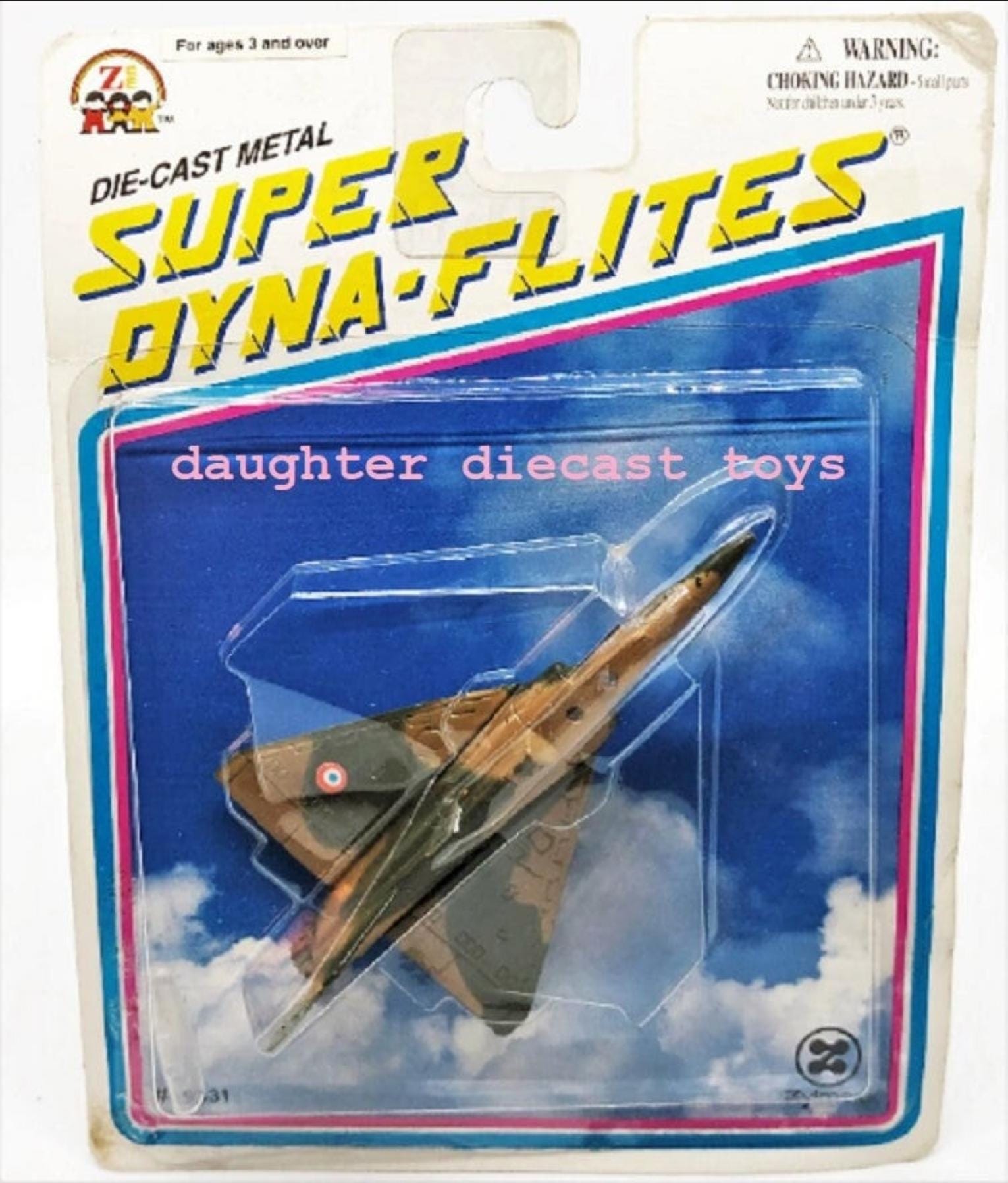

Vintage French Dassault MIRAGE 2000 Fighter Jet Diecast Metal Airplane Mint Condition/Factory Sealed! Zlymex Zee Toy
$ 29.99

Vintage French Dassault MIRAGE 2000 Fighter Jet Diecast Metal Airplane Mint
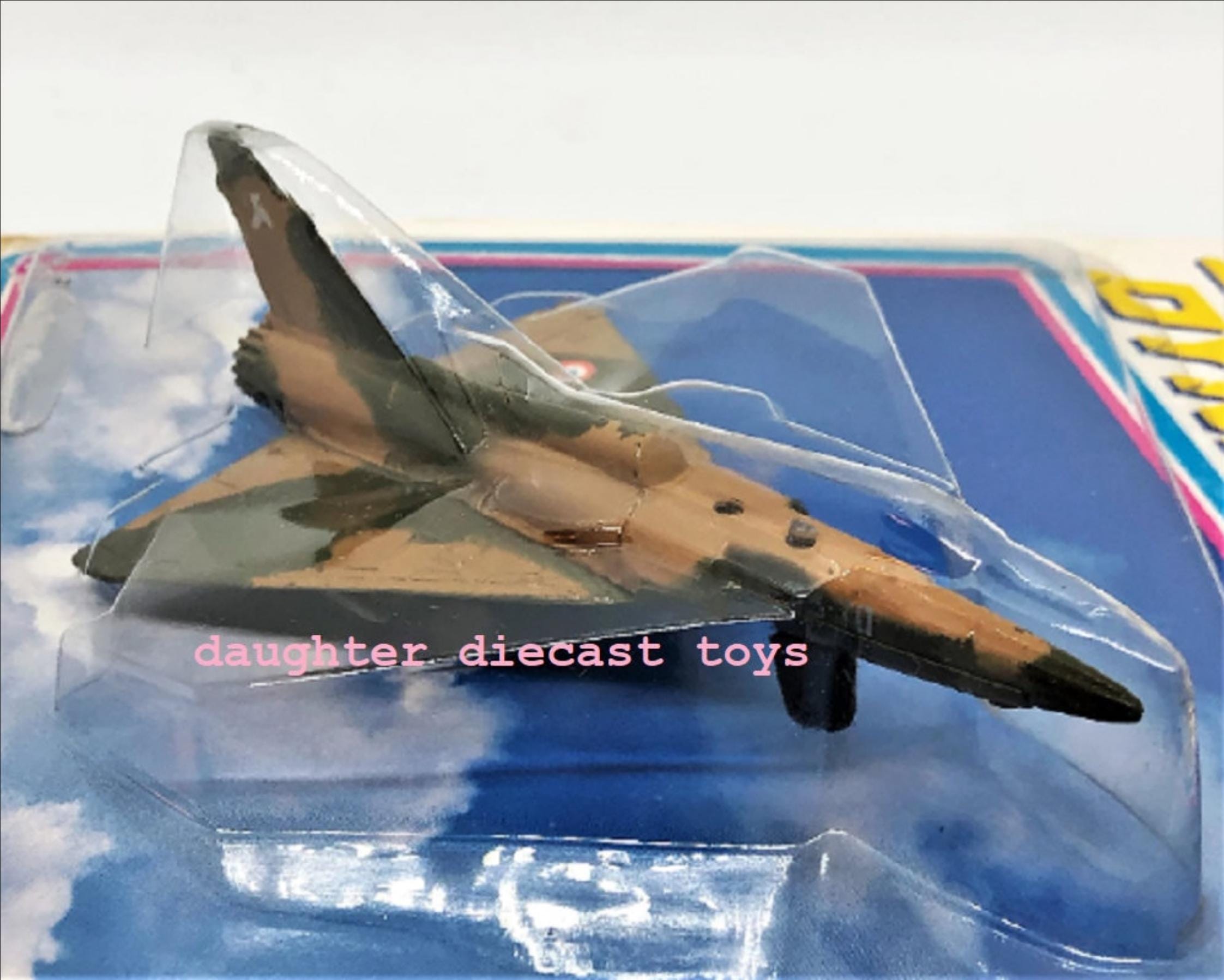
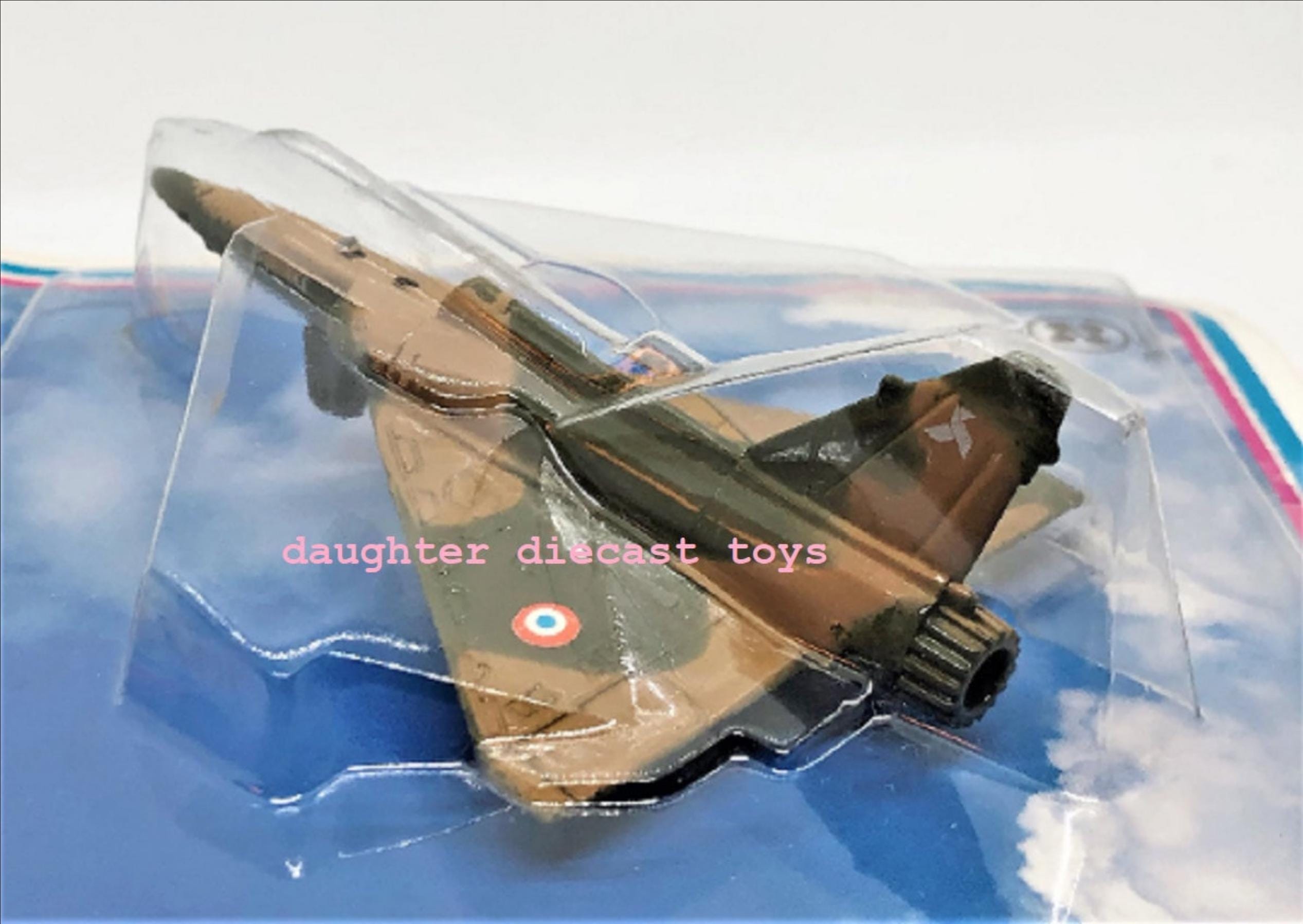
Condition/Factory Sealed! Zlymex Zee ToyAwesome! French DASSAULT MIRAGE 2000 Fighter Jet. Made by Zee Toys/constructed of die cast metal. Highly sought-after, hard to find vintage model! Measures 4 1/2"L x 2 1/2"W x 1 "H. Beautiful/pristine condition model. Never removed from its factory-sealed card. Perfect gift for ZEE, aircraft, and vintage toy collectors! We ship fast & safe worldwide every day! Read Aircraft bio below....Note: My dad owned a Diecast toy store for 30 years. I inherited the store inventory when he passed away several years ago. I am (just now) able to bring myself to begin selling his cars-so they can be shared with the world. All pristine and mint condition vintage models will (eventually) be listed here on ETSY. All the inventory is NEW (vintage) merchandise-which was intended for retail sale. Please know-our diecast toys have NEVER been "played-with” we do not sell used, or damaged toys.
•
•
•FOR A LIMITED TIME
•
•
•Purchases totaling $35 and above qualify for FREE shipping to USA! Add more items to your Etsy shopping cart to save $$$.AIRCRAFT BIO:General characteristicsCrew: 1 Length: 14.36 m (47 ft 1 in) Wingspan: 9.13 m (29 ft 11 in) Height: 5.2 m (17 ft 1 in) Wing area: 41 m2 (440 sq ft) Empty weight: 7,500 kg (16,535 lb) Gross weight: 13,800 kg (30,424 lb) Max takeoff weight: 17,000 kg (37,479 lb) Fuel capacity: 3,950 l internal / 8,000 l maximal[129] Powerplant: 1 × SNECMA M53-P2 afterburning turbofan engine, 64.3 kN (14,500 lbf) thrust dry, 95.1 kN (21,400 lbf) with afterburnerPerformanceMaximum speed: 2,336 km/h (1,452 mph, 1,261 kn) / M2.2 at high altitude1,110 km/h (690 mph; 600 kn) at sea levelRange: 1,550 km (960 mi, 840 nmi) Ferry range: 3,335 km (2,072 mi, 1,801 nmi) with auxiliary fuel Service ceiling: 17,060 m (55,970 ft) Rate of climb: 285 m/s (56,100 ft/min)[citation needed] Wing loading: 337 kg/m2 (69 lb/sq ft) Thrust/weight: 0.7ArmamentGuns: 2× 30 mm (1.2 in) DEFA 554 revolver cannon, 125 rounds per gun Hardpoints: 9 total (4× under-wing, 5× under-fuselage) with a capacity of 6,300 kg (13,900 lb) external fuel and ordnance Rockets: Matra 68 mm unguided rocket pods, 18 rockets per pod Missiles:
•
• Air-to-air missiles: 6× MBDA MICA IR/RF (Mirage 2000-5, Mirage 2000-9, Mirage 2000 I) 2× Matra R550 Magic-II and 2× Matra Super 530D (Mirage 2000 C) Astra (Indian Air Force)[citation needed] Air-to-surface missiles: 2× AM.39 Exocet (Mirage 2000 EG, Mirage 2000-5 Mk2) 1× SCALP EG (Hellenic Air Force)[131][132] Bombs:
•
•Unguided: Mk.82 Guided: PGM 500 and PGM 2000 modular guided bombs (Mirage 2000-9) 2× AS-30L laser-guided missile (Mirage 2000 D) 2× GBU-12 laser-guided bombs (Mirage 2000 D, Mirage 2000 C & Mirage 2000 N with external laser designation) 1× GBU-16 laser-guided bomb (Mirage 2000 D, Mirage 2000 C & Mirage 2000 N with external laser designation) 1× GBU-24 laser-guided bomb (Mirage 2000 D, Mirage 2000 C & Mirage 2000 N with external laser designation) 2× GBU-49 laser-guided bombs (Mirage 2000 D) 1× ASMP-A tactical nuclear cruise missile (Mirage 2000 N) 1x Spice 2000 (Mirage 2000 N)[130]AvionicsThomson-CSF RDY (Radar Doppler Multi-target) radar (Mirage 2000-5) The Dassault Mirage 2000 is a French multirole, single-engine, fourth-generation jet fighter manufactured by Dassault Aviation. It was designed in the late 1970s as a lightweight fighter to replace the Mirage III for the French Air Force (Armée de l'air). The Mirage 2000 evolved into a multirole aircraft with several variants developed, with sales to a number of nations. It was later developed into the Mirage 2000N and 2000D strike variants, the improved Mirage 2000-5, and several export variants. Over 600 aircraft were built and it has been in service with 9 nations. The first aircraft entered service in July 1984.[27] The first operational squadron was formed during the same year, the 50th anniversary of the French Air Force. About 124 Mirage 2000Cs were obtained by the AdA.French Mirage 2000s were used during the Gulf War, where they flew high-altitude air defence for USAF U-2 spy aircraft, as well as in UN and NATO air operations during the Bosnian War and the Kosovo War. During Operation Deliberate Force, on 30 August 1995, one Mirage 2000D was shot down over Bosnia by a 9K38 Igla shoulder-launched missile fired by air defence units of the Army of Republika Srpska, prompting efforts to obtain improved defensive systems. Both crew members were captured and later released through mediation of Federal Republic of Yugoslavia.[28][verification needed]French Mirage 2000Ds later served with the International Security Assistance Force during the conflict in Afghanistan in 2001–2002, operating in close conjunction with international forces and performing precision attacks with laser-guided bombs. In the summer of 2007, after the Dassault Rafale fighters had been removed from the theater of operations, three French Mirage 2000s were deployed to Afghanistan in support of NATO troops.[29]The Mirage 2000 is being replaced in French service by the Dassault Rafale, which became operational with the French Air Force in June 2006.French Mirage 2000s were committed to enforcing the no-fly zone in Libya as part of Opération Harmattan in 2011.[30]On 14 April 2018, four French Mirage 2000-5Fs participated in a joint military operation against the Syrian government with the UK and U.S. during the Syrian Civil War.[31][32] EgyptEgypt became the first export customer of the Mirage 2000 when it ordered 20 aircraft in December 1981. The $890 million order encompassed 16 single-seat Mirage 2000EMs and four two-seat Mirage 2000BMs, as well as options for 20 more aircraft. The aircraft were delivered between June 1986 and January 1988.[33] One was lost in a training accident.[citation needed] IndiaIn 1980, the Indian Air Force (IAF) learned of a successful approach by Pakistan to the US that year to purchase F-16A/B fighters, delivery of which was to commence in 1982.[34] By late 1980, the IAF had quickly convinced the Indian government to purchase an equally potent aircraft, as its MiG-21s and MiG-23s were inferior to the F-16. When evaluating the Mirage F-1 earlier,[35] they became aware of a high-performance prototype of the Mirage 2000 in the flight-testing phase. No other aircraft of this potential were in the offering. An internal assessment of the Mirage 2000 was carried out and the Indian government felt that the French plane was more advanced and a superior response to the F-16s that the US was to supply to Pakistan and approached France for 150 Mirage 2000s.[36][37] In October 1982, the country placed an order with Dassault for 36 single-seat Mirage 2000Hs and four twin-seat Mirage 2000THs (with H standing for "Hindustan") with the possibility of a follow-on purchase of 9 aircraft (eight single- and one twin-seater aircraft) as war, maintenance and attrition reserve. The purchase of 150 aircraft,[38] could well have paved the way for joint production with Hindustan Aeronautics Limited, but the number of aircraft ordered (40+9) was too small for such an arrangement. India nevertheless had the option to produce a number of Mirage 2000s under license that was later scrapped due to the country's close relationship with the Soviet Union. This led to the induction of the MiG-29, instead, overriding reservations expressed by the IAF.[39]With the delivery of the first seven aircraft on 29 June 1985 to No. 7 Squadron, the Battleaxes, the Indian Air Force (IAF) became the first foreign user of the type, which it renamed the Vajra (Sanskrit: वज्र, for Lightning, Thunderbolt).[40][41][42] The service's early aircraft were powered by Snecma M53-5 engines (so were designated Mirage 2000H5 and Mirage 2000TH5), which were quickly replaced by more powerful M53-P2 engines. The second unit to convert to the type was No. 1 Squadron (the Tigers), which was formally designated a Mirage 2000 unit in January 1986. Within 12 months of the first delivery, the IAF had received all 40 aircraft ordered. The follow-on order of 9 aircraft was signed in 1986. Five aircraft were delivered by 1990, two more in 1992, and the last two aircraft were delivered in 1994. As such, full unit establishment was not achieved until 1990.[43][44]The Mirage 2000 fleet encountered other issues during the first decade of service, which were largely operational and maintenance-based. In 1995, the Indian government's comptroller and auditor general reported delays in the construction of overhaul facilities and a shortage of spare parts, which had led the fleet being unable to meet its required flying hours.[44] India also purchased ATLIS II pods and several Matra Bombe Guidée Laser (BGL) Arcole 1,000 kg laser-guided penetrating bombs for the Mirage.[45][46] The ATLIS II pods have an inherent limitation in that they are unusable at high altitudes.[47] In its place, the IAF has bought a number of the cheaper US Paveway II laser-guided bomb kits for use with the Israeli Litening laser designator pods (LDPs), but certain parts of the Paveway kit were not available, as they were under US embargo.[48] The aircraft were heavily modified in a short time frame to drop laser-guided bombs as well as conventional unguided bombs.[49] Due to a lack of enemy air action,[50] aircrew quickly became highly proficient in dropping dumb bombs. IAF Mirage 2000s have reportedly only used the Paveway LGB on eight occasions, mainly for the destruction of enemy command bunkers.[47]In 1999, when the Kargil War broke out, the IAF was asked to act jointly with ground troops on 25 May.[51] The code name assigned to their role was Operation Safed Sagar[52] and the Mirage 2000 flew its first sortie on 30 May.[47] This multi-role aircraft, the most advanced in the IAF, performed remarkably well during the whole conflict in the high Himalayas, and was considered the game changer in the two-month war.[53][54] During Operation Safed Sagar from May to July 1999, the two Mirage squadrons flew a total of 514 sorties[48] with only three drop outs.[55] No. 1 Squadron flew 274 air defence and strike escort missions, while No. 7 Squadron conducted 240 strike missions during which it dropped 55,000 kg (121,000 lb) of ordnance.[56]During the 2001–02 India–Pakistan standoff, IAF Mirage 2000s were used to destroy Pakistani bunkers with precision-guided bombs.[45]The morale-boosting service of the Mirage 2000 in 1999 prompted the IAF to consider the acquisition of a further 126 aircraft. Instead, the Mirage 2000-5 became a contender for the IAF's Indian MRCA competition in competition with the Mikoyan MiG-35, F-16 Fighting Falcon, and JAS 39 Gripen. In 2004, the Indian government approved purchase of 10 Mirage 2000Hs, featuring improved avionics, particularly an upgraded RDM 7 radar; they were delivered in 2007 for a total of 50 aircraft. Dassault replaced the Mirage 2000 with the newer Rafale as its contender due to the impending closure of the Mirage 2000 production line.[57] IAF Mirage 2000 in Cope India 2004In 2004, India placed its third Mirage 2000 order, and the government announced its intention to upgrade the existing fleet, as well. After a period of protracted negotiations for the next several years, during which India and Dassault came close to signing a contract several times.In July 2011, India approved a $2.2 billion upgrade package for its Mirage 2000s. Worth some $43 million per aircraft, the upgrade the fleet to Mirage 2000-5 Mk. 2 standards, with provisions made for the use of a night vision-capable glass cockpit, upgraded navigation and IFF systems, advanced multimode multilayered radar, and fully integrated electronic warfare suite, among other updates. In addition, the fleet's inventory of Super 530D and Magic II missiles would be replaced by MICA, an order for which was placed in 2012.[58][59][60] The first of the two IAF Mirages sent to France to be upgraded made its first flight in October 2013, marking the start of a test campaign that would encompass 250 flights, culminating in the handover of the first aircraft, redesignated Mirage 2000I, in March 2015. The new jets were redesignated Mirage 2000I for the single-seat version and Mirage 2000TI for the twin-seat version.[61][62][63] Mirage 2000 at Aero India showOn 26 February 2019, 12 Mirage 2000s were used to strike an alleged Jaish-e-Mohammed training camp in Balakot, Pakistan.[64] This engagement was the first time since the 1971 war that IAF fighters had entered Pakistani airspace.[65][66][67] All aircraft were armed with one Israeli Spice 2000 (one-tonne) bomb.[68][69][70][71]On 27 February 2019, IAF Mirage 2000Is, Su-30MKIs, and MiG-21s were used against Pakistan Air Force JF-17, Mirage IIIs, and F-16s,[72][73] whose aim was to target Indian Army ammunition dumps and other infrastructure near Srinagar, Poonch and Jammu area, according to Indian government officials. However, Pakistanis officials say that air strikes in India by Pakistan Air Force jets were meant to demonstrate Pakistan's capability and Pakistani jets were ordered to drop their bomb in open space to avoid any human or collateral damage.[74] This led to a dogfight and a confirmed shootdown of an IAF MiG-21. Pakistan also claims that an additional IAF Su-30MKI was also shot down in this dogfight.[75] However, India denies the loss of any of its Su-30MKIs and instead claims that a PAF F-16 was shot down in the dogfight.[76] Pakistan also denies the loss of any of its F-16 in the dogfight.[75] The only confirmed loss of the engagement was that of IAF Mig-21 and a IAF Mi-17 which was lost to a friendly fire.[77]During the 2020 China-India standoff, India deployed Mirage 2000Is along the line of actual control during tensions between China, particularly after Galwan Valley skirmish near Pangong Tso in Ladakh UT.[78][79]In September 2021, France agreed to sell its ageing fleet of Mirage 2000 at 1 Million Euro per plane to India, raising one squadron. Out of the 24 fighters to be bought, 13 are in ready to fly condition, 8 with intact engine and airframe shall fly after servicing, the remaining 11 fighters are partially complete but with fuel tanks and ejection seats, which will be scavenged to secure parts for the IAF’s two existing squadrons of the fighter.[80] PeruIn December 1982, Peru placed an $800 million order for 14 single-seat Mirage 2000Ps and two two-seat Mirage 2000DP trainers, with an option for eight and two more aircraft, respectively. Although the contract was signed in 1985, the Peruvian government, due to the country's financial issues, renegotiated the number of aircraft to be reduced to 10 single-seaters and two two-seaters. Handover of the first aircraft occurred in June 1985, although the first deliveries to Peru were not made until December 1986, after the initial training of pilots in France had been completed.[81][82][83]The Peruvian Air Force ordered a set of munitions similar to that ordered by Egypt, along with ATLIS II targeting pods. The Peruvian Mirages flew combat air patrol missions in 1995 during the Cenepa War.[84] A Peruvian Air Force Mirage 2000Peru's Mirage 2000s underwent an inspection and partial electronic modernisation programme following a $140 million deal in 2009 that involved Dassault, Snecma, and Thales.[85][86] The aircraft are expected to be retired by 2025.[87] United Arab EmiratesIn May 1983, the United Arab Emirates (UAE) placed an order for 36 Mirage 2000 aircraft. The order consisted of 22 single-seat Mirage 2000EAD, eight unique single-seat reconnaissance variants designated Mirage 2000RAD, and six Mirage 2000DAD trainers, which collectively are known as SAD-8 (Standard Abu Dhabi). The order specified an Italian-made defensive avionics suite that delayed delivery of the first of these aircraft until 1989.[citation needed] UAE Mirage 2000RAD during Operation Desert StormIn November 1998, the UAE signed a $3.2 billion contract that consisted of an order for 30 Mirage 2000-9s, as well as the deal to upgrade 33 of the surviving SAD-8 aircraft up the new standard. The contract was later amended so it would encompass 32 new-built aircraft—20 single-seater Mirage 2000-9s and 12 two-seater 2000-9Ds—and 30 upgrade kits for original aircraft. The aircraft were equipped with a classified countermeasures system designated IMEWS. Although deliveries were scheduled for 2001, the first aircraft arrived in the spring of 2003.[88][89]The UAE's Mirage 2000-9s are equipped for the strike mission, with the Shehab laser targeting pod (a variant of the Damocles) and the Nahar navigation pod, complementing the air-to-ground modes of the RDY-2 radar. They are also equipped with a classified countermeasures system designated IMEWS, which is comparable to the ICMS 3. Emirati Mirage 2000s are armed with weapons such as the PGM 500 guided bomb and the "Black Shaheen" cruise missile, which is basically a variant of the MBDA Apache cruise missile.[90] All 30 survivors of this first batch have been extensively refurbished and upgraded, bringing them to the same standard as the Mirage 2000-9.[citation needed]UAE Mirage 2000s flew in the Gulf War of 1991, but had little action. Six Mirage 2000s were to participate in the enforcement of the no-fly zone over Libya.[91]As part of the Saudi Arabian-led intervention in Yemen on 14 March 2016, a United Arab Emirates Mirage 2000-9D crashed in the southern Yemeni city of Aden during a combat operation in the early morning hours, killing its two pilots. The Arab coalition claims the Mirage crashed due to a technical fault.[92] Other sources reported that the Mirage 2000-9D was shot down by Yemeni Al-Qaeda militants using a Strela-2 MANPADS while flying low.[93]On 2 July 2019, during the 2019–20 Western Libya campaign, an airstrike hit the Tajoura Detention Center outside Tripoli, Libya, which was being used as a holding facility for migrants and refugees trying to reach Europe, was struck from the air. A storage hangar being used as a residential facility was destroyed by the attack, killing at least 53 people and wounding 130.[94] The Libyan Government of National Accord (GNA) initially claimed that the airstrike was conducted by the Libyan National Army (LNA),[95][96] but later attributed the attack to a UAE aircraft.[citation needed] A January 2020 report by the United Nations Support Mission in Libya (UNSMIL) and the Office of the United Nations High Commissioner for Human Rights (OHCHR) stated that the strike was likely to have been carried out with a guided bomb fired from a non-Libyan aircraft, again suggesting that a foreign Mirage 2000 had been used.[97] Greece Hellenic Air Force Mirage 2000-5In July 1985, Greece signed a contract for 40 Mirage 2000s comprising 36 single-seat aircraft and 4 two-seat trainers. The order came as part of a larger defence acquisition programme that saw the country, for political reasons, proceed with an order for the F-16.[clarification needed] The $1.38 billion Mirage contract also consisted of weapons and equipment, as well as industrial offsets that permitted HAI to produce the M53-P2 engines. The first aircraft were delivered in June 1988 and the last, by the end of 1989. They featured an "ICMS mk1" defensive countermeasures suite (DCS), an updated version of the standard Mirage 2000C DCS, characterised by two small antennas near the top of the tailfin. Initially armed with R.550 Matra Magic-2 missiles. During the "Talos" modernisation project of the 1990s, carried out by Hellenic Aerospace Industry and supervised by Dassault and Thompson-CSF, the aircraft received: a vastly improved RDM-3 radar set; the ICMS 1 DCS; the ability to carry the Super-530D medium-range missile and the AM39 Exocet Block II anti-ship missile. After "Talos", the aircraft were renamed Mirage-2000EGM/BGM.[citation needed]In August 2000, Greece placed a $1.1 billion order for a batch of 15 new Mirage 2000-5 Mk. 2 fighters, and had 10 existing Mirage 2000EGMs upgraded to Mirage 2000-5 Mk. 2 standard. The upgrade meant the addition of the RDY-2 radar and ICMS-3 DCS, and the ability to deploy SCALP cruise missiles and both versions of the MICA instead, an order for which was placed.[98][99] All Greek machines (Mk 2s and EGMs) feature the TOTEM-3000 INS of the Mk2 instead of the Uliss-52 and have hose-and-drogue aerial refueling capability.[citation needed]On 8 October 1996, seven months after the escalation of the dispute with Turkey over the Imia/Kardak islands, a Turkish F-16D jet crashed into the Aegean Sea after interception by Greek Mirages.[100] The Turkish pilot died, while the co-pilot ejected and was rescued by Greek forces.[101] In August 2012, after the downing of a RF-4E on the Syrian coast, Turkish Defence Minister İsmet Yılmaz claimed that the Turkish F-16D was shot down in 1996 by a Greek Mirage 2000 with an R.550 Magic II near Chios island.[102] Greece denies that the F-16 was shot down.[citation needed] Both Mirage 2000 pilots reported that the F-16 caught fire and that they saw one parachute.[103]On 12 April 2018, a Greek Mirage 2000-5, part of a two-ship formation, crashed into the Aegean Sea north of the Skyros air base after being scrambled to intercept two Turkish F-16s that were violating Greek airspace. When the Mirage pair arrived in the area, the Turkish jets had already left. The Greek pilot died in the crash, which was attributed to Saharan dust in the air; both Mirage pilots were flying low in poor visibility.[104][105] TaiwanIn response to mainland China's purchase of the Su-27, the Republic of China (Taiwan) began talks with the US and France about the possible purchase of new fighters. While the US opposed Taiwan's acquisition of the Mirage 2000 and instead pressured it to procure the F-16, the Republic of China Air Force became the first customer for the Mirage 2000-5 in November 1992. The order for 48 single-seat Mirage 2000-5EIs and 12 Mirage 2000-5DI trainers was condemned by China. The order also included 480 Magic short-range air-to-air missiles, 960 MICA intermediate-range air-to-air missiles, auxiliary fuel tanks, ground support equipment, and monitoring equipment; total costs amounted to US$4.9 billion, of which $2.6 billion was for the aircraft.[106] The MICA missile provides the Mirage with a degree of BVR capability needed for its role as front-line interceptor. In addition, a set of ASTAC electronic intelligence (ELINT) pods was ordered.[citation needed] A number of centerline twin gun pods with DEFA 554 cannons were also acquired and fitted on the two-seaters, as they do not have an internal gun armament. Taiwanese Air Force Mirage 2000-5EITaiwanese Mirage 2000s were delivered from May 1997 to November 1998, and are based at Hsinchu AB.[citation needed] The RoCAF's Mirages have suffered from low operational readiness and high maintenance costs; the harsh environment and high operational tempo had caused higher-than-expected wear and tear. After cracks were detected in the blades of the aircraft's engines in 2009, Dassault worked with Taiwanese authorities to successfully rectify the issue and provided compensation for the engine damage. By the following year, normal training hours of 15 per month had resumed and the fleet's operational readiness had been restored, after having reportedly dropped to 6 hours per month because of the engine troubles.[107][108] In addition, there were considerations of mothballing the entire Mirage fleet because of its high maintenance costs.[109] Although the aircraft's maintenance supplies cost more than those of the Republic's AIDC F-CK-1 Ching-kuo and the Lockheed F-16 Fighting Falcon, the fleet was reportedly[citation needed] still being maintained adequately because of its popularity. Yet plans to upgrade the fleet had not been carried out as costs for doing so in France would be very high.[110] QatarIn 1994, Qatar became the second export customer for the Mirage 2000-5 as it ordered twelve aircraft to replace its Mirage F1EDAs. Designated Mirage 2000-5DAs, the aircraft ordered consisted of nine single-seaters (5EDA) and three two-seaters (5DDA), and the first delivery was made in September 1997. Qatar also purchased the MICA missile and the Apache stand-off cruise missile.[111][112] The aircraft would be used sparingly, and by the mid-2000s, under pressure from the US to dispose of the aircraft and with most of the aircraft's operational life still intact, Qatar offered to sell the aircraft to Pakistan and later India. Such a deal would not materialise.[113] A Qatar Air Force Dassault Mirage 2000-5 participating in Odyssey DawnIn March 2011, Mirage 2000s were deployed to an airbase on the Greek island of Crete as part of Qatar's commitment to assist in the NATO-enforced no-fly zone over Libya. The aircraft would soon jointly enforce the no-fly zone along with French Mirage 2000-5 aircraft.[114][115] BrazilDassault participated in a competition to replace the Brazilian Air Force's aging Mirage IIIEBR/DBRs with a Brazilian-specific version of the Mirage 2000-9 that would have been developed in collaboration with Embraer designated Mirage 2000BR. However, due to Brazilian fiscal problems, the competition dragged on for years until it was suspended in February 2005. Instead, Brazil in July 2005 purchased 12 ex-French Air Force Mirage 2000 aircraft (ten "C" and two "B" versions), designated F-2000, for $72 million.[116] Deliveries began in September 2006 and concluded on 27 August 2008 with the delivery of the last 2 aircraft.[117] According to Journal of Electronic Defense, the figure was $200 million, which consisted of a significant number of Magic 2 air-to-air missiles, and the AdA would provide full conversion training in France and full logistical support. The ten single-seat fighters and two twin-seat combat-trainers were drawn from operational squadrons Escadron de Chasse 1/5 and 2/5, based at Orange AB, respectively. The first delivery was made September 2006 to 1º Grupo de Defesa Aérea (1º GDA – 1st Air Defence Group) based at Annapolis.[118] They were primarily used in the air-defence role and were equipped with Matra Super 530D and Matra Magic 2.[119] Brazil officially retired its fleet in December 2013,[120][121] just before the maintenance contract with Dassault concluded.
Condition/Factory Sealed! Zlymex Zee ToyAwesome! French DASSAULT MIRAGE 2000 Fighter Jet. Made by Zee Toys/constructed of die cast metal. Highly sought-after, hard to find vintage model! Measures 4 1/2"L x 2 1/2"W x 1 "H. Beautiful/pristine condition model. Never removed from its factory-sealed card. Perfect gift for ZEE, aircraft, and vintage toy collectors! We ship fast & safe worldwide every day! Read Aircraft bio below....Note: My dad owned a Diecast toy store for 30 years. I inherited the store inventory when he passed away several years ago. I am (just now) able to bring myself to begin selling his cars-so they can be shared with the world. All pristine and mint condition vintage models will (eventually) be listed here on ETSY. All the inventory is NEW (vintage) merchandise-which was intended for retail sale. Please know-our diecast toys have NEVER been "played-with” we do not sell used, or damaged toys.
•
•
•FOR A LIMITED TIME
•
•
•Purchases totaling $35 and above qualify for FREE shipping to USA! Add more items to your Etsy shopping cart to save $$$.AIRCRAFT BIO:General characteristicsCrew: 1 Length: 14.36 m (47 ft 1 in) Wingspan: 9.13 m (29 ft 11 in) Height: 5.2 m (17 ft 1 in) Wing area: 41 m2 (440 sq ft) Empty weight: 7,500 kg (16,535 lb) Gross weight: 13,800 kg (30,424 lb) Max takeoff weight: 17,000 kg (37,479 lb) Fuel capacity: 3,950 l internal / 8,000 l maximal[129] Powerplant: 1 × SNECMA M53-P2 afterburning turbofan engine, 64.3 kN (14,500 lbf) thrust dry, 95.1 kN (21,400 lbf) with afterburnerPerformanceMaximum speed: 2,336 km/h (1,452 mph, 1,261 kn) / M2.2 at high altitude1,110 km/h (690 mph; 600 kn) at sea levelRange: 1,550 km (960 mi, 840 nmi) Ferry range: 3,335 km (2,072 mi, 1,801 nmi) with auxiliary fuel Service ceiling: 17,060 m (55,970 ft) Rate of climb: 285 m/s (56,100 ft/min)[citation needed] Wing loading: 337 kg/m2 (69 lb/sq ft) Thrust/weight: 0.7ArmamentGuns: 2× 30 mm (1.2 in) DEFA 554 revolver cannon, 125 rounds per gun Hardpoints: 9 total (4× under-wing, 5× under-fuselage) with a capacity of 6,300 kg (13,900 lb) external fuel and ordnance Rockets: Matra 68 mm unguided rocket pods, 18 rockets per pod Missiles:
•
• Air-to-air missiles: 6× MBDA MICA IR/RF (Mirage 2000-5, Mirage 2000-9, Mirage 2000 I) 2× Matra R550 Magic-II and 2× Matra Super 530D (Mirage 2000 C) Astra (Indian Air Force)[citation needed] Air-to-surface missiles: 2× AM.39 Exocet (Mirage 2000 EG, Mirage 2000-5 Mk2) 1× SCALP EG (Hellenic Air Force)[131][132] Bombs:
•
•Unguided: Mk.82 Guided: PGM 500 and PGM 2000 modular guided bombs (Mirage 2000-9) 2× AS-30L laser-guided missile (Mirage 2000 D) 2× GBU-12 laser-guided bombs (Mirage 2000 D, Mirage 2000 C & Mirage 2000 N with external laser designation) 1× GBU-16 laser-guided bomb (Mirage 2000 D, Mirage 2000 C & Mirage 2000 N with external laser designation) 1× GBU-24 laser-guided bomb (Mirage 2000 D, Mirage 2000 C & Mirage 2000 N with external laser designation) 2× GBU-49 laser-guided bombs (Mirage 2000 D) 1× ASMP-A tactical nuclear cruise missile (Mirage 2000 N) 1x Spice 2000 (Mirage 2000 N)[130]AvionicsThomson-CSF RDY (Radar Doppler Multi-target) radar (Mirage 2000-5) The Dassault Mirage 2000 is a French multirole, single-engine, fourth-generation jet fighter manufactured by Dassault Aviation. It was designed in the late 1970s as a lightweight fighter to replace the Mirage III for the French Air Force (Armée de l'air). The Mirage 2000 evolved into a multirole aircraft with several variants developed, with sales to a number of nations. It was later developed into the Mirage 2000N and 2000D strike variants, the improved Mirage 2000-5, and several export variants. Over 600 aircraft were built and it has been in service with 9 nations. The first aircraft entered service in July 1984.[27] The first operational squadron was formed during the same year, the 50th anniversary of the French Air Force. About 124 Mirage 2000Cs were obtained by the AdA.French Mirage 2000s were used during the Gulf War, where they flew high-altitude air defence for USAF U-2 spy aircraft, as well as in UN and NATO air operations during the Bosnian War and the Kosovo War. During Operation Deliberate Force, on 30 August 1995, one Mirage 2000D was shot down over Bosnia by a 9K38 Igla shoulder-launched missile fired by air defence units of the Army of Republika Srpska, prompting efforts to obtain improved defensive systems. Both crew members were captured and later released through mediation of Federal Republic of Yugoslavia.[28][verification needed]French Mirage 2000Ds later served with the International Security Assistance Force during the conflict in Afghanistan in 2001–2002, operating in close conjunction with international forces and performing precision attacks with laser-guided bombs. In the summer of 2007, after the Dassault Rafale fighters had been removed from the theater of operations, three French Mirage 2000s were deployed to Afghanistan in support of NATO troops.[29]The Mirage 2000 is being replaced in French service by the Dassault Rafale, which became operational with the French Air Force in June 2006.French Mirage 2000s were committed to enforcing the no-fly zone in Libya as part of Opération Harmattan in 2011.[30]On 14 April 2018, four French Mirage 2000-5Fs participated in a joint military operation against the Syrian government with the UK and U.S. during the Syrian Civil War.[31][32] EgyptEgypt became the first export customer of the Mirage 2000 when it ordered 20 aircraft in December 1981. The $890 million order encompassed 16 single-seat Mirage 2000EMs and four two-seat Mirage 2000BMs, as well as options for 20 more aircraft. The aircraft were delivered between June 1986 and January 1988.[33] One was lost in a training accident.[citation needed] IndiaIn 1980, the Indian Air Force (IAF) learned of a successful approach by Pakistan to the US that year to purchase F-16A/B fighters, delivery of which was to commence in 1982.[34] By late 1980, the IAF had quickly convinced the Indian government to purchase an equally potent aircraft, as its MiG-21s and MiG-23s were inferior to the F-16. When evaluating the Mirage F-1 earlier,[35] they became aware of a high-performance prototype of the Mirage 2000 in the flight-testing phase. No other aircraft of this potential were in the offering. An internal assessment of the Mirage 2000 was carried out and the Indian government felt that the French plane was more advanced and a superior response to the F-16s that the US was to supply to Pakistan and approached France for 150 Mirage 2000s.[36][37] In October 1982, the country placed an order with Dassault for 36 single-seat Mirage 2000Hs and four twin-seat Mirage 2000THs (with H standing for "Hindustan") with the possibility of a follow-on purchase of 9 aircraft (eight single- and one twin-seater aircraft) as war, maintenance and attrition reserve. The purchase of 150 aircraft,[38] could well have paved the way for joint production with Hindustan Aeronautics Limited, but the number of aircraft ordered (40+9) was too small for such an arrangement. India nevertheless had the option to produce a number of Mirage 2000s under license that was later scrapped due to the country's close relationship with the Soviet Union. This led to the induction of the MiG-29, instead, overriding reservations expressed by the IAF.[39]With the delivery of the first seven aircraft on 29 June 1985 to No. 7 Squadron, the Battleaxes, the Indian Air Force (IAF) became the first foreign user of the type, which it renamed the Vajra (Sanskrit: वज्र, for Lightning, Thunderbolt).[40][41][42] The service's early aircraft were powered by Snecma M53-5 engines (so were designated Mirage 2000H5 and Mirage 2000TH5), which were quickly replaced by more powerful M53-P2 engines. The second unit to convert to the type was No. 1 Squadron (the Tigers), which was formally designated a Mirage 2000 unit in January 1986. Within 12 months of the first delivery, the IAF had received all 40 aircraft ordered. The follow-on order of 9 aircraft was signed in 1986. Five aircraft were delivered by 1990, two more in 1992, and the last two aircraft were delivered in 1994. As such, full unit establishment was not achieved until 1990.[43][44]The Mirage 2000 fleet encountered other issues during the first decade of service, which were largely operational and maintenance-based. In 1995, the Indian government's comptroller and auditor general reported delays in the construction of overhaul facilities and a shortage of spare parts, which had led the fleet being unable to meet its required flying hours.[44] India also purchased ATLIS II pods and several Matra Bombe Guidée Laser (BGL) Arcole 1,000 kg laser-guided penetrating bombs for the Mirage.[45][46] The ATLIS II pods have an inherent limitation in that they are unusable at high altitudes.[47] In its place, the IAF has bought a number of the cheaper US Paveway II laser-guided bomb kits for use with the Israeli Litening laser designator pods (LDPs), but certain parts of the Paveway kit were not available, as they were under US embargo.[48] The aircraft were heavily modified in a short time frame to drop laser-guided bombs as well as conventional unguided bombs.[49] Due to a lack of enemy air action,[50] aircrew quickly became highly proficient in dropping dumb bombs. IAF Mirage 2000s have reportedly only used the Paveway LGB on eight occasions, mainly for the destruction of enemy command bunkers.[47]In 1999, when the Kargil War broke out, the IAF was asked to act jointly with ground troops on 25 May.[51] The code name assigned to their role was Operation Safed Sagar[52] and the Mirage 2000 flew its first sortie on 30 May.[47] This multi-role aircraft, the most advanced in the IAF, performed remarkably well during the whole conflict in the high Himalayas, and was considered the game changer in the two-month war.[53][54] During Operation Safed Sagar from May to July 1999, the two Mirage squadrons flew a total of 514 sorties[48] with only three drop outs.[55] No. 1 Squadron flew 274 air defence and strike escort missions, while No. 7 Squadron conducted 240 strike missions during which it dropped 55,000 kg (121,000 lb) of ordnance.[56]During the 2001–02 India–Pakistan standoff, IAF Mirage 2000s were used to destroy Pakistani bunkers with precision-guided bombs.[45]The morale-boosting service of the Mirage 2000 in 1999 prompted the IAF to consider the acquisition of a further 126 aircraft. Instead, the Mirage 2000-5 became a contender for the IAF's Indian MRCA competition in competition with the Mikoyan MiG-35, F-16 Fighting Falcon, and JAS 39 Gripen. In 2004, the Indian government approved purchase of 10 Mirage 2000Hs, featuring improved avionics, particularly an upgraded RDM 7 radar; they were delivered in 2007 for a total of 50 aircraft. Dassault replaced the Mirage 2000 with the newer Rafale as its contender due to the impending closure of the Mirage 2000 production line.[57] IAF Mirage 2000 in Cope India 2004In 2004, India placed its third Mirage 2000 order, and the government announced its intention to upgrade the existing fleet, as well. After a period of protracted negotiations for the next several years, during which India and Dassault came close to signing a contract several times.In July 2011, India approved a $2.2 billion upgrade package for its Mirage 2000s. Worth some $43 million per aircraft, the upgrade the fleet to Mirage 2000-5 Mk. 2 standards, with provisions made for the use of a night vision-capable glass cockpit, upgraded navigation and IFF systems, advanced multimode multilayered radar, and fully integrated electronic warfare suite, among other updates. In addition, the fleet's inventory of Super 530D and Magic II missiles would be replaced by MICA, an order for which was placed in 2012.[58][59][60] The first of the two IAF Mirages sent to France to be upgraded made its first flight in October 2013, marking the start of a test campaign that would encompass 250 flights, culminating in the handover of the first aircraft, redesignated Mirage 2000I, in March 2015. The new jets were redesignated Mirage 2000I for the single-seat version and Mirage 2000TI for the twin-seat version.[61][62][63] Mirage 2000 at Aero India showOn 26 February 2019, 12 Mirage 2000s were used to strike an alleged Jaish-e-Mohammed training camp in Balakot, Pakistan.[64] This engagement was the first time since the 1971 war that IAF fighters had entered Pakistani airspace.[65][66][67] All aircraft were armed with one Israeli Spice 2000 (one-tonne) bomb.[68][69][70][71]On 27 February 2019, IAF Mirage 2000Is, Su-30MKIs, and MiG-21s were used against Pakistan Air Force JF-17, Mirage IIIs, and F-16s,[72][73] whose aim was to target Indian Army ammunition dumps and other infrastructure near Srinagar, Poonch and Jammu area, according to Indian government officials. However, Pakistanis officials say that air strikes in India by Pakistan Air Force jets were meant to demonstrate Pakistan's capability and Pakistani jets were ordered to drop their bomb in open space to avoid any human or collateral damage.[74] This led to a dogfight and a confirmed shootdown of an IAF MiG-21. Pakistan also claims that an additional IAF Su-30MKI was also shot down in this dogfight.[75] However, India denies the loss of any of its Su-30MKIs and instead claims that a PAF F-16 was shot down in the dogfight.[76] Pakistan also denies the loss of any of its F-16 in the dogfight.[75] The only confirmed loss of the engagement was that of IAF Mig-21 and a IAF Mi-17 which was lost to a friendly fire.[77]During the 2020 China-India standoff, India deployed Mirage 2000Is along the line of actual control during tensions between China, particularly after Galwan Valley skirmish near Pangong Tso in Ladakh UT.[78][79]In September 2021, France agreed to sell its ageing fleet of Mirage 2000 at 1 Million Euro per plane to India, raising one squadron. Out of the 24 fighters to be bought, 13 are in ready to fly condition, 8 with intact engine and airframe shall fly after servicing, the remaining 11 fighters are partially complete but with fuel tanks and ejection seats, which will be scavenged to secure parts for the IAF’s two existing squadrons of the fighter.[80] PeruIn December 1982, Peru placed an $800 million order for 14 single-seat Mirage 2000Ps and two two-seat Mirage 2000DP trainers, with an option for eight and two more aircraft, respectively. Although the contract was signed in 1985, the Peruvian government, due to the country's financial issues, renegotiated the number of aircraft to be reduced to 10 single-seaters and two two-seaters. Handover of the first aircraft occurred in June 1985, although the first deliveries to Peru were not made until December 1986, after the initial training of pilots in France had been completed.[81][82][83]The Peruvian Air Force ordered a set of munitions similar to that ordered by Egypt, along with ATLIS II targeting pods. The Peruvian Mirages flew combat air patrol missions in 1995 during the Cenepa War.[84] A Peruvian Air Force Mirage 2000Peru's Mirage 2000s underwent an inspection and partial electronic modernisation programme following a $140 million deal in 2009 that involved Dassault, Snecma, and Thales.[85][86] The aircraft are expected to be retired by 2025.[87] United Arab EmiratesIn May 1983, the United Arab Emirates (UAE) placed an order for 36 Mirage 2000 aircraft. The order consisted of 22 single-seat Mirage 2000EAD, eight unique single-seat reconnaissance variants designated Mirage 2000RAD, and six Mirage 2000DAD trainers, which collectively are known as SAD-8 (Standard Abu Dhabi). The order specified an Italian-made defensive avionics suite that delayed delivery of the first of these aircraft until 1989.[citation needed] UAE Mirage 2000RAD during Operation Desert StormIn November 1998, the UAE signed a $3.2 billion contract that consisted of an order for 30 Mirage 2000-9s, as well as the deal to upgrade 33 of the surviving SAD-8 aircraft up the new standard. The contract was later amended so it would encompass 32 new-built aircraft—20 single-seater Mirage 2000-9s and 12 two-seater 2000-9Ds—and 30 upgrade kits for original aircraft. The aircraft were equipped with a classified countermeasures system designated IMEWS. Although deliveries were scheduled for 2001, the first aircraft arrived in the spring of 2003.[88][89]The UAE's Mirage 2000-9s are equipped for the strike mission, with the Shehab laser targeting pod (a variant of the Damocles) and the Nahar navigation pod, complementing the air-to-ground modes of the RDY-2 radar. They are also equipped with a classified countermeasures system designated IMEWS, which is comparable to the ICMS 3. Emirati Mirage 2000s are armed with weapons such as the PGM 500 guided bomb and the "Black Shaheen" cruise missile, which is basically a variant of the MBDA Apache cruise missile.[90] All 30 survivors of this first batch have been extensively refurbished and upgraded, bringing them to the same standard as the Mirage 2000-9.[citation needed]UAE Mirage 2000s flew in the Gulf War of 1991, but had little action. Six Mirage 2000s were to participate in the enforcement of the no-fly zone over Libya.[91]As part of the Saudi Arabian-led intervention in Yemen on 14 March 2016, a United Arab Emirates Mirage 2000-9D crashed in the southern Yemeni city of Aden during a combat operation in the early morning hours, killing its two pilots. The Arab coalition claims the Mirage crashed due to a technical fault.[92] Other sources reported that the Mirage 2000-9D was shot down by Yemeni Al-Qaeda militants using a Strela-2 MANPADS while flying low.[93]On 2 July 2019, during the 2019–20 Western Libya campaign, an airstrike hit the Tajoura Detention Center outside Tripoli, Libya, which was being used as a holding facility for migrants and refugees trying to reach Europe, was struck from the air. A storage hangar being used as a residential facility was destroyed by the attack, killing at least 53 people and wounding 130.[94] The Libyan Government of National Accord (GNA) initially claimed that the airstrike was conducted by the Libyan National Army (LNA),[95][96] but later attributed the attack to a UAE aircraft.[citation needed] A January 2020 report by the United Nations Support Mission in Libya (UNSMIL) and the Office of the United Nations High Commissioner for Human Rights (OHCHR) stated that the strike was likely to have been carried out with a guided bomb fired from a non-Libyan aircraft, again suggesting that a foreign Mirage 2000 had been used.[97] Greece Hellenic Air Force Mirage 2000-5In July 1985, Greece signed a contract for 40 Mirage 2000s comprising 36 single-seat aircraft and 4 two-seat trainers. The order came as part of a larger defence acquisition programme that saw the country, for political reasons, proceed with an order for the F-16.[clarification needed] The $1.38 billion Mirage contract also consisted of weapons and equipment, as well as industrial offsets that permitted HAI to produce the M53-P2 engines. The first aircraft were delivered in June 1988 and the last, by the end of 1989. They featured an "ICMS mk1" defensive countermeasures suite (DCS), an updated version of the standard Mirage 2000C DCS, characterised by two small antennas near the top of the tailfin. Initially armed with R.550 Matra Magic-2 missiles. During the "Talos" modernisation project of the 1990s, carried out by Hellenic Aerospace Industry and supervised by Dassault and Thompson-CSF, the aircraft received: a vastly improved RDM-3 radar set; the ICMS 1 DCS; the ability to carry the Super-530D medium-range missile and the AM39 Exocet Block II anti-ship missile. After "Talos", the aircraft were renamed Mirage-2000EGM/BGM.[citation needed]In August 2000, Greece placed a $1.1 billion order for a batch of 15 new Mirage 2000-5 Mk. 2 fighters, and had 10 existing Mirage 2000EGMs upgraded to Mirage 2000-5 Mk. 2 standard. The upgrade meant the addition of the RDY-2 radar and ICMS-3 DCS, and the ability to deploy SCALP cruise missiles and both versions of the MICA instead, an order for which was placed.[98][99] All Greek machines (Mk 2s and EGMs) feature the TOTEM-3000 INS of the Mk2 instead of the Uliss-52 and have hose-and-drogue aerial refueling capability.[citation needed]On 8 October 1996, seven months after the escalation of the dispute with Turkey over the Imia/Kardak islands, a Turkish F-16D jet crashed into the Aegean Sea after interception by Greek Mirages.[100] The Turkish pilot died, while the co-pilot ejected and was rescued by Greek forces.[101] In August 2012, after the downing of a RF-4E on the Syrian coast, Turkish Defence Minister İsmet Yılmaz claimed that the Turkish F-16D was shot down in 1996 by a Greek Mirage 2000 with an R.550 Magic II near Chios island.[102] Greece denies that the F-16 was shot down.[citation needed] Both Mirage 2000 pilots reported that the F-16 caught fire and that they saw one parachute.[103]On 12 April 2018, a Greek Mirage 2000-5, part of a two-ship formation, crashed into the Aegean Sea north of the Skyros air base after being scrambled to intercept two Turkish F-16s that were violating Greek airspace. When the Mirage pair arrived in the area, the Turkish jets had already left. The Greek pilot died in the crash, which was attributed to Saharan dust in the air; both Mirage pilots were flying low in poor visibility.[104][105] TaiwanIn response to mainland China's purchase of the Su-27, the Republic of China (Taiwan) began talks with the US and France about the possible purchase of new fighters. While the US opposed Taiwan's acquisition of the Mirage 2000 and instead pressured it to procure the F-16, the Republic of China Air Force became the first customer for the Mirage 2000-5 in November 1992. The order for 48 single-seat Mirage 2000-5EIs and 12 Mirage 2000-5DI trainers was condemned by China. The order also included 480 Magic short-range air-to-air missiles, 960 MICA intermediate-range air-to-air missiles, auxiliary fuel tanks, ground support equipment, and monitoring equipment; total costs amounted to US$4.9 billion, of which $2.6 billion was for the aircraft.[106] The MICA missile provides the Mirage with a degree of BVR capability needed for its role as front-line interceptor. In addition, a set of ASTAC electronic intelligence (ELINT) pods was ordered.[citation needed] A number of centerline twin gun pods with DEFA 554 cannons were also acquired and fitted on the two-seaters, as they do not have an internal gun armament. Taiwanese Air Force Mirage 2000-5EITaiwanese Mirage 2000s were delivered from May 1997 to November 1998, and are based at Hsinchu AB.[citation needed] The RoCAF's Mirages have suffered from low operational readiness and high maintenance costs; the harsh environment and high operational tempo had caused higher-than-expected wear and tear. After cracks were detected in the blades of the aircraft's engines in 2009, Dassault worked with Taiwanese authorities to successfully rectify the issue and provided compensation for the engine damage. By the following year, normal training hours of 15 per month had resumed and the fleet's operational readiness had been restored, after having reportedly dropped to 6 hours per month because of the engine troubles.[107][108] In addition, there were considerations of mothballing the entire Mirage fleet because of its high maintenance costs.[109] Although the aircraft's maintenance supplies cost more than those of the Republic's AIDC F-CK-1 Ching-kuo and the Lockheed F-16 Fighting Falcon, the fleet was reportedly[citation needed] still being maintained adequately because of its popularity. Yet plans to upgrade the fleet had not been carried out as costs for doing so in France would be very high.[110] QatarIn 1994, Qatar became the second export customer for the Mirage 2000-5 as it ordered twelve aircraft to replace its Mirage F1EDAs. Designated Mirage 2000-5DAs, the aircraft ordered consisted of nine single-seaters (5EDA) and three two-seaters (5DDA), and the first delivery was made in September 1997. Qatar also purchased the MICA missile and the Apache stand-off cruise missile.[111][112] The aircraft would be used sparingly, and by the mid-2000s, under pressure from the US to dispose of the aircraft and with most of the aircraft's operational life still intact, Qatar offered to sell the aircraft to Pakistan and later India. Such a deal would not materialise.[113] A Qatar Air Force Dassault Mirage 2000-5 participating in Odyssey DawnIn March 2011, Mirage 2000s were deployed to an airbase on the Greek island of Crete as part of Qatar's commitment to assist in the NATO-enforced no-fly zone over Libya. The aircraft would soon jointly enforce the no-fly zone along with French Mirage 2000-5 aircraft.[114][115] BrazilDassault participated in a competition to replace the Brazilian Air Force's aging Mirage IIIEBR/DBRs with a Brazilian-specific version of the Mirage 2000-9 that would have been developed in collaboration with Embraer designated Mirage 2000BR. However, due to Brazilian fiscal problems, the competition dragged on for years until it was suspended in February 2005. Instead, Brazil in July 2005 purchased 12 ex-French Air Force Mirage 2000 aircraft (ten "C" and two "B" versions), designated F-2000, for $72 million.[116] Deliveries began in September 2006 and concluded on 27 August 2008 with the delivery of the last 2 aircraft.[117] According to Journal of Electronic Defense, the figure was $200 million, which consisted of a significant number of Magic 2 air-to-air missiles, and the AdA would provide full conversion training in France and full logistical support. The ten single-seat fighters and two twin-seat combat-trainers were drawn from operational squadrons Escadron de Chasse 1/5 and 2/5, based at Orange AB, respectively. The first delivery was made September 2006 to 1º Grupo de Defesa Aérea (1º GDA – 1st Air Defence Group) based at Annapolis.[118] They were primarily used in the air-defence role and were equipped with Matra Super 530D and Matra Magic 2.[119] Brazil officially retired its fleet in December 2013,[120][121] just before the maintenance contract with Dassault concluded.
Other Products