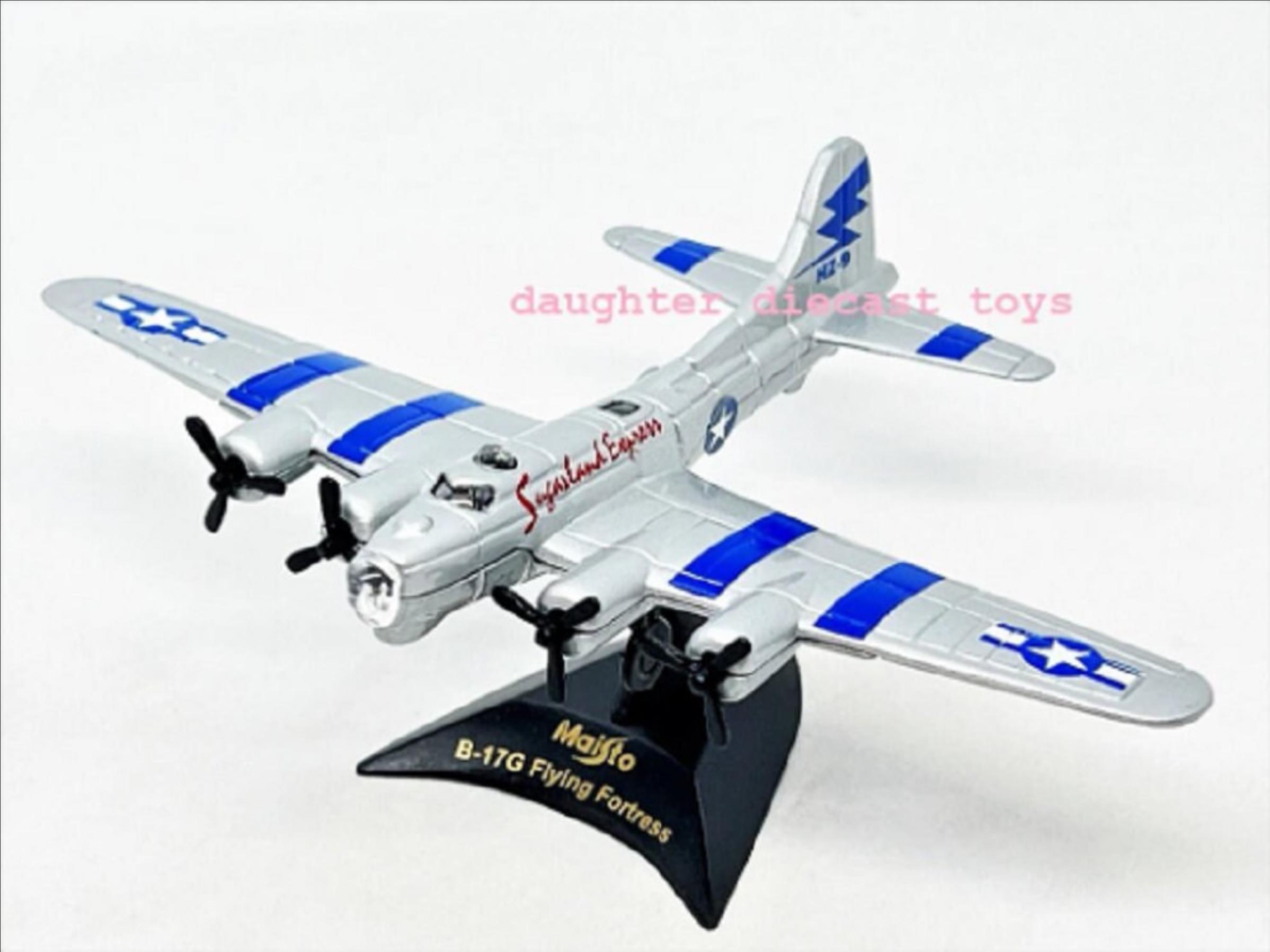
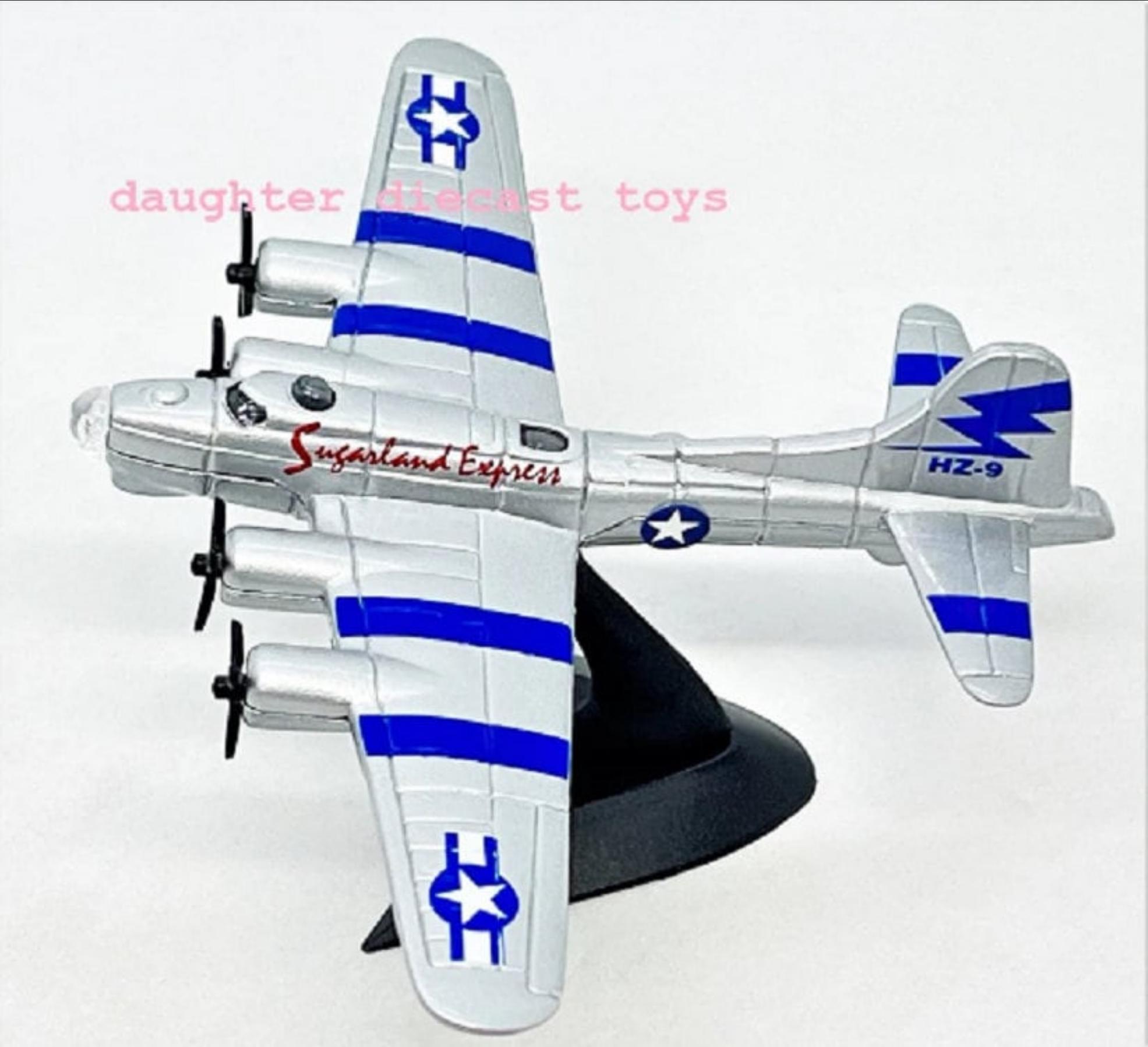
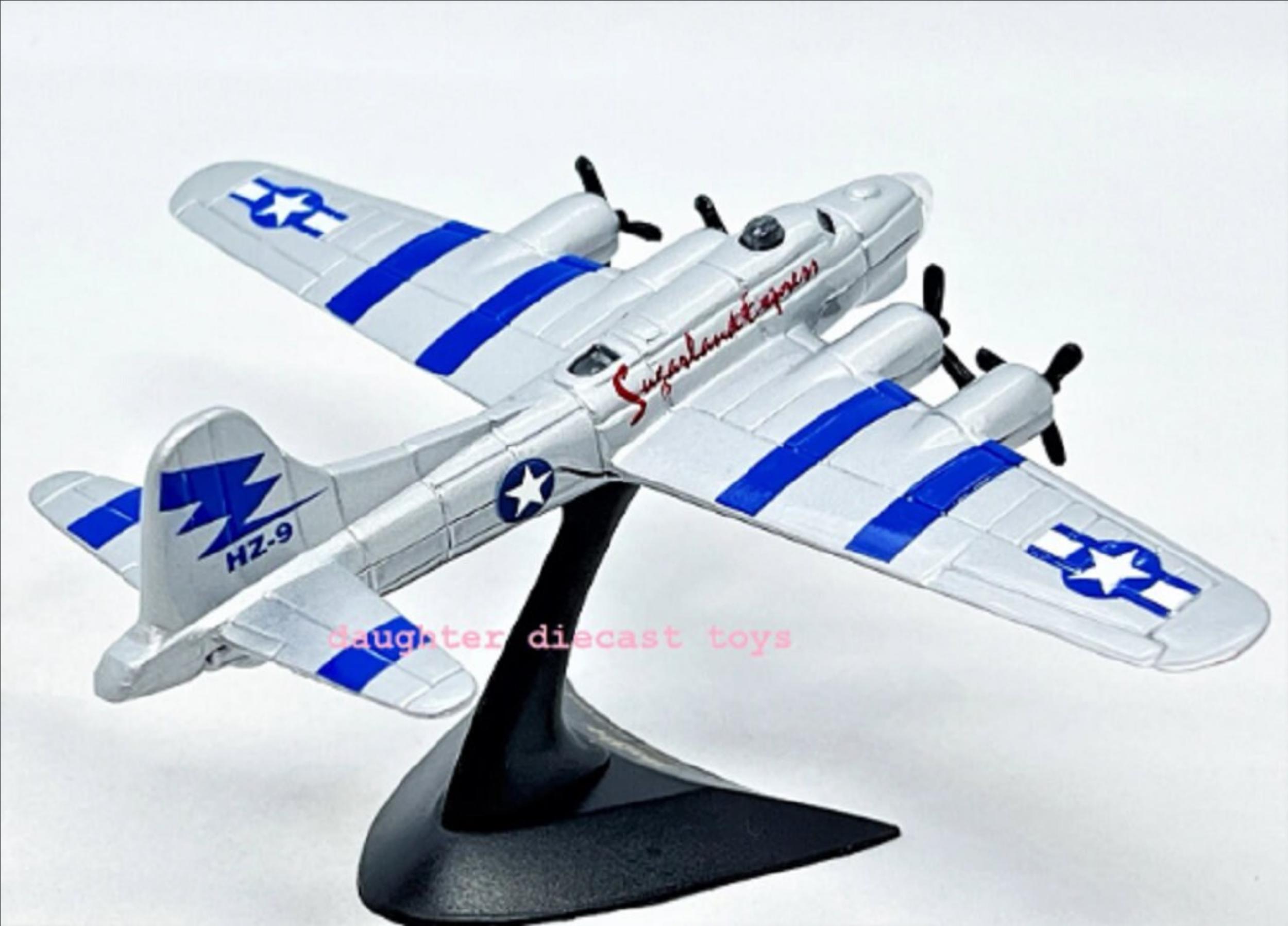
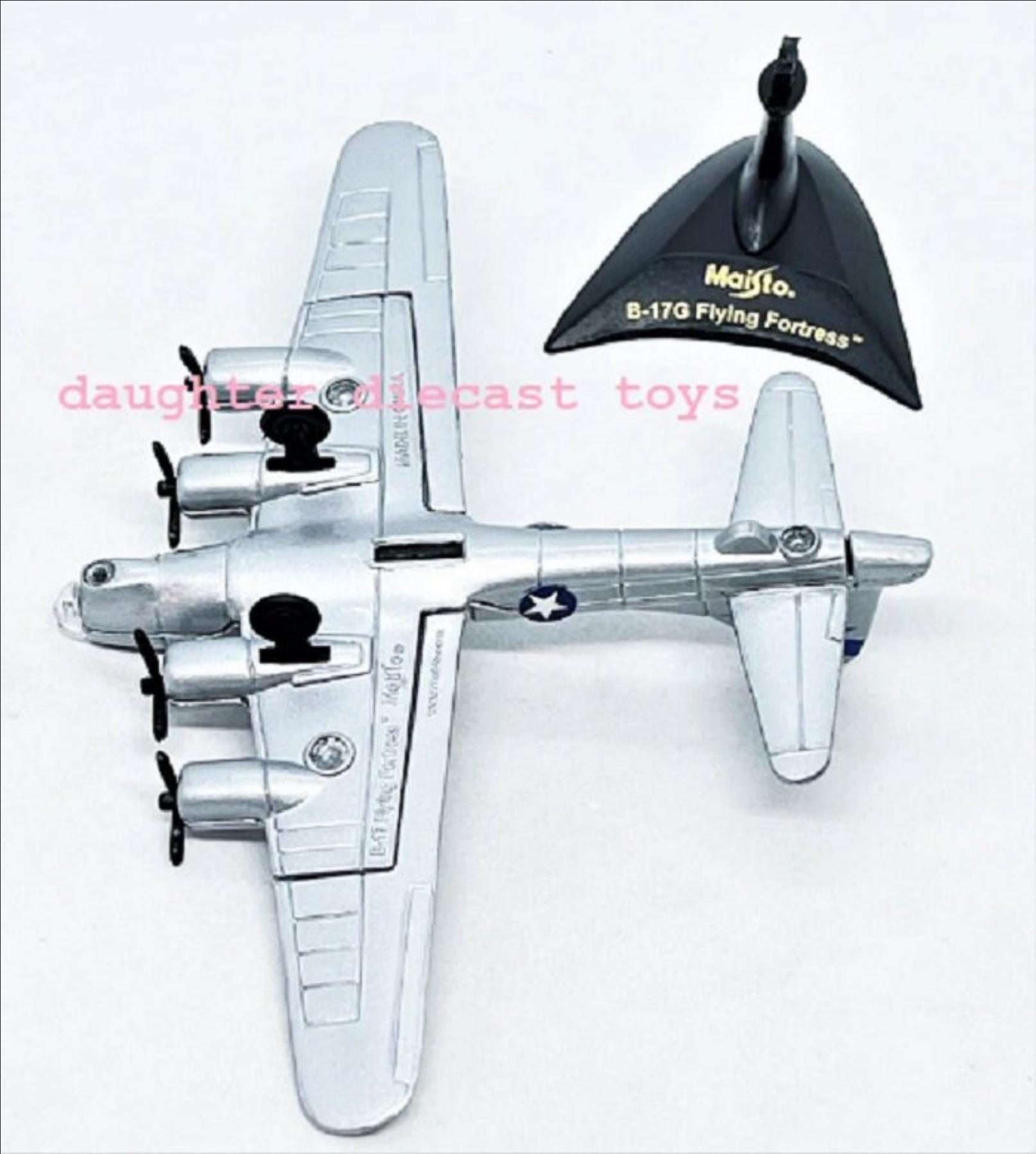

Vintage WWII B-17 BOMBER Flying Fortress-Adult Collector Diecast Metal Airplane-Pristine Condition-Perfect Gift for Aviation History Buffs!
$ 45.00

Fantastic looking Vintage WWII BOEING B-17G BOMBER/"FLYING FORTRESS". Adult
collector model-constructed of heavy die cast metal. Made by Maisto. Highly sought-after, hard to find vintage model! Scale=1/72 prox-measures 4"L x 5 1/2"W x 2 1/4" (mounted). This model is in pristine condition and has never been handled or displayed (until today for your photos). Perfect gift for Military aircraft, vintage toy collectors and Aviation History buffs! We ship fast & safe worldwide every day! READ Aircraft bio below...
•
•
•FOR A LIMITED TIME
•
•
•Purchases totaling $35 and above qualify for FREE shipping to USA! Add more items to your Etsy shopping cart to save $$$.NOTE: My dad owned a Diecast toy store for 30 years. I inherited the store inventory when he passed away many years ago. I am just now, beginning to sell the mint condition vintage models. All are store-inventory is new-old-stock, models have never been "played with". Please visit often-as I am adding more cool stuff every day!AIRCRAFT BIO:The Boeing B-17 Flying Fortress is a four-engined heavy bomber developed in the 1930s for the United States Army Air Corps (USAAC). Fast and high-flying for a bomber of its era, the B-17 was used primarily in the European Theater of Operations and dropped more bombs than any other aircraft during World War II. It is the third-most produced bomber of all time, behind the four-engined Consolidated B-24 Liberator and the multirole, twin-engined Junkers Ju 88. It was also employed as a transport, antisubmarine aircraft, drone controller, and search-and-rescue aircraft.In a USAAC competition, Boeing's prototype Model 299/XB-17 outperformed two other entries but crashed, losing the initial 200-bomber contract to the Douglas B-18 Bolo. Still, the Air Corps ordered 13 more B-17s for further evaluation, then introduced it into service in 1938. The B-17 evolved through numerous design advances[4][5] but from its inception, the USAAC (later, the USAAF) promoted the aircraft as a strategic weapon. It was a relatively fast, high-flying, long-range bomber with heavy defensive armament at the expense of bombload. It also developed a reputation for toughness based upon stories and photos of badly damaged B-17s safely returning to base.The B-17 saw early action in the Pacific War, where it conducted raids against Japanese shipping and airfields.[6] But it was primarily employed by the USAAF in the daylight strategic bombing campaign over Europe, complementing RAF Bomber Command's night-time area bombing of German industrial, military and civilian targets.[7] Of the roughly 1.5 million tons of bombs dropped on Nazi Germany and its occupied territories by U.S. aircraft, over 640 000 tons (42.6%) were dropped from B-17s.[8]As of November 2022, four aircraft remain airworthy, none flown in combat. Dozens more are in storage or on static display. The oldest of these is a D-series flown in combat in the Pacific on the first day of the United States' involvement in World War II.Operational historyBoeing B-17E Flying Fortress of the 19th Bombardment Group USAAF, summer 1942B-17 Flying Fortresses from the 398th Bombardment Group flying a bombing mission to Neumünster, Germany, on 13 April 1945. The B-17 began operations in World War II with the Royal Air Force (RAF) in 1941, and in the Southwest Pacific with the U.S. Army. The 19th Bombardment Group had deployed to Clark Field in the Philippines a few weeks before the Japanese attack on Pearl Harbor as the first of a planned heavy bomber buildup in the Pacific. Half of the group's B-17s were wiped out on 8 December 1941 when they were caught on the ground during refueling and rearming for a planned attack on Japanese airfields on Formosa. The small force of B-17s operated against the Japanese invasion force until they were withdrawn to Darwin, in Australia's Northern Territory. In early 1942, the 7th Bombardment Group began arriving in Java with a mixed force of B-17s and LB-30/B-24s.[73] A squadron of B-17s from this force detached to the Middle East to join the First Provisional Bombardment Group, thus becoming the first American B-17 squadron to go to war against the Germans.[citation needed] After the defeat in Java, the 19th withdrew to Australia, where it continued in combat until it was sent home by General George C. Kenney when he arrived in Australia in mid-1942.[74] In July 1942, the first USAAF B-17s were sent to England to join the Eighth Air Force. Later that year, two groups moved to Algeria to join Twelfth Air Force for operations in North Africa. The B-17s were primarily involved in the daylight precision strategic bombing campaign against German targets ranging from U-boat pens, docks, warehouses, and airfields to industrial targets such as aircraft factories.[75] In the campaign against German aircraft forces in preparation for the invasion of France, B-17 and B-24 raids were directed against German aircraft production while their presence drew the Luftwaffe fighters into battle with Allied fighters.[7]During World War II, the B-17 equipped 32 overseas combat groups, inventory peaking in August 1944 at 4,574 USAAF aircraft worldwide.[76] The British heavy bombers, the Avro Lancaster and Handley Page Halifax, dropped 608,612 long tons (681,645 short tons) and 224,207 long tons (251,112 short tons)[77] respectively.RAF useRAF Fortress I serial AN529, with He 111H-style "bathtub" ventral gondola The RAF entered World War II with no heavy bomber of its own in service; the biggest available were long-range medium bombers such as the Vickers Wellington, which could carry up to 4,500 pounds (2,000 kg) of bombs.[78] While the Short Stirling and Handley Page Halifax became its primary bombers by 1941, in early 1940, the RAF agreed with the U.S. Army Air Corps to acquire 20 B-17Cs, which were given the service name Fortress I. Their first operation, against Wilhelmshaven on 8 July 1941 was unsuccessful.[79][80] On 24 July three B-17s of 90 Squadron took part in a raid on the German capital ship Gneisenau and Prinz Eugen anchored in Brest from 30,000 ft (9,100 m), to draw German fighters away from 18 Handley Page Hampdens attacking at lower altitudes, and in time for 79 Vickers Wellingtons to attack later with the German fighters refueling. The operation did not work as expected, with 90 Squadron's Fortresses being unopposed.[81][82][83]By September, the RAF had lost eight B-17Cs in combat and had experienced numerous mechanical problems, and Bomber Command abandoned daylight bombing raids using the Fortress I because of the aircraft's poor performance. The experience showed both the RAF and USAAF that the B-17C was not ready for combat, and that improved defenses, larger bomb loads, and more accurate bombing methods were required. However, the USAAF continued using the B-17 as a day bomber, despite misgivings by the RAF that attempts at daylight bombing would be ineffective.[84]As use by Bomber Command had been curtailed, the RAF transferred its remaining Fortress I aircraft to Coastal Command for use as a long-range maritime patrol aircraft.[85] These were augmented starting in July 1942 by 45 Fortress Mk IIA (B-17E) followed by 19 Fortress Mk II (B-17F) and three Fortress Mk III (B-17G). A Fortress IIA from No. 206 Squadron RAF sank U-627 on 27 October 1942, the first of 11 U-boat kills credited to RAF Fortress bombers during the war.[86]As sufficient Consolidated Liberators finally became available, Coastal Command withdrew the Fortress from the Azores, transferring the type to the meteorological reconnaissance role. Three squadrons undertook Met profiles from airfields in Iceland, Scotland, and England, gathering data for vital weather forecasting purposes.The RAF's No. 223 Squadron, as part of 100 Group, operated several Fortresses equipped with an electronic warfare system known as "Airborne Cigar" (ABC). This was operated by German-speaking radio operators to identify and jam German ground controllers' broadcasts to their nightfighters. They could also pose as ground controllers themselves to steer nightfighters away from the bomber streams.[87]Initial USAAF operations over EuropeMarks and letters on the tails of B-17 during WWII in Europe The air corps – renamed United States Army Air Forces (USAAF) on 20 June 1941 – used the B-17 and other bombers to bomb from high altitudes with the aid of the then-secret Norden bombsight, known as the "Blue Ox",[88][89] which was an optical electromechanical gyrostabilized analog computer.[90] The device was able to determine, from variables put in by the bombardier, the point at which the aircraft's bombs should be released to hit the target. The bombardier essentially took over flight control of the aircraft during the bomb run, maintaining a level altitude during the final moments before release.[91]The USAAF began building up its air forces in Europe using B-17Es soon after entering the war. The first Eighth Air Force units arrived in High Wycombe, England, on 12 May 1942, to form the 97th Bomb Group.[92] On 17 August 1942, 12 B-17Es of the 97th, with the lead aircraft piloted by Major Paul Tibbets and carrying Brigadier General Ira Eaker as an observer, were close escorted by four squadrons of RAF Spitfire IXs (and a further five squadrons of Spitfire Vs to cover the withdrawal) on the first USAAF heavy bomber raid over Europe, against the large railroad marshalling yards at Rouen-Sotteville in France, while a further six aircraft flew a diversionary raid along the French coast.[93][94] The operation, carried out in good visibility, was a success, with only minor damage to one aircraft, unrelated to enemy action, and half the bombs landing in the target area.[95] The raid helped allay British doubts about the capabilities of American heavy bombers in operations over Europe.[citation needed]Two additional groups arrived in Britain at the same time, bringing with them the first B-17Fs, which served as the primary AAF heavy bomber fighting the Germans until September 1943. As the raids of the American bombing campaign grew in numbers and frequency, German interception efforts grew in strength (such as during the attempted bombing of Kiel on 13 June 1943[96]), such that unescorted bombing missions came to be discouraged.[97]Combined offensive The two different strategies of the American and British bomber commands were organized at the Casablanca Conference in January 1943. The resulting "Combined Bomber Offensive" weakened the Wehrmacht, destroyed German morale, and established air superiority through Operation Pointblank's destruction of German fighter strength in preparation for a ground offensive.[7] The USAAF bombers attacked by day, with British operations – chiefly against industrial cities – by night.[98] B-17F formation over Schweinfurt, Germany, 17 August 1943Boeing B-17F radar bombing through clouds: Bremen, Germany, on 13 November 1943 Operation Pointblank opened with attacks on targets in Western Europe. General Ira C. Eaker and the Eighth Air Force placed highest priority on attacks on the German aircraft industry, especially fighter assembly plants, engine factories, and ball-bearing manufacturers.[7] Attacks began in April 1943 on heavily fortified key industrial plants in Bremen and Recklinghausen.[99]Since the airfield bombings were not appreciably reducing German fighter strength, additional B-17 groups were formed, and Eaker ordered major missions deeper into Germany against important industrial targets. The 8th Air Force then targeted the ball-bearing factories in Schweinfurt, hoping to cripple the war effort there. The first raid on 17 August 1943 did not result in critical damage to the factories, with the 230 attacking B-17s being intercepted by an estimated 300 Luftwaffe fighters. The Germans shot down 36 aircraft with the loss of 200 men, and coupled with a raid earlier in the day against Regensburg, a total of 60 B-17s were lost that day.[100]A second attempt on Schweinfurt on 14 October 1943 later came to be known as "Black Thursday".[101] While the attack was successful at disrupting the entire works, severely curtailing work there for the remainder of the war, it was at an extreme cost.[102] Of the 291 attacking Fortresses, 60 were shot down over Germany, five crashed on approach to Britain, and 12 more were scrapped due to damage – a loss of 77 B-17s.[103] Additionally, 122 bombers were damaged and needed repairs before their next flights. Of 2,900 men in the crews, about 650 did not return, although some survived as prisoners of war. Only 33 bombers landed without damage. These losses were a result of concentrated attacks by over 300 German fighters.[104] B-17G of the 384th Bomb Group on the bomb run Such high losses of aircrews could not be sustained, and the USAAF, recognizing the vulnerability of heavy bombers to interceptors when operating alone, suspended daylight bomber raids deep into Germany until the development of an escort fighter that could protect the bombers all the way from the United Kingdom to Germany and back. At the same time, the German nightfighting ability noticeably improved to counter the nighttime strikes, challenging the conventional faith in the cover of darkness.[105] The 8th Air Force alone lost 176 bombers in October 1943,[106] and was to suffer similar casualties on 11 January 1944 on missions to Oschersleben, Halberstadt, and Brunswick. Lieutenant General James Doolittle, commander of the 8th, had ordered the second Schweinfurt mission to be cancelled as the weather deteriorated, but the lead units had already entered hostile air space and continued with the mission. Most of the escorts turned back or missed the rendezvous, and as a result, 60 B-17s were destroyed.[107][108]A third raid on Schweinfurt on 24 February 1944 highlighted what came to be known as "Big Week",[109] during which the bombing missions were directed against German aircraft production.[105] German fighters needed to respond, and the North American P-51 Mustang and Republic P-47 Thunderbolt fighters (equipped with improved drop tanks to extend their range) accompanying the American heavies all the way to and from the targets engaged them.[110] The escort fighters reduced the loss rate to below 7%, with a total of 247 B-17s lost in 3,500 sorties while taking part in the Big Week raids.[111]By September 1944, 27 of the 42 bomb groups of the 8th Air Force and six of the 21 groups of the 15th Air Force used B-17s. Losses to flak continued to take a high toll of heavy bombers through 1944, but the war in Europe was being won by the Allies. And by 27 April 1945, 2 days after the last heavy bombing mission in Europe, the rate of aircraft loss was so low that replacement aircraft were no longer arriving and the number of bombers per bomb group was reduced. The Combined Bomber Offensive was effectively complete.[112]Designed By: Boeing Company Model: B-17G Flying Fortress Army Air Corps Serial Number: 44-83563 Built Under License By: Douglas Aircraft Company Prototype First Flight: July 28, 1935 Crew: Ten—Pilot, Co-pilot, Navigator, Bombardier, Flight Engineer / Top Turret Gunner, Radio Operator, 2 Waist Gunners, Tail Gunner and Ball Turret Gunner Delivery Date: April 7, 1945 Power: Four 1,200-horsepower Wright Cyclone R-1820, 9-cylinder radial piston engines driving 11 feet, 7 inches in diameter Hamilton Standard propellers Weight: Basic Empty Weight – 34,000 pounds, Gross Weight (Wartime) – 65,500 pounds Fuel Capacity: 1,700 gallons Range: 1,850 miles. Range could be extended when equipped with “Tokyo Tanks” which provided a total capacity of 3,630 gallons. Wing Span: 103 feet, 9 inches Length: 74 feet, 4 inches Height: 19 feet, 1 inches Service Ceiling: 35,600 feet Typical Armament: Thirteen Browning M-2 .50 caliber machine guns. Fire rate approximately 13 rounds per second, per gun Typical Bomb Load: Maximum normal load – 8,000 pounds With special external racks, maximum normal short-range bomb load – 17,600 pounds Number Built: 12,731, with production of the “G” Model by Boeing, Douglas and Lockheed reaching 8,680 Speed: Maximum – 300 miles per hour at 30,000 feet Colors: 447th Bomb Group
collector model-constructed of heavy die cast metal. Made by Maisto. Highly sought-after, hard to find vintage model! Scale=1/72 prox-measures 4"L x 5 1/2"W x 2 1/4" (mounted). This model is in pristine condition and has never been handled or displayed (until today for your photos). Perfect gift for Military aircraft, vintage toy collectors and Aviation History buffs! We ship fast & safe worldwide every day! READ Aircraft bio below...
•
•
•FOR A LIMITED TIME
•
•
•Purchases totaling $35 and above qualify for FREE shipping to USA! Add more items to your Etsy shopping cart to save $$$.NOTE: My dad owned a Diecast toy store for 30 years. I inherited the store inventory when he passed away many years ago. I am just now, beginning to sell the mint condition vintage models. All are store-inventory is new-old-stock, models have never been "played with". Please visit often-as I am adding more cool stuff every day!AIRCRAFT BIO:The Boeing B-17 Flying Fortress is a four-engined heavy bomber developed in the 1930s for the United States Army Air Corps (USAAC). Fast and high-flying for a bomber of its era, the B-17 was used primarily in the European Theater of Operations and dropped more bombs than any other aircraft during World War II. It is the third-most produced bomber of all time, behind the four-engined Consolidated B-24 Liberator and the multirole, twin-engined Junkers Ju 88. It was also employed as a transport, antisubmarine aircraft, drone controller, and search-and-rescue aircraft.In a USAAC competition, Boeing's prototype Model 299/XB-17 outperformed two other entries but crashed, losing the initial 200-bomber contract to the Douglas B-18 Bolo. Still, the Air Corps ordered 13 more B-17s for further evaluation, then introduced it into service in 1938. The B-17 evolved through numerous design advances[4][5] but from its inception, the USAAC (later, the USAAF) promoted the aircraft as a strategic weapon. It was a relatively fast, high-flying, long-range bomber with heavy defensive armament at the expense of bombload. It also developed a reputation for toughness based upon stories and photos of badly damaged B-17s safely returning to base.The B-17 saw early action in the Pacific War, where it conducted raids against Japanese shipping and airfields.[6] But it was primarily employed by the USAAF in the daylight strategic bombing campaign over Europe, complementing RAF Bomber Command's night-time area bombing of German industrial, military and civilian targets.[7] Of the roughly 1.5 million tons of bombs dropped on Nazi Germany and its occupied territories by U.S. aircraft, over 640 000 tons (42.6%) were dropped from B-17s.[8]As of November 2022, four aircraft remain airworthy, none flown in combat. Dozens more are in storage or on static display. The oldest of these is a D-series flown in combat in the Pacific on the first day of the United States' involvement in World War II.Operational historyBoeing B-17E Flying Fortress of the 19th Bombardment Group USAAF, summer 1942B-17 Flying Fortresses from the 398th Bombardment Group flying a bombing mission to Neumünster, Germany, on 13 April 1945. The B-17 began operations in World War II with the Royal Air Force (RAF) in 1941, and in the Southwest Pacific with the U.S. Army. The 19th Bombardment Group had deployed to Clark Field in the Philippines a few weeks before the Japanese attack on Pearl Harbor as the first of a planned heavy bomber buildup in the Pacific. Half of the group's B-17s were wiped out on 8 December 1941 when they were caught on the ground during refueling and rearming for a planned attack on Japanese airfields on Formosa. The small force of B-17s operated against the Japanese invasion force until they were withdrawn to Darwin, in Australia's Northern Territory. In early 1942, the 7th Bombardment Group began arriving in Java with a mixed force of B-17s and LB-30/B-24s.[73] A squadron of B-17s from this force detached to the Middle East to join the First Provisional Bombardment Group, thus becoming the first American B-17 squadron to go to war against the Germans.[citation needed] After the defeat in Java, the 19th withdrew to Australia, where it continued in combat until it was sent home by General George C. Kenney when he arrived in Australia in mid-1942.[74] In July 1942, the first USAAF B-17s were sent to England to join the Eighth Air Force. Later that year, two groups moved to Algeria to join Twelfth Air Force for operations in North Africa. The B-17s were primarily involved in the daylight precision strategic bombing campaign against German targets ranging from U-boat pens, docks, warehouses, and airfields to industrial targets such as aircraft factories.[75] In the campaign against German aircraft forces in preparation for the invasion of France, B-17 and B-24 raids were directed against German aircraft production while their presence drew the Luftwaffe fighters into battle with Allied fighters.[7]During World War II, the B-17 equipped 32 overseas combat groups, inventory peaking in August 1944 at 4,574 USAAF aircraft worldwide.[76] The British heavy bombers, the Avro Lancaster and Handley Page Halifax, dropped 608,612 long tons (681,645 short tons) and 224,207 long tons (251,112 short tons)[77] respectively.RAF useRAF Fortress I serial AN529, with He 111H-style "bathtub" ventral gondola The RAF entered World War II with no heavy bomber of its own in service; the biggest available were long-range medium bombers such as the Vickers Wellington, which could carry up to 4,500 pounds (2,000 kg) of bombs.[78] While the Short Stirling and Handley Page Halifax became its primary bombers by 1941, in early 1940, the RAF agreed with the U.S. Army Air Corps to acquire 20 B-17Cs, which were given the service name Fortress I. Their first operation, against Wilhelmshaven on 8 July 1941 was unsuccessful.[79][80] On 24 July three B-17s of 90 Squadron took part in a raid on the German capital ship Gneisenau and Prinz Eugen anchored in Brest from 30,000 ft (9,100 m), to draw German fighters away from 18 Handley Page Hampdens attacking at lower altitudes, and in time for 79 Vickers Wellingtons to attack later with the German fighters refueling. The operation did not work as expected, with 90 Squadron's Fortresses being unopposed.[81][82][83]By September, the RAF had lost eight B-17Cs in combat and had experienced numerous mechanical problems, and Bomber Command abandoned daylight bombing raids using the Fortress I because of the aircraft's poor performance. The experience showed both the RAF and USAAF that the B-17C was not ready for combat, and that improved defenses, larger bomb loads, and more accurate bombing methods were required. However, the USAAF continued using the B-17 as a day bomber, despite misgivings by the RAF that attempts at daylight bombing would be ineffective.[84]As use by Bomber Command had been curtailed, the RAF transferred its remaining Fortress I aircraft to Coastal Command for use as a long-range maritime patrol aircraft.[85] These were augmented starting in July 1942 by 45 Fortress Mk IIA (B-17E) followed by 19 Fortress Mk II (B-17F) and three Fortress Mk III (B-17G). A Fortress IIA from No. 206 Squadron RAF sank U-627 on 27 October 1942, the first of 11 U-boat kills credited to RAF Fortress bombers during the war.[86]As sufficient Consolidated Liberators finally became available, Coastal Command withdrew the Fortress from the Azores, transferring the type to the meteorological reconnaissance role. Three squadrons undertook Met profiles from airfields in Iceland, Scotland, and England, gathering data for vital weather forecasting purposes.The RAF's No. 223 Squadron, as part of 100 Group, operated several Fortresses equipped with an electronic warfare system known as "Airborne Cigar" (ABC). This was operated by German-speaking radio operators to identify and jam German ground controllers' broadcasts to their nightfighters. They could also pose as ground controllers themselves to steer nightfighters away from the bomber streams.[87]Initial USAAF operations over EuropeMarks and letters on the tails of B-17 during WWII in Europe The air corps – renamed United States Army Air Forces (USAAF) on 20 June 1941 – used the B-17 and other bombers to bomb from high altitudes with the aid of the then-secret Norden bombsight, known as the "Blue Ox",[88][89] which was an optical electromechanical gyrostabilized analog computer.[90] The device was able to determine, from variables put in by the bombardier, the point at which the aircraft's bombs should be released to hit the target. The bombardier essentially took over flight control of the aircraft during the bomb run, maintaining a level altitude during the final moments before release.[91]The USAAF began building up its air forces in Europe using B-17Es soon after entering the war. The first Eighth Air Force units arrived in High Wycombe, England, on 12 May 1942, to form the 97th Bomb Group.[92] On 17 August 1942, 12 B-17Es of the 97th, with the lead aircraft piloted by Major Paul Tibbets and carrying Brigadier General Ira Eaker as an observer, were close escorted by four squadrons of RAF Spitfire IXs (and a further five squadrons of Spitfire Vs to cover the withdrawal) on the first USAAF heavy bomber raid over Europe, against the large railroad marshalling yards at Rouen-Sotteville in France, while a further six aircraft flew a diversionary raid along the French coast.[93][94] The operation, carried out in good visibility, was a success, with only minor damage to one aircraft, unrelated to enemy action, and half the bombs landing in the target area.[95] The raid helped allay British doubts about the capabilities of American heavy bombers in operations over Europe.[citation needed]Two additional groups arrived in Britain at the same time, bringing with them the first B-17Fs, which served as the primary AAF heavy bomber fighting the Germans until September 1943. As the raids of the American bombing campaign grew in numbers and frequency, German interception efforts grew in strength (such as during the attempted bombing of Kiel on 13 June 1943[96]), such that unescorted bombing missions came to be discouraged.[97]Combined offensive The two different strategies of the American and British bomber commands were organized at the Casablanca Conference in January 1943. The resulting "Combined Bomber Offensive" weakened the Wehrmacht, destroyed German morale, and established air superiority through Operation Pointblank's destruction of German fighter strength in preparation for a ground offensive.[7] The USAAF bombers attacked by day, with British operations – chiefly against industrial cities – by night.[98] B-17F formation over Schweinfurt, Germany, 17 August 1943Boeing B-17F radar bombing through clouds: Bremen, Germany, on 13 November 1943 Operation Pointblank opened with attacks on targets in Western Europe. General Ira C. Eaker and the Eighth Air Force placed highest priority on attacks on the German aircraft industry, especially fighter assembly plants, engine factories, and ball-bearing manufacturers.[7] Attacks began in April 1943 on heavily fortified key industrial plants in Bremen and Recklinghausen.[99]Since the airfield bombings were not appreciably reducing German fighter strength, additional B-17 groups were formed, and Eaker ordered major missions deeper into Germany against important industrial targets. The 8th Air Force then targeted the ball-bearing factories in Schweinfurt, hoping to cripple the war effort there. The first raid on 17 August 1943 did not result in critical damage to the factories, with the 230 attacking B-17s being intercepted by an estimated 300 Luftwaffe fighters. The Germans shot down 36 aircraft with the loss of 200 men, and coupled with a raid earlier in the day against Regensburg, a total of 60 B-17s were lost that day.[100]A second attempt on Schweinfurt on 14 October 1943 later came to be known as "Black Thursday".[101] While the attack was successful at disrupting the entire works, severely curtailing work there for the remainder of the war, it was at an extreme cost.[102] Of the 291 attacking Fortresses, 60 were shot down over Germany, five crashed on approach to Britain, and 12 more were scrapped due to damage – a loss of 77 B-17s.[103] Additionally, 122 bombers were damaged and needed repairs before their next flights. Of 2,900 men in the crews, about 650 did not return, although some survived as prisoners of war. Only 33 bombers landed without damage. These losses were a result of concentrated attacks by over 300 German fighters.[104] B-17G of the 384th Bomb Group on the bomb run Such high losses of aircrews could not be sustained, and the USAAF, recognizing the vulnerability of heavy bombers to interceptors when operating alone, suspended daylight bomber raids deep into Germany until the development of an escort fighter that could protect the bombers all the way from the United Kingdom to Germany and back. At the same time, the German nightfighting ability noticeably improved to counter the nighttime strikes, challenging the conventional faith in the cover of darkness.[105] The 8th Air Force alone lost 176 bombers in October 1943,[106] and was to suffer similar casualties on 11 January 1944 on missions to Oschersleben, Halberstadt, and Brunswick. Lieutenant General James Doolittle, commander of the 8th, had ordered the second Schweinfurt mission to be cancelled as the weather deteriorated, but the lead units had already entered hostile air space and continued with the mission. Most of the escorts turned back or missed the rendezvous, and as a result, 60 B-17s were destroyed.[107][108]A third raid on Schweinfurt on 24 February 1944 highlighted what came to be known as "Big Week",[109] during which the bombing missions were directed against German aircraft production.[105] German fighters needed to respond, and the North American P-51 Mustang and Republic P-47 Thunderbolt fighters (equipped with improved drop tanks to extend their range) accompanying the American heavies all the way to and from the targets engaged them.[110] The escort fighters reduced the loss rate to below 7%, with a total of 247 B-17s lost in 3,500 sorties while taking part in the Big Week raids.[111]By September 1944, 27 of the 42 bomb groups of the 8th Air Force and six of the 21 groups of the 15th Air Force used B-17s. Losses to flak continued to take a high toll of heavy bombers through 1944, but the war in Europe was being won by the Allies. And by 27 April 1945, 2 days after the last heavy bombing mission in Europe, the rate of aircraft loss was so low that replacement aircraft were no longer arriving and the number of bombers per bomb group was reduced. The Combined Bomber Offensive was effectively complete.[112]Designed By: Boeing Company Model: B-17G Flying Fortress Army Air Corps Serial Number: 44-83563 Built Under License By: Douglas Aircraft Company Prototype First Flight: July 28, 1935 Crew: Ten—Pilot, Co-pilot, Navigator, Bombardier, Flight Engineer / Top Turret Gunner, Radio Operator, 2 Waist Gunners, Tail Gunner and Ball Turret Gunner Delivery Date: April 7, 1945 Power: Four 1,200-horsepower Wright Cyclone R-1820, 9-cylinder radial piston engines driving 11 feet, 7 inches in diameter Hamilton Standard propellers Weight: Basic Empty Weight – 34,000 pounds, Gross Weight (Wartime) – 65,500 pounds Fuel Capacity: 1,700 gallons Range: 1,850 miles. Range could be extended when equipped with “Tokyo Tanks” which provided a total capacity of 3,630 gallons. Wing Span: 103 feet, 9 inches Length: 74 feet, 4 inches Height: 19 feet, 1 inches Service Ceiling: 35,600 feet Typical Armament: Thirteen Browning M-2 .50 caliber machine guns. Fire rate approximately 13 rounds per second, per gun Typical Bomb Load: Maximum normal load – 8,000 pounds With special external racks, maximum normal short-range bomb load – 17,600 pounds Number Built: 12,731, with production of the “G” Model by Boeing, Douglas and Lockheed reaching 8,680 Speed: Maximum – 300 miles per hour at 30,000 feet Colors: 447th Bomb Group
Other Products