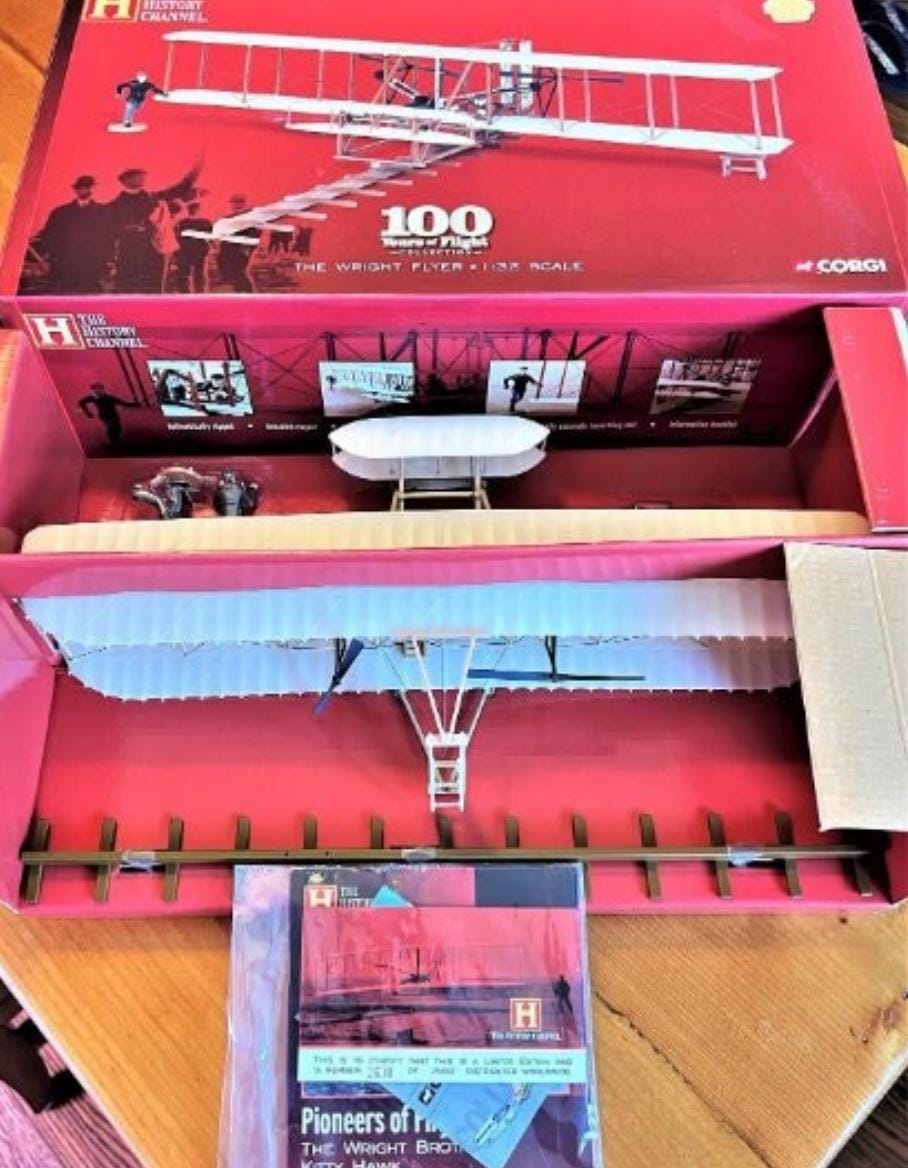
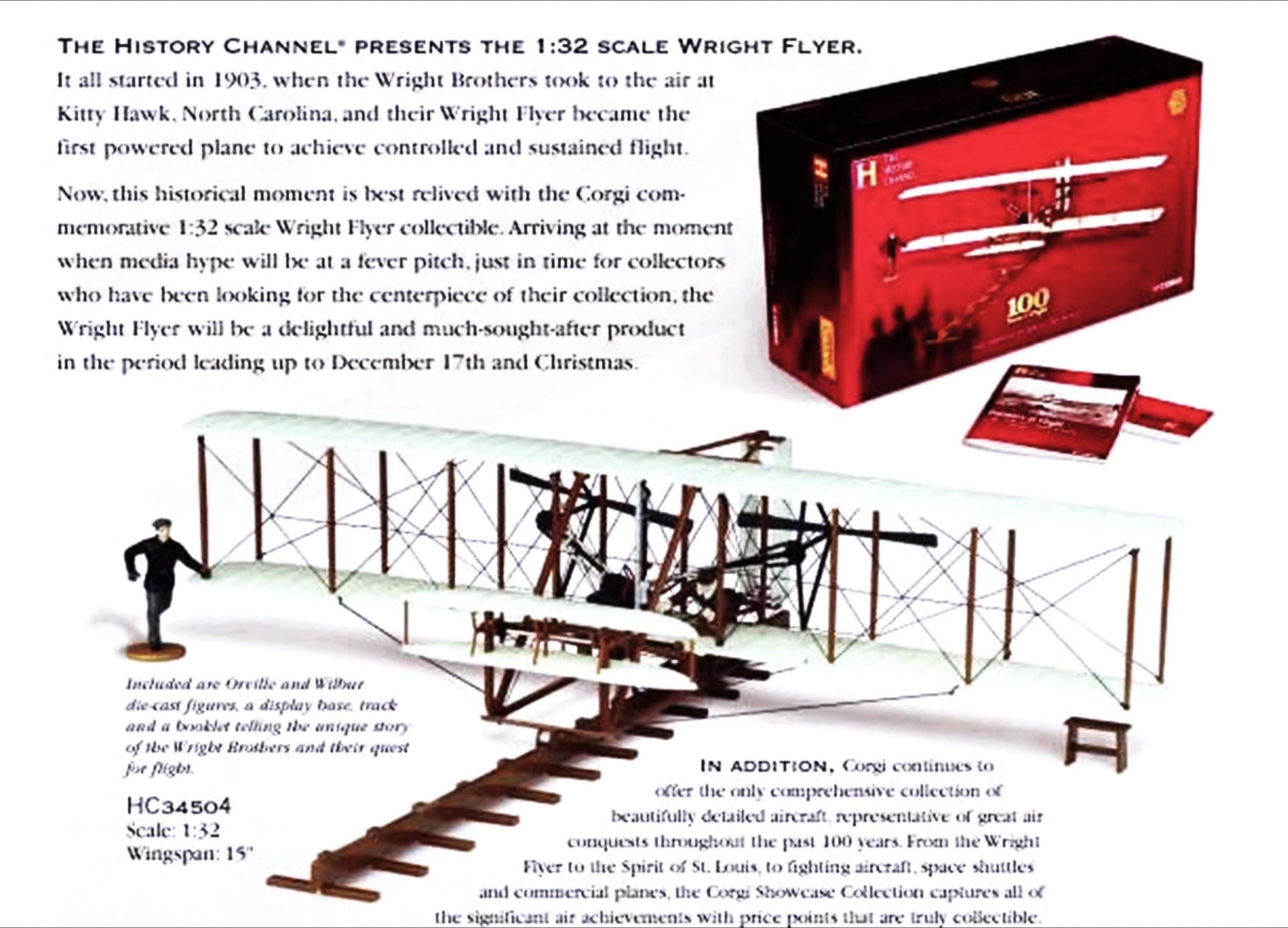
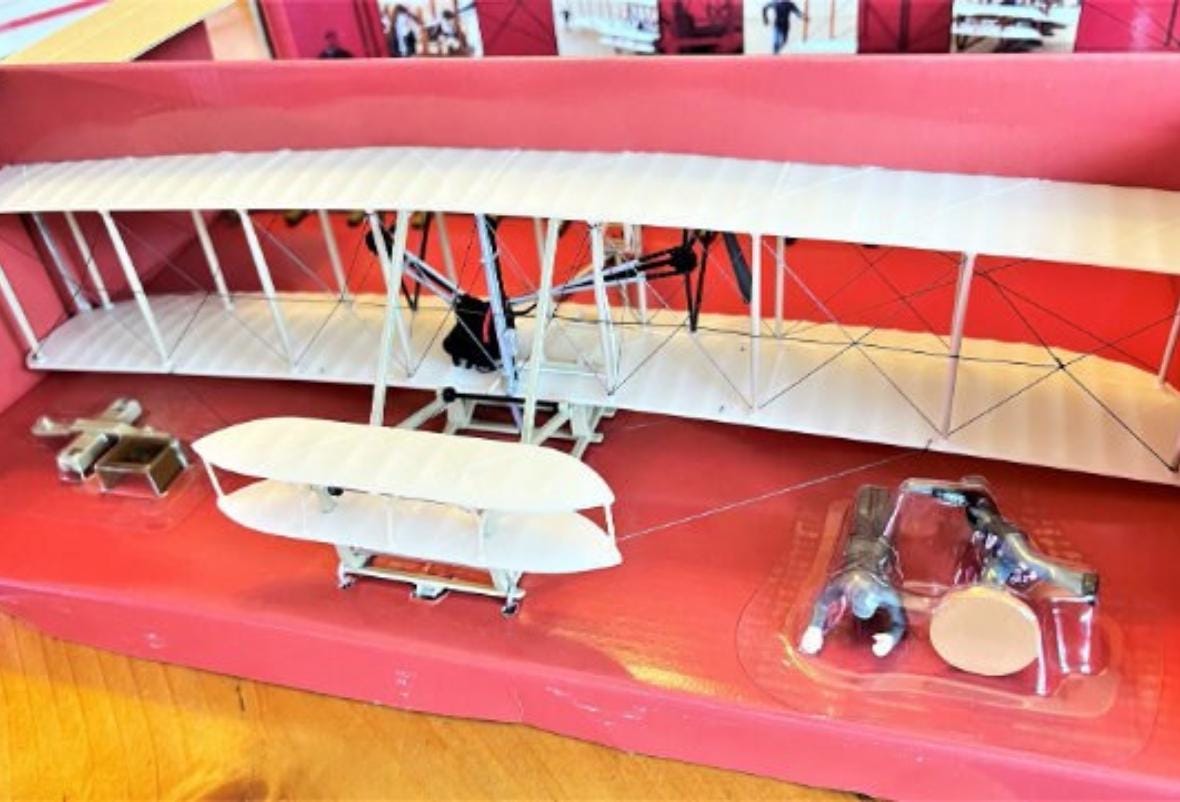
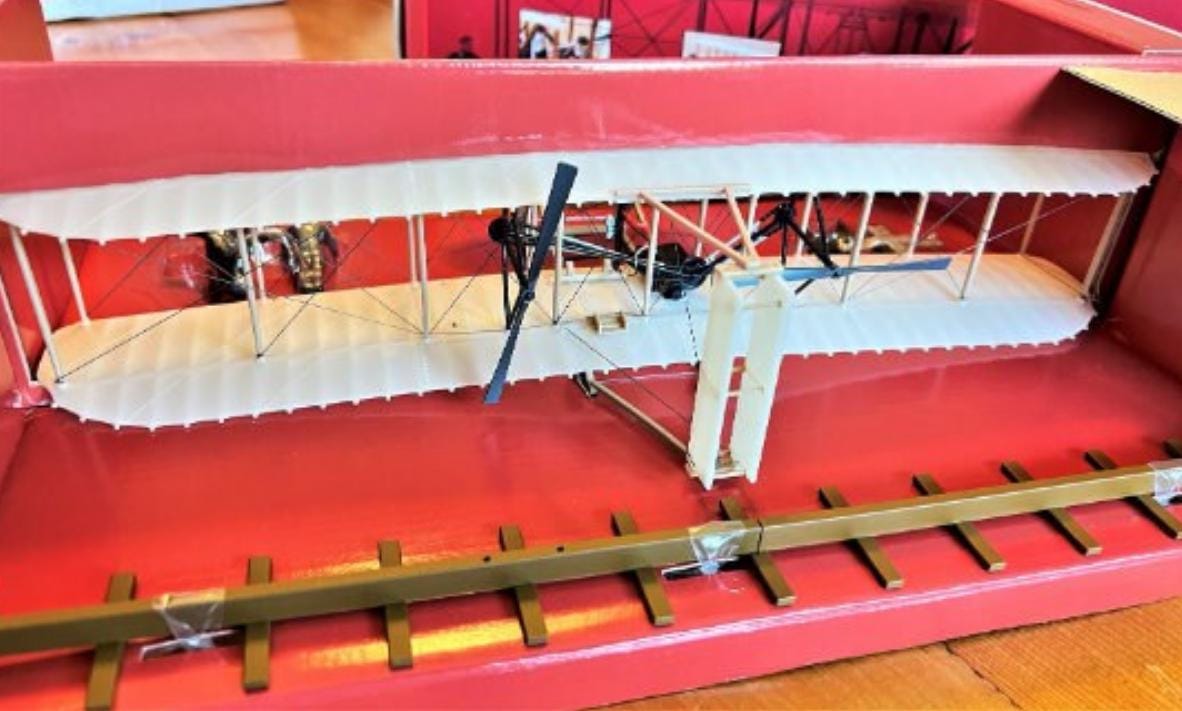
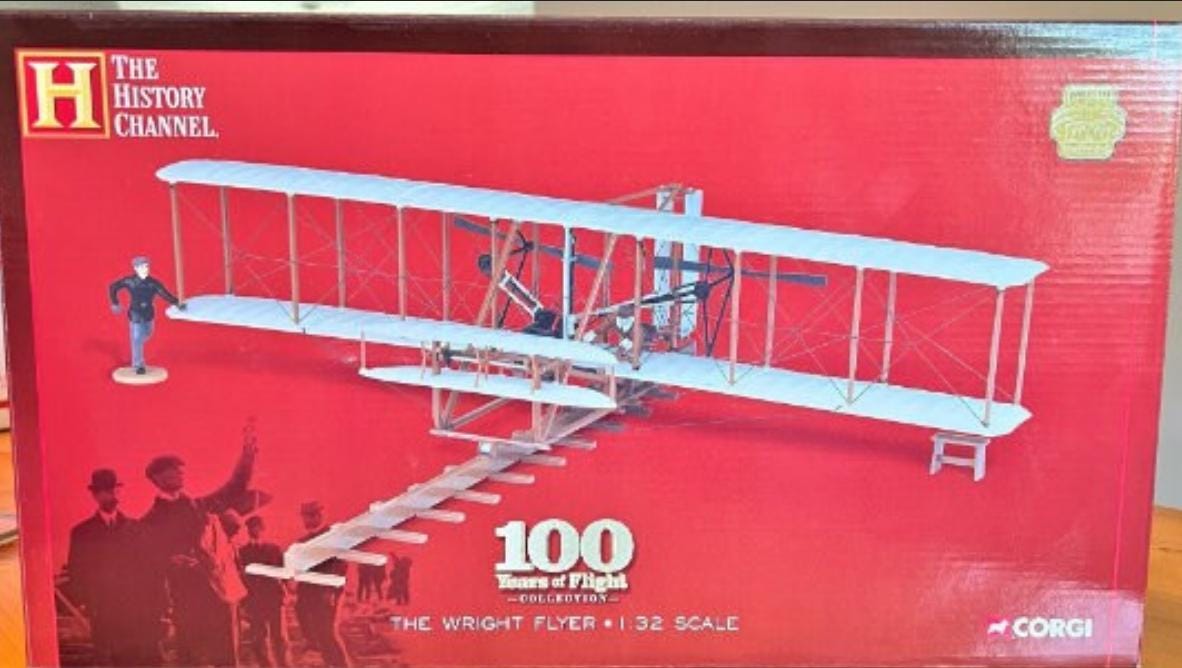

HUGE 15" Wright Flyer KITTYHAWK Airplane Made by Corgi. Pristine condition in box! Limited Ed. Beautiful gift for fans of Aviation History!
$ 125.00

Beautiful, massive & highly detailed replica model of WRIGHT BROTHERS FLYER
"KittyHawk" AIRPLANE. Made by Corgi. Huge size, scale= 1/32 measures 15"(wing tip to tip) x 8 1/2L x 3"H. Limited edition model. Fantastic-crisp box-includes certificate of authentication. Pristine condition model-never previously handled or displayed-until today for our photos. Super-cool gift for fans of Aviation History! 100% happiness guaranteed! This model qualifies for FREE shipping to anywhere in the USA. See Aircraft bio below....Note: My dad owned a Diecast toy store for 30 years. I inherited the store inventory when he passed away several years ago. I am (just now) able to bring myself to begin selling his cars-so they can be shared with the world. All pristine and mint condition vintage models will (eventually) be listed here on ETSY. All the inventory is NEW (vintage) merchandise-which was intended for retail sale. Please know-our diecast toys have NEVER been "played-with” we do not sell used, or damaged toys.
•
•
•FOR A LIMITED TIME
•
•
•Purchases totaling $35 and above qualify for FREE shipping to USA! Add more items to your Etsy shopping cart to save $$$.AIRCRAFT BIO:The Wright Flyer (also known as the Kitty Hawk,[3][4] Flyer I or the 1903 Flyer) made the first sustained flight by a manned heavier-than-air powered and controlled aircraft—an airplane—on December 17, 1903.[2] Invented and flown by brothers Orville and Wilbur Wright, it marked the beginning of the pioneer era of aviation.The aircraft is a single-place biplane design with anhedral (drooping) wings, front elevator (a canard) and rear rudder. It used a 12 horsepower gasoline engine powering two pusher propellers. Employing 'wing warping' it was relatively unstable and very difficult to fly.The Wright brothers flew it four times in a location now part of the town of Kill Devil Hills, about 4 miles (6 kilometers) south of Kitty Hawk, North Carolina. The airplane flew 852 ft (260 m) on its fourth and final flight, but was damaged on landing, and minutes later powerful gusts blew it over, wrecking it.The aircraft never flew again but was shipped home and subsequently restored by Orville. The aircraft was initially displayed in a place of honor at the London Science Museum until 1948 when the resolution of an acrimonious priority dispute finally allowed it to be displayed in the Smithsonian. It is now exhibited in the National Air and Space Museum in Washington, D.C.Design and constructionPatent planDetailed 3D model of the Wright Flyer The Flyer was based on the Wrights' experience testing gliders at Kitty Hawk between 1900 and 1902. Their last glider, the 1902 Glider, led directly to the design of the Wright Flyer.[5]The Wrights built the aircraft in 1903 using spruce for straight members of the airframe (such as wing spars) and ash wood for curved components (wing ribs).[6] The wings were designed with a 1-in-20 camber. Since they could not find a suitable automobile engine for the task, they commissioned their employee Charlie Taylor to build a new design from scratch, a lightweight 12-horsepower (9-kilowatt) gasoline engine, weighing 180 pounds (82 kg), with a 1-US-gallon (3.8 L; 0.83 imp gal) fuel tank.[7] A sprocket chain drive, borrowing from bicycle technology, powered the twin propellers, which were also made by hand.[5] In order to avoid the risk of torque effects from affecting the aircraft handling, one drive chain was crossed over so that the propellers rotated in opposite directions.[8] According to Taylor:They figured on four cylinders and estimated the bore and stroke at four inches. It took me six weeks to make that engine. The completed engine weighed 180 pounds and developed 12 horsepower at 1025 revolutions per minute...The body of the first engine was of cast aluminum, and was bored out on the lathe for independent cylinders. The pistons were cast iron, and these were turned down and grooved for piston rings. The rings were cast iron, too. A one-gallon fuel tank was suspended from a wing strut, and the gasoline fed by gravity down a tube to the engine. The fuel valve was an ordinary gaslight petcock. There was no carburetor as we know it today. The fuel was fed into a shallow chamber in the manifold. No spark plug. The spark was made by opening and closing of two contact points inside the combustion chamber. Dry batteries were used for starting the engine and then we switched onto a magneto bought from the Dayton Electric Company. There was no battery on the plane. Several lengths of speaking tube...were used in the radiator. We blocked-tested the motor before crating it for shipment to Kitty Hawk."[9]The 8.5 foot (2.6 m) long propellers were based on airfoil number 9 from their wind tunnel data, which provided the best "gliding angle" for different angles of attack. The propellers were connected to the engine by chains from the Indianapolis Chain Company, with a sprocket gear reduction of 23-to-8. Wilbur had calculated that slower turning blades generated greater thrust, and two of them were better than a single blade turning faster. Made from three laminations of spruce, the tips were covered with duck canvas, and the entire propeller painted with aluminum paint.[9]: 178–186 On November 5, 1903, the brothers tested their engine on the Wright Flyer at Kitty Hawk, but before they could tune the engine, the propeller hubs came loose. The drive shafts were sent back to Dayton for repair, and returned on 20 November. A hairline crack was discovered in one of the propeller shafts. Orville returned to Dayton on 30 November to make new spring steel shafts. On December 12, the brothers installed the new shafts on the Wright Flyer and tested it on their 60-foot (18 m) launching rail system that included a wheeled launching dolly. According to Orville:We had designed our propellers to give 90 pounds (41 kg) thrust at a speed of 330 rev. per minute (about 950 of engine), which we had figured would be the required amount for the machine weighing 630 pounds (290 kg).In practice tests, they were able to achieve a propeller rpm of 351, with a thrust of 132 pounds (60 kg), more than enough for their 700-pound (320 kg) flyer.[9]: 194–201 The Wright Flyer was a canard biplane configuration, with a wingspan of 40 feet 4 inches (12.29 m), a camber of 1-20, a wing area of 510 square feet (47 m2), and a length of 21 feet 1 inch (6.43 m). The right wing was 4 inches (10 cm) longer because the engine was 30 to 40 pounds (14 to 18 kg) heavier than Orville or Wilbur. Unoccupied, the machine weighed 605 pounds (274 kg). As with the gliders, the pilot flew lying on his stomach on the lower wing with his head toward the front of the craft in an effort to reduce drag. The pilot was left of center while the engine was right of center. He steered by moving a hip cradle in the direction he wished to fly. The cradle pulled wires to warp the wings, and simultaneously turn the rudder, for coordinated flight. The pilot operated the elevator lever with his left hand, while holding a strut with his right. The Wright Flyer's "runway" was a 60 feet (18 m) track of 2x4s, which the brothers nicknamed the "Junction Railroad". The Wright Flyer skids rested on a launching dolly, consisting of a 6-foot (1.8 m) plank, with a wheeled wooden section. The two tandem ball bearing wheels were made from bicycle hubs. A restraining wire held the plane back, while the engine was running and the propellers turning, until the pilot was ready to be released.[9]: 202–204 The Wright Flyer had three instruments onboard. A Veeder engine revolution recorder measured the number of propeller turns. A stopwatch recorded the flight time, and a Richard hand anemometer, attached to the front center strut, recorded the distance covered in meters.[9]: 213 [10]Flight trials at Kitty Hawk Upon returning to Kitty Hawk in 1903, the Wrights completed assembly of the Flyer while practicing on the 1902 Glider from the previous season. On December 14, 1903, they felt ready for their first attempt at powered flight. With the help of men from the nearby government life-saving station, the Wrights moved the Flyer and its launching rail to the incline of a nearby sand dune, Big Kill Devil Hill, intending to make a gravity-assisted takeoff. The brothers tossed a coin to decide who would get the first chance at piloting, and Wilbur won. The airplane left the rail, but Wilbur pulled up too sharply, stalled, and came down after covering 105 ft (32 m) in 31⁄2 seconds, sustaining little damage.[5][11]Repairs after the abortive first flight took three days. When they were ready again on December 17, the wind was averaging more than 20 mph (32 km/h), so the brothers laid the launching rail on level ground, pointed into the wind, near their camp. This time the wind, instead of an inclined launch, provided the necessary airspeed for takeoff. Because Wilbur had already had the first chance, Orville took his turn at the controls. His first flight lasted 12 seconds for a total distance of 120 ft (37 m) – shorter than the wingspan of a Boeing 747.[1][12]Taking turns, the Wrights made four brief, low-altitude flights that day. The flight paths were all essentially straight; turns were not attempted. Each flight ended in a bumpy and unintended landing. The last flight, by Wilbur, covered 852 ft (260 m) in 59 seconds, much longer than each of the three previous flights of 120, 175 and 200 feet (37, 53 and 61 m) in 12, 12, and 15 seconds respectively. The fourth flight's landing broke the front elevator supports, which the Wrights hoped to repair for a possible four-mile (6 km) flight to Kitty Hawk village. Soon after, a heavy gust picked up the Flyer and tumbled it end over end, damaging it beyond any hope of quick repair.[5] It was never flown again. Distant view of the Wright airplane just after landing, taken from the starting point, with wing-rest in center of picture and launching rail at right. This flight, the fourth and final of 17 December 1903, was the longest: 852 feet (260 m) covered in 59 seconds.[13][14] The photo was published in 1908. In 1904, the Wrights continued refining their designs and piloting techniques in order to obtain fully controlled flight. Major progress toward this goal was achieved with a new machine called the Wright Flyer II in 1904 and even more decisively in 1905 with the third, Wright Flyer III, in which Wilbur made a 39-minute, 24-mile (39 km) nonstop circling flight on October 5.[15]InfluenceOrville Wright with a later Model A Flyer at Tempelhof Field in Berlin The Flyer series of aircraft were the first to achieve controlled heavier-than-air flight, but some of the mechanical techniques the Wrights used to accomplish this were not influential for the development of aviation as a whole, although their theoretical achievements were. The Flyer design depended on wing-warping controlled by a hip cradle under the pilot, and a foreplane or "canard" for pitch control, features which would not scale and produced a hard-to-control aircraft. The Wrights' pioneering use of "roll control" by twisting the wings to change wingtip angle in relation to the airstream led to the more practical use of ailerons by their imitators, such as Glenn Curtiss and Henri Farman. The Wrights' original concept of simultaneous coordinated roll and yaw control (rear rudder deflection), which they discovered in 1902, perfected in 1903–1905, and patented in 1906, represents the solution to controlled flight and is used today on virtually every fixed-wing aircraft. The Wright patent included the use of hinged rather than warped surfaces for the forward elevator and rear rudder. Other features that made the Flyer a success were highly efficient wings and propellers, which resulted from the Wrights' exacting wind tunnel tests and made the most of the marginal power delivered by their early homebuilt engines; slow flying speeds (and hence survivable accidents); and an incremental test/development approach. The future of aircraft design lay with rigid wings, ailerons and rear control surfaces. A British patent of 1868 for aileron technology[16] had apparently been completely forgotten by the time the 20th century dawned.After a single statement to the press in January 1904 and a failed public demonstration in May, the Wright Brothers did not publicize their efforts, and other aviators who were working on the problem of flight (notably Alberto Santos-Dumont) were thought by the press to have preceded them by many years. After their successful demonstration flight in France on August 8, 1908, they were accepted as pioneers and received extensive media coverage.[17] 1909 Wright Military flier, Model B, (replica) at the National Museum of the United States Air Force In 1909, the Wright Military Flyer became the world's first military aircraft after successful tests on June 3, 1909. This airplane was purchased by the army but was never used in combat; it was, however, used to train some pilots.[18] It was donated to the Smithsonian Institution in 1911 and is on display in the Early Flight exhibit at the National Air and Space Museum.[19][20] A modified version, the Wright Model B, was produced in larger numbers by the Wright brothers and was used by the army "for training pilots and conducting aerial experiments" including tests of "a bombsight and bomb-dropping device".[21]The issue of patent control was correctly seen as critical by the Wrights, and they acquired a wide American patent, intended to give them ownership of basic aerodynamic control. This was fought in both American and European courts. European designers were little affected by the litigation and continued their own development. The legal fight in the U.S. had a crushing effect on the nascent American aircraft industry, and even by the time of America's entry into World War I, in 1917, the U.S. had "only six [American made] airplanes, and fourteen trained pilots". The numbers increased substantially over the subsequent years but during the war, all of the fighter aircraft flown by Americans were designed and built in Europe.[22]Stability The Wright Flyer was conceived as a control-canard, as the Wrights were more concerned with control than stability.[23] It was found to be unstable and barely controllable.[24] During flight tests near Dayton the Wrights added ballast to the nose of the aircraft to move the center of gravity forward and reduce pitch instability. The Wright Brothers did not understand the basics of pitch stability of the canard configuration. F.E.C. Culick stated, "The backward state of the general theory and understanding of flight mechanics hindered them... Indeed, the most serious gap in their knowledge was probably the basic reason for their unwitting mistake in selecting their canard configuration."[25]According to aviation author Harry Combs, "Wright designs incorporated a 'balanced' forward elevator...the movable surface extending an equal distance on both sides of its hinge or pivot axis, as opposed to an 'in-trail' configuration...which would have enhanced controllability in flight." Orville wrote of the elevator, which the brothers called a "front rudder", "I found the control of the front rudder quite difficult on account of its being balanced too near the center and thus had a tendency to turn itself when started so that the rudder was turned too far on one side and then too far on the other." Thus, these early flights suffered from overcontrol.[9]
"KittyHawk" AIRPLANE. Made by Corgi. Huge size, scale= 1/32 measures 15"(wing tip to tip) x 8 1/2L x 3"H. Limited edition model. Fantastic-crisp box-includes certificate of authentication. Pristine condition model-never previously handled or displayed-until today for our photos. Super-cool gift for fans of Aviation History! 100% happiness guaranteed! This model qualifies for FREE shipping to anywhere in the USA. See Aircraft bio below....Note: My dad owned a Diecast toy store for 30 years. I inherited the store inventory when he passed away several years ago. I am (just now) able to bring myself to begin selling his cars-so they can be shared with the world. All pristine and mint condition vintage models will (eventually) be listed here on ETSY. All the inventory is NEW (vintage) merchandise-which was intended for retail sale. Please know-our diecast toys have NEVER been "played-with” we do not sell used, or damaged toys.
•
•
•FOR A LIMITED TIME
•
•
•Purchases totaling $35 and above qualify for FREE shipping to USA! Add more items to your Etsy shopping cart to save $$$.AIRCRAFT BIO:The Wright Flyer (also known as the Kitty Hawk,[3][4] Flyer I or the 1903 Flyer) made the first sustained flight by a manned heavier-than-air powered and controlled aircraft—an airplane—on December 17, 1903.[2] Invented and flown by brothers Orville and Wilbur Wright, it marked the beginning of the pioneer era of aviation.The aircraft is a single-place biplane design with anhedral (drooping) wings, front elevator (a canard) and rear rudder. It used a 12 horsepower gasoline engine powering two pusher propellers. Employing 'wing warping' it was relatively unstable and very difficult to fly.The Wright brothers flew it four times in a location now part of the town of Kill Devil Hills, about 4 miles (6 kilometers) south of Kitty Hawk, North Carolina. The airplane flew 852 ft (260 m) on its fourth and final flight, but was damaged on landing, and minutes later powerful gusts blew it over, wrecking it.The aircraft never flew again but was shipped home and subsequently restored by Orville. The aircraft was initially displayed in a place of honor at the London Science Museum until 1948 when the resolution of an acrimonious priority dispute finally allowed it to be displayed in the Smithsonian. It is now exhibited in the National Air and Space Museum in Washington, D.C.Design and constructionPatent planDetailed 3D model of the Wright Flyer The Flyer was based on the Wrights' experience testing gliders at Kitty Hawk between 1900 and 1902. Their last glider, the 1902 Glider, led directly to the design of the Wright Flyer.[5]The Wrights built the aircraft in 1903 using spruce for straight members of the airframe (such as wing spars) and ash wood for curved components (wing ribs).[6] The wings were designed with a 1-in-20 camber. Since they could not find a suitable automobile engine for the task, they commissioned their employee Charlie Taylor to build a new design from scratch, a lightweight 12-horsepower (9-kilowatt) gasoline engine, weighing 180 pounds (82 kg), with a 1-US-gallon (3.8 L; 0.83 imp gal) fuel tank.[7] A sprocket chain drive, borrowing from bicycle technology, powered the twin propellers, which were also made by hand.[5] In order to avoid the risk of torque effects from affecting the aircraft handling, one drive chain was crossed over so that the propellers rotated in opposite directions.[8] According to Taylor:They figured on four cylinders and estimated the bore and stroke at four inches. It took me six weeks to make that engine. The completed engine weighed 180 pounds and developed 12 horsepower at 1025 revolutions per minute...The body of the first engine was of cast aluminum, and was bored out on the lathe for independent cylinders. The pistons were cast iron, and these were turned down and grooved for piston rings. The rings were cast iron, too. A one-gallon fuel tank was suspended from a wing strut, and the gasoline fed by gravity down a tube to the engine. The fuel valve was an ordinary gaslight petcock. There was no carburetor as we know it today. The fuel was fed into a shallow chamber in the manifold. No spark plug. The spark was made by opening and closing of two contact points inside the combustion chamber. Dry batteries were used for starting the engine and then we switched onto a magneto bought from the Dayton Electric Company. There was no battery on the plane. Several lengths of speaking tube...were used in the radiator. We blocked-tested the motor before crating it for shipment to Kitty Hawk."[9]The 8.5 foot (2.6 m) long propellers were based on airfoil number 9 from their wind tunnel data, which provided the best "gliding angle" for different angles of attack. The propellers were connected to the engine by chains from the Indianapolis Chain Company, with a sprocket gear reduction of 23-to-8. Wilbur had calculated that slower turning blades generated greater thrust, and two of them were better than a single blade turning faster. Made from three laminations of spruce, the tips were covered with duck canvas, and the entire propeller painted with aluminum paint.[9]: 178–186 On November 5, 1903, the brothers tested their engine on the Wright Flyer at Kitty Hawk, but before they could tune the engine, the propeller hubs came loose. The drive shafts were sent back to Dayton for repair, and returned on 20 November. A hairline crack was discovered in one of the propeller shafts. Orville returned to Dayton on 30 November to make new spring steel shafts. On December 12, the brothers installed the new shafts on the Wright Flyer and tested it on their 60-foot (18 m) launching rail system that included a wheeled launching dolly. According to Orville:We had designed our propellers to give 90 pounds (41 kg) thrust at a speed of 330 rev. per minute (about 950 of engine), which we had figured would be the required amount for the machine weighing 630 pounds (290 kg).In practice tests, they were able to achieve a propeller rpm of 351, with a thrust of 132 pounds (60 kg), more than enough for their 700-pound (320 kg) flyer.[9]: 194–201 The Wright Flyer was a canard biplane configuration, with a wingspan of 40 feet 4 inches (12.29 m), a camber of 1-20, a wing area of 510 square feet (47 m2), and a length of 21 feet 1 inch (6.43 m). The right wing was 4 inches (10 cm) longer because the engine was 30 to 40 pounds (14 to 18 kg) heavier than Orville or Wilbur. Unoccupied, the machine weighed 605 pounds (274 kg). As with the gliders, the pilot flew lying on his stomach on the lower wing with his head toward the front of the craft in an effort to reduce drag. The pilot was left of center while the engine was right of center. He steered by moving a hip cradle in the direction he wished to fly. The cradle pulled wires to warp the wings, and simultaneously turn the rudder, for coordinated flight. The pilot operated the elevator lever with his left hand, while holding a strut with his right. The Wright Flyer's "runway" was a 60 feet (18 m) track of 2x4s, which the brothers nicknamed the "Junction Railroad". The Wright Flyer skids rested on a launching dolly, consisting of a 6-foot (1.8 m) plank, with a wheeled wooden section. The two tandem ball bearing wheels were made from bicycle hubs. A restraining wire held the plane back, while the engine was running and the propellers turning, until the pilot was ready to be released.[9]: 202–204 The Wright Flyer had three instruments onboard. A Veeder engine revolution recorder measured the number of propeller turns. A stopwatch recorded the flight time, and a Richard hand anemometer, attached to the front center strut, recorded the distance covered in meters.[9]: 213 [10]Flight trials at Kitty Hawk Upon returning to Kitty Hawk in 1903, the Wrights completed assembly of the Flyer while practicing on the 1902 Glider from the previous season. On December 14, 1903, they felt ready for their first attempt at powered flight. With the help of men from the nearby government life-saving station, the Wrights moved the Flyer and its launching rail to the incline of a nearby sand dune, Big Kill Devil Hill, intending to make a gravity-assisted takeoff. The brothers tossed a coin to decide who would get the first chance at piloting, and Wilbur won. The airplane left the rail, but Wilbur pulled up too sharply, stalled, and came down after covering 105 ft (32 m) in 31⁄2 seconds, sustaining little damage.[5][11]Repairs after the abortive first flight took three days. When they were ready again on December 17, the wind was averaging more than 20 mph (32 km/h), so the brothers laid the launching rail on level ground, pointed into the wind, near their camp. This time the wind, instead of an inclined launch, provided the necessary airspeed for takeoff. Because Wilbur had already had the first chance, Orville took his turn at the controls. His first flight lasted 12 seconds for a total distance of 120 ft (37 m) – shorter than the wingspan of a Boeing 747.[1][12]Taking turns, the Wrights made four brief, low-altitude flights that day. The flight paths were all essentially straight; turns were not attempted. Each flight ended in a bumpy and unintended landing. The last flight, by Wilbur, covered 852 ft (260 m) in 59 seconds, much longer than each of the three previous flights of 120, 175 and 200 feet (37, 53 and 61 m) in 12, 12, and 15 seconds respectively. The fourth flight's landing broke the front elevator supports, which the Wrights hoped to repair for a possible four-mile (6 km) flight to Kitty Hawk village. Soon after, a heavy gust picked up the Flyer and tumbled it end over end, damaging it beyond any hope of quick repair.[5] It was never flown again. Distant view of the Wright airplane just after landing, taken from the starting point, with wing-rest in center of picture and launching rail at right. This flight, the fourth and final of 17 December 1903, was the longest: 852 feet (260 m) covered in 59 seconds.[13][14] The photo was published in 1908. In 1904, the Wrights continued refining their designs and piloting techniques in order to obtain fully controlled flight. Major progress toward this goal was achieved with a new machine called the Wright Flyer II in 1904 and even more decisively in 1905 with the third, Wright Flyer III, in which Wilbur made a 39-minute, 24-mile (39 km) nonstop circling flight on October 5.[15]InfluenceOrville Wright with a later Model A Flyer at Tempelhof Field in Berlin The Flyer series of aircraft were the first to achieve controlled heavier-than-air flight, but some of the mechanical techniques the Wrights used to accomplish this were not influential for the development of aviation as a whole, although their theoretical achievements were. The Flyer design depended on wing-warping controlled by a hip cradle under the pilot, and a foreplane or "canard" for pitch control, features which would not scale and produced a hard-to-control aircraft. The Wrights' pioneering use of "roll control" by twisting the wings to change wingtip angle in relation to the airstream led to the more practical use of ailerons by their imitators, such as Glenn Curtiss and Henri Farman. The Wrights' original concept of simultaneous coordinated roll and yaw control (rear rudder deflection), which they discovered in 1902, perfected in 1903–1905, and patented in 1906, represents the solution to controlled flight and is used today on virtually every fixed-wing aircraft. The Wright patent included the use of hinged rather than warped surfaces for the forward elevator and rear rudder. Other features that made the Flyer a success were highly efficient wings and propellers, which resulted from the Wrights' exacting wind tunnel tests and made the most of the marginal power delivered by their early homebuilt engines; slow flying speeds (and hence survivable accidents); and an incremental test/development approach. The future of aircraft design lay with rigid wings, ailerons and rear control surfaces. A British patent of 1868 for aileron technology[16] had apparently been completely forgotten by the time the 20th century dawned.After a single statement to the press in January 1904 and a failed public demonstration in May, the Wright Brothers did not publicize their efforts, and other aviators who were working on the problem of flight (notably Alberto Santos-Dumont) were thought by the press to have preceded them by many years. After their successful demonstration flight in France on August 8, 1908, they were accepted as pioneers and received extensive media coverage.[17] 1909 Wright Military flier, Model B, (replica) at the National Museum of the United States Air Force In 1909, the Wright Military Flyer became the world's first military aircraft after successful tests on June 3, 1909. This airplane was purchased by the army but was never used in combat; it was, however, used to train some pilots.[18] It was donated to the Smithsonian Institution in 1911 and is on display in the Early Flight exhibit at the National Air and Space Museum.[19][20] A modified version, the Wright Model B, was produced in larger numbers by the Wright brothers and was used by the army "for training pilots and conducting aerial experiments" including tests of "a bombsight and bomb-dropping device".[21]The issue of patent control was correctly seen as critical by the Wrights, and they acquired a wide American patent, intended to give them ownership of basic aerodynamic control. This was fought in both American and European courts. European designers were little affected by the litigation and continued their own development. The legal fight in the U.S. had a crushing effect on the nascent American aircraft industry, and even by the time of America's entry into World War I, in 1917, the U.S. had "only six [American made] airplanes, and fourteen trained pilots". The numbers increased substantially over the subsequent years but during the war, all of the fighter aircraft flown by Americans were designed and built in Europe.[22]Stability The Wright Flyer was conceived as a control-canard, as the Wrights were more concerned with control than stability.[23] It was found to be unstable and barely controllable.[24] During flight tests near Dayton the Wrights added ballast to the nose of the aircraft to move the center of gravity forward and reduce pitch instability. The Wright Brothers did not understand the basics of pitch stability of the canard configuration. F.E.C. Culick stated, "The backward state of the general theory and understanding of flight mechanics hindered them... Indeed, the most serious gap in their knowledge was probably the basic reason for their unwitting mistake in selecting their canard configuration."[25]According to aviation author Harry Combs, "Wright designs incorporated a 'balanced' forward elevator...the movable surface extending an equal distance on both sides of its hinge or pivot axis, as opposed to an 'in-trail' configuration...which would have enhanced controllability in flight." Orville wrote of the elevator, which the brothers called a "front rudder", "I found the control of the front rudder quite difficult on account of its being balanced too near the center and thus had a tendency to turn itself when started so that the rudder was turned too far on one side and then too far on the other." Thus, these early flights suffered from overcontrol.[9]
Other Products