
W.W.I.I G/B France Alliance RECON AIRPLANE-Heavy Diecast Metal-Adult Collector Model-Perfect gift for Collectors & Vintage Aircraft Fans!
$ 60.00

WWII GREAT BRITAN & FRANCE ALLIANCE RECONNAISSANCE AIRPLANE/De Havilland
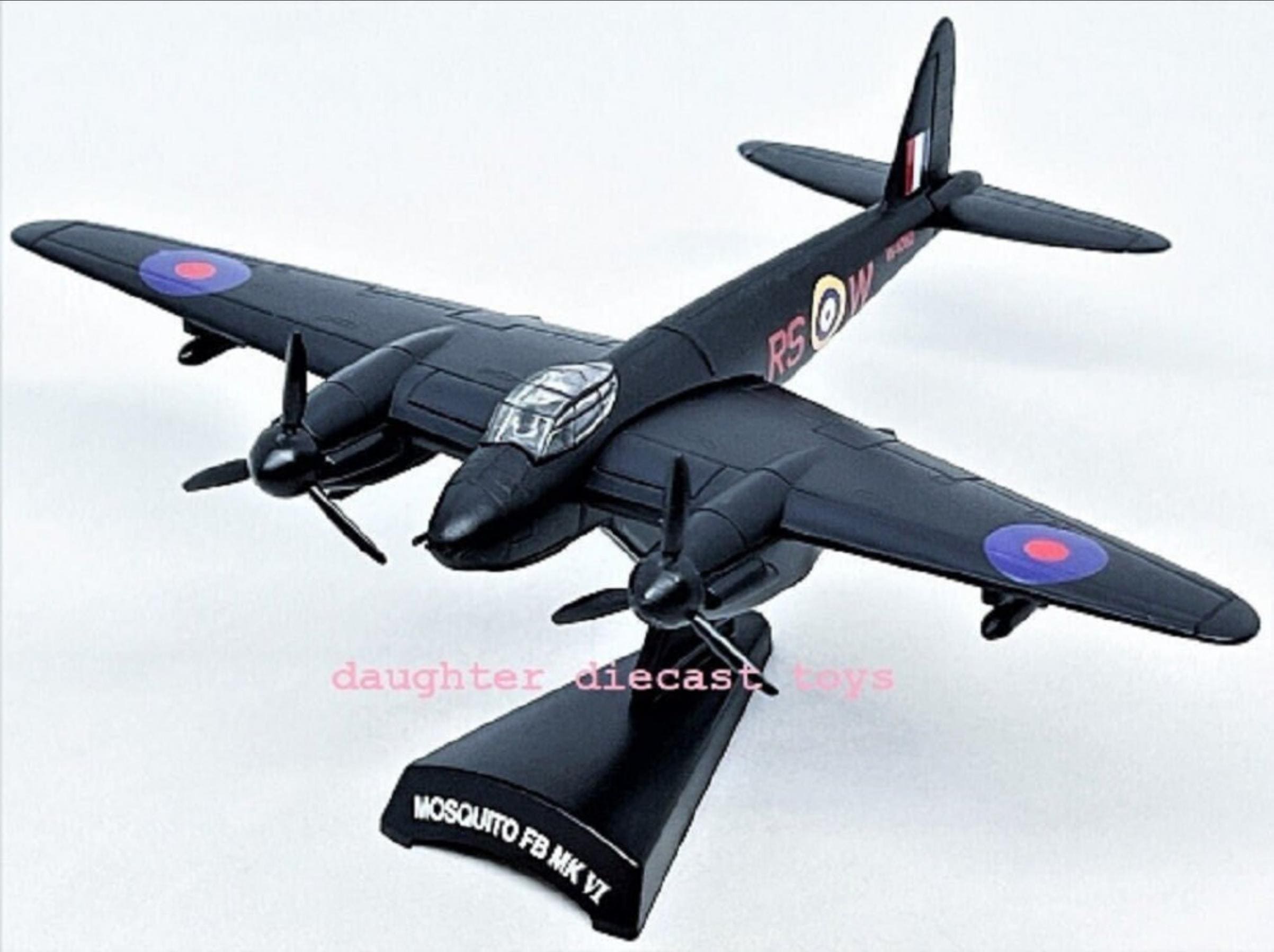
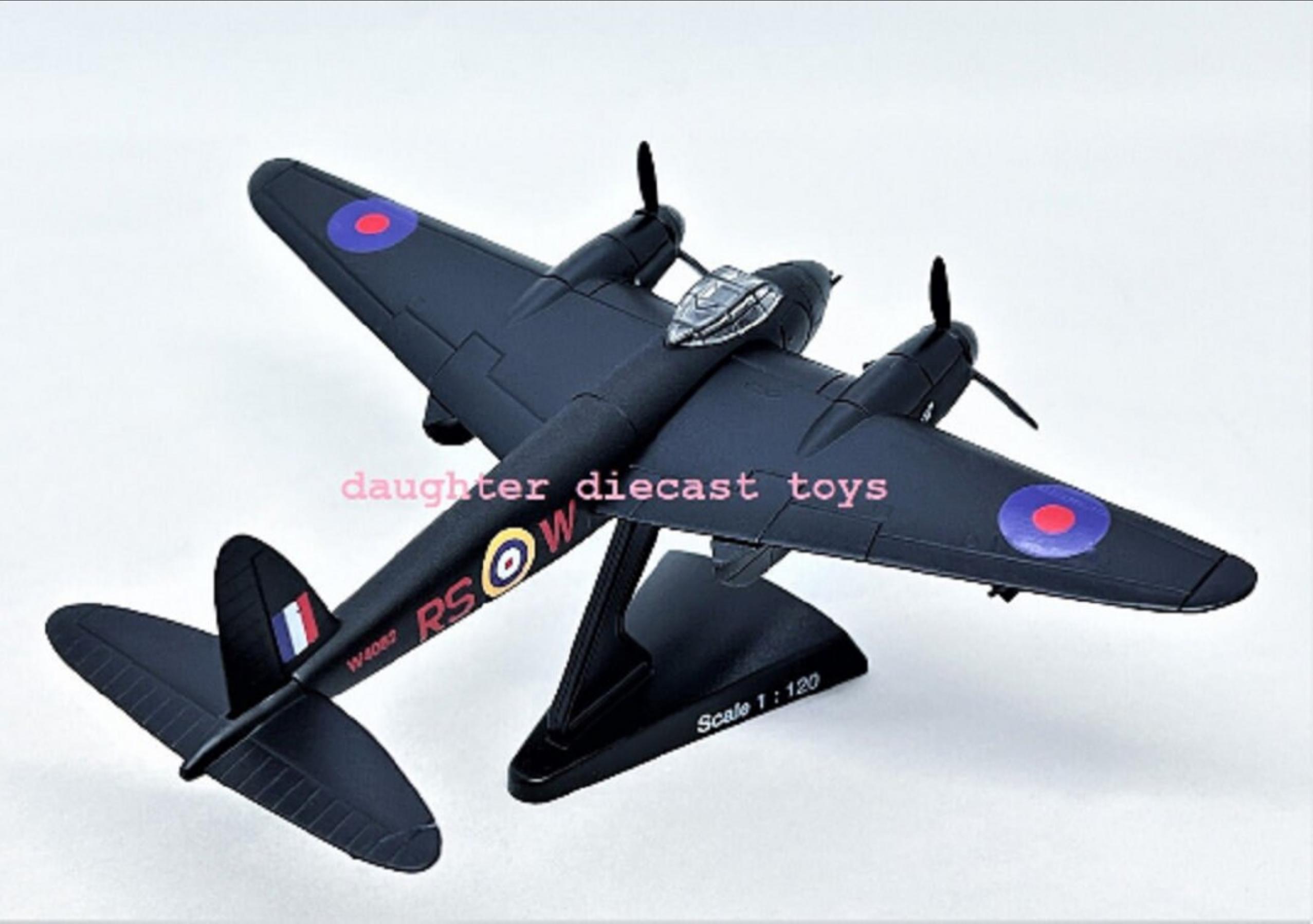
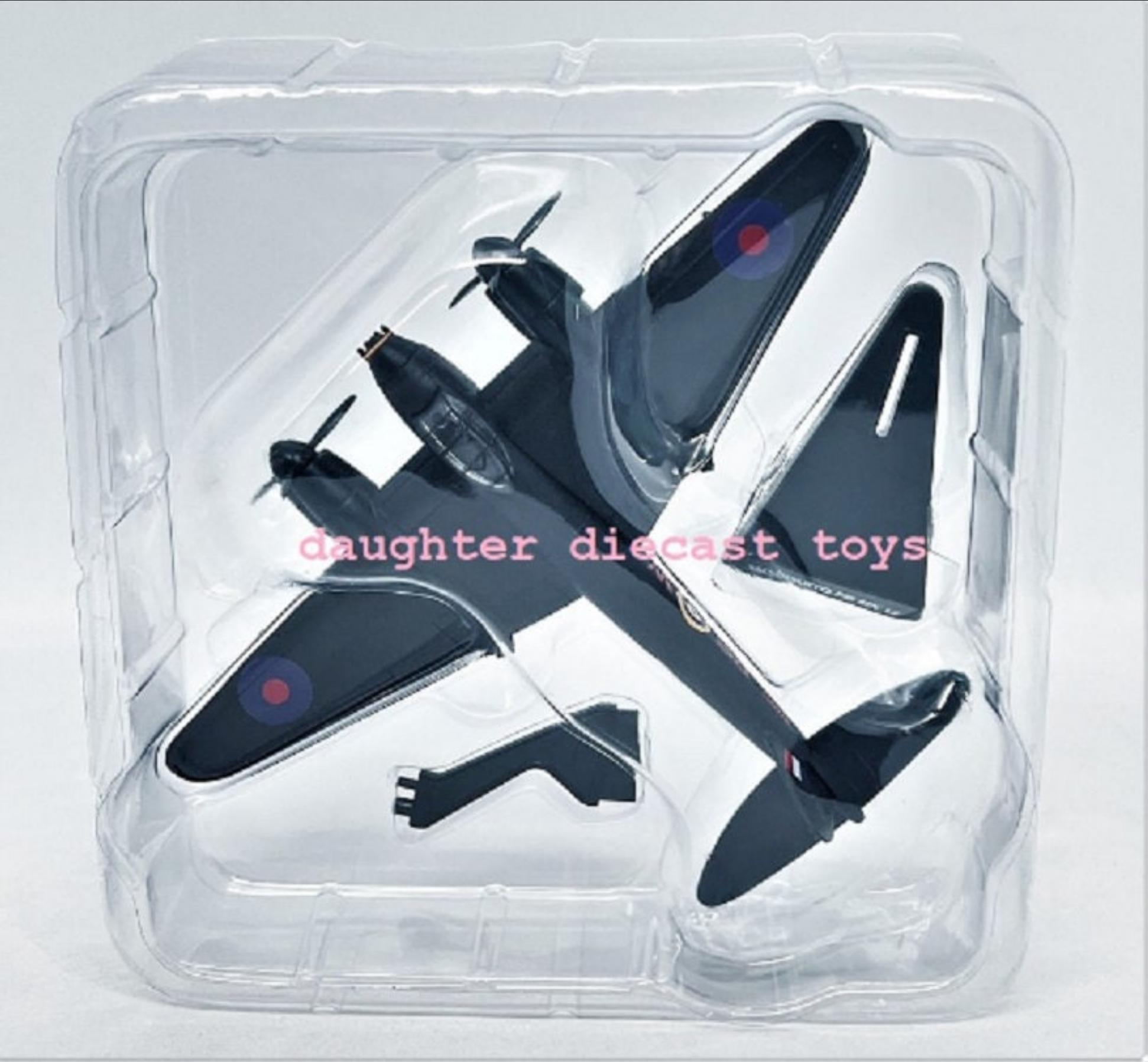
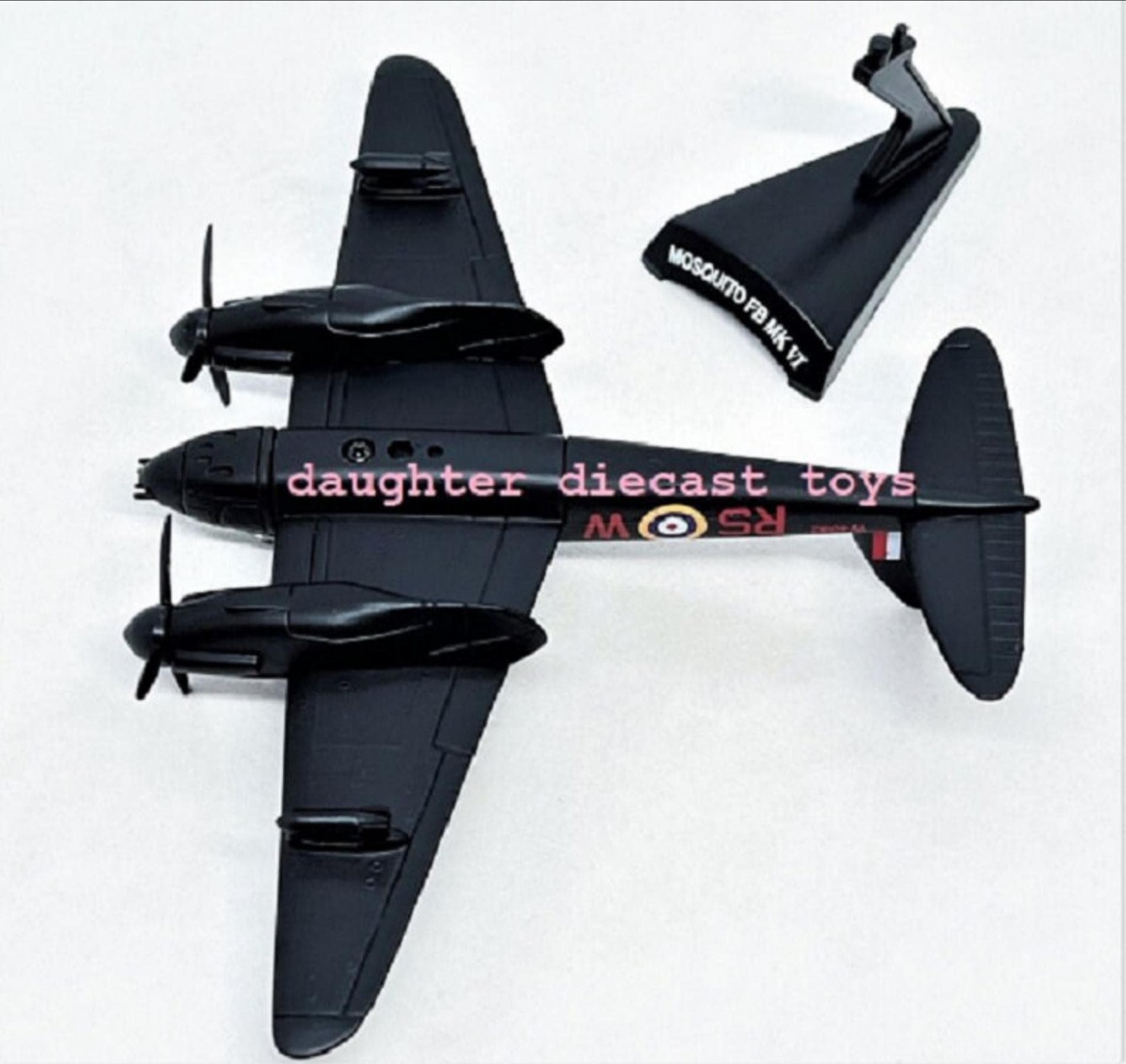
MOSQUITO FB MK 17. Premium quality, intricately detailed Adult Collector. Constructed of (very heavy) diecast metal-by Model Power Co. Scale= 1/90, measures 4"L x 4 5/8"W x 2 1/2"H (mounted). This model has never been removed from its factory-sealed packaging until today for the photos in this listing. Tail symbols were blurred in our photos to meet website listing compliance. Pristine condition model-never previously handled or displayed. Aircraft comes complete with desktop display stand and is enclosed in protective plastic clamshell case (see photo 5). Perfect gift for vintage toy collectors, military history enthusiasts, war diorama creators, and airshow fans (like me)! FREE shipping to anywhere in the continental USA. 100% happiness guaranteed. Read plane bio below....Purchases totaling $35 and above qualify for FREE shipping to USA! Add more items to your Etsy shopping cart to save $$$. …Note: My dad owned a Diecast toy store for 30 years. I inherited the store inventory when he passed away several years ago. I am (just now) able to bring myself to begin selling his toys-so they can be shared with the world. All the inventory is NEW (vintage) merchandise-which was intended for retail sale. Please know-our diecast toys have NEVER been "played-with” we do not sell used, or damaged mechandise. AIRCRAFT BIO:The de Havilland Mosquito was a British light bomber that served in many roles during and after the Second World War. Mosquito-equipped squadrons performed medium bomber, reconnaissance, tactical strike, anti-submarine warfare and shipping attack and night fighter duties, both defensive and offensive.[1] Mosquitos were widely used by the RAF Pathfinder Force, which marked targets for night-time strategic bombing. Despite an initially high loss rate due to low-level daylight attack operations, the Mosquito ended the war with the lowest losses of any of the aircraft types in RAF Bomber Command service.ten pressed to within 100 yds (90 m).Although the RAF had continued to use aerial photography since the end of World War I, by 1939 it had become a very under-developed and neglected branch of the service.[47] On the eve of World War II, Sidney Cotton took aerial photos during flights over parts of the Middle East, North Africa and even over German military airfields. Using a pair of Lockheed 12A's [nb 15] based at Heston, just north of London, Cotton undertook a further programme of photographic flights over Germany and Italy, with camera improvements such as a warm-air blown unit that overcame condensation problems. Two weeks after war was declared, Cotton's photographs of the Dutch coast were used finally to convince RAF senior officers of his capabilities. He was appointed as an honorary RAF Squadron Leader on 22 September 1939 and tasked to head up a new RAF 1 Photographic Development Unit at Heston Aerodrome.[48] Cotton rapidly improved photo reconnaissance capabilities, working at first with a Bristol Blenheim (too slow), but soon acquiring a couple of Supermarine Spitfires that were rapidly adapted. [nb 16]Birtles [47] gives the following reasons for the suitability of the Mosquito for PR operations: could carry more cameras than the Spitfire; long range combined with high speed; security of two engines; navigator could locate and identify targets whilst pilot concentrated on flying (and evasion when necessary). Later as more advanced variants were introduced, high altitude capability was added. On 13 July 1941, PR.1 W4051 LY-U was delivered to 1 PRU at RAF Benson.[nb 17] Two more aircraft were delivered in July and August.The first operational sortie by a PR Mk I of 1 PRU was flown in W4055 on 17 September 1941. During this flight reconnoitering the Biscay coasts of France, the pilot, Squadron Leader Clarke [nb 18] evaded three Messerschmitt Bf 109s at 23,000 feet (7,000 m).[47][50] In October, three PR Mosquitos were detached to RAF Wick to perform reconnaissance flights over Norway. Clarke flew back to Benson from Wick on 15 October in 1 hr. 32 m. - a record run. On 4 December, Sqn Ldr Alastair Taylor DFC with two bars and his navigator, Sgt. Sidney Horsfall, were lost in the Trondheim-Bergen area, becoming the first 1 PRU casualties.[51]Improved longer-range standard PR.Mk.I Mosquitos were introduced at 1 PRU, Benson, in early 1942. This enabled more distant reconnaissance missions, to Poland, for example. Also from around that date there were searches and photographic evidence, by the RAF Leuchars detachment, concerning the German Scharnhorst-class battleships. And on 16 January 1942 this unit had a further success when a round-trip flight to Murmansk located the hiding place in a Norwegian fjord of the Tirpitz. [nb 19][47] Mosquito PR Mark IX of 1409 (Meteorological) Flight RAF, November 1944 In 1942 Benson airfield was given new runways and No.1 PRU was expanded. Placed under RAF Coastal Command,[nb 20] there were five new squadron numbers, Nos. 540 to 544 inclusive. Of these, Sqns. 540 and 544 were the most significant for ongoing Mosquito PR operations.[47][53]In the spring of 1943 the No. 1409 Flight RAF (Meteorological Flight) was transferred to Bomber Command, and placed under No. 8 Group Pathfinder Force, based firstly at RAF Oakington. At that stage, it was using the PR Mark IX Mosquito but in 1944 it moved to RAF Wyton and received pressurised high altitude Mosquito PR XVIs. The crews, of which two were on constant standby, performed special reconnaissance duties. These included short-term on-the-spot meteorological reporting, containing photographs of weather conditions. Also, photographs of terrain and water features of topical intelligence significance. [54][55]The South African Air Force (SAAF) also served with distinction in PRU duties.[56][47] In February 1943 60 Squadron acquired their first PR Mosquito II's at the instigation of Field Marshal Bernard Montgomery whilst they were serving in North Africa.[nb 21]. In May 1943, the squadron was sent to USAAF San Severo in Italy [nb 22] This move was to prepare for the southern European campaign; the squadron was equipped with Mosquito PR XVI's, with red and white rudder stripes. They carried out large-scale photographic surveys of parts of Sicily and other Axis held areas, eventually ranging over the Alps and deep into Austria and Germany, where they met with dangerous interceptions by Me 262 jets. [nb 23] On 4 April 1944 the Squadron obtained the first photographic evidence of Nazi genocides when an aircraft accidentally photographed Auschwitz concentration camp, intending to photograph nearby rubber plantations. When analysed, the photographs showed rows of people lined up, plus chimneys and all the other characteristics of a death camp. With the cessation of hostilities, 60 Squadron assisted the RAF in a photo survey of Greece before being withdrawn from operations on 22 August 1945 after it had returned to AFS Zwartkop, South Africa.In 1945, an RAF PR Mk XVI Mosquito of Eastern Air Command operating out of airfields in Burma set a twin-engine record on a single photo-reconnaissance mission covering 2,400 mi (3,900 km) in 8 hours and 50 minutes.[57]The PR Mk 34 was the final wartime photo reconnaissance version of the Mosquito, designed for long range reconnaissance in the Pacific. To increase its range it had no armor and its bulged bomb bay had a fuel tank, giving an internal fuel capacity of 1,192 gallons plus two 200 gallon drop tanks when required. Power was by two 1,635 hp Merlin 25's. With a full fuel load its range was 3,600 miles at a speed of 300 mph. It could reach 425 mph (684 km/h), placing it among the fastest piston-engined aircraft of World War II.[58] Tested in Britain in April–May 1945, it was then flown to India, establishing a new record time for the flight. Before the Japanese surrender, it conducted 38 sorties from the Cocos Islands, reaching destinations such as Sumatra and Malaya (Malaysia).[59]The United States Army Air Forces (USAAF) ordered 120 Mosquitos for photographic reconnaissance, but only 40 were delivered and given the U.S. designation F-8. These were built in Canada. There were six B Mk VII's and 34 B Mk XX's. Only 16 of these reached Europe, where 11 were turned over to the RAF and five were sent to Italy. The RAF also provided 145 Hatfield-built PR Mk XVI aircraft to the Eighth Air Force between February 1944 and the end of the war. These were used for a variety of photographic and night reconnaissance missions and also for covert operations.
MOSQUITO FB MK 17. Premium quality, intricately detailed Adult Collector. Constructed of (very heavy) diecast metal-by Model Power Co. Scale= 1/90, measures 4"L x 4 5/8"W x 2 1/2"H (mounted). This model has never been removed from its factory-sealed packaging until today for the photos in this listing. Tail symbols were blurred in our photos to meet website listing compliance. Pristine condition model-never previously handled or displayed. Aircraft comes complete with desktop display stand and is enclosed in protective plastic clamshell case (see photo 5). Perfect gift for vintage toy collectors, military history enthusiasts, war diorama creators, and airshow fans (like me)! FREE shipping to anywhere in the continental USA. 100% happiness guaranteed. Read plane bio below....Purchases totaling $35 and above qualify for FREE shipping to USA! Add more items to your Etsy shopping cart to save $$$. …Note: My dad owned a Diecast toy store for 30 years. I inherited the store inventory when he passed away several years ago. I am (just now) able to bring myself to begin selling his toys-so they can be shared with the world. All the inventory is NEW (vintage) merchandise-which was intended for retail sale. Please know-our diecast toys have NEVER been "played-with” we do not sell used, or damaged mechandise. AIRCRAFT BIO:The de Havilland Mosquito was a British light bomber that served in many roles during and after the Second World War. Mosquito-equipped squadrons performed medium bomber, reconnaissance, tactical strike, anti-submarine warfare and shipping attack and night fighter duties, both defensive and offensive.[1] Mosquitos were widely used by the RAF Pathfinder Force, which marked targets for night-time strategic bombing. Despite an initially high loss rate due to low-level daylight attack operations, the Mosquito ended the war with the lowest losses of any of the aircraft types in RAF Bomber Command service.ten pressed to within 100 yds (90 m).Although the RAF had continued to use aerial photography since the end of World War I, by 1939 it had become a very under-developed and neglected branch of the service.[47] On the eve of World War II, Sidney Cotton took aerial photos during flights over parts of the Middle East, North Africa and even over German military airfields. Using a pair of Lockheed 12A's [nb 15] based at Heston, just north of London, Cotton undertook a further programme of photographic flights over Germany and Italy, with camera improvements such as a warm-air blown unit that overcame condensation problems. Two weeks after war was declared, Cotton's photographs of the Dutch coast were used finally to convince RAF senior officers of his capabilities. He was appointed as an honorary RAF Squadron Leader on 22 September 1939 and tasked to head up a new RAF 1 Photographic Development Unit at Heston Aerodrome.[48] Cotton rapidly improved photo reconnaissance capabilities, working at first with a Bristol Blenheim (too slow), but soon acquiring a couple of Supermarine Spitfires that were rapidly adapted. [nb 16]Birtles [47] gives the following reasons for the suitability of the Mosquito for PR operations: could carry more cameras than the Spitfire; long range combined with high speed; security of two engines; navigator could locate and identify targets whilst pilot concentrated on flying (and evasion when necessary). Later as more advanced variants were introduced, high altitude capability was added. On 13 July 1941, PR.1 W4051 LY-U was delivered to 1 PRU at RAF Benson.[nb 17] Two more aircraft were delivered in July and August.The first operational sortie by a PR Mk I of 1 PRU was flown in W4055 on 17 September 1941. During this flight reconnoitering the Biscay coasts of France, the pilot, Squadron Leader Clarke [nb 18] evaded three Messerschmitt Bf 109s at 23,000 feet (7,000 m).[47][50] In October, three PR Mosquitos were detached to RAF Wick to perform reconnaissance flights over Norway. Clarke flew back to Benson from Wick on 15 October in 1 hr. 32 m. - a record run. On 4 December, Sqn Ldr Alastair Taylor DFC with two bars and his navigator, Sgt. Sidney Horsfall, were lost in the Trondheim-Bergen area, becoming the first 1 PRU casualties.[51]Improved longer-range standard PR.Mk.I Mosquitos were introduced at 1 PRU, Benson, in early 1942. This enabled more distant reconnaissance missions, to Poland, for example. Also from around that date there were searches and photographic evidence, by the RAF Leuchars detachment, concerning the German Scharnhorst-class battleships. And on 16 January 1942 this unit had a further success when a round-trip flight to Murmansk located the hiding place in a Norwegian fjord of the Tirpitz. [nb 19][47] Mosquito PR Mark IX of 1409 (Meteorological) Flight RAF, November 1944 In 1942 Benson airfield was given new runways and No.1 PRU was expanded. Placed under RAF Coastal Command,[nb 20] there were five new squadron numbers, Nos. 540 to 544 inclusive. Of these, Sqns. 540 and 544 were the most significant for ongoing Mosquito PR operations.[47][53]In the spring of 1943 the No. 1409 Flight RAF (Meteorological Flight) was transferred to Bomber Command, and placed under No. 8 Group Pathfinder Force, based firstly at RAF Oakington. At that stage, it was using the PR Mark IX Mosquito but in 1944 it moved to RAF Wyton and received pressurised high altitude Mosquito PR XVIs. The crews, of which two were on constant standby, performed special reconnaissance duties. These included short-term on-the-spot meteorological reporting, containing photographs of weather conditions. Also, photographs of terrain and water features of topical intelligence significance. [54][55]The South African Air Force (SAAF) also served with distinction in PRU duties.[56][47] In February 1943 60 Squadron acquired their first PR Mosquito II's at the instigation of Field Marshal Bernard Montgomery whilst they were serving in North Africa.[nb 21]. In May 1943, the squadron was sent to USAAF San Severo in Italy [nb 22] This move was to prepare for the southern European campaign; the squadron was equipped with Mosquito PR XVI's, with red and white rudder stripes. They carried out large-scale photographic surveys of parts of Sicily and other Axis held areas, eventually ranging over the Alps and deep into Austria and Germany, where they met with dangerous interceptions by Me 262 jets. [nb 23] On 4 April 1944 the Squadron obtained the first photographic evidence of Nazi genocides when an aircraft accidentally photographed Auschwitz concentration camp, intending to photograph nearby rubber plantations. When analysed, the photographs showed rows of people lined up, plus chimneys and all the other characteristics of a death camp. With the cessation of hostilities, 60 Squadron assisted the RAF in a photo survey of Greece before being withdrawn from operations on 22 August 1945 after it had returned to AFS Zwartkop, South Africa.In 1945, an RAF PR Mk XVI Mosquito of Eastern Air Command operating out of airfields in Burma set a twin-engine record on a single photo-reconnaissance mission covering 2,400 mi (3,900 km) in 8 hours and 50 minutes.[57]The PR Mk 34 was the final wartime photo reconnaissance version of the Mosquito, designed for long range reconnaissance in the Pacific. To increase its range it had no armor and its bulged bomb bay had a fuel tank, giving an internal fuel capacity of 1,192 gallons plus two 200 gallon drop tanks when required. Power was by two 1,635 hp Merlin 25's. With a full fuel load its range was 3,600 miles at a speed of 300 mph. It could reach 425 mph (684 km/h), placing it among the fastest piston-engined aircraft of World War II.[58] Tested in Britain in April–May 1945, it was then flown to India, establishing a new record time for the flight. Before the Japanese surrender, it conducted 38 sorties from the Cocos Islands, reaching destinations such as Sumatra and Malaya (Malaysia).[59]The United States Army Air Forces (USAAF) ordered 120 Mosquitos for photographic reconnaissance, but only 40 were delivered and given the U.S. designation F-8. These were built in Canada. There were six B Mk VII's and 34 B Mk XX's. Only 16 of these reached Europe, where 11 were turned over to the RAF and five were sent to Italy. The RAF also provided 145 Hatfield-built PR Mk XVI aircraft to the Eighth Air Force between February 1944 and the end of the war. These were used for a variety of photographic and night reconnaissance missions and also for covert operations.
Altri Prodotti