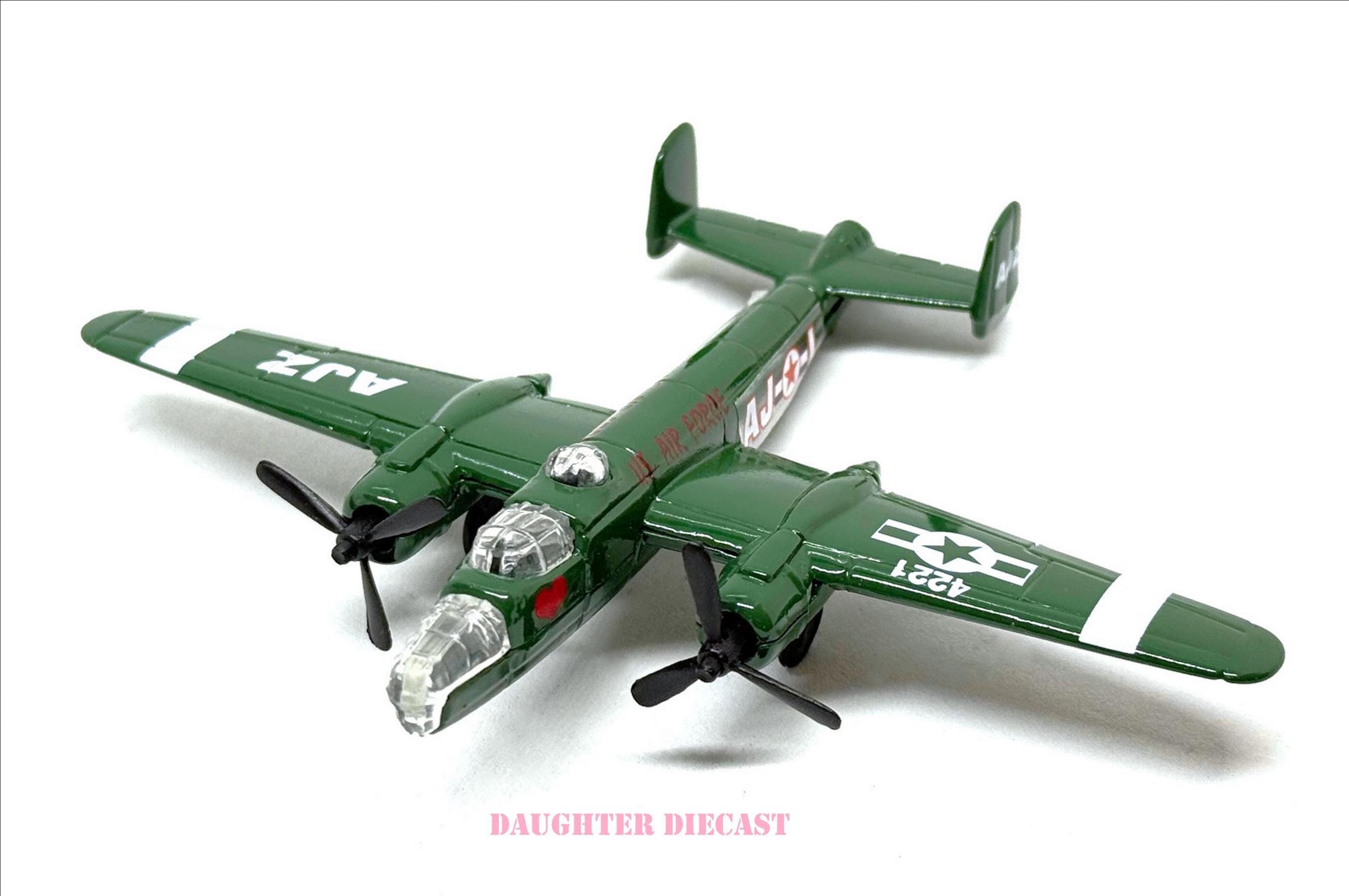
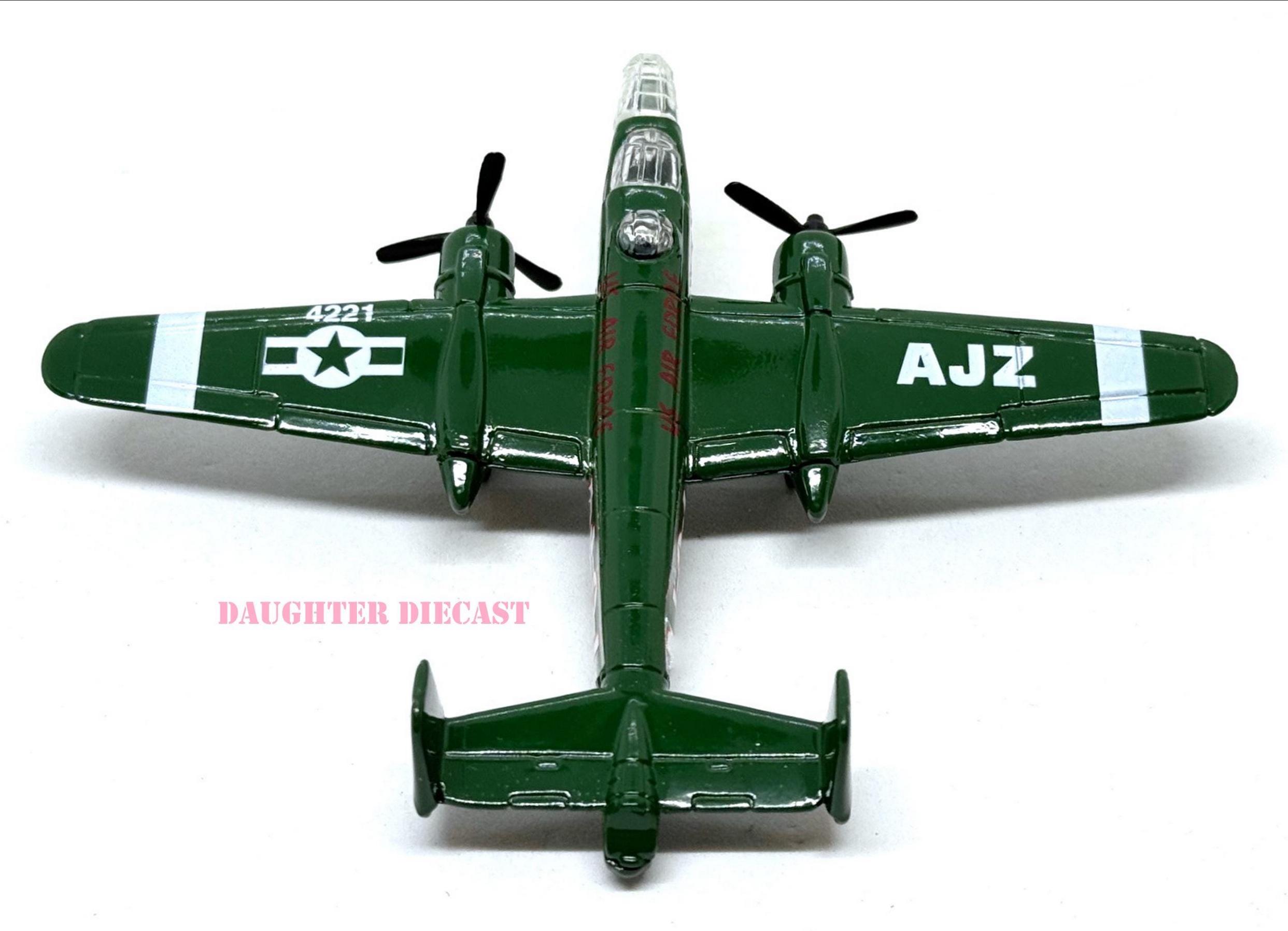
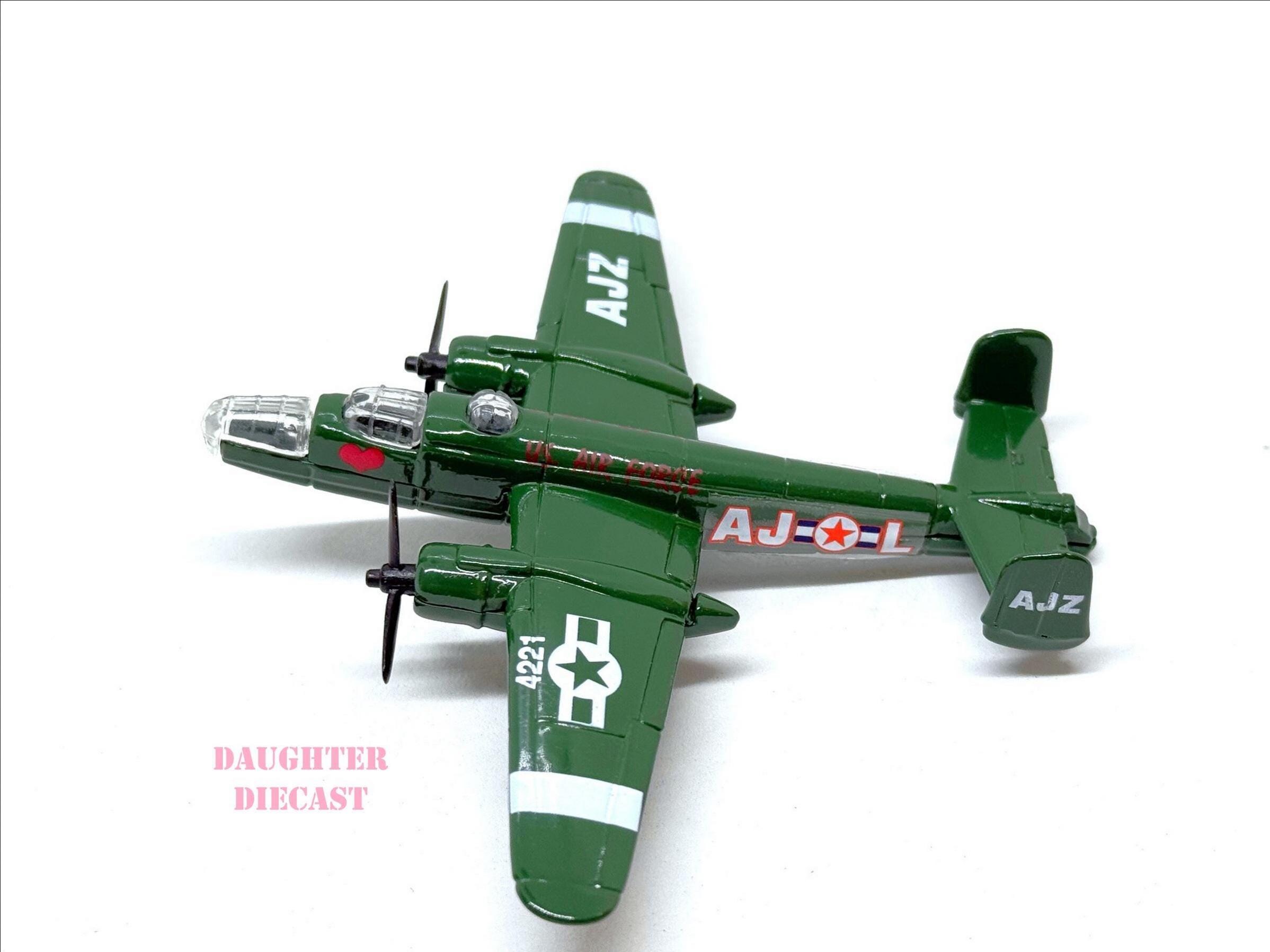
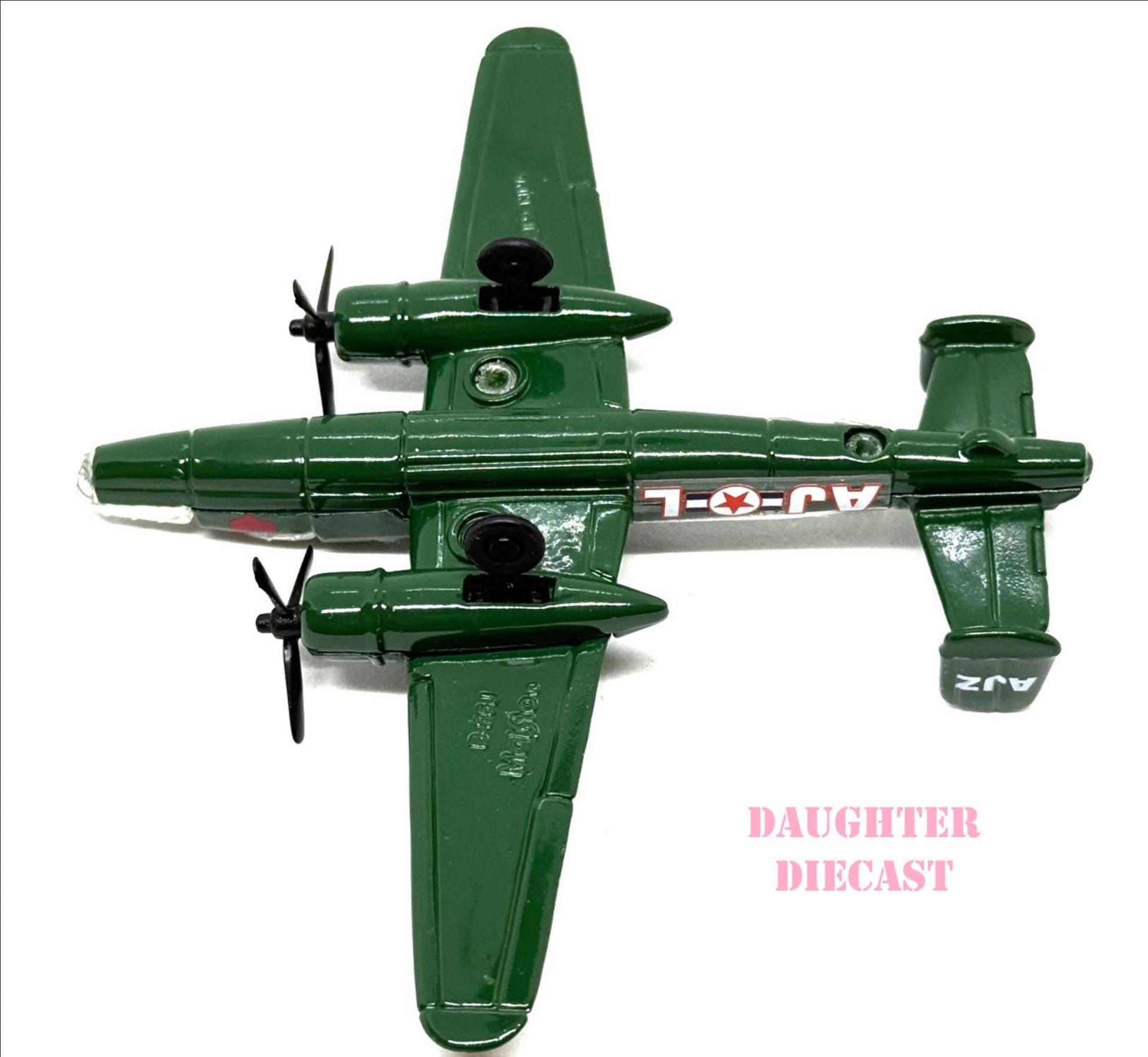

W.W.I.I. USAF Mitchell B-25J FIGHTER BOMBER Diecast Metal Airplane Mint Condition! Perfect gift for Airshow Fans & Collectors!
$ 39.99

Fierce looking US AIR FORCE MITCHELL B-25J FIGHTER BOMBER. Constructed of die
cast metal. Made by Maisto. Highly sought-after, hard to find vintage model! Nice hefty size...scale= 1/43-measures 4 1/2"L x 5 1/8 "W x 1 1/2 "H. Beautiful/mint condition. Never handled or displayed until today for the photos in this listing. Comes in its original factory clam-shell protective packaging. Perfect gift for airshow fans, and vintage military aircraft collectors and Veterans! We ship fast & safe worldwide every day! Read Aircraft bio below...
•
•
•FOR A LIMITED TIME
•
•
•Purchases totaling $35 and above qualify for FREE shipping to USA! Add more items to your Etsy shopping cart to save $$$.NOTE: My dad owned a Diecast toy store for 30 years. I inherited the store inventory when he passed away many years ago. I am just now, beginning to sell the mint condition vintage models. All are store-inventory is new-old-stock, models have never been "played with". Please visit often-as I adding more cool stuff every day!AIRCRAFT BIO:Following the two gunship series, NAA again produced the medium bomber configuration with the B-25J series. It optimized the mix of the interim NA-100 and the H series, having both the bombardier's station and fixed guns of the D and the forward turret and refined armament of the H series. NAA also produced a strafer nose-first shipped to air depots as kits, then introduced on the production line in alternating blocks with the bombardier nose. The solid-metal "strafer" nose housed eight centerline Browning M2 .50 caliber machine guns. The remainder of the armament was as in the H-5. NAA also supplied kits to mount eight underwing 5 inches "high velocity airborne rockets" (HVAR) just outside the propeller arcs. These were mounted on zero-length launch rails, four to a wing. The restored B-25J Mitchell Take-Off Time at the Mid-Atlantic Air Museum for World War II Weekend 2015 in Reading, Pennsylvania The final, and the most built, series of the Mitchell, the B-25J, looked less like earlier series apart from the well-glazed bombardier's nose of nearly identical appearance to the earliest B-25 subtypes.[14] Instead, the J followed the overall configuration of the H series from the cockpit aft. It had the forward dorsal turret and other armament and airframe advancements. All J models included four .50 in (12.7 mm) light-barrel Browning AN/M2 guns in a pair of "fuselage packages", conformal gun pods each flanking the lower cockpit, each pod containing two Browning M2s. By 1945, however, combat squadrons removed these. The J series restored the co-pilot's seat and dual flight controls. The factory made available kits to the Air Depot system to create the strafer-nose B-25J-2. This configuration carried a total of 18 .50 in (12.7 mm) light-barrel AN/M2 Browning M2 machine guns: eight in the nose, four in the flank-mount conformal gun pod packages, two in the dorsal turret, one each in the pair of waist positions, and a pair in the tail – with 14 of the guns either aimed directly forward or aimed to fire directly forward for strafing missions. Some aircraft had eight 5-inch (130 mm) high-velocity aircraft rockets.[14] NAA introduced the J-2 into production in alternating blocks at the J-22. Total J series production was 4,318.Mention the B-25 or “Mitchell” to many people and they are likely to respond: “Oh, the Doolittle Raid”. While the attack on mainland Japan on April 18, 1942 was the most famous of its missions, North American Aviation’s magnificent medium bomber played a much larger part in World War II.The B-25 was in production before the U.S. entry into the war through VJ-Day. About 9,815 B-25’s were built. This was the largest production of U.S. twin-engine combat airplanes in World War II. B-25’s were used in all theaters of war from Alaska to North Africa, China, Europe and the Southwest Pacific. They were flown by the U.S. Army Air Forces and U.S. Marine Corps, as well as the air forces of Britain, Canada, Australia, Russia, China, Brazil and the Netherland East Indies. Post war, B-25’s soldiered on in other roles as well as combat with the U.S. Air Force and the air forces of Canada, Indonesia and many Latin American countries.The B-25 was designed as a medium bomber to operate at altitudes between 8,000 and 12,000 thousand feet. Powered by two 1700 hp Wright R-2600 engines, the basic configuration stayed the same throughout production. However, there were many changes in armament to improve both offensive and defensive capabilities. These variations included 75 mm cannon, rockets and up to eighteen .50 caliber machine guns. The armament modifications varied on the B-25’s depending on the squadron mission. Some B-25’s were modified to carry torpedoes; both standard aerial and glide versions. Tactics used in the South and Southwest Pacific included low altitude strikes with strafing and skip-bombing against shipping and para-frag bombs against airfield targets. The airplane was also used for photo-mapping, an advanced trainer and fast transport.The 41st Bombardment Group was the only B-25 medium bomber unit in the Seventh Air Force. The 41st operated in the Central Pacific Theater during the period from December, 1943 to October, 1944. The 41st flew over 240 missions in single squadron strength, often at low altitudes against Japanese shipping while bypassing many of the islands. On October, 1944, the 41st was transferred to Wheeler Field, Hawaii for rest, re-equipment, crew replacements and retraining. Their aircraft were cycled through the Hawaiian Air Depot where some of the B-25D’s and B-25G’s were converted to the 8-gun “strafer” nose. Other aircraft were replaced by the new B-25J’s.It was here that the B-25J, serial number 43-28147, was assigned to Captain Don Seiler of the 396th Bomb Squadron. Capt. Seiler named his new plane “Panchito” after the feisty Mexican rooster from the 1943 animated musical “The Three Caballeros”.Much can be learned of the trials those bomber crews went through by studying official records. The real flavor comes through talking to the crews or reading their diaries. Bill Miller kept a simple diary. The following are a few samples from his diary. Panchito’s second mission was on July 10, 1945: “Our first trip over the Jap homeland. Sure don’t seem to be Japan – could pass for Penna. Woodland. Saw our first flak bursts today – so we wore our “flak suits”; and later, “My friend Arena – went down in yesterday’s raid. Saw his plane go down in flames after collision with Corsair.” Corporal Raymond Arena was a gunner on the first B-25 lost by the 41st during this tour. Mission records show the collision actually was between two B-25’s of the 820th Bomb Squadron. The other B-25 limped home to base on one engine. On August 9th, 1945, flight crews reported and photographed a towering cloud of smoke coming from the Nagasaki area some 75 miles away. From Bill Miller’s diary; “Well if smoke means damage then Nagasaki is ruined. The smoke was visible from Kanoya.” He later added a note in the margin; “Nagasaki bomb 11:02 am” and a clipping from the base newspaper describing other crews’ observations of the 20,000 ft. plume of smoke over Nagasaki from the atomic bomb.The August 15th, 1945 entry in Bill Miller’s diary expresses the feelings of many when they heard of the Japanese surrender; “…….and at last the announcement came that Japan has accepted the peace terms. At 5 o’clock (am)-the loudspeaker blared out “Mission for today cancelled-and all planes will leave for Manila at dawn”. Boy we were glad! By noon, all available parking space on the island was taken up by C-54s, C-47s, and C-46s – awaiting trip to Tokyo Airfield. Can’t write on paper my innermost feelings- but its wonderful. Now to sweat out transportation home.” Finally the war was over for Panchito and the Miller brothers. The next day, the 41st Bomb Group packed up and headed for Clark Field in the Philippines where the beloved Mitchells were parked for final disposition. Air Force records show aircraft serial number 43-28147, Panchito, as being “condemned for reclamation” in the Philippines on December 4, 1946. It was finally reported that reclamation was completed July 13, 1949.
cast metal. Made by Maisto. Highly sought-after, hard to find vintage model! Nice hefty size...scale= 1/43-measures 4 1/2"L x 5 1/8 "W x 1 1/2 "H. Beautiful/mint condition. Never handled or displayed until today for the photos in this listing. Comes in its original factory clam-shell protective packaging. Perfect gift for airshow fans, and vintage military aircraft collectors and Veterans! We ship fast & safe worldwide every day! Read Aircraft bio below...
•
•
•FOR A LIMITED TIME
•
•
•Purchases totaling $35 and above qualify for FREE shipping to USA! Add more items to your Etsy shopping cart to save $$$.NOTE: My dad owned a Diecast toy store for 30 years. I inherited the store inventory when he passed away many years ago. I am just now, beginning to sell the mint condition vintage models. All are store-inventory is new-old-stock, models have never been "played with". Please visit often-as I adding more cool stuff every day!AIRCRAFT BIO:Following the two gunship series, NAA again produced the medium bomber configuration with the B-25J series. It optimized the mix of the interim NA-100 and the H series, having both the bombardier's station and fixed guns of the D and the forward turret and refined armament of the H series. NAA also produced a strafer nose-first shipped to air depots as kits, then introduced on the production line in alternating blocks with the bombardier nose. The solid-metal "strafer" nose housed eight centerline Browning M2 .50 caliber machine guns. The remainder of the armament was as in the H-5. NAA also supplied kits to mount eight underwing 5 inches "high velocity airborne rockets" (HVAR) just outside the propeller arcs. These were mounted on zero-length launch rails, four to a wing. The restored B-25J Mitchell Take-Off Time at the Mid-Atlantic Air Museum for World War II Weekend 2015 in Reading, Pennsylvania The final, and the most built, series of the Mitchell, the B-25J, looked less like earlier series apart from the well-glazed bombardier's nose of nearly identical appearance to the earliest B-25 subtypes.[14] Instead, the J followed the overall configuration of the H series from the cockpit aft. It had the forward dorsal turret and other armament and airframe advancements. All J models included four .50 in (12.7 mm) light-barrel Browning AN/M2 guns in a pair of "fuselage packages", conformal gun pods each flanking the lower cockpit, each pod containing two Browning M2s. By 1945, however, combat squadrons removed these. The J series restored the co-pilot's seat and dual flight controls. The factory made available kits to the Air Depot system to create the strafer-nose B-25J-2. This configuration carried a total of 18 .50 in (12.7 mm) light-barrel AN/M2 Browning M2 machine guns: eight in the nose, four in the flank-mount conformal gun pod packages, two in the dorsal turret, one each in the pair of waist positions, and a pair in the tail – with 14 of the guns either aimed directly forward or aimed to fire directly forward for strafing missions. Some aircraft had eight 5-inch (130 mm) high-velocity aircraft rockets.[14] NAA introduced the J-2 into production in alternating blocks at the J-22. Total J series production was 4,318.Mention the B-25 or “Mitchell” to many people and they are likely to respond: “Oh, the Doolittle Raid”. While the attack on mainland Japan on April 18, 1942 was the most famous of its missions, North American Aviation’s magnificent medium bomber played a much larger part in World War II.The B-25 was in production before the U.S. entry into the war through VJ-Day. About 9,815 B-25’s were built. This was the largest production of U.S. twin-engine combat airplanes in World War II. B-25’s were used in all theaters of war from Alaska to North Africa, China, Europe and the Southwest Pacific. They were flown by the U.S. Army Air Forces and U.S. Marine Corps, as well as the air forces of Britain, Canada, Australia, Russia, China, Brazil and the Netherland East Indies. Post war, B-25’s soldiered on in other roles as well as combat with the U.S. Air Force and the air forces of Canada, Indonesia and many Latin American countries.The B-25 was designed as a medium bomber to operate at altitudes between 8,000 and 12,000 thousand feet. Powered by two 1700 hp Wright R-2600 engines, the basic configuration stayed the same throughout production. However, there were many changes in armament to improve both offensive and defensive capabilities. These variations included 75 mm cannon, rockets and up to eighteen .50 caliber machine guns. The armament modifications varied on the B-25’s depending on the squadron mission. Some B-25’s were modified to carry torpedoes; both standard aerial and glide versions. Tactics used in the South and Southwest Pacific included low altitude strikes with strafing and skip-bombing against shipping and para-frag bombs against airfield targets. The airplane was also used for photo-mapping, an advanced trainer and fast transport.The 41st Bombardment Group was the only B-25 medium bomber unit in the Seventh Air Force. The 41st operated in the Central Pacific Theater during the period from December, 1943 to October, 1944. The 41st flew over 240 missions in single squadron strength, often at low altitudes against Japanese shipping while bypassing many of the islands. On October, 1944, the 41st was transferred to Wheeler Field, Hawaii for rest, re-equipment, crew replacements and retraining. Their aircraft were cycled through the Hawaiian Air Depot where some of the B-25D’s and B-25G’s were converted to the 8-gun “strafer” nose. Other aircraft were replaced by the new B-25J’s.It was here that the B-25J, serial number 43-28147, was assigned to Captain Don Seiler of the 396th Bomb Squadron. Capt. Seiler named his new plane “Panchito” after the feisty Mexican rooster from the 1943 animated musical “The Three Caballeros”.Much can be learned of the trials those bomber crews went through by studying official records. The real flavor comes through talking to the crews or reading their diaries. Bill Miller kept a simple diary. The following are a few samples from his diary. Panchito’s second mission was on July 10, 1945: “Our first trip over the Jap homeland. Sure don’t seem to be Japan – could pass for Penna. Woodland. Saw our first flak bursts today – so we wore our “flak suits”; and later, “My friend Arena – went down in yesterday’s raid. Saw his plane go down in flames after collision with Corsair.” Corporal Raymond Arena was a gunner on the first B-25 lost by the 41st during this tour. Mission records show the collision actually was between two B-25’s of the 820th Bomb Squadron. The other B-25 limped home to base on one engine. On August 9th, 1945, flight crews reported and photographed a towering cloud of smoke coming from the Nagasaki area some 75 miles away. From Bill Miller’s diary; “Well if smoke means damage then Nagasaki is ruined. The smoke was visible from Kanoya.” He later added a note in the margin; “Nagasaki bomb 11:02 am” and a clipping from the base newspaper describing other crews’ observations of the 20,000 ft. plume of smoke over Nagasaki from the atomic bomb.The August 15th, 1945 entry in Bill Miller’s diary expresses the feelings of many when they heard of the Japanese surrender; “…….and at last the announcement came that Japan has accepted the peace terms. At 5 o’clock (am)-the loudspeaker blared out “Mission for today cancelled-and all planes will leave for Manila at dawn”. Boy we were glad! By noon, all available parking space on the island was taken up by C-54s, C-47s, and C-46s – awaiting trip to Tokyo Airfield. Can’t write on paper my innermost feelings- but its wonderful. Now to sweat out transportation home.” Finally the war was over for Panchito and the Miller brothers. The next day, the 41st Bomb Group packed up and headed for Clark Field in the Philippines where the beloved Mitchells were parked for final disposition. Air Force records show aircraft serial number 43-28147, Panchito, as being “condemned for reclamation” in the Philippines on December 4, 1946. It was finally reported that reclamation was completed July 13, 1949.
Other Products