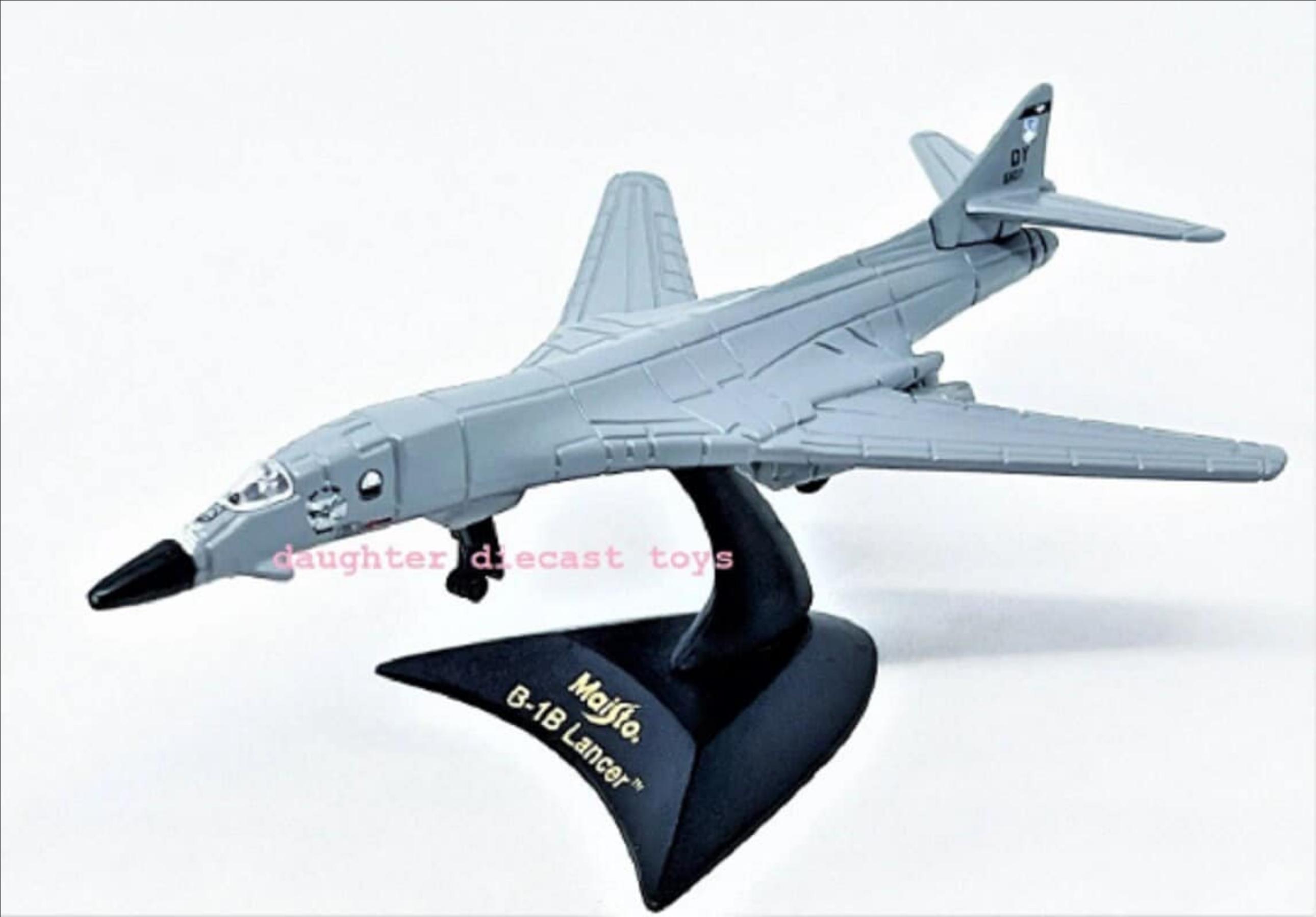
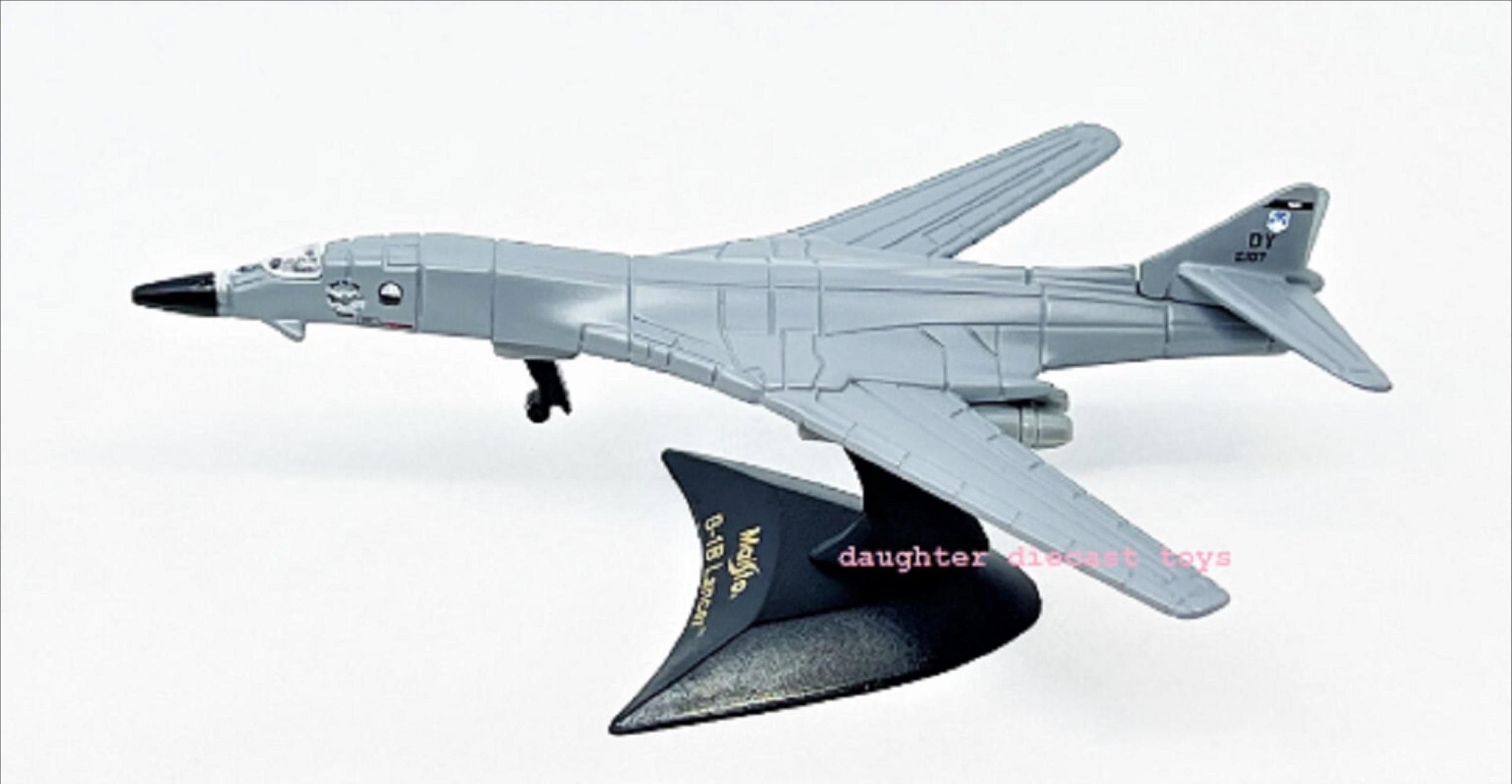
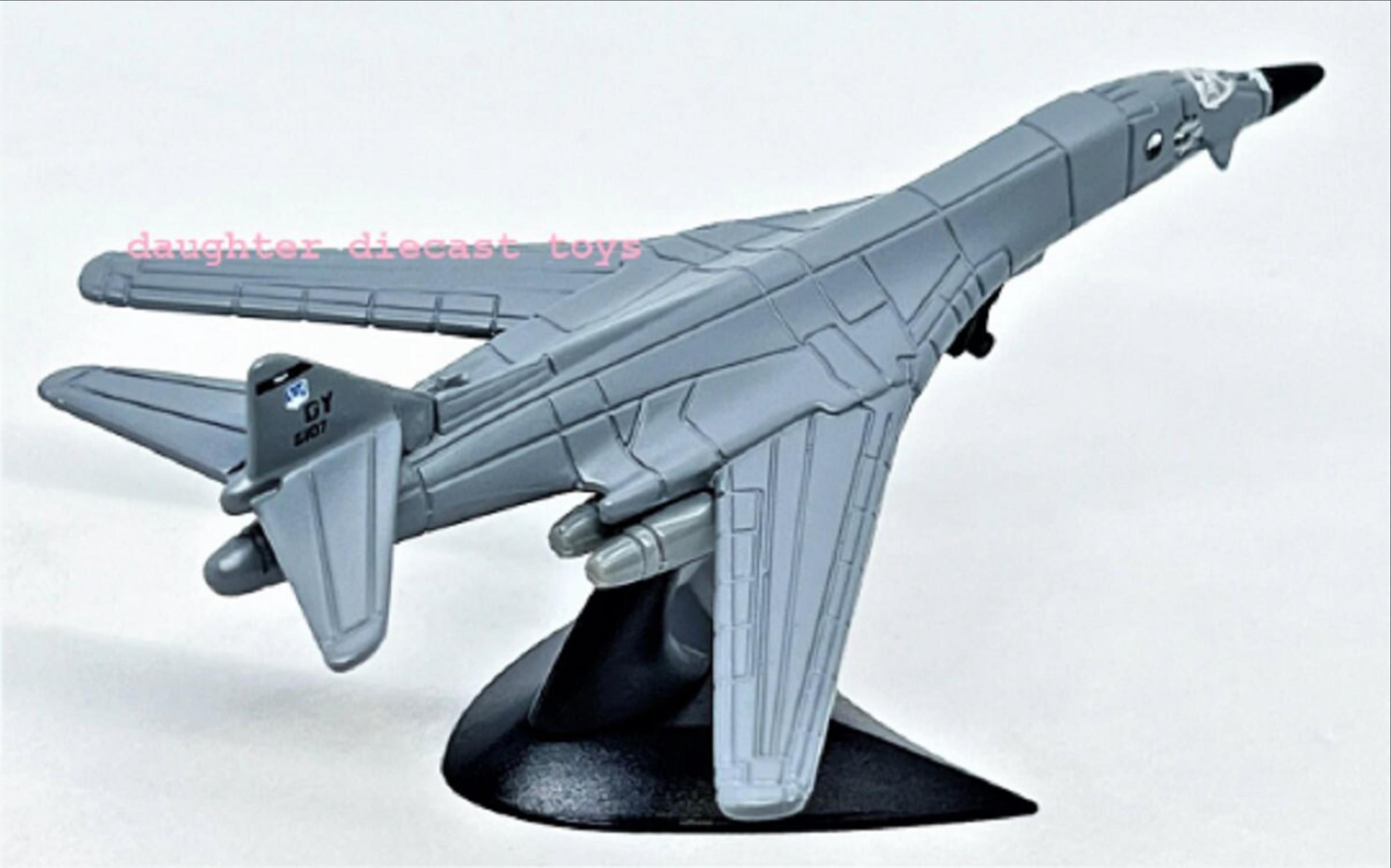
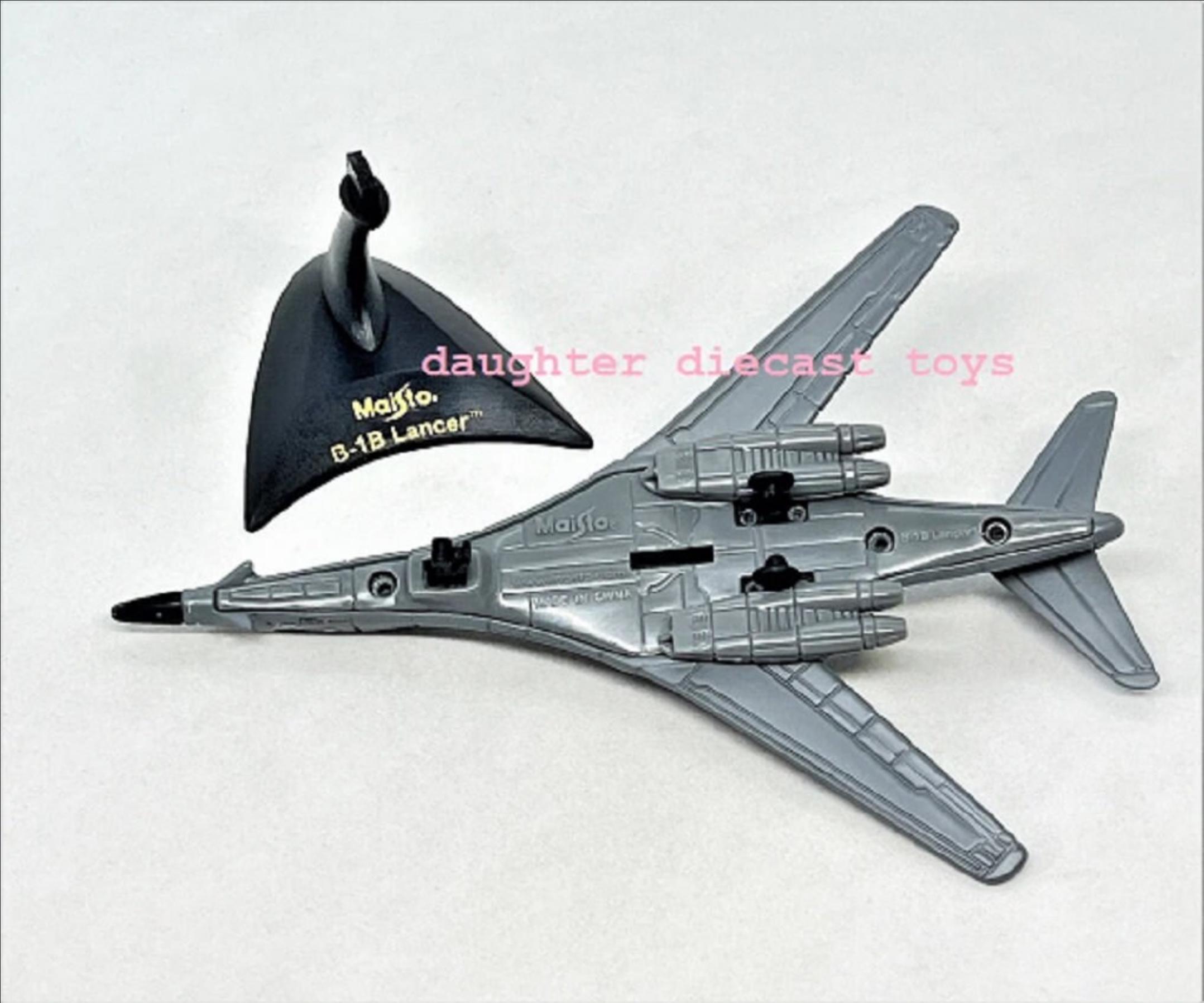

U.S.A.F. B-1B LANCER BOMBER Jet Airplane-Adult Collector Diecast Metal-w/Stand-Pristine Condition/Maisto-Perfect Gift for Collectors!
$ 39.99

Gorgeous! USAF B-1 BOMBER LANCER JET AIRPLANE. Weighty, constructed of diecast
metal. Intricately-detailed, adult collector-made by Maisto. Hard to find vintage model! Desktop display model-comes with (easy to set up) stand. Scale=1/72 prox, measures 5"L x 3 3/4"W x 2 1/2 "H (mounted). Pristine/mint condition model-never previously handled or displayed (until today for our photos). Sold loose in collectors' bag with stand. The perfect gift for aviation history fans (like me!), vintage toy collectors, and veterans. We ship fast & safe worldwide every day. See Aircraft Bio below....
•
•
•FOR A LIMITED TIME
•
•
•Purchases totaling $35 and above qualify for FREE shipping to USA! Add more items to your Etsy shopping cart to save $$$.NOTE: My dad owned a Diecast toy store for 30 years. I inherited the store inventory when he passed away many years ago. I am just now, beginning to sell the mint condition vintage models. All are store-inventory is new-old-stock, models have never been "played with". Please visit often-as I am adding more cool stuff every day!AIRCRAFT BIO: Role: Supersonic strategic heavy bomber National origin United States Manufacturer: North American Rockwell/Rockwell International Boeing First flight 23 December 1974; 45 years ago Introduction 1 October 1986 Status: In service Primary user United States Air Force Produced 1973–1974, 1983–1988 Unit cost: US $283.1 million in 1998The Rockwell B-1 Lancer is a supersonic variable-sweep wing, heavy bomber used by the United States Air Force. It is commonly called the "Bone" (from "B-One"). It is one of three strategic bombers in the U.S. Air Force fleet as of 2018, the other two being the B-2 Spirit and the B-52 Stratofortress.The B-1 was first envisioned in the 1960s as a platform that would combine the Mach 2 speed of the B-58 Hustler with the range and payload of the B-52, and was meant to ultimately replace both bombers. After a long series of studies, Rockwell International (now part of Boeing) won the design contest for what emerged as the B-1A. This version had a top speed of Mach 2.2 at high altitude and the capability of flying for long distances at Mach 0.85 at very low altitudes. The combination of the high cost of the aircraft, the introduction of the AGM-86 cruise missile that flew the same basic profile, and early work on the stealth bomber all significantly affected the need for the B-1. This led to the program being canceled in 1977, after the B-1A prototypes had been built.The program was restarted in 1981, largely as an interim measure due to delays in the B-2 stealth bomber program, with the B-2 eventually reaching initial operational capability in 1997. This led to a redesign as the B-1B, which differed from the B-1A by having a lower top speed at high altitude of Mach 1.25, but improved low-altitude performance of Mach 0.96. The electronics were also extensively improved during the redesign, and the airframe was improved to allow takeoff with the maximum possible fuel and weapons load. The B-1B began deliveries in 1986 and formally entered service with Strategic Air Command (SAC) as a nuclear bomber in that same year. By 1988, all 100 aircraft had been delivered.In the early 1990s, following the Gulf War and concurrent with the disestablishment of SAC and its reassignment to the newly formed Air Combat Command, the B-1B was converted to conventional bombing use. It first served in combat during Operation Desert Fox in 1998 and again during the NATO action in Kosovo the following year. The B-1B has supported U.S. and NATO military forces in Afghanistan and Iraq. The Air Force had 66 B-1Bs in service as of September 2012. The B-1B is expected to continue to serve into the 2030s, with the Northrop Grumman B-21 Raider to begin replacing the B-1B after 2025. The B-1s in inventory are planned to be retired by 2036.B-1B program On taking office, Reagan was faced with the same decision as Carter before: whether to continue with the B-1 for the short term, or to wait for the development of the ATB, a much more advanced aircraft. Studies suggested that the existing B-52 fleet with ALCM would remain a credible threat until 1985. It was predicted that 75% of the B-52 force would survive to attack its targets.[56] After 1985, the introduction of the SA-10 missile, the MiG-31 interceptor and the first effective Soviet Airborne Early Warning and Control (AWACS) systems would make the B-52 increasingly vulnerable.[57] During 1981, funds were allocated to a new study for a bomber for the 1990s time-frame which led to developing the Long-Range Combat Aircraft (LRCA) project. The LRCA evaluated the B-1, F-111, and ATB as possible solutions; an emphasis was placed on multi-role capabilities, as opposed to purely strategic operations.[56]In 1981, it was believed the B-1 could be in operation before the ATB, covering the transitional period between the B-52's increasing vulnerability and the ATB's introduction. Reagan decided the best solution was to procure both the B-1 and ATB, and on 2 October 1981 he announced that 100 B-1s were to be ordered to fill the LRCA role.[37][58]In January 1982, the U.S. Air Force awarded two contracts to Rockwell worth a combined $2.2 billion for the development and production of 100 new B-1 bombers.[59] Numerous changes were made to the design to make it better suited to the now expected missions, resulting in the B-1B.[48] These changes included a reduction in maximum speed,[55] which allowed the variable-aspect intake ramps to be replaced by simpler fixed geometry intake ramps. This reduced the B-1B's radar cross-section which was seen as a good trade off for the speed decrease.[37] High subsonic speeds at low altitude became a focus area for the revised design,[55] and low-level speeds were increased from about Mach 0.85 to 0.92. The B-1B has a maximum speed of Mach 1.25 at higher altitudes.[37][60]The B-1B's maximum takeoff weight was increased to 477,000 pounds (216,000 kg) from the B-1A's 395,000 pounds (179,000 kg).[37][61] The weight increase was to allow for takeoff with a full internal fuel load and for external weapons to be carried. Rockwell engineers were able to reinforce critical areas and lighten non-critical areas of the airframe, so the increase in empty weight was minimal.[61] To deal with the introduction of the MiG-31 equipped with the new Zaslon radar system, and other aircraft with look-down capability, the B-1B's electronic warfare suite was significantly upgraded.[37] B-1B with its wings swept back doing a banked turn during a demonstration A B-1B banking during a demonstration in 2004Opposition to the plan was widespread within Congress. Critics pointed out that many of the original problems remained in both areas of performance and expense.[62] In particular it seemed the B-52 fitted with electronics similar to the B-1B would be equally able to avoid interception, as the speed advantage of the B-1 was now minimal. It also appeared that the "interim" time frame served by the B-1B would be less than a decade, being rendered obsolete shortly after the introduction of a much more capable ATB design.[63] The primary argument in favor of the B-1 was its large conventional weapon payload, and that its takeoff performance allowed it to operate with a credible bomb load from a much wider variety of airfields. Production subcontracts were spread across many congressional districts, making the aircraft more popular on Capitol Hill.[citation needed]B-1A No. 1 was disassembled and used for radar testing at the Rome Air Development Center at the former Griffiss Air Force Base, New York.[64] B-1As No. 2 and No. 4 were then modified to include B-1B systems. The first B-1B was completed and began flight testing in March 1983. The first production B-1B was rolled out on 4 September 1984 and first flew on 18 October 1984.[65] The 100th and final B-1B was delivered on 2 May 1988;[66] before the last B-1B was delivered, the USAF had determined that the aircraft was vulnerable to Sovi
metal. Intricately-detailed, adult collector-made by Maisto. Hard to find vintage model! Desktop display model-comes with (easy to set up) stand. Scale=1/72 prox, measures 5"L x 3 3/4"W x 2 1/2 "H (mounted). Pristine/mint condition model-never previously handled or displayed (until today for our photos). Sold loose in collectors' bag with stand. The perfect gift for aviation history fans (like me!), vintage toy collectors, and veterans. We ship fast & safe worldwide every day. See Aircraft Bio below....
•
•
•FOR A LIMITED TIME
•
•
•Purchases totaling $35 and above qualify for FREE shipping to USA! Add more items to your Etsy shopping cart to save $$$.NOTE: My dad owned a Diecast toy store for 30 years. I inherited the store inventory when he passed away many years ago. I am just now, beginning to sell the mint condition vintage models. All are store-inventory is new-old-stock, models have never been "played with". Please visit often-as I am adding more cool stuff every day!AIRCRAFT BIO: Role: Supersonic strategic heavy bomber National origin United States Manufacturer: North American Rockwell/Rockwell International Boeing First flight 23 December 1974; 45 years ago Introduction 1 October 1986 Status: In service Primary user United States Air Force Produced 1973–1974, 1983–1988 Unit cost: US $283.1 million in 1998The Rockwell B-1 Lancer is a supersonic variable-sweep wing, heavy bomber used by the United States Air Force. It is commonly called the "Bone" (from "B-One"). It is one of three strategic bombers in the U.S. Air Force fleet as of 2018, the other two being the B-2 Spirit and the B-52 Stratofortress.The B-1 was first envisioned in the 1960s as a platform that would combine the Mach 2 speed of the B-58 Hustler with the range and payload of the B-52, and was meant to ultimately replace both bombers. After a long series of studies, Rockwell International (now part of Boeing) won the design contest for what emerged as the B-1A. This version had a top speed of Mach 2.2 at high altitude and the capability of flying for long distances at Mach 0.85 at very low altitudes. The combination of the high cost of the aircraft, the introduction of the AGM-86 cruise missile that flew the same basic profile, and early work on the stealth bomber all significantly affected the need for the B-1. This led to the program being canceled in 1977, after the B-1A prototypes had been built.The program was restarted in 1981, largely as an interim measure due to delays in the B-2 stealth bomber program, with the B-2 eventually reaching initial operational capability in 1997. This led to a redesign as the B-1B, which differed from the B-1A by having a lower top speed at high altitude of Mach 1.25, but improved low-altitude performance of Mach 0.96. The electronics were also extensively improved during the redesign, and the airframe was improved to allow takeoff with the maximum possible fuel and weapons load. The B-1B began deliveries in 1986 and formally entered service with Strategic Air Command (SAC) as a nuclear bomber in that same year. By 1988, all 100 aircraft had been delivered.In the early 1990s, following the Gulf War and concurrent with the disestablishment of SAC and its reassignment to the newly formed Air Combat Command, the B-1B was converted to conventional bombing use. It first served in combat during Operation Desert Fox in 1998 and again during the NATO action in Kosovo the following year. The B-1B has supported U.S. and NATO military forces in Afghanistan and Iraq. The Air Force had 66 B-1Bs in service as of September 2012. The B-1B is expected to continue to serve into the 2030s, with the Northrop Grumman B-21 Raider to begin replacing the B-1B after 2025. The B-1s in inventory are planned to be retired by 2036.B-1B program On taking office, Reagan was faced with the same decision as Carter before: whether to continue with the B-1 for the short term, or to wait for the development of the ATB, a much more advanced aircraft. Studies suggested that the existing B-52 fleet with ALCM would remain a credible threat until 1985. It was predicted that 75% of the B-52 force would survive to attack its targets.[56] After 1985, the introduction of the SA-10 missile, the MiG-31 interceptor and the first effective Soviet Airborne Early Warning and Control (AWACS) systems would make the B-52 increasingly vulnerable.[57] During 1981, funds were allocated to a new study for a bomber for the 1990s time-frame which led to developing the Long-Range Combat Aircraft (LRCA) project. The LRCA evaluated the B-1, F-111, and ATB as possible solutions; an emphasis was placed on multi-role capabilities, as opposed to purely strategic operations.[56]In 1981, it was believed the B-1 could be in operation before the ATB, covering the transitional period between the B-52's increasing vulnerability and the ATB's introduction. Reagan decided the best solution was to procure both the B-1 and ATB, and on 2 October 1981 he announced that 100 B-1s were to be ordered to fill the LRCA role.[37][58]In January 1982, the U.S. Air Force awarded two contracts to Rockwell worth a combined $2.2 billion for the development and production of 100 new B-1 bombers.[59] Numerous changes were made to the design to make it better suited to the now expected missions, resulting in the B-1B.[48] These changes included a reduction in maximum speed,[55] which allowed the variable-aspect intake ramps to be replaced by simpler fixed geometry intake ramps. This reduced the B-1B's radar cross-section which was seen as a good trade off for the speed decrease.[37] High subsonic speeds at low altitude became a focus area for the revised design,[55] and low-level speeds were increased from about Mach 0.85 to 0.92. The B-1B has a maximum speed of Mach 1.25 at higher altitudes.[37][60]The B-1B's maximum takeoff weight was increased to 477,000 pounds (216,000 kg) from the B-1A's 395,000 pounds (179,000 kg).[37][61] The weight increase was to allow for takeoff with a full internal fuel load and for external weapons to be carried. Rockwell engineers were able to reinforce critical areas and lighten non-critical areas of the airframe, so the increase in empty weight was minimal.[61] To deal with the introduction of the MiG-31 equipped with the new Zaslon radar system, and other aircraft with look-down capability, the B-1B's electronic warfare suite was significantly upgraded.[37] B-1B with its wings swept back doing a banked turn during a demonstration A B-1B banking during a demonstration in 2004Opposition to the plan was widespread within Congress. Critics pointed out that many of the original problems remained in both areas of performance and expense.[62] In particular it seemed the B-52 fitted with electronics similar to the B-1B would be equally able to avoid interception, as the speed advantage of the B-1 was now minimal. It also appeared that the "interim" time frame served by the B-1B would be less than a decade, being rendered obsolete shortly after the introduction of a much more capable ATB design.[63] The primary argument in favor of the B-1 was its large conventional weapon payload, and that its takeoff performance allowed it to operate with a credible bomb load from a much wider variety of airfields. Production subcontracts were spread across many congressional districts, making the aircraft more popular on Capitol Hill.[citation needed]B-1A No. 1 was disassembled and used for radar testing at the Rome Air Development Center at the former Griffiss Air Force Base, New York.[64] B-1As No. 2 and No. 4 were then modified to include B-1B systems. The first B-1B was completed and began flight testing in March 1983. The first production B-1B was rolled out on 4 September 1984 and first flew on 18 October 1984.[65] The 100th and final B-1B was delivered on 2 May 1988;[66] before the last B-1B was delivered, the USAF had determined that the aircraft was vulnerable to Sovi
Other Products