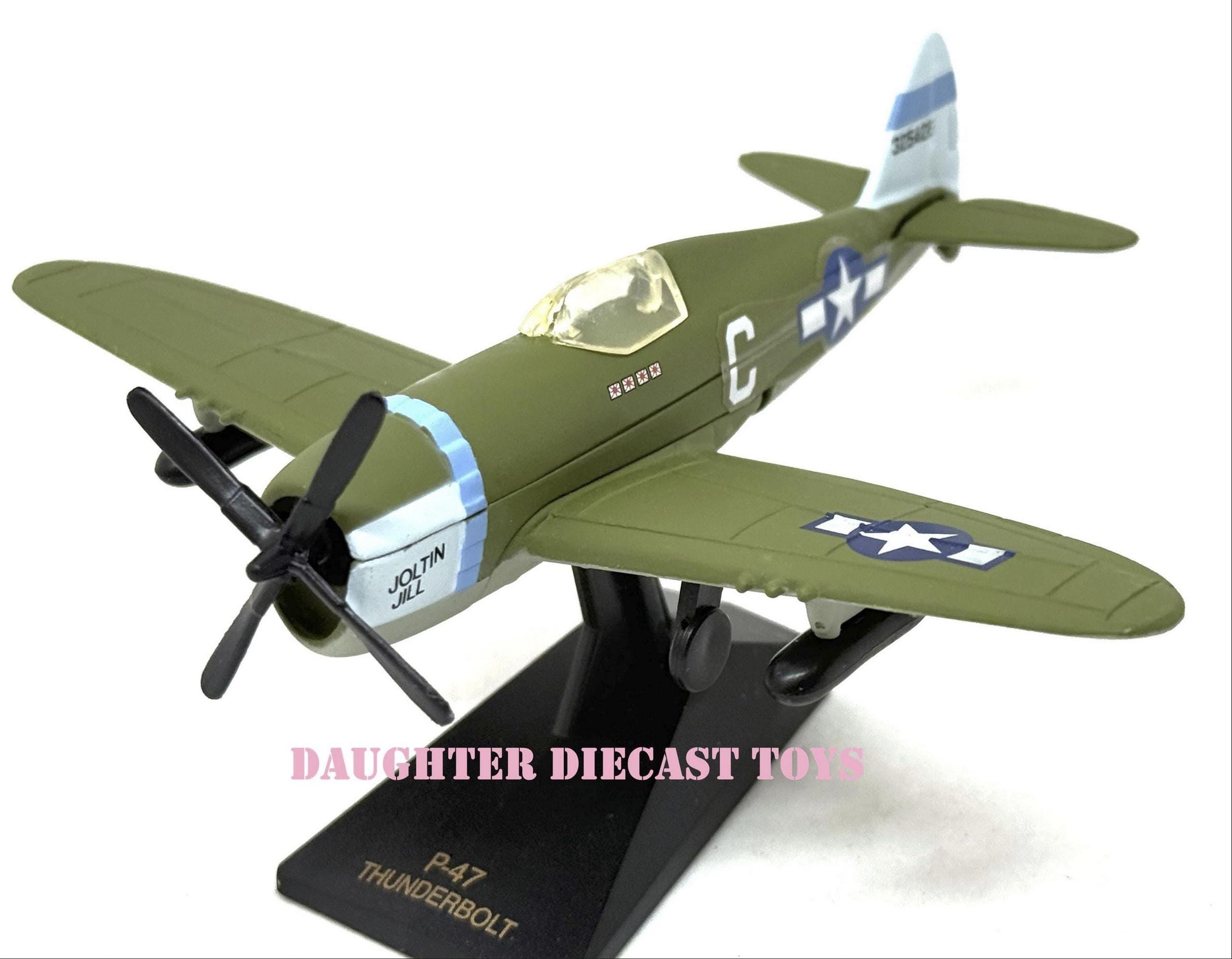
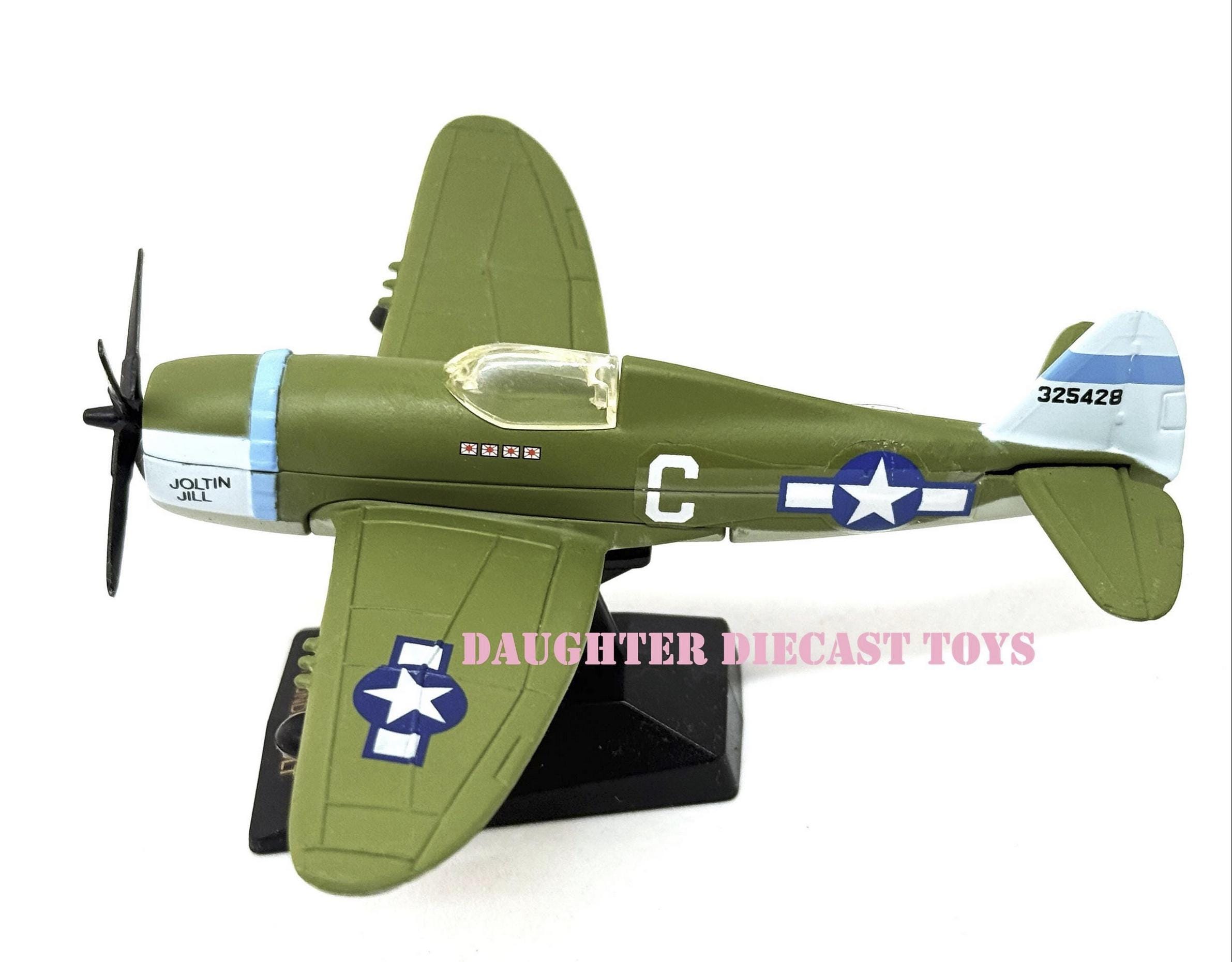
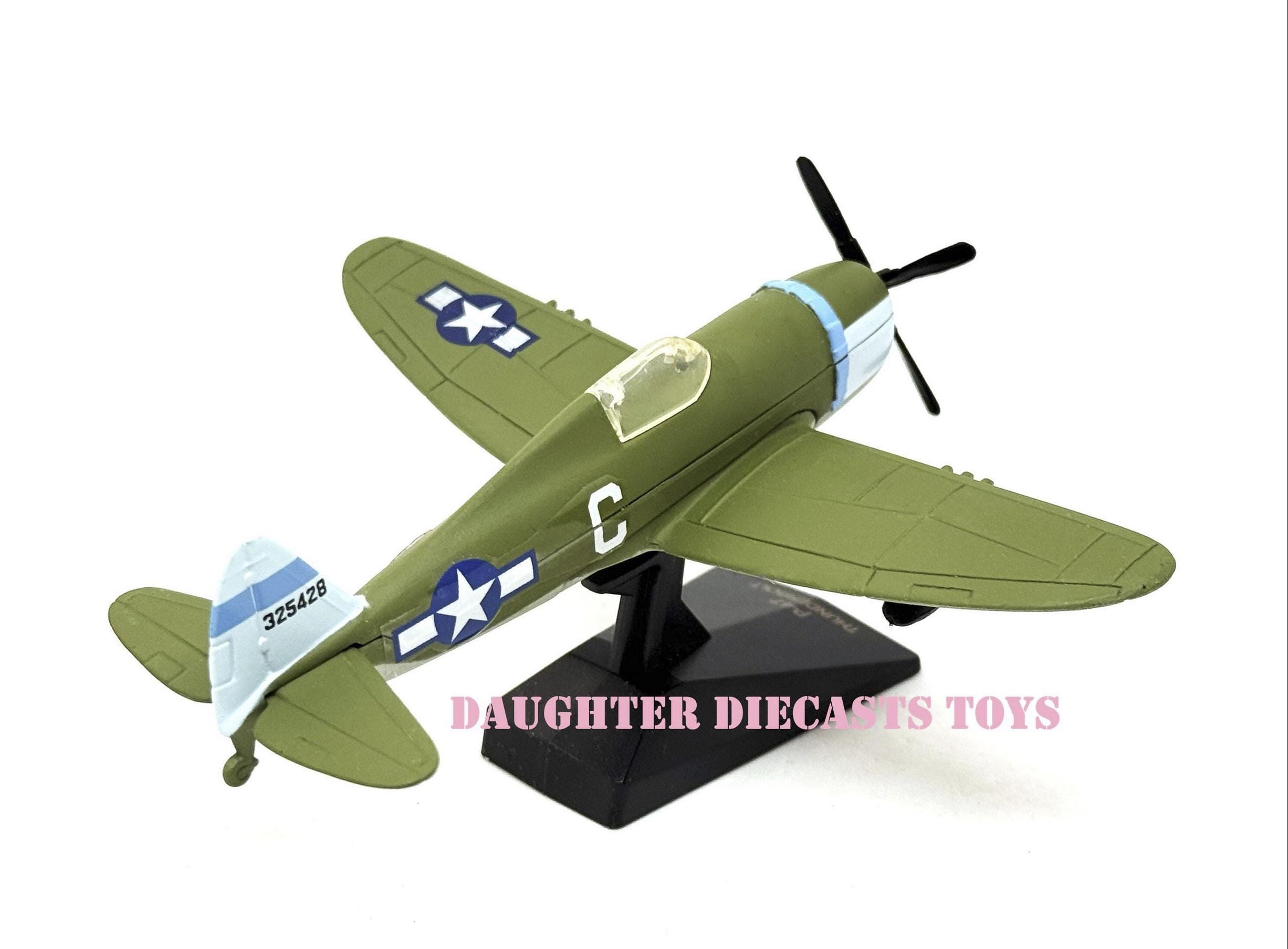
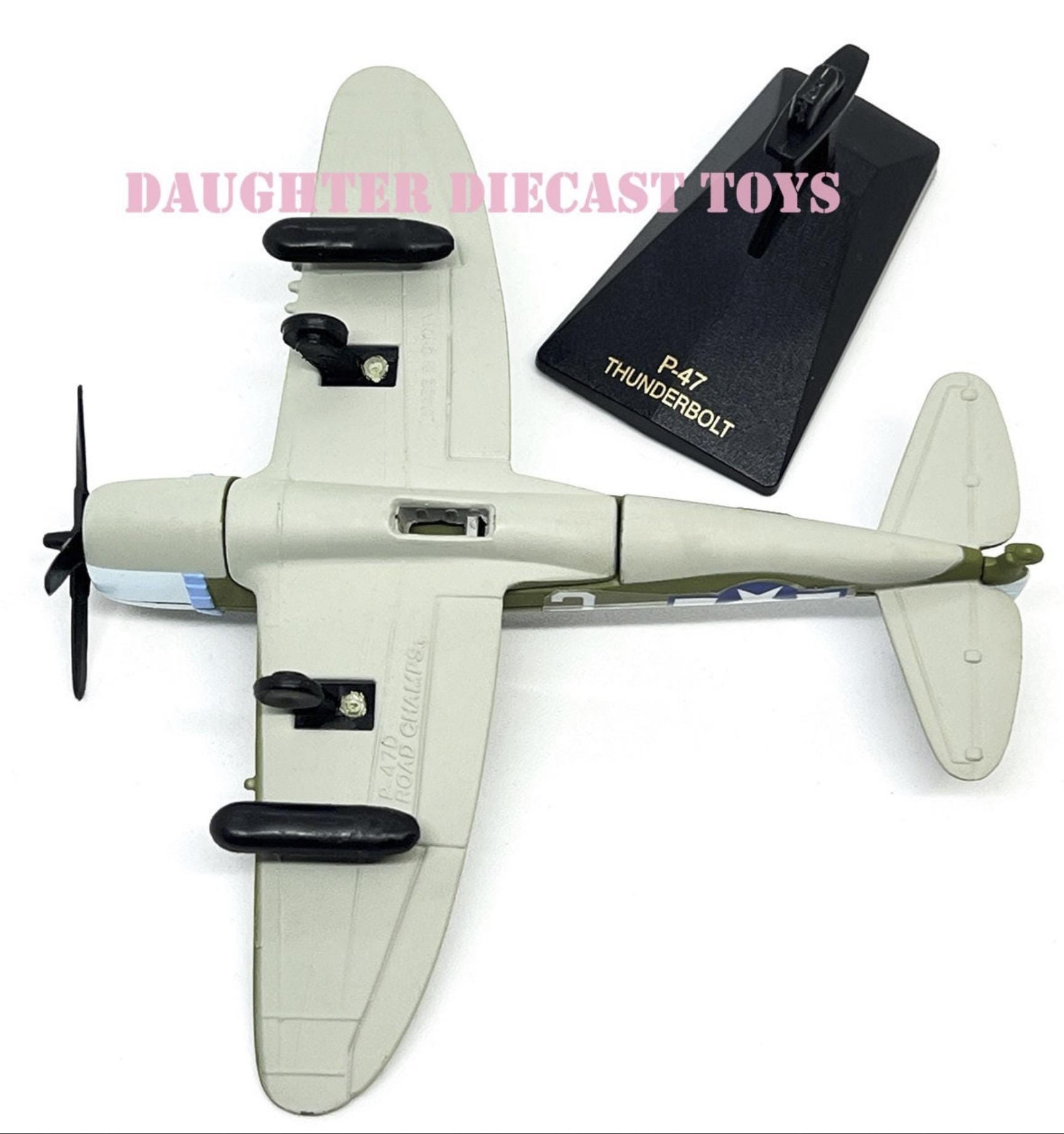

WWII P-47 "Joltin Jill" FIGHTER Bomber Diecast Metal Airplane-Perfect Gift fans of Military Aircraft & Collectors!
$ 49.99

WWII P-47D "JOLTIN JILL" FIGHTER BOMBER Diecast Metal Airplane w/Stand! Pristine
Condition-Perfect Gift fans of Military Aircraft & Collectors!Awesome!... REPUBLIC P-47D WWII FIGHTER BOMBER AIRPLANE (see bio below). Adult collector model-made of heavy diecast metal by Road Champs. Highly sought-after model! 1/72 scale prox. Measures 4 1/4"L x 5"W x 3"H (mounted). Model-never displayed or handled (until today for our photos) However, please notice there is a bullet hole in the cracked canopy on this aircraft. Comes with sturdy desktop display stand. Sold loose in collectors' bag. Perfect gift for Military aircraft/ vintage toy collectors and fans of Aviation history (like me)! We ship fast & safe worldwide every day!
•
•
•FOR A LIMITED TIME
•
•
•Purchases totaling $35 and above qualify for FREE shipping to USA! Add more items to your Etsy shopping cart to save $$$.NOTE: My dad owned a Diecast toy store for 30 years. I inherited the store inventory when he passed away many years ago. I am just now, beginning to sell the mint condition vintage models. All are store-inventory is new-old-stock, models have never been "played with". Please visit often-as I am adding more cool stuff every day!AIRCRAFT BIO:The Republic P-47 Thunderbolt is a World War II-era fighter aircraft produced by the American company Republic Aviation from 1941 through 1945. It was a successful high-altitude fighter, and it also served as the foremost American fighter-bomber in the ground-attack role. Its primary armament was eight .50-caliber machine guns, and it could carry 5-inch rockets or a bomb load of 2,500 lb (1,100 kg). When fully loaded, the P-47 weighed up to 8 tons, making it one of the heaviest fighters of the war.The Thunderbolt was effective as a short- to medium-range escort fighter in high-altitude air-to-air combat and ground attack in both the European and Pacific theaters. The P-47 was designed around the powerful Pratt & Whitney R-2800 Double Wasp 18-cylinder radial engine, which also powered two U.S. Navy/U.S. Marine Corps fighters, the Grumman F6F Hellcat and the Vought F4U Corsair. An advanced turbosupercharger system ensured the aircraft's eventual dominance at high altitudes, while also influencing its size and design.The P-47 was one of the main United States Army Air Forces (USAAF) fighters of World War II. It also served with other Allied air forces, including those of France, the United Kingdom, and the Soviet Union. Mexican and Brazilian squadrons fighting alongside the USAAF also flew the P-47.The armored cockpit was relatively roomy and comfortable, and the bubble canopy introduced on the P-47D offered good visibility. Nicknamed the "Jug" owing to its appearance if stood on its nose, the P-47 was noted for its firepower and its ability to resist battle damage and remain airworthy. A present-day U.S. ground-attack aircraft, the Fairchild Republic A-10 Thunderbolt II, takes its name from the P-47.[Note 1]By the end of 1942, P-47Cs were sent to England for combat operations. The initial Thunderbolt flyers, 56th Fighter Group, were sent overseas to join the 8th Air Force. As the P-47 Thunderbolt worked up to operational status, it gained a nickname: "Jug" (because its profile was similar to that of a common milk jug of the time).[Note 4] Two fighter groups already stationed in England began introducing the Jugs in January 1943 - the Spitfire-flying 4th Fighter Group, a unit built around a core of experienced American pilots who had flown in the RAF Eagle Squadrons prior to the US entry in the war; and the 78th Fighter Group, formerly flying P-38 Lightnings. P-47 pilot Lt Col Francis S. "Gabby" Gabreski, 56th Fighter Group, leading ace of the 8th Air ForceBeginning in January 1943, Thunderbolt fighters were sent to the joint Army Air Forces – civilian Millville Airport in Millville, New Jersey, to train civilian and military pilots.The first P-47 combat mission took place 10 March 1943 when the 4th FG took their aircraft on a fighter sweep over France. The mission was a failure due to radio malfunctions. All P-47s were refitted with British radios, and missions resumed 8 April. The first P-47 air combat took place 15 April with Major Don Blakeslee of the 4th FG scoring the Thunderbolt's first air victory (against a Focke-Wulf Fw 190).By mid-1943, the Jug was also in service with the 12th Air Force in Italy[13] and against the Japanese in the Pacific, with the 348th Fighter Group flying missions out of Port Moresby, New Guinea. By 1944, the Thunderbolt was in combat with the USAAF in all its operational theaters except Alaska. One of several gun-harmonization schemes used on the P-47: This one converged the eight guns into a point at about 1,100 ft (340 m) out front.Luftwaffe ace Heinz Bär said that the P-47 "could absorb an astounding amount of lead [from shooting at it] and had to be handled very carefully".[14] Although the North American P-51 Mustang replaced the P-47 in the long-range escort role in Europe, the Thunderbolt still ended the war with an aerial kill ratio of 4.6:1[15] in over 746,000 sorties of all types, at the cost of 3,499 P-47s to all causes in combat.[16] By the end of the war, the 56th FG was the only 8th Air Force unit still flying the P-47, by preference, instead of the P-51. The unit claimed 677-1/2 air victories and 311 ground kills, at the cost of 128 aircraft.[17] Lieutenant Colonel Francis S. Gabreski scored 28 victories,[18] Captain Robert S. Johnson scored 27 (with one unconfirmed probable kill leading to some giving his tally as 28),[19] and 56th FG Commanding Officer Colonel Hubert Zemke scored 17.75 kills.[Note 5] Despite being the sole remaining P-47 group in the 8th Air Force, the 56th FG remained its top-scoring group in aerial victories throughout the war.With increases in fuel capacity as the type was refined, the range of escort missions over Europe steadily increased until the P-47 was able to accompany bombers in raids all the way into Germany. On the way back from the raids, pilots shot up ground targets of opportunity, and also used belly shackles to carry bombs on short-range missions, which led to the realization that the P-47 could perform a dual function on escort missions as a fighter-bomber. Even with its complicated turbosupercharger system, its sturdy airframe and tough radial engine could absorb significant damage and still return home.The P-47 gradually became the USAAF's primary fighter-bomber; by late 1943, early versions of the P-47D carried 500 lb (230 kg) bombs underneath their bellies, midproduction versions of the P-47D could carry 1,000 lb (450 kg) bombs and M8 4.5 in (115 mm) rockets under their wings or from the last version of the P-47D in 1944, 5 in (130 mm) High Velocity Aircraft Rockets (HVARs, also known as "Holy Moses"). From D-Day until VE day, Thunderbolt pilots claimed to have destroyed 86,000 railroad cars, 9,000 locomotives, 6,000 armored fighting vehicles, and 68,000 trucks.[21] During Operation Cobra, in the vicinity of Roncey, P-47 Thunderbolts of the 405th Fighter group destroyed a German column of 122 tanks, 259 other vehicles, and 11 artillery pieces.[22][23]
Condition-Perfect Gift fans of Military Aircraft & Collectors!Awesome!... REPUBLIC P-47D WWII FIGHTER BOMBER AIRPLANE (see bio below). Adult collector model-made of heavy diecast metal by Road Champs. Highly sought-after model! 1/72 scale prox. Measures 4 1/4"L x 5"W x 3"H (mounted). Model-never displayed or handled (until today for our photos) However, please notice there is a bullet hole in the cracked canopy on this aircraft. Comes with sturdy desktop display stand. Sold loose in collectors' bag. Perfect gift for Military aircraft/ vintage toy collectors and fans of Aviation history (like me)! We ship fast & safe worldwide every day!
•
•
•FOR A LIMITED TIME
•
•
•Purchases totaling $35 and above qualify for FREE shipping to USA! Add more items to your Etsy shopping cart to save $$$.NOTE: My dad owned a Diecast toy store for 30 years. I inherited the store inventory when he passed away many years ago. I am just now, beginning to sell the mint condition vintage models. All are store-inventory is new-old-stock, models have never been "played with". Please visit often-as I am adding more cool stuff every day!AIRCRAFT BIO:The Republic P-47 Thunderbolt is a World War II-era fighter aircraft produced by the American company Republic Aviation from 1941 through 1945. It was a successful high-altitude fighter, and it also served as the foremost American fighter-bomber in the ground-attack role. Its primary armament was eight .50-caliber machine guns, and it could carry 5-inch rockets or a bomb load of 2,500 lb (1,100 kg). When fully loaded, the P-47 weighed up to 8 tons, making it one of the heaviest fighters of the war.The Thunderbolt was effective as a short- to medium-range escort fighter in high-altitude air-to-air combat and ground attack in both the European and Pacific theaters. The P-47 was designed around the powerful Pratt & Whitney R-2800 Double Wasp 18-cylinder radial engine, which also powered two U.S. Navy/U.S. Marine Corps fighters, the Grumman F6F Hellcat and the Vought F4U Corsair. An advanced turbosupercharger system ensured the aircraft's eventual dominance at high altitudes, while also influencing its size and design.The P-47 was one of the main United States Army Air Forces (USAAF) fighters of World War II. It also served with other Allied air forces, including those of France, the United Kingdom, and the Soviet Union. Mexican and Brazilian squadrons fighting alongside the USAAF also flew the P-47.The armored cockpit was relatively roomy and comfortable, and the bubble canopy introduced on the P-47D offered good visibility. Nicknamed the "Jug" owing to its appearance if stood on its nose, the P-47 was noted for its firepower and its ability to resist battle damage and remain airworthy. A present-day U.S. ground-attack aircraft, the Fairchild Republic A-10 Thunderbolt II, takes its name from the P-47.[Note 1]By the end of 1942, P-47Cs were sent to England for combat operations. The initial Thunderbolt flyers, 56th Fighter Group, were sent overseas to join the 8th Air Force. As the P-47 Thunderbolt worked up to operational status, it gained a nickname: "Jug" (because its profile was similar to that of a common milk jug of the time).[Note 4] Two fighter groups already stationed in England began introducing the Jugs in January 1943 - the Spitfire-flying 4th Fighter Group, a unit built around a core of experienced American pilots who had flown in the RAF Eagle Squadrons prior to the US entry in the war; and the 78th Fighter Group, formerly flying P-38 Lightnings. P-47 pilot Lt Col Francis S. "Gabby" Gabreski, 56th Fighter Group, leading ace of the 8th Air ForceBeginning in January 1943, Thunderbolt fighters were sent to the joint Army Air Forces – civilian Millville Airport in Millville, New Jersey, to train civilian and military pilots.The first P-47 combat mission took place 10 March 1943 when the 4th FG took their aircraft on a fighter sweep over France. The mission was a failure due to radio malfunctions. All P-47s were refitted with British radios, and missions resumed 8 April. The first P-47 air combat took place 15 April with Major Don Blakeslee of the 4th FG scoring the Thunderbolt's first air victory (against a Focke-Wulf Fw 190).By mid-1943, the Jug was also in service with the 12th Air Force in Italy[13] and against the Japanese in the Pacific, with the 348th Fighter Group flying missions out of Port Moresby, New Guinea. By 1944, the Thunderbolt was in combat with the USAAF in all its operational theaters except Alaska. One of several gun-harmonization schemes used on the P-47: This one converged the eight guns into a point at about 1,100 ft (340 m) out front.Luftwaffe ace Heinz Bär said that the P-47 "could absorb an astounding amount of lead [from shooting at it] and had to be handled very carefully".[14] Although the North American P-51 Mustang replaced the P-47 in the long-range escort role in Europe, the Thunderbolt still ended the war with an aerial kill ratio of 4.6:1[15] in over 746,000 sorties of all types, at the cost of 3,499 P-47s to all causes in combat.[16] By the end of the war, the 56th FG was the only 8th Air Force unit still flying the P-47, by preference, instead of the P-51. The unit claimed 677-1/2 air victories and 311 ground kills, at the cost of 128 aircraft.[17] Lieutenant Colonel Francis S. Gabreski scored 28 victories,[18] Captain Robert S. Johnson scored 27 (with one unconfirmed probable kill leading to some giving his tally as 28),[19] and 56th FG Commanding Officer Colonel Hubert Zemke scored 17.75 kills.[Note 5] Despite being the sole remaining P-47 group in the 8th Air Force, the 56th FG remained its top-scoring group in aerial victories throughout the war.With increases in fuel capacity as the type was refined, the range of escort missions over Europe steadily increased until the P-47 was able to accompany bombers in raids all the way into Germany. On the way back from the raids, pilots shot up ground targets of opportunity, and also used belly shackles to carry bombs on short-range missions, which led to the realization that the P-47 could perform a dual function on escort missions as a fighter-bomber. Even with its complicated turbosupercharger system, its sturdy airframe and tough radial engine could absorb significant damage and still return home.The P-47 gradually became the USAAF's primary fighter-bomber; by late 1943, early versions of the P-47D carried 500 lb (230 kg) bombs underneath their bellies, midproduction versions of the P-47D could carry 1,000 lb (450 kg) bombs and M8 4.5 in (115 mm) rockets under their wings or from the last version of the P-47D in 1944, 5 in (130 mm) High Velocity Aircraft Rockets (HVARs, also known as "Holy Moses"). From D-Day until VE day, Thunderbolt pilots claimed to have destroyed 86,000 railroad cars, 9,000 locomotives, 6,000 armored fighting vehicles, and 68,000 trucks.[21] During Operation Cobra, in the vicinity of Roncey, P-47 Thunderbolts of the 405th Fighter group destroyed a German column of 122 tanks, 259 other vehicles, and 11 artillery pieces.[22][23]
Other Products