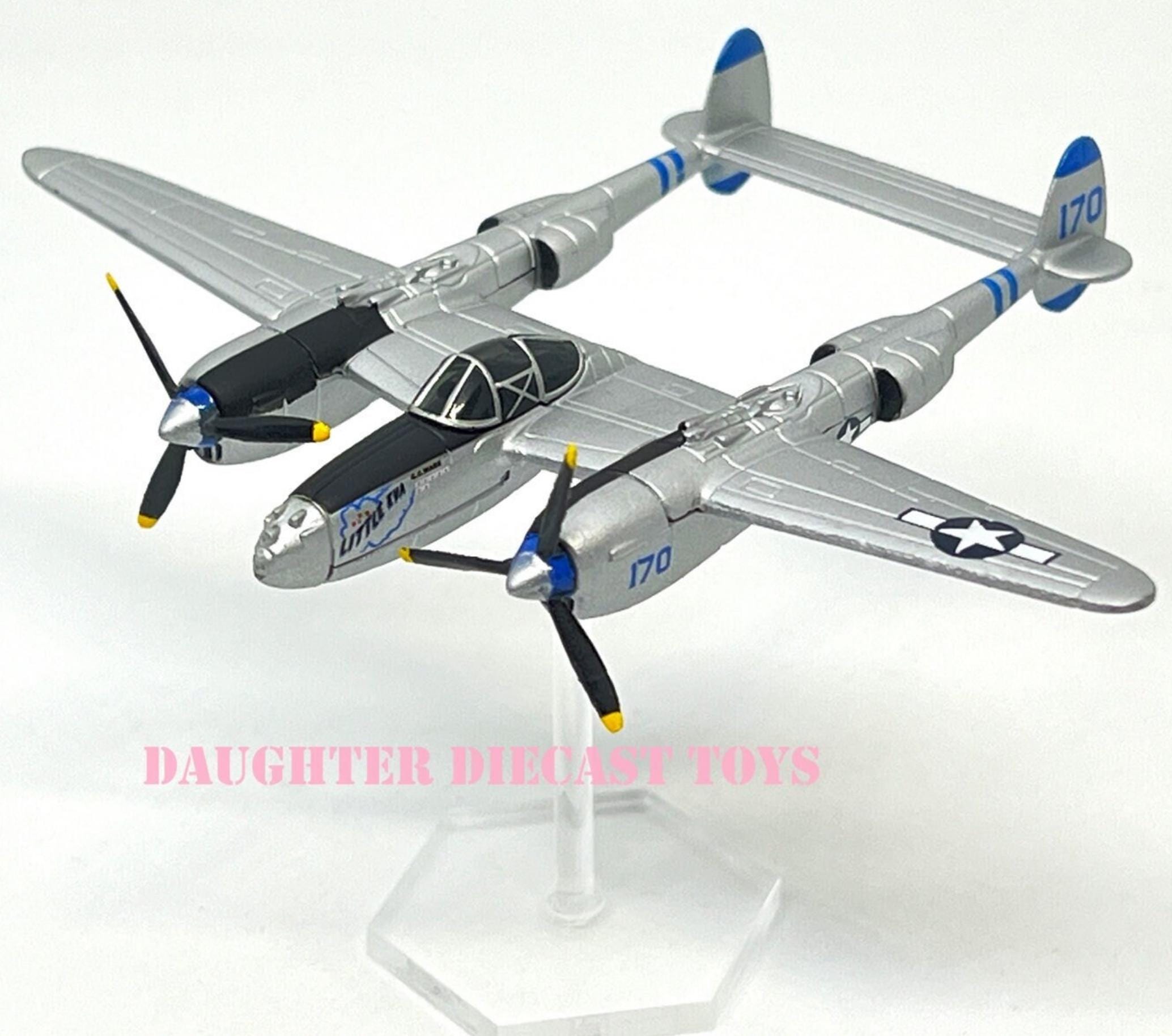
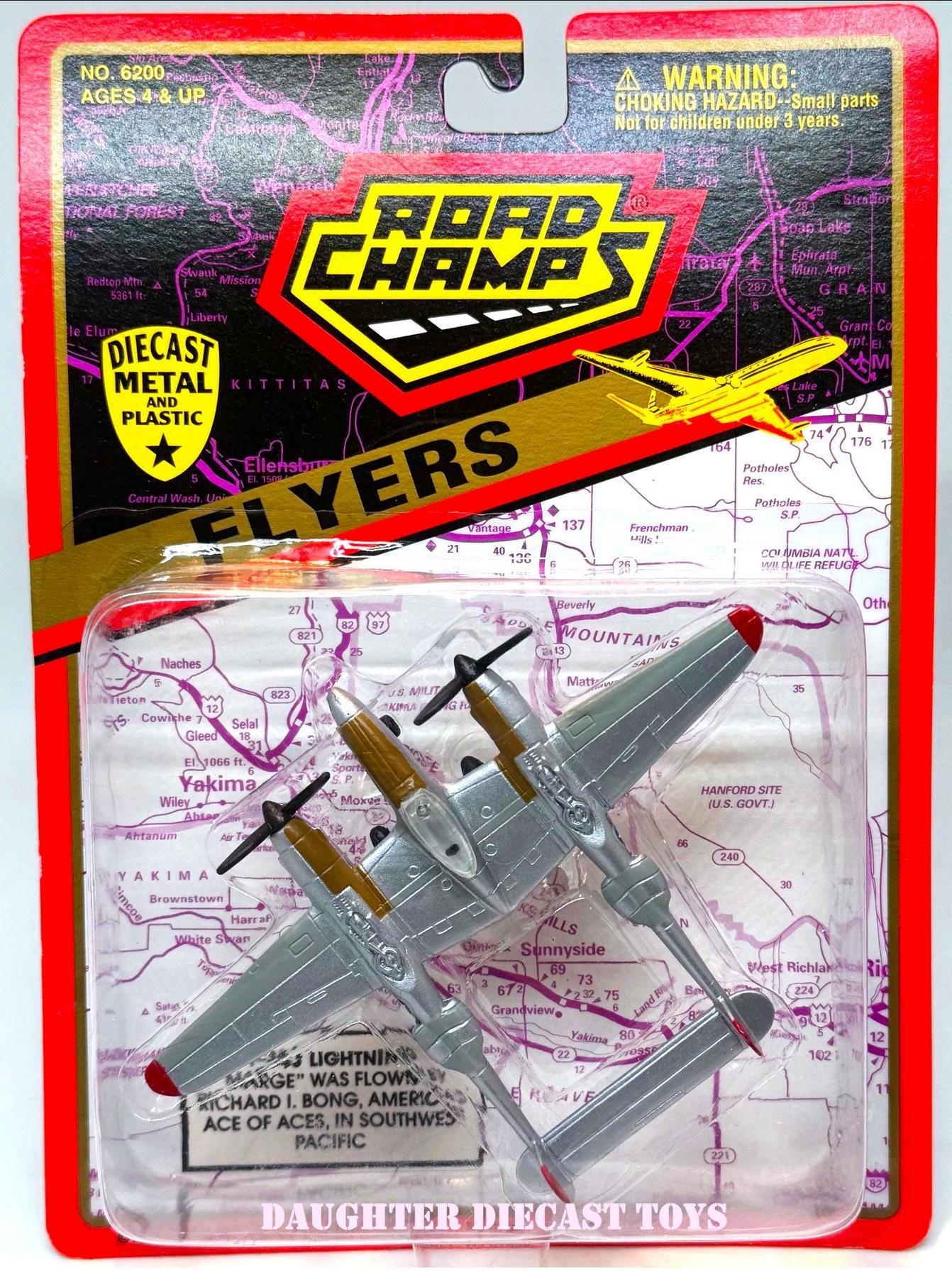
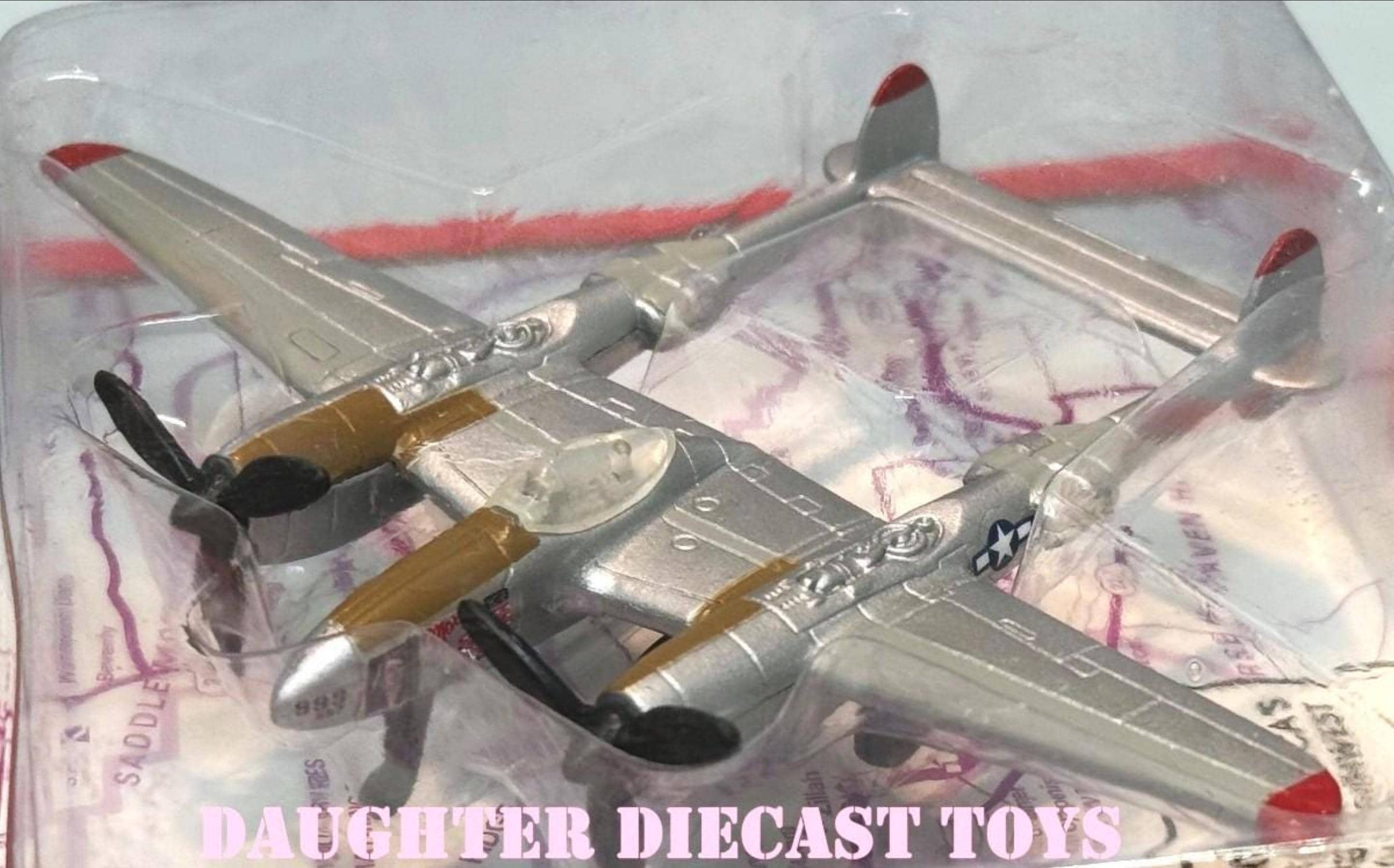
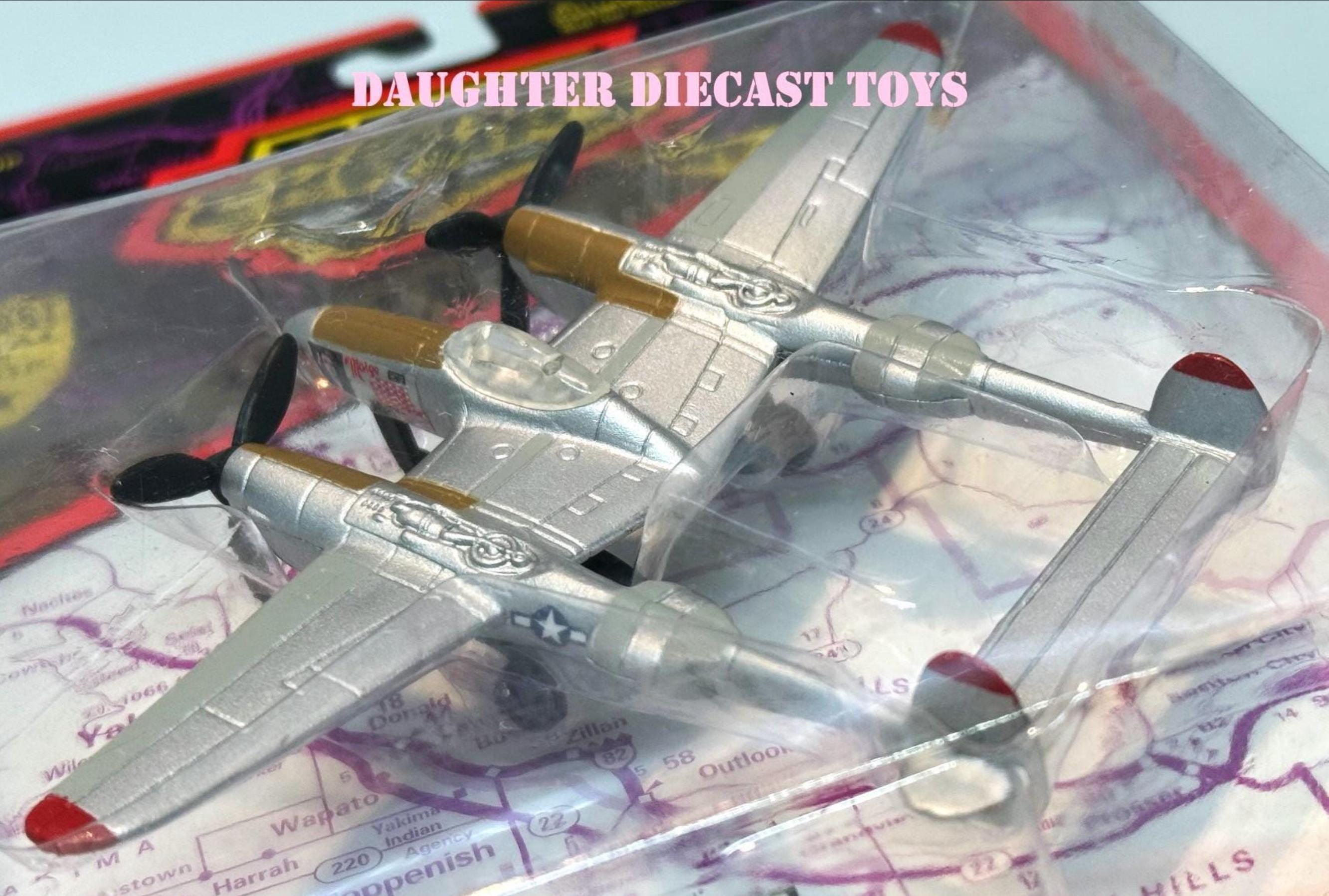
U.S. Army WWII P-38 FIGHTER "Marge"- Adult Collector Diecast Metal Airplane-Pristine Condition-Perfect Gift for Aviation History Buffs!
$ 34.99

US ARMY WWII P-38 FIGHTER "MARGE" - Adult Collector Diecast Metal
Airplane-Pristine Condition-Perfect Gift for Aviation History Buffs!Fantastic looking US ARMY WWII P-38 FIGHTER. Adult collector-constructed of heavy die cast metal. Made by Road Champs. Highly sought-after, hard to find vintage model! Scale=1/43 prox-measures 3 3/4"L x 5 "W x 2 1/4" (mounted on rolling wheels). This model is in pristine condition and has never been removed from its original factory-sealed packaging. Perfect gift for Military aircraft, vintage toy collectors and Aviation History buffs (like me)! We ship fast & safe worldwide every day! READ Aircraft bio below...
•
•
•FOR A LIMITED TIME
•
•
•Purchases totaling $35 and above qualify for FREE shipping to USA! Add more items to your Etsy shopping cart to save $$$.NOTE: My dad owned a Diecast toy store for 30 years. I inherited the store inventory when he passed away many years ago. I am just now, beginning to sell the mint condition vintage models. All are store-inventory is new-old-stock, models have never been "played with". Please visit often-as I am adding more cool stuff every day!AIRCRAFT BIO:The Lockheed P-38 Lightning is a World War II–era American piston-engined fighter aircraft. Developed for the United States Army Air Corps, the P-38 had distinctive twin booms and a central nacelle containing the cockpit and armament. Allied propaganda claimed it had been nicknamed the fork-tailed devil (German: der Gabelschwanz-Teufel) by the Luftwaffe and "two planes, one pilot" by the Japanese.[6] The P-38 was used for interception, dive bombing, level bombing, ground attack, night fighting, photo reconnaissance, radar and visual pathfinding for bombers and evacuation missions,[7] and extensively as a long-range escort fighter when equipped with drop tanks under its wings.The P-38 was used most successfully in the Pacific Theater of Operations and the China-Burma-India Theater of Operations as the aircraft of America's top aces, Richard Bong (40 victories), Thomas McGuire (38 victories) and Charles H. MacDonald (27 victories). In the South West Pacific theater, the P-38 was the primary long-range fighter of United States Army Air Forces until the introduction of large numbers of P-51D Mustangs toward the end of the war.[8][9]The P-38 was unusually quiet for a fighter, since the exhaust was muffled by the turbo-superchargers. It was extremely forgiving and could be mishandled in many ways, but the rate of roll in the early versions was too low for it to excel as a dogfighter.[10] The P-38 was the only American fighter aircraft in large-scale production throughout American involvement in the war, from Pearl Harbor to Victory over Japan Day.[11] At the end of the war, orders for 1,887 more were cancelled.[12]Operational historyCocooned Lockheed P-38 Lightnings and North American Aviation P-51 Mustangs line the decks of a U.S. Navy Escort "Jeep" Carrier (CVE) ready for shipment to Europe from New York.The first unit to receive P-38s was the 1st Fighter Group. After the attack on Pearl Harbor, the unit joined the 14th Pursuit Group in San Diego to provide West Coast defense.[68]Entry to the warThe first Lightning to see active service was the F-4 version, a P-38E in which the guns were replaced by four K17 cameras.[69] They joined the 8th Photographic Squadron in Australia on 4 April 1942.[42] Three F-4s were operated by the Royal Australian Air Force in this theater for a short period beginning in September 1942.On 29 May 1942, 25 P-38s began operating in the Aleutian Islands in Alaska. The fighter's long range made it well-suited to the campaign over the almost 1,200-mile (1,900 km)-long island chain, and it was flown there for the rest of the war. The Aleutians were some of the most rugged environments available for testing the new aircraft under combat conditions. More Lightnings were lost due to severe weather and other conditions than enemy action; cases occurred where Lightning pilots, mesmerized by flying for hours over gray seas under gray skies, simply flew into the water. On 9 August 1942, two P-38Es of the 343rd Fighter Group, 11th Air Force, at the end of a 1,000-mile (1,600 km) long-range patrol, happened upon a pair of Japanese Kawanishi H6K "Mavis" flying boats and destroyed them,[42] making them the first Japanese aircraft to be shot down by Lightnings. European theater North Africa and Italy Reconnaissance P-38 with bold black and white invasion stripes participating in the Normandy CampaignAfter the Battle of Midway, the USAAF began redeploying fighter groups to Britain as part of Operation Bolero and Lightnings of the 1st Fighter Group were flown across the Atlantic via Iceland. On 14 August 1942, Second Lieutenant Elza Shahan of the 27th Fighter Squadron, and Second Lieutenant Joseph Shaffer of the 33rd Squadron operating out of Iceland shot down a Focke-Wulf Fw 200 Condor over the Atlantic. Shaffer, flying either a P-40C or a P-39, scored the first hit, causing a fire on the Condor; Shahan in his P-38F finished it off with a high-speed gunnery pass.[70] This was the first Luftwaffe aircraft destroyed by the USAAF.[71]After 347 sorties with no enemy contact, the 1st and 14th Fighter Groups transferred from the UK to the 12th Air Force in North Africa as part of the force being built up for Operation Torch. The Lightning's long range allowed the pilots to fly their fighters over the Bay of Biscay, skirting neutral Spain and Portugal to refuel in Morocco. The P-38s were initially based at Tafaroui Airfield in Algeria alongside P-40 Warhawks and the rest of the 12th Air Force. P-38s were first involved in North African combat operations on 11 November 1942. The first North African P-38 kill was on 22 November, when Lieutenant Mark Shipman of the 14th downed an Italian airplane with twin engines. Shipman later made two more kills – a Messerschmitt Bf 109 fighter and a very large Me 323 Gigant transport.[72]Early results in the Mediterranean Theater of Operations were mixed. Some P-38 pilots scored multiple kills to become aces, while many others were shot down due to inexperience or tactical strictures. Overall, the P-38 suffered its highest losses in the Mediterranean Theater. The primary function of the P-38 in North Africa was to escort bombers,[73] but the fighters also targeted transport aircraft, and later in the campaign, they were sometimes tasked with ground-attack missions. When tied to bomber-escort duties, the P-38 squadrons were vulnerable to attack from above by German fighters, who selected the most advantageous position and timing. The initial tactical doctrine of the American units was for the P-38s to fly near the bombers at all times rather than to defend aggressively or to fly ahead and clear the airspace for the bombers, and many American pilots were downed because of this limitation. Losses mounted, and all available P-38s in the UK were flown over to North Africa to restore squadron strength.[72] After this painful experience, the American leadership changed tactics, and in February 1943, the P-38s were given free rein in their battles.[74]
Airplane-Pristine Condition-Perfect Gift for Aviation History Buffs!Fantastic looking US ARMY WWII P-38 FIGHTER. Adult collector-constructed of heavy die cast metal. Made by Road Champs. Highly sought-after, hard to find vintage model! Scale=1/43 prox-measures 3 3/4"L x 5 "W x 2 1/4" (mounted on rolling wheels). This model is in pristine condition and has never been removed from its original factory-sealed packaging. Perfect gift for Military aircraft, vintage toy collectors and Aviation History buffs (like me)! We ship fast & safe worldwide every day! READ Aircraft bio below...
•
•
•FOR A LIMITED TIME
•
•
•Purchases totaling $35 and above qualify for FREE shipping to USA! Add more items to your Etsy shopping cart to save $$$.NOTE: My dad owned a Diecast toy store for 30 years. I inherited the store inventory when he passed away many years ago. I am just now, beginning to sell the mint condition vintage models. All are store-inventory is new-old-stock, models have never been "played with". Please visit often-as I am adding more cool stuff every day!AIRCRAFT BIO:The Lockheed P-38 Lightning is a World War II–era American piston-engined fighter aircraft. Developed for the United States Army Air Corps, the P-38 had distinctive twin booms and a central nacelle containing the cockpit and armament. Allied propaganda claimed it had been nicknamed the fork-tailed devil (German: der Gabelschwanz-Teufel) by the Luftwaffe and "two planes, one pilot" by the Japanese.[6] The P-38 was used for interception, dive bombing, level bombing, ground attack, night fighting, photo reconnaissance, radar and visual pathfinding for bombers and evacuation missions,[7] and extensively as a long-range escort fighter when equipped with drop tanks under its wings.The P-38 was used most successfully in the Pacific Theater of Operations and the China-Burma-India Theater of Operations as the aircraft of America's top aces, Richard Bong (40 victories), Thomas McGuire (38 victories) and Charles H. MacDonald (27 victories). In the South West Pacific theater, the P-38 was the primary long-range fighter of United States Army Air Forces until the introduction of large numbers of P-51D Mustangs toward the end of the war.[8][9]The P-38 was unusually quiet for a fighter, since the exhaust was muffled by the turbo-superchargers. It was extremely forgiving and could be mishandled in many ways, but the rate of roll in the early versions was too low for it to excel as a dogfighter.[10] The P-38 was the only American fighter aircraft in large-scale production throughout American involvement in the war, from Pearl Harbor to Victory over Japan Day.[11] At the end of the war, orders for 1,887 more were cancelled.[12]Operational historyCocooned Lockheed P-38 Lightnings and North American Aviation P-51 Mustangs line the decks of a U.S. Navy Escort "Jeep" Carrier (CVE) ready for shipment to Europe from New York.The first unit to receive P-38s was the 1st Fighter Group. After the attack on Pearl Harbor, the unit joined the 14th Pursuit Group in San Diego to provide West Coast defense.[68]Entry to the warThe first Lightning to see active service was the F-4 version, a P-38E in which the guns were replaced by four K17 cameras.[69] They joined the 8th Photographic Squadron in Australia on 4 April 1942.[42] Three F-4s were operated by the Royal Australian Air Force in this theater for a short period beginning in September 1942.On 29 May 1942, 25 P-38s began operating in the Aleutian Islands in Alaska. The fighter's long range made it well-suited to the campaign over the almost 1,200-mile (1,900 km)-long island chain, and it was flown there for the rest of the war. The Aleutians were some of the most rugged environments available for testing the new aircraft under combat conditions. More Lightnings were lost due to severe weather and other conditions than enemy action; cases occurred where Lightning pilots, mesmerized by flying for hours over gray seas under gray skies, simply flew into the water. On 9 August 1942, two P-38Es of the 343rd Fighter Group, 11th Air Force, at the end of a 1,000-mile (1,600 km) long-range patrol, happened upon a pair of Japanese Kawanishi H6K "Mavis" flying boats and destroyed them,[42] making them the first Japanese aircraft to be shot down by Lightnings. European theater North Africa and Italy Reconnaissance P-38 with bold black and white invasion stripes participating in the Normandy CampaignAfter the Battle of Midway, the USAAF began redeploying fighter groups to Britain as part of Operation Bolero and Lightnings of the 1st Fighter Group were flown across the Atlantic via Iceland. On 14 August 1942, Second Lieutenant Elza Shahan of the 27th Fighter Squadron, and Second Lieutenant Joseph Shaffer of the 33rd Squadron operating out of Iceland shot down a Focke-Wulf Fw 200 Condor over the Atlantic. Shaffer, flying either a P-40C or a P-39, scored the first hit, causing a fire on the Condor; Shahan in his P-38F finished it off with a high-speed gunnery pass.[70] This was the first Luftwaffe aircraft destroyed by the USAAF.[71]After 347 sorties with no enemy contact, the 1st and 14th Fighter Groups transferred from the UK to the 12th Air Force in North Africa as part of the force being built up for Operation Torch. The Lightning's long range allowed the pilots to fly their fighters over the Bay of Biscay, skirting neutral Spain and Portugal to refuel in Morocco. The P-38s were initially based at Tafaroui Airfield in Algeria alongside P-40 Warhawks and the rest of the 12th Air Force. P-38s were first involved in North African combat operations on 11 November 1942. The first North African P-38 kill was on 22 November, when Lieutenant Mark Shipman of the 14th downed an Italian airplane with twin engines. Shipman later made two more kills – a Messerschmitt Bf 109 fighter and a very large Me 323 Gigant transport.[72]Early results in the Mediterranean Theater of Operations were mixed. Some P-38 pilots scored multiple kills to become aces, while many others were shot down due to inexperience or tactical strictures. Overall, the P-38 suffered its highest losses in the Mediterranean Theater. The primary function of the P-38 in North Africa was to escort bombers,[73] but the fighters also targeted transport aircraft, and later in the campaign, they were sometimes tasked with ground-attack missions. When tied to bomber-escort duties, the P-38 squadrons were vulnerable to attack from above by German fighters, who selected the most advantageous position and timing. The initial tactical doctrine of the American units was for the P-38s to fly near the bombers at all times rather than to defend aggressively or to fly ahead and clear the airspace for the bombers, and many American pilots were downed because of this limitation. Losses mounted, and all available P-38s in the UK were flown over to North Africa to restore squadron strength.[72] After this painful experience, the American leadership changed tactics, and in February 1943, the P-38s were given free rein in their battles.[74]
Other Products