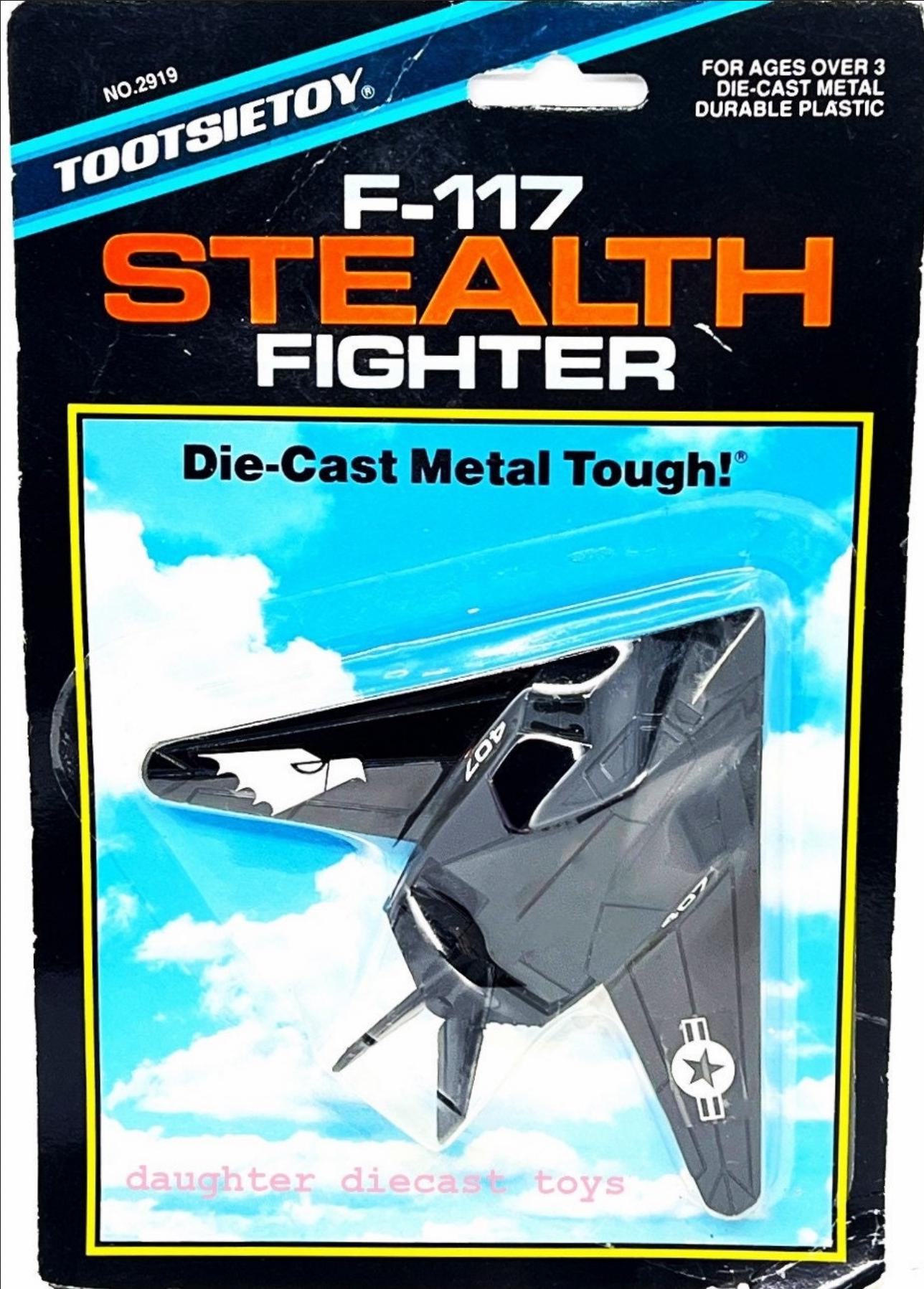
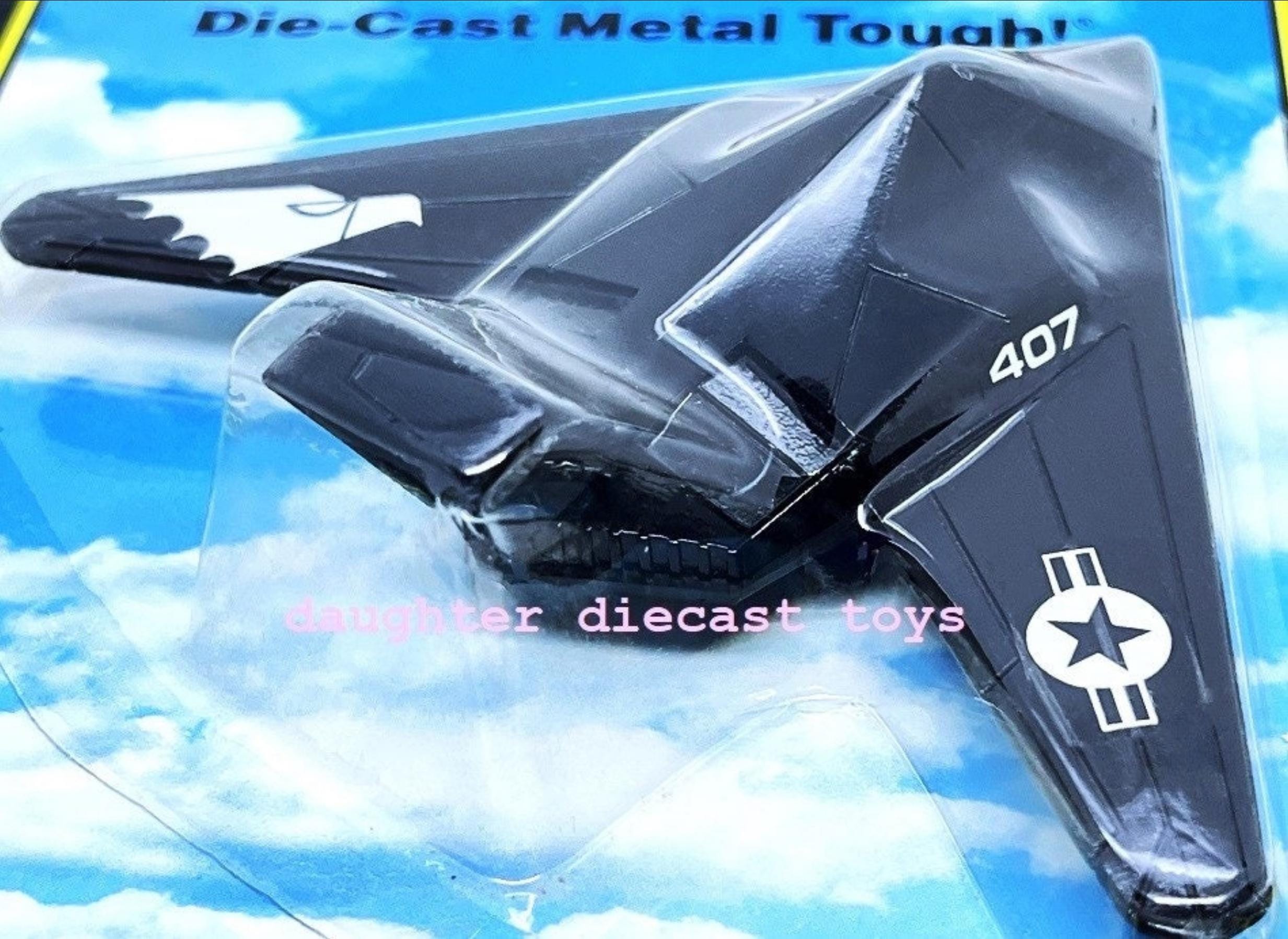
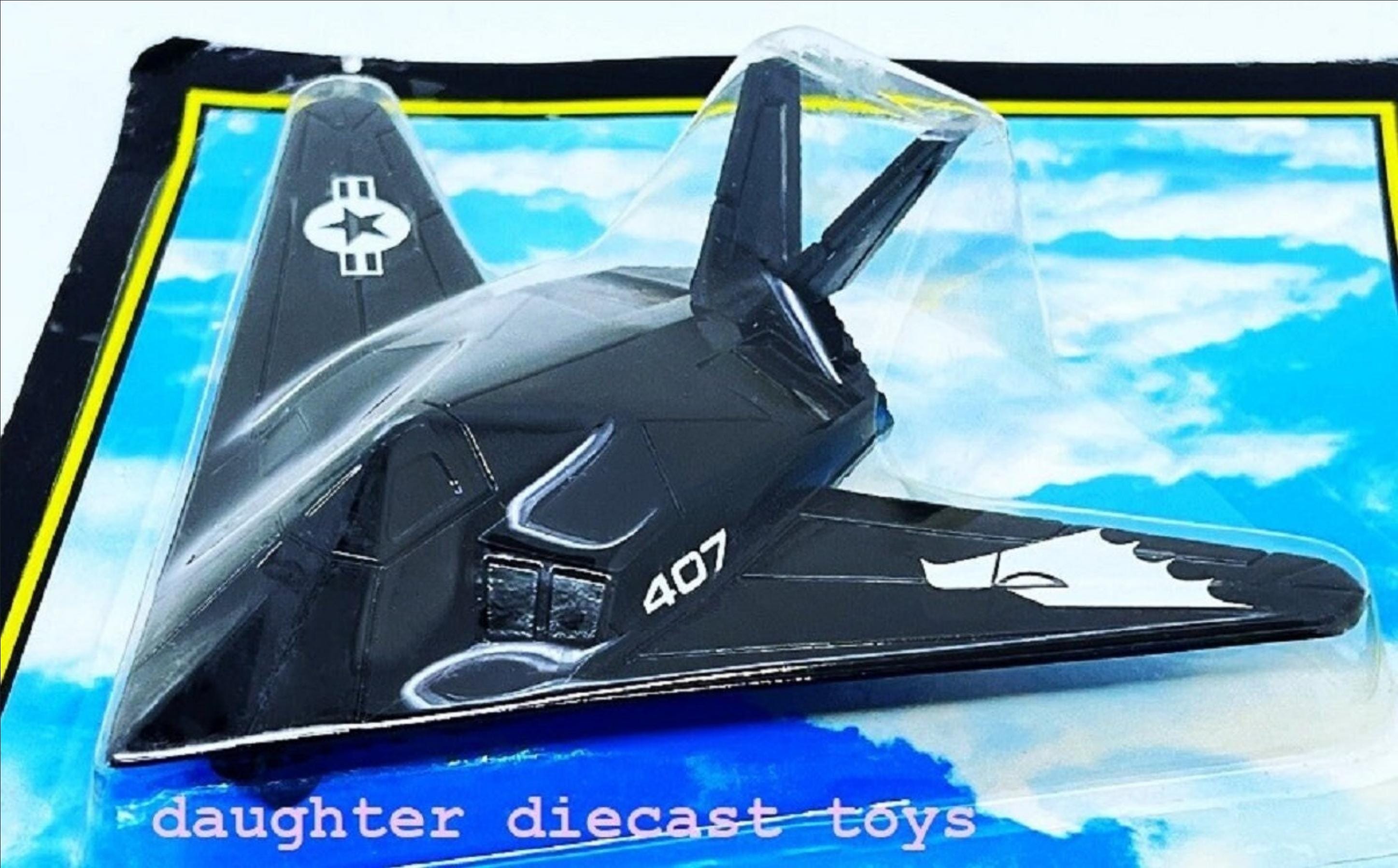

Vintage 1987 F-117 Nighthawk STEALTH FIGHTER - Big Diecast Metal Military Airplane Mint Condition/Factory Sealed! TootsieToy Rare Find!
$ 29.99

Vintage 1987 F-117 NIGHTHAWK STEALTH FIGHTER. Made by TootsieToy-constructed of
die cast metal. Highly sought-after, hard to find vintage model! Large size measures 4 1/2"L x 5 1/2"W x 1 1/2 "H. Pristine condition. Never been removed from its factory-sealed card. Perfect gift for TootsieToy, aircraft, and vintage toy collectors + fans of aviation history and air shows (like me!). Read aircraft bio below....
•
•
•FOR A LIMITED TIME
•
•
•Purchases totaling $35 and above qualify for FREE shipping to USA! Add more items to your Etsy shopping cart to save $$$.NOTE: My dad owned a Diecast toy store for 30 years. I inherited the store inventory when he passed away many years ago. I am just now, beginning to sell the mint condition vintage models. All are store-inventory is new-old-stock, models have never been "played with". Please visit often-as I am adding more cool stuff every day!AIRCRAFT BIO:Role: Stealth attack aircraft National origin: United States Manufacturer: Lockheed Corporation First flight: June 18, 1981; 42 years ago Introduction October 1983 Retired : 22 April 2008 Status: Used as training aircraft as of 2023 Primary user: United States Air Force Number built : 64 (5 YF-117As, 59 F-117As) Developed from: Lockheed Have Bluehe Lockheed F-117 Nighthawk is a retired American single-seat, subsonic twin-engine stealth attack aircraft developed by Lockheed's secretive Skunk Works division and operated by the United States Air Force (USAF). It was the first operational aircraft to be designed with stealth technology.The F-117 was based on the Have Blue technology demonstrator. The Nighthawk's maiden flight took place in 1981 at Groom Lake, Nevada, and the aircraft achieved initial operating capability status in 1983. The aircraft was shrouded in secrecy until it was revealed to the public in 1988. Of the 64 F-117s built, 59 were production versions, with the other five being prototypes.The F-117 was widely publicized for its role in the Gulf War of 1991. Although it was commonly referred to as the "Stealth Fighter", it was strictly an attack aircraft. F-117s took part in the conflict in Yugoslavia, where one was shot down by a surface-to-air missile (SAM) in 1999. The U.S. Air Force retired the F-117 in April 2008, primarily due to the fielding of the F-22 Raptor.[4] Despite the type's official retirement, a portion of the fleet has been kept in airworthy condition, and Nighthawks have been observed flying since 2009.[5]Operational historyAn F-117 conducts a live exercise bombing run using GBU-27 laser-guided bombsDuring the program's early years, from 1984 to mid-1992, the F-117 fleet was based at Tonopah Test Range Airport, Nevada, where it served under the 4450th Tactical Group. Because the F-117 was classified during this time, the unit was officially located at Nellis Air Force Base, Nevada, and equipped with A-7 Corsair II aircraft. All military personnel were permanently assigned to Nellis AFB, and most personnel and their families lived in Las Vegas. This required commercial air and trucking to transport personnel between Las Vegas and Tonopah each week. The 4450th was absorbed by the 37th Tactical Fighter Wing in 1989. In 1992, the entire fleet was transferred to Holloman Air Force Base, New Mexico, under the command of the 49th Fighter Wing. This move also eliminated the Key Air and American Trans Air contract flights to Tonopah, which flew 22,000 passenger trips on 300 flights from Nellis to Tonopah per month.The F-117 reached initial operating capability status in 1983.[2] The Nighthawk's pilots called themselves "Bandits". Each of the 558 Air Force pilots who have flown the F-117 has a Bandit number, such as "Bandit 52", that indicates the sequential order of their first flight in the F-117.[49] Pilots told friends and families that they flew the Northrop F-5 in aggressor squadrons against Tactical Air Command.[28]The F-117 has been used several times in war. Its first mission was during the United States invasion of Panama in 1989.[50] During that invasion two F-117 Nighthawks dropped two bombs on Rio Hato airfield.During the Gulf War in 1991, the F-117 flew approximately 1,300 sorties and scored direct hits on what the U.S. called 1,600 high-value targets in Iraq[2] over 6,905 flight hours.[51] Leaflet drops on Iraqi forces displayed the F-117 destroying ground targets and warned "Escape now and save yourselves".[29] Only 229 Coalition tactical aircraft could drop and designate laser-guided bombs of which 36 F-117s represented 15.7%, and only the USAF had the I-2000 bombs intended for hardened targets. So the F-117 represented 32% of all coalition aircraft that could deliver such bombs.[52]: 73–74 Notably, F-117s were used in the Amiriyah shelter bombing killing at least 408 civilians.[53]Early claims of the F-117's effectiveness were later found to be overstated.[54] Initial reports of F-117s hitting 80% of their targets were later scaled back to "41–60%".[52]: 132 On the first night, they failed to hit 40% of their assigned air-defense targets, including the Air Defense Operations Center in Baghdad, and 8 such targets remained functional out of 10 that could be assessed.[52]: 136–137 In their Desert Storm white paper, the USAF stated that "the F-117 was the only airplane that the planners dared risk over downtown Baghdad" and that this area was particularly well defended. (Dozens of F-16s were routinely tasked to attack Baghdad in the first few days of the war.)[52]: 137–138 In fact, most of the air defenses were on the outskirts of the city and many other aircraft hit targets in the downtown area, with minimal casualties when they attacked at night like the F-117;[52] they avoided the optically aimed anti-aircraft cannon and infrared SAMs which were the biggest threat to Coalition aircraft.[52]: 105 The aircraft was operated in secret from Tonopah for almost a decade, but after the Gulf War the aircraft moved to Holloman in 1992—however, its integration with the USAF's non-stealth "iron jets" occurred slowly. As one senior F-117 pilot later said: Because of ongoing secrecy others continued to see the aircraft as "none of their business, a stand-alone system".[12] The F-117 and the men and women of the 49th Fighter Wing were deployed to Southwest Asia on multiple occasions. On their first deployment, with the aid of aerial refueling, pilots flew non-stop from Holloman to Kuwait, a flight of approximately 18.5 hours.[55] Combat over Yugoslavia Main article: 1999 F-117A shootdown Canopy of F-117 shot down in Serbia in March 1999 at the Museum of Aviation in BelgradeOne F-117 (AF ser. no. 82-0806) was lost to enemy action. It was downed during an Operation Allied Force mission against the Army of Yugoslavia on 27 March 1999.[56] The aircraft was acquired by a fire control radar at a distance of 8.1 mi (13 km) and an altitude of 5.0 mi (8 km). SA-3s were then launched by a Yugoslav version of the Soviet Isayev S-125 "Neva" (NATO name SA-3 "Goa") anti-aircraft missile system.[56][57][58] The launcher was run by the 3rd Battalion of the 250th Air Defence Missile Brigade under the command of Colonel Zoltán Dani.[59]After the explosion, the aircraft became uncontrollable, forcing the pilot to eject.[56] The pilot was recovered six hours later by a United States Air Force Pararescue team.[56][60] The stealth technology from the downed F-117 may have been acquired by Russia and China,[61] but the U.S. did not attempt to destroy the wreckage; senior Pentagon officials claimed that its technology was already dated and no longer important to protect.[28] The USAF continued using the F-117 during Operation Allied Force.[62] Later service and retirement A pair of F-117A NighthawksThe F-117 was later used in the Operation Enduring Freedom in 2001 and Operation Iraqi Freedom in 2003. It was only operated by the U.S. Air Force.The loss in Serbia caused the USAF to create a subsection of their existing weapons school to improve tactics. More training was done with other units, and the F-117 began to participate in Red Flag exercises. Though advanced for its time, the F-117's stealthy faceted airframe required a large amount of maintenance and was eventually superseded by streamlined shapes produced with computer-aided design. Other weapon systems began to take on the F-117's roles, such as the F-22 Raptor gaining the ability to drop guided bombs.[4] By 2005, the aircraft was used only for certain missions, such as if a pilot needed to verify that the correct target had been hit, or when minimal collateral damage was vital.[12]The USAF had once planned to retire the F-117 in 2011, but Program Budget Decision 720 (PBD 720), dated 28 December 2005, proposed retiring it by October 2008 to free up an estimated $1.07 billion[63] to buy more F-22s.[49] PBD 720 called for 10 F-117s to be retired in FY2007 and the remaining 42 in FY2008, stating that other USAF planes and missiles could stealthily deliver precision ordnance, including the B-2 Spirit, F-22 and JASSM.[64] The planned introduction of the multi-role F-35 Lightning II also contributed to the retirement decision.[65]In late 2006, the USAF closed the F-117 formal training unit (FTU),[66] and announced the retirement of the F-117.[67] The first six aircraft to be retired took their last flight on 12 March 2007 after a ceremony at Holloman AFB to commemorate the aircraft's career. Brigadier General David L. Goldfein, commander of the 49th Fighter Wing, said at the ceremony, "With the launch of these great aircraft today, the circle comes to a close—their service to our nation's defense fulfilled, their mission accomplished and a job well done. We send them today to their final resting place—a home they are intimately familiar with—their first, and only, home outside of Holloman."[68] A pair of specially painted F-117 Nighthawks sporting a United States flag theme on their bellies fly off from their last refueling by the Ohio Air National Guard's 121st Air Refueling WingUnlike most other USAF aircraft that are retired to Davis-Monthan AFB for scrapping, or dispersal to museums, most of the F-117s were placed in "Type 1000" storage[69] in their original hangars at the Tonopah Test Range Airport.[56] At Tonopah, their wings were removed and the aircraft are stored in their original climate-controlled hangars.[68] The decommissioning occurred in eight phases, with the operational aircraft retired to Tonopah in seven waves from 13 March 2007 until the last wave's arrival on 22 April 2008.[3][56] Four aircraft were kept flying beyond April by the 410th Flight Test Squadron at Palmdale for flight test. By August, two were remaining. The last F-117 (AF Serial No. 86-0831) left Palmdale to fly to Tonopah on 11 August 2008.[56][70] With the last aircraft retired, the 410th was inactivated in a ceremony on 1 August 2008.[71]Five aircraft were placed in museums, including the first four YF-117As and some remains of the F-117 shot down over Serbia. Through 2009, one F-117 had been scrapped; AF Serial No. 79-0784 was scrapped at the Palmdale test facility on 26 April 2008. It was the last F-117 at Palmdale and was scrapped to test an effective method for destroying F-117 airframes.[56]Congress had ordered that all F-117s mothballed from 30 September 2006 onwards were to be maintained "in a condition that would allow recall of that aircraft to future service" as part of the 2007 National Defense Authorization Act. By April 2016, lawmakers appeared ready to "remove the requirement that certain F-117 aircraft be maintained in a condition that would allow recall of those aircraft to future service", which would move them from storage to the aerospace maintenance and regeneration yard in Arizona to be scavenged for hard-to-find parts, or completely disassembled.[72] On 11 September 2017, it was reported that in accordance with the National Defense Authorization Act for Fiscal Year 2017, signed into law on 23 December 2016, "the Air Force will remove four F-117s every year to fully divest them—a process known as demilitarizing aircraft".[73]
die cast metal. Highly sought-after, hard to find vintage model! Large size measures 4 1/2"L x 5 1/2"W x 1 1/2 "H. Pristine condition. Never been removed from its factory-sealed card. Perfect gift for TootsieToy, aircraft, and vintage toy collectors + fans of aviation history and air shows (like me!). Read aircraft bio below....
•
•
•FOR A LIMITED TIME
•
•
•Purchases totaling $35 and above qualify for FREE shipping to USA! Add more items to your Etsy shopping cart to save $$$.NOTE: My dad owned a Diecast toy store for 30 years. I inherited the store inventory when he passed away many years ago. I am just now, beginning to sell the mint condition vintage models. All are store-inventory is new-old-stock, models have never been "played with". Please visit often-as I am adding more cool stuff every day!AIRCRAFT BIO:Role: Stealth attack aircraft National origin: United States Manufacturer: Lockheed Corporation First flight: June 18, 1981; 42 years ago Introduction October 1983 Retired : 22 April 2008 Status: Used as training aircraft as of 2023 Primary user: United States Air Force Number built : 64 (5 YF-117As, 59 F-117As) Developed from: Lockheed Have Bluehe Lockheed F-117 Nighthawk is a retired American single-seat, subsonic twin-engine stealth attack aircraft developed by Lockheed's secretive Skunk Works division and operated by the United States Air Force (USAF). It was the first operational aircraft to be designed with stealth technology.The F-117 was based on the Have Blue technology demonstrator. The Nighthawk's maiden flight took place in 1981 at Groom Lake, Nevada, and the aircraft achieved initial operating capability status in 1983. The aircraft was shrouded in secrecy until it was revealed to the public in 1988. Of the 64 F-117s built, 59 were production versions, with the other five being prototypes.The F-117 was widely publicized for its role in the Gulf War of 1991. Although it was commonly referred to as the "Stealth Fighter", it was strictly an attack aircraft. F-117s took part in the conflict in Yugoslavia, where one was shot down by a surface-to-air missile (SAM) in 1999. The U.S. Air Force retired the F-117 in April 2008, primarily due to the fielding of the F-22 Raptor.[4] Despite the type's official retirement, a portion of the fleet has been kept in airworthy condition, and Nighthawks have been observed flying since 2009.[5]Operational historyAn F-117 conducts a live exercise bombing run using GBU-27 laser-guided bombsDuring the program's early years, from 1984 to mid-1992, the F-117 fleet was based at Tonopah Test Range Airport, Nevada, where it served under the 4450th Tactical Group. Because the F-117 was classified during this time, the unit was officially located at Nellis Air Force Base, Nevada, and equipped with A-7 Corsair II aircraft. All military personnel were permanently assigned to Nellis AFB, and most personnel and their families lived in Las Vegas. This required commercial air and trucking to transport personnel between Las Vegas and Tonopah each week. The 4450th was absorbed by the 37th Tactical Fighter Wing in 1989. In 1992, the entire fleet was transferred to Holloman Air Force Base, New Mexico, under the command of the 49th Fighter Wing. This move also eliminated the Key Air and American Trans Air contract flights to Tonopah, which flew 22,000 passenger trips on 300 flights from Nellis to Tonopah per month.The F-117 reached initial operating capability status in 1983.[2] The Nighthawk's pilots called themselves "Bandits". Each of the 558 Air Force pilots who have flown the F-117 has a Bandit number, such as "Bandit 52", that indicates the sequential order of their first flight in the F-117.[49] Pilots told friends and families that they flew the Northrop F-5 in aggressor squadrons against Tactical Air Command.[28]The F-117 has been used several times in war. Its first mission was during the United States invasion of Panama in 1989.[50] During that invasion two F-117 Nighthawks dropped two bombs on Rio Hato airfield.During the Gulf War in 1991, the F-117 flew approximately 1,300 sorties and scored direct hits on what the U.S. called 1,600 high-value targets in Iraq[2] over 6,905 flight hours.[51] Leaflet drops on Iraqi forces displayed the F-117 destroying ground targets and warned "Escape now and save yourselves".[29] Only 229 Coalition tactical aircraft could drop and designate laser-guided bombs of which 36 F-117s represented 15.7%, and only the USAF had the I-2000 bombs intended for hardened targets. So the F-117 represented 32% of all coalition aircraft that could deliver such bombs.[52]: 73–74 Notably, F-117s were used in the Amiriyah shelter bombing killing at least 408 civilians.[53]Early claims of the F-117's effectiveness were later found to be overstated.[54] Initial reports of F-117s hitting 80% of their targets were later scaled back to "41–60%".[52]: 132 On the first night, they failed to hit 40% of their assigned air-defense targets, including the Air Defense Operations Center in Baghdad, and 8 such targets remained functional out of 10 that could be assessed.[52]: 136–137 In their Desert Storm white paper, the USAF stated that "the F-117 was the only airplane that the planners dared risk over downtown Baghdad" and that this area was particularly well defended. (Dozens of F-16s were routinely tasked to attack Baghdad in the first few days of the war.)[52]: 137–138 In fact, most of the air defenses were on the outskirts of the city and many other aircraft hit targets in the downtown area, with minimal casualties when they attacked at night like the F-117;[52] they avoided the optically aimed anti-aircraft cannon and infrared SAMs which were the biggest threat to Coalition aircraft.[52]: 105 The aircraft was operated in secret from Tonopah for almost a decade, but after the Gulf War the aircraft moved to Holloman in 1992—however, its integration with the USAF's non-stealth "iron jets" occurred slowly. As one senior F-117 pilot later said: Because of ongoing secrecy others continued to see the aircraft as "none of their business, a stand-alone system".[12] The F-117 and the men and women of the 49th Fighter Wing were deployed to Southwest Asia on multiple occasions. On their first deployment, with the aid of aerial refueling, pilots flew non-stop from Holloman to Kuwait, a flight of approximately 18.5 hours.[55] Combat over Yugoslavia Main article: 1999 F-117A shootdown Canopy of F-117 shot down in Serbia in March 1999 at the Museum of Aviation in BelgradeOne F-117 (AF ser. no. 82-0806) was lost to enemy action. It was downed during an Operation Allied Force mission against the Army of Yugoslavia on 27 March 1999.[56] The aircraft was acquired by a fire control radar at a distance of 8.1 mi (13 km) and an altitude of 5.0 mi (8 km). SA-3s were then launched by a Yugoslav version of the Soviet Isayev S-125 "Neva" (NATO name SA-3 "Goa") anti-aircraft missile system.[56][57][58] The launcher was run by the 3rd Battalion of the 250th Air Defence Missile Brigade under the command of Colonel Zoltán Dani.[59]After the explosion, the aircraft became uncontrollable, forcing the pilot to eject.[56] The pilot was recovered six hours later by a United States Air Force Pararescue team.[56][60] The stealth technology from the downed F-117 may have been acquired by Russia and China,[61] but the U.S. did not attempt to destroy the wreckage; senior Pentagon officials claimed that its technology was already dated and no longer important to protect.[28] The USAF continued using the F-117 during Operation Allied Force.[62] Later service and retirement A pair of F-117A NighthawksThe F-117 was later used in the Operation Enduring Freedom in 2001 and Operation Iraqi Freedom in 2003. It was only operated by the U.S. Air Force.The loss in Serbia caused the USAF to create a subsection of their existing weapons school to improve tactics. More training was done with other units, and the F-117 began to participate in Red Flag exercises. Though advanced for its time, the F-117's stealthy faceted airframe required a large amount of maintenance and was eventually superseded by streamlined shapes produced with computer-aided design. Other weapon systems began to take on the F-117's roles, such as the F-22 Raptor gaining the ability to drop guided bombs.[4] By 2005, the aircraft was used only for certain missions, such as if a pilot needed to verify that the correct target had been hit, or when minimal collateral damage was vital.[12]The USAF had once planned to retire the F-117 in 2011, but Program Budget Decision 720 (PBD 720), dated 28 December 2005, proposed retiring it by October 2008 to free up an estimated $1.07 billion[63] to buy more F-22s.[49] PBD 720 called for 10 F-117s to be retired in FY2007 and the remaining 42 in FY2008, stating that other USAF planes and missiles could stealthily deliver precision ordnance, including the B-2 Spirit, F-22 and JASSM.[64] The planned introduction of the multi-role F-35 Lightning II also contributed to the retirement decision.[65]In late 2006, the USAF closed the F-117 formal training unit (FTU),[66] and announced the retirement of the F-117.[67] The first six aircraft to be retired took their last flight on 12 March 2007 after a ceremony at Holloman AFB to commemorate the aircraft's career. Brigadier General David L. Goldfein, commander of the 49th Fighter Wing, said at the ceremony, "With the launch of these great aircraft today, the circle comes to a close—their service to our nation's defense fulfilled, their mission accomplished and a job well done. We send them today to their final resting place—a home they are intimately familiar with—their first, and only, home outside of Holloman."[68] A pair of specially painted F-117 Nighthawks sporting a United States flag theme on their bellies fly off from their last refueling by the Ohio Air National Guard's 121st Air Refueling WingUnlike most other USAF aircraft that are retired to Davis-Monthan AFB for scrapping, or dispersal to museums, most of the F-117s were placed in "Type 1000" storage[69] in their original hangars at the Tonopah Test Range Airport.[56] At Tonopah, their wings were removed and the aircraft are stored in their original climate-controlled hangars.[68] The decommissioning occurred in eight phases, with the operational aircraft retired to Tonopah in seven waves from 13 March 2007 until the last wave's arrival on 22 April 2008.[3][56] Four aircraft were kept flying beyond April by the 410th Flight Test Squadron at Palmdale for flight test. By August, two were remaining. The last F-117 (AF Serial No. 86-0831) left Palmdale to fly to Tonopah on 11 August 2008.[56][70] With the last aircraft retired, the 410th was inactivated in a ceremony on 1 August 2008.[71]Five aircraft were placed in museums, including the first four YF-117As and some remains of the F-117 shot down over Serbia. Through 2009, one F-117 had been scrapped; AF Serial No. 79-0784 was scrapped at the Palmdale test facility on 26 April 2008. It was the last F-117 at Palmdale and was scrapped to test an effective method for destroying F-117 airframes.[56]Congress had ordered that all F-117s mothballed from 30 September 2006 onwards were to be maintained "in a condition that would allow recall of that aircraft to future service" as part of the 2007 National Defense Authorization Act. By April 2016, lawmakers appeared ready to "remove the requirement that certain F-117 aircraft be maintained in a condition that would allow recall of those aircraft to future service", which would move them from storage to the aerospace maintenance and regeneration yard in Arizona to be scavenged for hard-to-find parts, or completely disassembled.[72] On 11 September 2017, it was reported that in accordance with the National Defense Authorization Act for Fiscal Year 2017, signed into law on 23 December 2016, "the Air Force will remove four F-117s every year to fully divest them—a process known as demilitarizing aircraft".[73]
Other Products