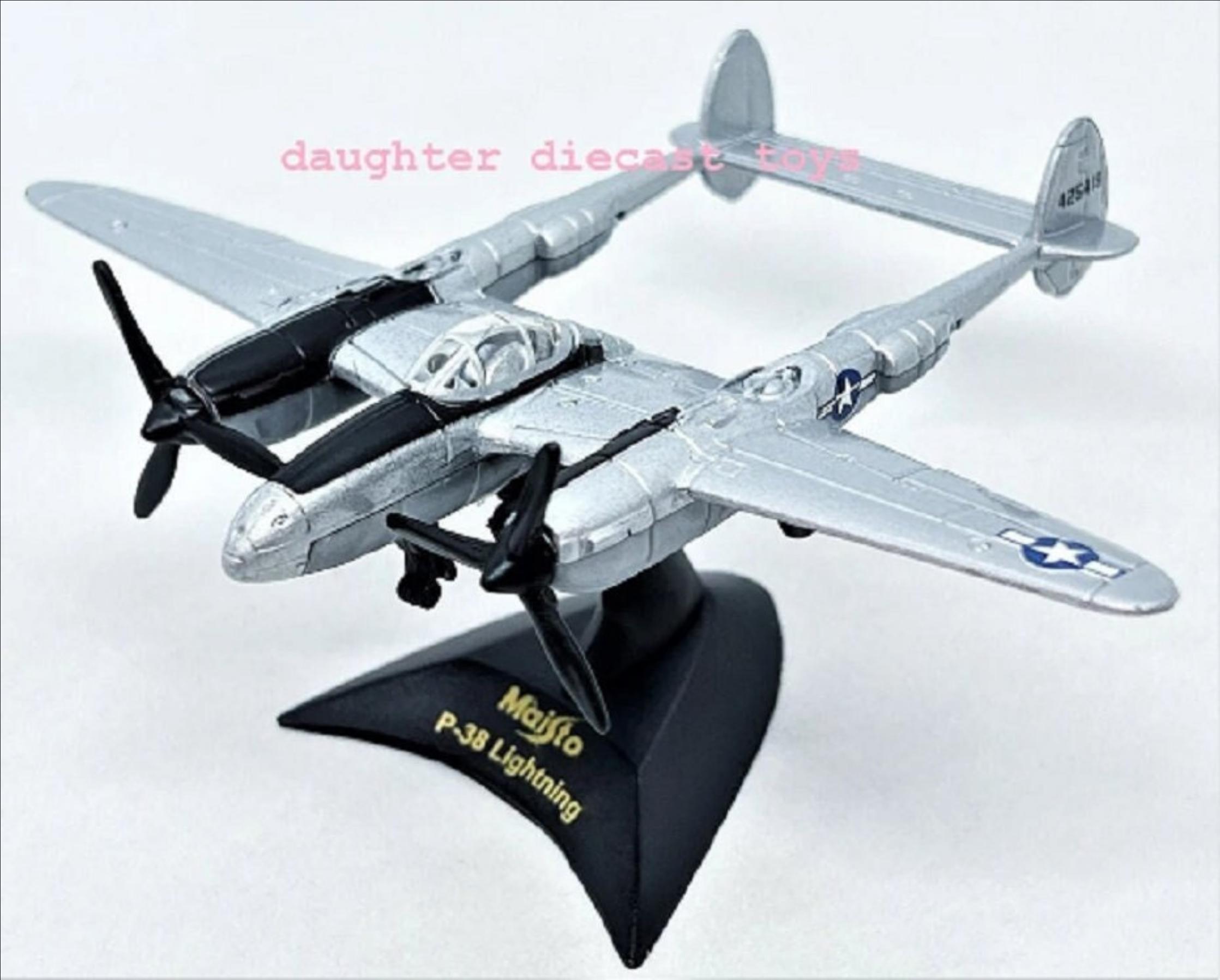
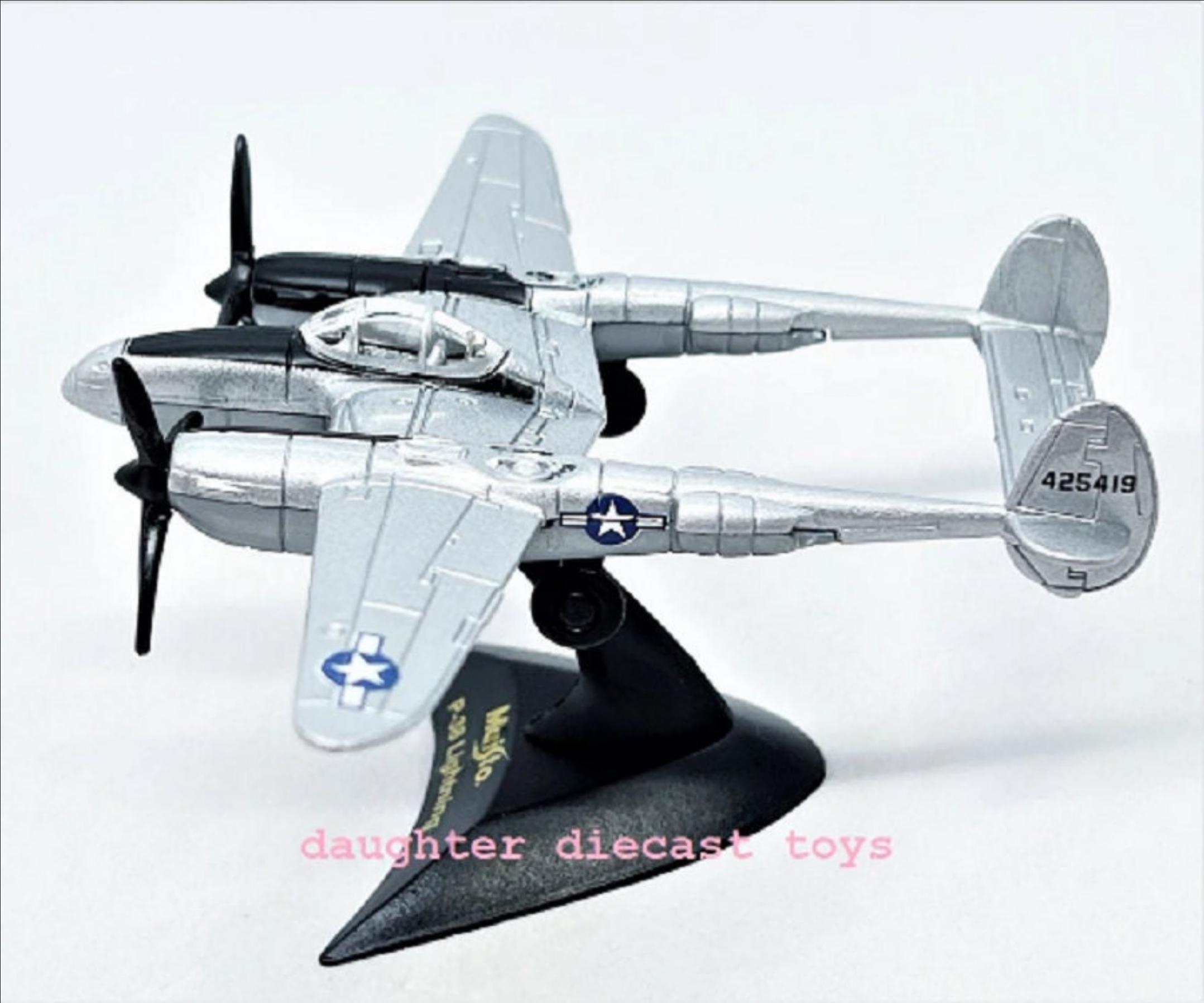
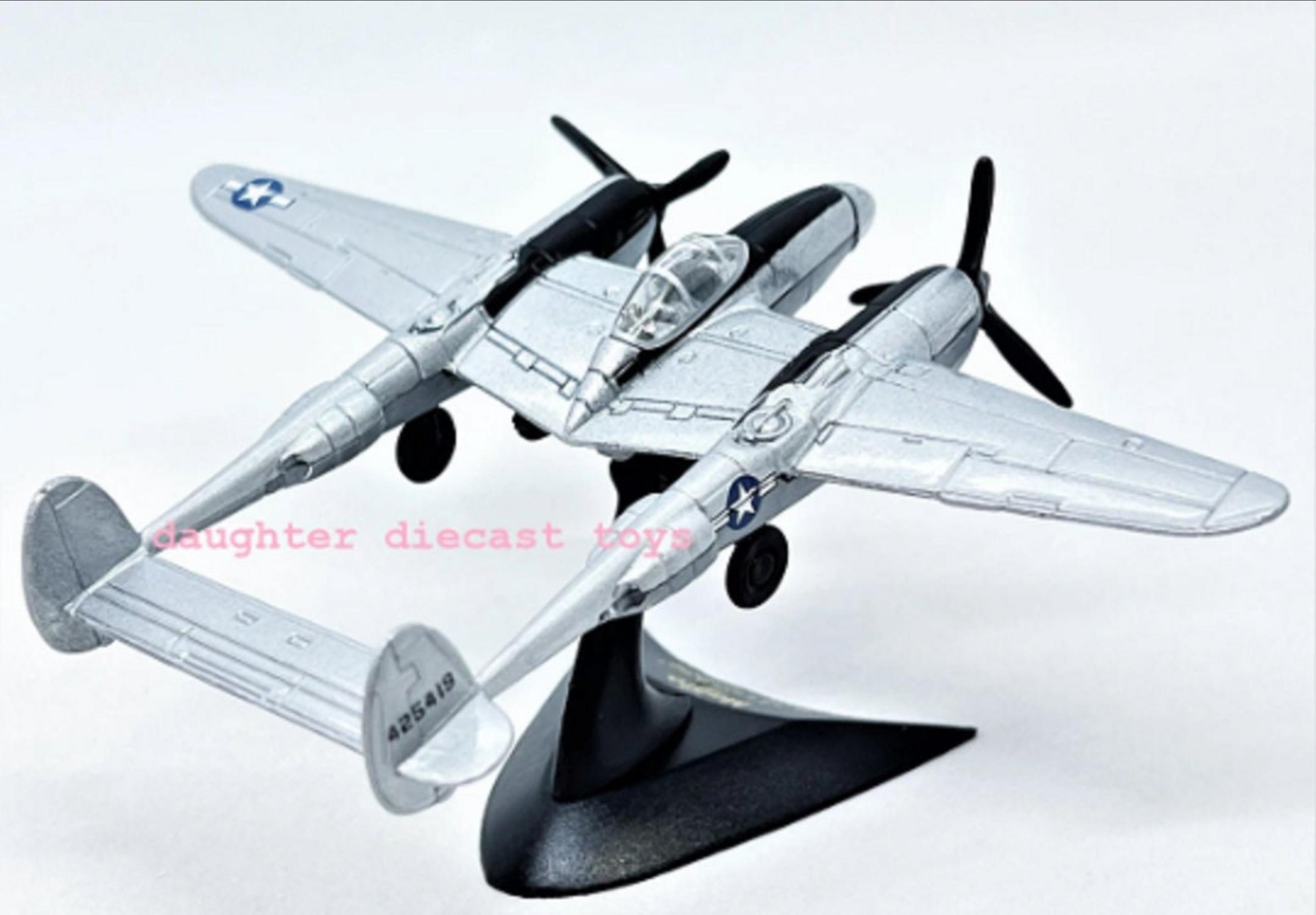
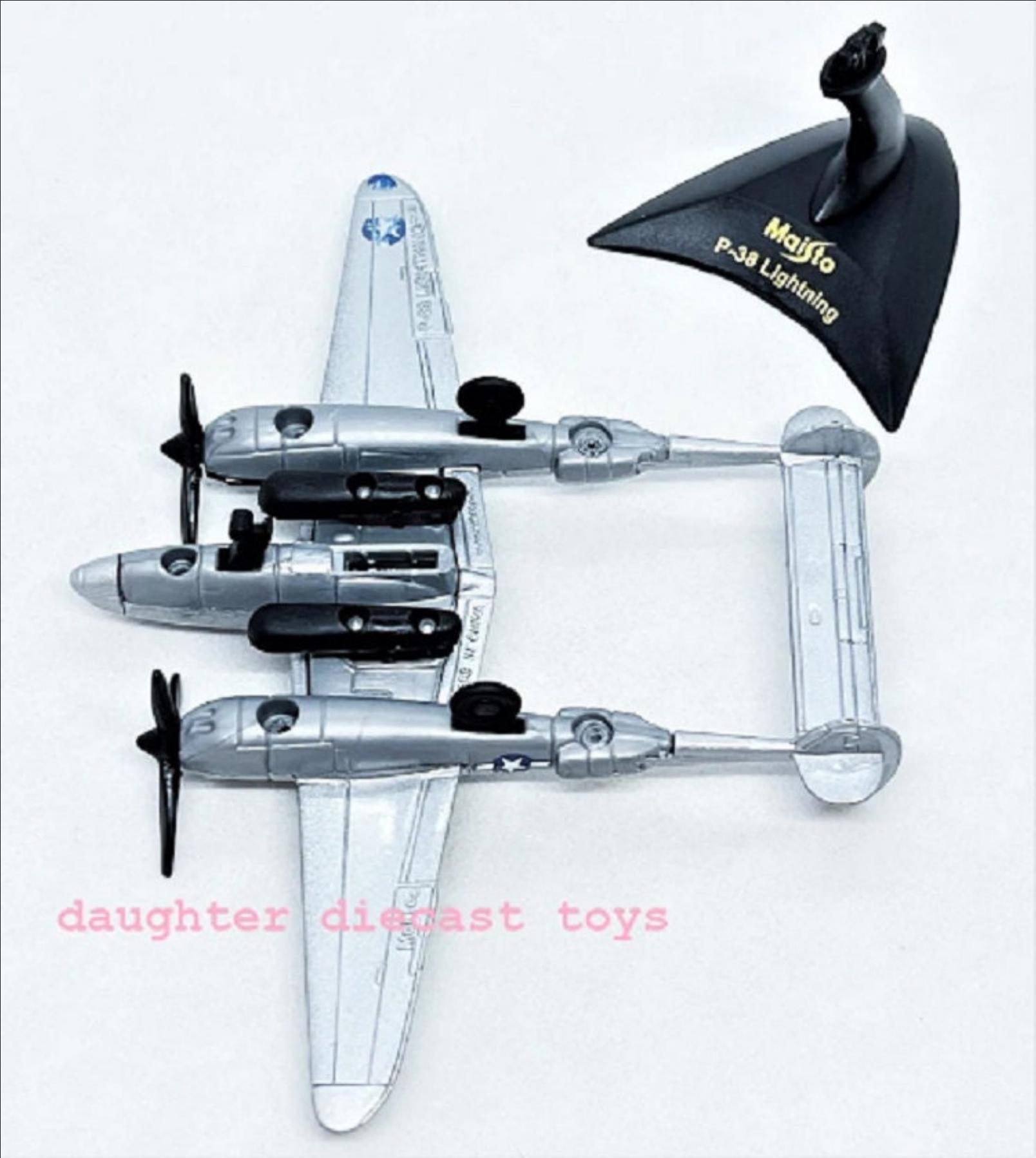

U.S. Army WWII P-38 FIGHTER - Adult Collector Diecast Metal Airplane-Pristine Condition-Perfect Gift for Aviation History Buffs!
$ 45.00

VINTAGE WWII P-38 FIGHTER. Adult collector-constructed of heavy die cast metal.
Made by Maisto. Highly sought-after, hard to find vintage model! Scale=1/72 prox-measures 3 3/4"L x 5 1/4"W x 2 1/4" (mounted). This model is in pristine condition and has never been handled or displayed (until today for your photos). Perfect gift for Military aircraft, vintage toy collectors and Aviation History buffs (like me)! We ship fast & safe worldwide every day! READ Aircraft bio below....
•
•
•FOR A LIMITED TIME
•
•
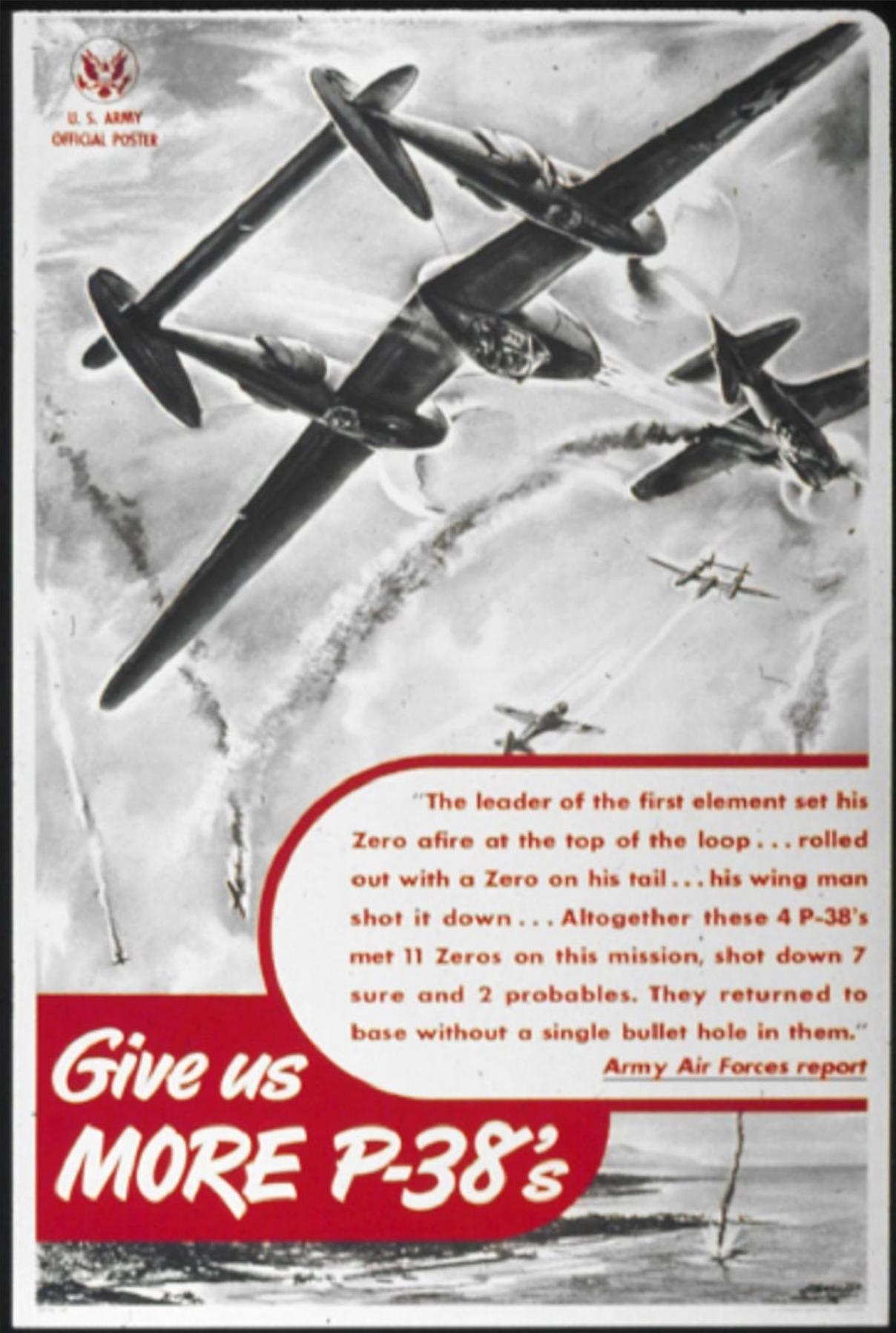
•Purchases totaling $35 and above qualify for FREE shipping to USA! Add more items to your Etsy shopping cart to save $$$.NOTE: My dad owned a Diecast toy store for 30 years. I inherited the store inventory when he passed away many years ago. I am just now, beginning to sell the mint condition vintage models. All are store-inventory is new-old-stock, models have never been "played with". Please visit often-as I adding more cool stuff every day!AIRCRAFT BIO:The Lockheed P-38 Lightning is a World War II–era American piston-engined fighter aircraft. Developed for the United States Army Air Corps, the P-38 had distinctive twin booms and a central nacelle containing the cockpit and armament. Allied propaganda claimed it had been nicknamed the fork-tailed devil (German: der Gabelschwanz-Teufel) by the Luftwaffe and "two planes, one pilot" by the Japanese.[6] The P-38 was used for interception, dive bombing, level bombing, ground attack, night fighting, photo reconnaissance, radar and visual pathfinding for bombers and evacuation missions,[7] and extensively as a long-range escort fighter when equipped with drop tanks under its wings.The P-38 was used most successfully in the Pacific Theater of Operations and the China-Burma-India Theater of Operations as the aircraft of America's top aces, Richard Bong (40 victories), Thomas McGuire (38 victories) and Charles H. MacDonald (27 victories). In the South West Pacific theater, the P-38 was the primary long-range fighter of United States Army Air Forces until the introduction of large numbers of P-51D Mustangs toward the end of the war.[8][9]The P-38 was unusually quiet for a fighter, since the exhaust was muffled by the turbo-superchargers. It was extremely forgiving and could be mishandled in many ways, but the rate of roll in the early versions was too low for it to excel as a dogfighter.[10] The P-38 was the only American fighter aircraft in large-scale production throughout American involvement in the war, from Pearl Harbor to Victory over Japan Day.[11] At the end of the war, orders for 1,887 more were cancelled.[12]Operational historyCocooned Lockheed P-38 Lightnings and North American Aviation P-51 Mustangs line the decks of a U.S. Navy Escort "Jeep" Carrier (CVE) ready for shipment to Europe from New York.The first unit to receive P-38s was the 1st Fighter Group. After the attack on Pearl Harbor, the unit joined the 14th Pursuit Group in San Diego to provide West Coast defense.[68] Entry to the warThe first Lightning to see active service was the F-4 version, a P-38E in which the guns were replaced by four K17 cameras.[69] They joined the 8th Photographic Squadron in Australia on 4 April 1942.[42] Three F-4s were operated by the Royal Australian Air Force in this theater for a short period beginning in September 1942.On 29 May 1942, 25 P-38s began operating in the Aleutian Islands in Alaska. The fighter's long range made it well-suited to the campaign over the almost 1,200-mile (1,900 km)-long island chain, and it was flown there for the rest of the war. The Aleutians were some of the most rugged environments available for testing the new aircraft under combat conditions. More Lightnings were lost due to severe weather and other conditions than enemy action; cases occurred where Lightning pilots, mesmerized by flying for hours over gray seas under gray skies, simply flew into the water. On 9 August 1942, two P-38Es of the 343rd Fighter Group, 11th Air Force, at the end of a 1,000-mile (1,600 km) long-range patrol, happened upon a pair of Japanese Kawanishi H6K "Mavis" flying boats and destroyed them,[42] making them the first Japanese aircraft to be shot down by Lightnings. European theater North Africa and Italy Reconnaissance P-38 with bold black and white invasion stripes participating in the Normandy CampaignAfter the Battle of Midway, the USAAF began redeploying fighter groups to Britain as part of Operation Bolero and Lightnings of the 1st Fighter Group were flown across the Atlantic via Iceland. On 14 August 1942, Second Lieutenant Elza Shahan of the 27th Fighter Squadron, and Second Lieutenant Joseph Shaffer of the 33rd Squadron operating out of Iceland shot down a Focke-Wulf Fw 200 Condor over the Atlantic. Shaffer, flying either a P-40C or a P-39, scored the first hit, causing a fire on the Condor; Shahan in his P-38F finished it off with a high-speed gunnery pass.[70] This was the first Luftwaffe aircraft destroyed by the USAAF.[71]After 347 sorties with no enemy contact, the 1st and 14th Fighter Groups transferred from the UK to the 12th Air Force in North Africa as part of the force being built up for Operation Torch. The Lightning's long range allowed the pilots to fly their fighters over the Bay of Biscay, skirting neutral Spain and Portugal to refuel in Morocco. The P-38s were initially based at Tafaroui Airfield in Algeria alongside P-40 Warhawks and the rest of the 12th Air Force. P-38s were first involved in North African combat operations on 11 November 1942. The first North African P-38 kill was on 22 November, when Lieutenant Mark Shipman of the 14th downed an Italian airplane with twin engines. Shipman later made two more kills – a Messerschmitt Bf 109 fighter and a very large Me 323 Gigant transport.[72]Early results in the Mediterranean Theater of Operations were mixed. Some P-38 pilots scored multiple kills to become aces, while many others were shot down due to inexperience or tactical strictures. Overall, the P-38 suffered its highest losses in the Mediterranean Theater. The primary function of the P-38 in North Africa was to escort bombers,[73] but the fighters also targeted transport aircraft, and later in the campaign, they were sometimes tasked with ground-attack missions. When tied to bomber-escort duties, the P-38 squadrons were vulnerable to attack from above by German fighters, who selected the most advantageous position and timing. The initial tactical doctrine of the American units was for the P-38s to fly near the bombers at all times rather than to defend aggressively or to fly ahead and clear the airspace for the bombers, and many American pilots were downed because of this limitation. Losses mounted, and all available P-38s in the UK were flown over to North Africa to restore squadron strength.[72] After this painful experience, the American leadership changed tactics, and in February 1943, the P-38s were given free rein in their battles.[74]The first German success against the P-38 was on 28 November 1942, when Bf 109 pilots of Jagdgeschwader 53 claimed seven Lightnings for no loss of their own.[74] Further one-sided German victories were noted on several occasions through January 1943.[75] The first P-38 pilots to achieve ace status were Virgil Smith of the 14th FG and Jack Illfrey of the 1st FG, both credited with five wins by 26 December. Smith got a sixth enemy aircraft on 28 December, but was killed two days later in a crash landing, likely after taking fire from Oberfeldwebel Herbert Rollwage of JG 53, who survived the war with at least 71 kills. This was Rollwage's first victory over a P-38, and his 35th claim at the time.[76]The two squadrons of the 14th Fighter Group were reduced so badly in December 1942 that the 82nd FG was flown from the UK to North Africa to cover the shortage. The first kill by the 82nd was during a bomber-escort mission on 7 January 1943, when William J. "Dixie" Sloan broke formation and turned toward six attacking Bf 109s to shoot one of them down. Known for his maverick style, Sloan racked up 12 victories by July 1943.[76] After another heavy toll in January 1943, 14th FG had to be withdrawn from the front to reorganize, with surviving pilots sent home and the few remaining Lightnings transferred to the 82nd.[73] The 14th was out of action for three months, returning in May.[77]On 5 April 1943, 26 P-38Fs of the 82nd claimed 31 enemy aircraft destroyed, helping to establish air superiority in the area and earning it the German nickname "der Gabelschwanz Teufel" – the Fork-tailed Devil, coming from a recently downed German aviator, as described by Life magazine in August 1943.[78] The P-38s remained active in the Mediterranean for the rest of the war, continuing to deliver and receive damage in combat. On 30 August 1943, 13 P-38s were shot down by German and Italian fighters while escorting B-26 and B-17 bombers on raids against targets in Italy.[79][80] On 2 September, 10 P-38s were shot down in combat with Bf 109s of JG 53, with four Bf 109s, including that of 67-victory ace Franz Schieß, who had been the leading "Lightning killer" in the Luftwaffe with 17 destroyed.[81][80]The Mediterranean Theater had the first aerial combat between German fighters and P-38s. German fighter pilot appraisal of the P-38 was mixed. Some observers dismissed the P-38 as an easy kill, while others gave it high praise, a deadly enemy worthy of respect. Johannes Steinhoff, commander of JG 77 in North Africa, said that the unit's old Bf 109s were "perhaps, a little faster" than the P-38, but a dogfight with the twin-engined fighter was daunting because its turning radius was much smaller, and it could quickly get on the tail of the Bf 109. Franz Stigler, an ace with 28 kills, flew Bf 109s against the P-38 in North Africa. Stigler said the Lightning "could turn inside us with ease and they could go from level flight to climb almost instantaneously. We lost quite a few pilots who tried to make an attack and then pull up... One cardinal rule we never forgot was to avoid fighting the P-38 head on. That was suicide." Stigler said the best defense was to flick-roll the Bf 109 and dive, as the Lightning was slow in the first 10° of roll, and it was not as fast in a dive.[82] Herbert Kaiser, eventually a 68-kill ace, shot down his first P-38 in January 1943. Kaiser said that the P-38 should be respected as a formidable opponent, that it was faster and more maneuverable than the Bf 109G-6 model he flew, especially since the G-6 was slowed by underwing cannon pods. Johann Pichler, another high-scoring ace, said that the P-38 in 1943 was much faster in a climb than the Bf 109.[77] Kurt Bühligen, third-highest scoring German pilot on the Western front with 112 victories, recalled: "The P-38 fighter (and the B-24) were easy to burn. Once in Africa, we were six, and met eight P-38s and shot down seven. One sees a great distance in Africa and our observers and flak people called in sightings and we could get altitude first and they were low and slow."[83] General der Jagdflieger Adolf Galland was unimpressed with the P-38, declaring "it had similar shortcomings in combat to our Bf 110, our fighters were clearly superior to it."[84] Heinz Bäer said that P-38s "were not difficult at all. They were easy to outmaneuver and were generally a sure kill".[85]On 12 June 1943, a P-38G, while flying a special mission between Gibraltar and Malta, or perhaps, just after strafing the radar station of Capo Pula, landed on the airfield of Capoterra (Cagliari), in Sardinia, from navigation error due to a compass failure. Regia Aeronautica chief test pilot Colonnello (Lieutenant Colonel) Angelo Tondi flew the captured aircraft to Guidonia airfield, where the P-38G was evaluated. On 11 August 1943, Tondi took off to intercept a formation of about 50 bombers, returning from the bombing of Terni (Umbria). Tondi attacked B-17G Bonny Sue, 42–30307, that fell off the shore of Torvaianica, near Rome, while six airmen parachuted out. According to US sources, he also damaged three more bombers on that occasion. On 4 September, the 301st BG reported the loss of B-17 "The Lady Evelyn," 42–30344, downed by "an enemy P-38".[86] War missions for that plane were limited, as the Italian petrol was too corrosive for the Lockheed's tanks.[87] Other Lightnings were eventually acquired by Italy for postwar service.In a particular case when faced by more agile fighters at low altitudes in a constricted valley, Lightnings suffered heavy losses. On the morning of 10 June 1944, 96 P-38Js of the 1st and 82nd Fighter Groups took off from Italy for Ploiești, the third-most heavily defended target in Europe, after Berlin and Vienna.[88] Instead of bombing from high altitude as had been tried by the Fifteenth Air Force, USAAF planning had determined that a dive-bombing surprise attack, beginning at about 7,000 feet (2,100 m) with bomb release at or below 3,000 feet (900 m),[88] performed by 46 82nd Fighter Group P-38s, each carrying one 1,000-pound (500 kg) bomb, would yield more accurate results.[89] All of 1st Fighter Group and a few aircraft in 82nd Fighter Group were to fly cover, and all fighters were to strafe targets of opportunity on the return trip; a distance of some 1,255 miles (2,020 km), including a circuitous outward route made in an attempt to achieve surprise.[88] Some 85 or 86 fighters arrived in Romania to find enemy airfields alerted, with a wide assortment of aircraft scrambling for safety. P-38s shot down several, including heavy fighters, transports, and observation aircraft. At Ploiești, defense forces were fully alert, the target was concealed by smoke screen, and antiaircraft fire was very heavy, seven Lightnings were lost to antiaircraft fire at the target, and two more during strafing attacks on the return flight. German Bf 109 fighters from I./JG 53 and 2./JG 77 fought the Americans. Sixteen aircraft of the 71st Fighter Squadron were challenged by a large formation of Romanian single-seater IAR.81C fighters. The fight took place below 300 feet (100 m) in a narrow valley.[90] Herbert Hatch saw two IAR 81Cs that he misidentified as Focke-Wulf Fw 190s hit the ground after taking fire from his guns, and his fellow pilots confirmed three more of his kills. However, the outnumbered 71st Fighter Squadron took more damage than it dished out, losing nine aircraft. In all, the USAAF lost 22 aircraft on the mission. The Americans claimed 23 aerial victories, though Romanian and German fighter units admitted losing only one aircraft each.[91] Eleven enemy locomotives were strafed and left burning, and flak emplacements were destroyed, along with fuel trucks and other targets. Results of the bombing were not observed by the USAAF pilots because of the smoke. The dive-bombing mission profile was not repeated, though the 82nd Fighter Group was awarded the Presidential Unit Citation for its part.[92] Western EuropeExperiences over Germany had shown a need for long-range escort fighters to protect the Eighth Air Force's heavy-bomber operations. The P-38Hs of the 55th Fighter Group were transferred to the Eighth in England in September 1943, and were joined by the 20th Fighter Group, 364th Fighter Group, and 479th Fighter Group soon after. P-38s and Spitfires escorted Flying Fortress raids over Europe.[93]Because its distinctive shape was less prone to cases of mistaken identity and friendly fire,[94] Lieutenant General Jimmy Doolittle, commander of the 8th Air Force, chose to pilot a P-38 during the invasion of Normandy, so he could watch the progress of the air offensive over France.[95] At one point in the mission, Doolittle flick-rolled through a hole in the cloud cover, but his wingman, then–Major General Earle E. Partridge, was looking elsewhere and failed to notice Doolittle's quick maneuver, leaving Doolittle to continue on alone on his survey of the crucial battle. Of the P-38, Doolittle said that it was "the sweetest-flying plane in the sky".[96] P-38s of the 370th Fighter Group at RAF Andover in southern EnglandA little-known role of the P-38 in the European theater was that of fighter-bomber during the invasion of Normandy and the Allied advance across France into Germany. Assigned to the IX Tactical Air Command, the 370th Fighter Group and 474th Fighter Group and their P-38s initially flew missions from England, dive-bombing radar installations, enemy armor, troop concentrations, and flak towers, and providing air cover.[97] The 370th's group commander Howard F. Nichols and a squadron of his P-38 Lightnings attacked Field Marshal Günther von Kluge's headquarters in July 1944; Nichols himself skipped a 500 lb (230 kg) bomb through the front door.[98] The 370th later operated from Cardonville, France, and the 474th from various bases in France, flying ground-attack missions against gun emplacements, troops, supply dumps, and tanks near Saint-Lô in July and in the Falaise–Argentan area in August 1944.[97] The 370th participated in ground-attack missions across Europe until February 1945, when the unit changed over to the P-51 Mustang. The 474th operated out of bases in France, Belgium, and Germany in primarily the ground-attack missions until November–December 1945.[99]After some disastrous raids in 1944 with B-17s escorted by P-38s and Republic P-47 Thunderbolts, Doolittle, then head of the U.S. Eighth Air Force, went to the Royal Aircraft Establishment, Farnborough, asking for an evaluation of the various American fighters. Test pilot Captain Eric Brown, Fleet Air Arm, recalled:We had found out that the Bf 109 and the FW 190 could fight up to a Mach of 0.75, three-quarters the speed of sound. We checked the Lightning and it couldn't fly in combat faster than 0.68. So, it was useless. We told Doolittle that all it was good for was photoreconnaissance and had to be withdrawn from escort duties. And the funny thing is that the Americans had great difficulty understanding this because the Lightning had the two top aces in the Far East.[100]After evaluation tests at Farnborough, the P-38 was kept in fighting service in Europe for a while longer. Although many failings were remedied with the introduction of the P-38J, by September 1944, all but one of the Lightning groups in the Eighth Air Force had converted to the P-51 Mustang. The Eighth Air Force continued to conduct reconnaissance missions using the F-5 variant.[68] Pacific theater Wartime poster encouraging greater production of P-38sThe P-38 was used most extensively and successfully in the Pacific Theater, where it proved more suited, combining exceptional range with the reliability of two engines for long missions over water. The P-38 was used in a variety of roles, especially escorting bombers at altitudes of 18,000–25,000 ft (5,500–7,600 m). The P-38 was credited with destroying more Japanese aircraft than any other USAAF fighter.[3] Freezing cockpit temperatures were not a problem at low altitude in the tropics. In fact, the cockpit was often too hot since opening a window while in flight caused buffeting by setting up turbulence through the tailplane. Pilots taking low-altitude assignments often flew stripped down to shorts, tennis shoes, and parachute. While the P-38 could not out-turn the A6M Zero and most other Japanese fighters when flying below 200 mph (320 km/h), its superior speed coupled with a good rate of climb meant that it could use energy tactics, making multiple high-speed passes at its target. In addition, its tightly grouped guns were even more deadly to lightly armored Japanese warplanes than to German aircraft. The concentrated, parallel stream of bullets allowed aerial victory at much longer distances than fighters carrying wing guns. Dick Bong, the United States' highest-scoring World War II air ace (40 victories in P-38s), flew directly at his targets to ensure he hit them, in some cases flying through the debris of his target (and on one occasion colliding with an enemy aircraft, which was claimed as a "probable" victory). The twin Allison engines performed admirably in the Pacific. Col. MacDonald and Al Nelson in the Pacific with MacDonald's P-38JGeneral George C. Kenney, commander of the USAAF 5th Air Force operating in New Guinea, could not get enough P-38s; they had become his favorite fighter in November 1942 when one squadron, the 39th Fighter Squadron of the 35th Fighter Group, joined his assorted P-39s and P-40s. The Lightnings established local air superiority with their first combat action on 27 December 1942.[101][102][103][104][105] Kenney sent repeated requests to Arnold for more P-38s, and was rewarded with occasional shipments, but Europe was a higher priority in Washington.[106] Despite their small force, Lightning pilots began to compete in racking up scores against Japanese aircraft.On 2–4 March 1943, P-38s flew top cover for 5th Air Force and Australian bombers and attack aircraft during the Battle of the Bismarck Sea, in which eight Japanese troop transports and four escorting destroyers were sunk. Two P-38 aces from the 39th Fighter Squadron were killed on the second day of the battle: Bob Faurot and Hoyt "Curley" Eason (a veteran with five victories who had trained hundreds of pilots, including Dick Bong). In one notable engagement on 3 March 1943, P-38s escorted 13 B-17s (part of an attack including B-25 Mitchells and Beaufighters) as they bombed the Japanese convoy from a medium altitude of 7,000 ft (2,100 m), which dispersed the convoy formation and reduced their concentrated antiaircraft firepower. A B-17 was shot down and when Japanese Zero fighters machine-gunned some of the B-17 crew members who bailed out in parachutes, three P-38s promptly dived into action, claiming five Zeros.[107][108][109][110] Killing of Admiral Yamamoto Main article: Operation VengeanceBecause of its ability to fly long distances, the Lightning figured in one of the most significant operations in the Pacific Theater – the interception, on 18 April 1943, of Admiral Isoroku Yamamoto, the architect of Japan's naval strategy in the Pacific including the attack on Pearl Harbor. When American codebreakers found out that he was flying to Bougainville Island to conduct a front-line inspection, 16 P-38G Lightnings were sent on a long-range fighter-intercept mission, flying 435 miles (700 km) from Guadalcanal at heights of 10 to 50 ft (3 to 20 m) above the ocean to avoid detection. The Lightnings met Yamamoto's two Mitsubishi G4M "Betty" fast bomber transports and six escorting Zeros just as they arrived at the island. The first Betty crashed in the jungle and the second ditched near the coast. The Americans lost one P-38. Japanese search parties found Yamamoto's body at the jungle crash site the next day.[111] Service record Pilot and aircraft armorer inspect ammunition for the central 20 mm cannonThe P-38's service record shows mixed results, which may reflect more on its employment than on flaws with the aircraft. The P-38's engine troubles at high altitudes only occurred with the Eighth Air Force. One reason for this was the inadequate cooling systems of the G and H models; the improved P-38 J and L had tremendous success flying out of Italy into Germany at all altitudes.[68] Until the -J-25 variant, P-38s were easily avoided by German fighters because of the lack of dive flaps to counter compressibility in dives. German fighter pilots not wishing to fight would perform the first half of a Split S and continue into steep dives because they knew the Lightnings would be reluctant to follow.On the positive side, having two engines was a built-in insurance policy. Many pilots arrived safely back to base after having an engine failure en route or in combat. On 3 March 1944, the first Allied fighters reached Berlin on a frustrated escort mission. Lieutenant Colonel Jack Jenkins of 55th Fighter Group led the group of P-38H pilots, arriving with only half his force after flak damage and engine trouble took their toll. On the way into Berlin, Jenkins reported one rough-running engine, causing him to wonder if he would ever make it back. The B-17s he was supposed to escort never showed up, having turned back at Hamburg. Jenkins and his wingman were able to drop tanks and outrun enemy fighters to return home with three good engines between them.[112] P-38J 42-68008 flying over Southern CaliforniaIn the European Theater, P-38s made 130,000 sorties with a loss of 1.3% overall, comparing favorably with P-51s, which posted a 1.1% loss, considering that the P-38s were vastly outnumbered and suffered from poorly thought-out tactics. Most of the P-38 sorties were made in the period prior to Allied air superiority in Europe, when pilots fought against a very determined and skilled enemy.[113] Lieutenant Colonel Mark Hubbard, a vocal critic of the aircraft, rated it the third-best Allied fighter in Europe.[114] The Lightning's greatest virtues were long range, heavy payload, high speed, fast climb, and concentrated firepower. The P-38 was a formidable fighter, interceptor, and attack aircraft.In the Pacific Theater, the P-38 downed over 1,800 Japanese aircraft, with more than 100 pilots becoming aces by downing five or more enemy aircraft.[111] American fuel supplies contributed to a better engine performance and maintenance record, and range was increased with leaner mixtures. In the second half of 1944, the P-38L pilots out of Dutch New Guinea were flying 950 mi (1,530 km), fighting for 15 minutes and returning to base.[115] Such long legs were invaluable until the P-47N and P-51D entered service. Postwar operationsThe end of the war left the USAAF with thousands of P-38s rendered obsolete by the jet age. Orders for 1,887 more were cancelled.[116] The last P-38s in service with the United States Air Force were retired in 1949.[117] One-hundred late-model P-38L and F-5 Lightnings were acquired by Italy through an agreement dated April 1946. Delivered, after refurbishing, at the rate of one per month, they finally were all sent to the Aeronautica Militare by 1952. The Lightnings served in the 4° Stormo and other units including 3° Stormo, flying reconnaissance over the Balkans, ground attack, naval cooperation, and air-superiority missions. Due to old engines, pilot errors, and lack of experience in operations, large numbers of P-38s were lost in at least 30 accidents, many of them fatal. Despite this, many Italian pilots liked the P-38 because of its excellent visibility on the ground and stability on takeoff. The Italian P-38s were phased out in 1956; none survived the scrapyard.[118]Surplus P-38s were also used by other foreign air forces, with 12 sold to Honduras and 15 retained by China. Six F-5s and two unarmed black two-seater P-38s were operated by the Dominican Air Force based in San Isidro Airbase, Dominican Republic, in 1947. Most of the wartime Lightnings present in the continental U.S. at the end of the war were put up for sale for US$1,200 apiece; the rest were scrapped. P-38s in distant theaters of war were bulldozed into piles and abandoned or scrapped; very few avoided that fate.The CIA "Liberation Air Force" flew one P-38M to support the 1954 Guatemalan coup d'etat. On 27 June 1954, this aircraft dropped napalm bombs that destroyed the British cargo ship SS Springfjord, which was loading Guatemalan cotton[119] and coffee[120] for Grace Line[121][failed verification] in Puerto San José.[122] In 1957, five Honduran P-38s bombed and strafed a village occupied by Nicaraguan forces during a border dispute between these two countries concerning part of Gracias a Dios Department.[123]P-38s were popular contenders in the air races from 1946 through 1949, with brightly colored Lightnings making screaming turns around the pylons at Reno and Cleveland. Lockheed test pilot Tony LeVier was among those who bought a Lightning, choosing a P-38J model and painting it red to make it stand out as an air racer and stunt flyer. Lefty Gardner, former B-24 and B-17 pilot and associate of the Confederate Air Force, bought a mid-1944 P-38L-1-LO that had been modified into an F-5G. Gardner painted it white with red and blue trim and named it White Lightnin'; he reworked its turbo systems and intercoolers for optimum low-altitude performance and gave it P-38F-style air intakes for better streamlining. White Lightnin' was severely damaged in a crash landing following an engine fire on a transit flight, and was bought and restored with a brilliant polished-aluminum finish by the company that owns Red Bull. The aircraft is now located in Austria.F-5s were bought by aerial survey companies and employed for mapping. From the 1950s on, the use of the Lightning steadily declined, and only a few more than two dozen still exist, with few still flying. One example is a P-38L owned by the Lone Star Flight Museum in Galveston, Texas, painted in the colors of Charles H. MacDonald's Putt Putt Maru. Two other examples are F-5Gs, which were owned and operated by Kargl Aerial Surveys in 1946, and are now located in Chino, California, at Yanks Air Museum, and in McMinnville, Oregon, at Evergreen Aviation Museum. The earliest-built surviving P-38, Glacier Girl, was recovered from the Greenland ice cap in 1992, 50 years after she crashed there on a ferry flight to the UK, and after a complete restoration, flew once again 10 years after her recovery.
Made by Maisto. Highly sought-after, hard to find vintage model! Scale=1/72 prox-measures 3 3/4"L x 5 1/4"W x 2 1/4" (mounted). This model is in pristine condition and has never been handled or displayed (until today for your photos). Perfect gift for Military aircraft, vintage toy collectors and Aviation History buffs (like me)! We ship fast & safe worldwide every day! READ Aircraft bio below....
•
•
•FOR A LIMITED TIME
•
•
•Purchases totaling $35 and above qualify for FREE shipping to USA! Add more items to your Etsy shopping cart to save $$$.NOTE: My dad owned a Diecast toy store for 30 years. I inherited the store inventory when he passed away many years ago. I am just now, beginning to sell the mint condition vintage models. All are store-inventory is new-old-stock, models have never been "played with". Please visit often-as I adding more cool stuff every day!AIRCRAFT BIO:The Lockheed P-38 Lightning is a World War II–era American piston-engined fighter aircraft. Developed for the United States Army Air Corps, the P-38 had distinctive twin booms and a central nacelle containing the cockpit and armament. Allied propaganda claimed it had been nicknamed the fork-tailed devil (German: der Gabelschwanz-Teufel) by the Luftwaffe and "two planes, one pilot" by the Japanese.[6] The P-38 was used for interception, dive bombing, level bombing, ground attack, night fighting, photo reconnaissance, radar and visual pathfinding for bombers and evacuation missions,[7] and extensively as a long-range escort fighter when equipped with drop tanks under its wings.The P-38 was used most successfully in the Pacific Theater of Operations and the China-Burma-India Theater of Operations as the aircraft of America's top aces, Richard Bong (40 victories), Thomas McGuire (38 victories) and Charles H. MacDonald (27 victories). In the South West Pacific theater, the P-38 was the primary long-range fighter of United States Army Air Forces until the introduction of large numbers of P-51D Mustangs toward the end of the war.[8][9]The P-38 was unusually quiet for a fighter, since the exhaust was muffled by the turbo-superchargers. It was extremely forgiving and could be mishandled in many ways, but the rate of roll in the early versions was too low for it to excel as a dogfighter.[10] The P-38 was the only American fighter aircraft in large-scale production throughout American involvement in the war, from Pearl Harbor to Victory over Japan Day.[11] At the end of the war, orders for 1,887 more were cancelled.[12]Operational historyCocooned Lockheed P-38 Lightnings and North American Aviation P-51 Mustangs line the decks of a U.S. Navy Escort "Jeep" Carrier (CVE) ready for shipment to Europe from New York.The first unit to receive P-38s was the 1st Fighter Group. After the attack on Pearl Harbor, the unit joined the 14th Pursuit Group in San Diego to provide West Coast defense.[68] Entry to the warThe first Lightning to see active service was the F-4 version, a P-38E in which the guns were replaced by four K17 cameras.[69] They joined the 8th Photographic Squadron in Australia on 4 April 1942.[42] Three F-4s were operated by the Royal Australian Air Force in this theater for a short period beginning in September 1942.On 29 May 1942, 25 P-38s began operating in the Aleutian Islands in Alaska. The fighter's long range made it well-suited to the campaign over the almost 1,200-mile (1,900 km)-long island chain, and it was flown there for the rest of the war. The Aleutians were some of the most rugged environments available for testing the new aircraft under combat conditions. More Lightnings were lost due to severe weather and other conditions than enemy action; cases occurred where Lightning pilots, mesmerized by flying for hours over gray seas under gray skies, simply flew into the water. On 9 August 1942, two P-38Es of the 343rd Fighter Group, 11th Air Force, at the end of a 1,000-mile (1,600 km) long-range patrol, happened upon a pair of Japanese Kawanishi H6K "Mavis" flying boats and destroyed them,[42] making them the first Japanese aircraft to be shot down by Lightnings. European theater North Africa and Italy Reconnaissance P-38 with bold black and white invasion stripes participating in the Normandy CampaignAfter the Battle of Midway, the USAAF began redeploying fighter groups to Britain as part of Operation Bolero and Lightnings of the 1st Fighter Group were flown across the Atlantic via Iceland. On 14 August 1942, Second Lieutenant Elza Shahan of the 27th Fighter Squadron, and Second Lieutenant Joseph Shaffer of the 33rd Squadron operating out of Iceland shot down a Focke-Wulf Fw 200 Condor over the Atlantic. Shaffer, flying either a P-40C or a P-39, scored the first hit, causing a fire on the Condor; Shahan in his P-38F finished it off with a high-speed gunnery pass.[70] This was the first Luftwaffe aircraft destroyed by the USAAF.[71]After 347 sorties with no enemy contact, the 1st and 14th Fighter Groups transferred from the UK to the 12th Air Force in North Africa as part of the force being built up for Operation Torch. The Lightning's long range allowed the pilots to fly their fighters over the Bay of Biscay, skirting neutral Spain and Portugal to refuel in Morocco. The P-38s were initially based at Tafaroui Airfield in Algeria alongside P-40 Warhawks and the rest of the 12th Air Force. P-38s were first involved in North African combat operations on 11 November 1942. The first North African P-38 kill was on 22 November, when Lieutenant Mark Shipman of the 14th downed an Italian airplane with twin engines. Shipman later made two more kills – a Messerschmitt Bf 109 fighter and a very large Me 323 Gigant transport.[72]Early results in the Mediterranean Theater of Operations were mixed. Some P-38 pilots scored multiple kills to become aces, while many others were shot down due to inexperience or tactical strictures. Overall, the P-38 suffered its highest losses in the Mediterranean Theater. The primary function of the P-38 in North Africa was to escort bombers,[73] but the fighters also targeted transport aircraft, and later in the campaign, they were sometimes tasked with ground-attack missions. When tied to bomber-escort duties, the P-38 squadrons were vulnerable to attack from above by German fighters, who selected the most advantageous position and timing. The initial tactical doctrine of the American units was for the P-38s to fly near the bombers at all times rather than to defend aggressively or to fly ahead and clear the airspace for the bombers, and many American pilots were downed because of this limitation. Losses mounted, and all available P-38s in the UK were flown over to North Africa to restore squadron strength.[72] After this painful experience, the American leadership changed tactics, and in February 1943, the P-38s were given free rein in their battles.[74]The first German success against the P-38 was on 28 November 1942, when Bf 109 pilots of Jagdgeschwader 53 claimed seven Lightnings for no loss of their own.[74] Further one-sided German victories were noted on several occasions through January 1943.[75] The first P-38 pilots to achieve ace status were Virgil Smith of the 14th FG and Jack Illfrey of the 1st FG, both credited with five wins by 26 December. Smith got a sixth enemy aircraft on 28 December, but was killed two days later in a crash landing, likely after taking fire from Oberfeldwebel Herbert Rollwage of JG 53, who survived the war with at least 71 kills. This was Rollwage's first victory over a P-38, and his 35th claim at the time.[76]The two squadrons of the 14th Fighter Group were reduced so badly in December 1942 that the 82nd FG was flown from the UK to North Africa to cover the shortage. The first kill by the 82nd was during a bomber-escort mission on 7 January 1943, when William J. "Dixie" Sloan broke formation and turned toward six attacking Bf 109s to shoot one of them down. Known for his maverick style, Sloan racked up 12 victories by July 1943.[76] After another heavy toll in January 1943, 14th FG had to be withdrawn from the front to reorganize, with surviving pilots sent home and the few remaining Lightnings transferred to the 82nd.[73] The 14th was out of action for three months, returning in May.[77]On 5 April 1943, 26 P-38Fs of the 82nd claimed 31 enemy aircraft destroyed, helping to establish air superiority in the area and earning it the German nickname "der Gabelschwanz Teufel" – the Fork-tailed Devil, coming from a recently downed German aviator, as described by Life magazine in August 1943.[78] The P-38s remained active in the Mediterranean for the rest of the war, continuing to deliver and receive damage in combat. On 30 August 1943, 13 P-38s were shot down by German and Italian fighters while escorting B-26 and B-17 bombers on raids against targets in Italy.[79][80] On 2 September, 10 P-38s were shot down in combat with Bf 109s of JG 53, with four Bf 109s, including that of 67-victory ace Franz Schieß, who had been the leading "Lightning killer" in the Luftwaffe with 17 destroyed.[81][80]The Mediterranean Theater had the first aerial combat between German fighters and P-38s. German fighter pilot appraisal of the P-38 was mixed. Some observers dismissed the P-38 as an easy kill, while others gave it high praise, a deadly enemy worthy of respect. Johannes Steinhoff, commander of JG 77 in North Africa, said that the unit's old Bf 109s were "perhaps, a little faster" than the P-38, but a dogfight with the twin-engined fighter was daunting because its turning radius was much smaller, and it could quickly get on the tail of the Bf 109. Franz Stigler, an ace with 28 kills, flew Bf 109s against the P-38 in North Africa. Stigler said the Lightning "could turn inside us with ease and they could go from level flight to climb almost instantaneously. We lost quite a few pilots who tried to make an attack and then pull up... One cardinal rule we never forgot was to avoid fighting the P-38 head on. That was suicide." Stigler said the best defense was to flick-roll the Bf 109 and dive, as the Lightning was slow in the first 10° of roll, and it was not as fast in a dive.[82] Herbert Kaiser, eventually a 68-kill ace, shot down his first P-38 in January 1943. Kaiser said that the P-38 should be respected as a formidable opponent, that it was faster and more maneuverable than the Bf 109G-6 model he flew, especially since the G-6 was slowed by underwing cannon pods. Johann Pichler, another high-scoring ace, said that the P-38 in 1943 was much faster in a climb than the Bf 109.[77] Kurt Bühligen, third-highest scoring German pilot on the Western front with 112 victories, recalled: "The P-38 fighter (and the B-24) were easy to burn. Once in Africa, we were six, and met eight P-38s and shot down seven. One sees a great distance in Africa and our observers and flak people called in sightings and we could get altitude first and they were low and slow."[83] General der Jagdflieger Adolf Galland was unimpressed with the P-38, declaring "it had similar shortcomings in combat to our Bf 110, our fighters were clearly superior to it."[84] Heinz Bäer said that P-38s "were not difficult at all. They were easy to outmaneuver and were generally a sure kill".[85]On 12 June 1943, a P-38G, while flying a special mission between Gibraltar and Malta, or perhaps, just after strafing the radar station of Capo Pula, landed on the airfield of Capoterra (Cagliari), in Sardinia, from navigation error due to a compass failure. Regia Aeronautica chief test pilot Colonnello (Lieutenant Colonel) Angelo Tondi flew the captured aircraft to Guidonia airfield, where the P-38G was evaluated. On 11 August 1943, Tondi took off to intercept a formation of about 50 bombers, returning from the bombing of Terni (Umbria). Tondi attacked B-17G Bonny Sue, 42–30307, that fell off the shore of Torvaianica, near Rome, while six airmen parachuted out. According to US sources, he also damaged three more bombers on that occasion. On 4 September, the 301st BG reported the loss of B-17 "The Lady Evelyn," 42–30344, downed by "an enemy P-38".[86] War missions for that plane were limited, as the Italian petrol was too corrosive for the Lockheed's tanks.[87] Other Lightnings were eventually acquired by Italy for postwar service.In a particular case when faced by more agile fighters at low altitudes in a constricted valley, Lightnings suffered heavy losses. On the morning of 10 June 1944, 96 P-38Js of the 1st and 82nd Fighter Groups took off from Italy for Ploiești, the third-most heavily defended target in Europe, after Berlin and Vienna.[88] Instead of bombing from high altitude as had been tried by the Fifteenth Air Force, USAAF planning had determined that a dive-bombing surprise attack, beginning at about 7,000 feet (2,100 m) with bomb release at or below 3,000 feet (900 m),[88] performed by 46 82nd Fighter Group P-38s, each carrying one 1,000-pound (500 kg) bomb, would yield more accurate results.[89] All of 1st Fighter Group and a few aircraft in 82nd Fighter Group were to fly cover, and all fighters were to strafe targets of opportunity on the return trip; a distance of some 1,255 miles (2,020 km), including a circuitous outward route made in an attempt to achieve surprise.[88] Some 85 or 86 fighters arrived in Romania to find enemy airfields alerted, with a wide assortment of aircraft scrambling for safety. P-38s shot down several, including heavy fighters, transports, and observation aircraft. At Ploiești, defense forces were fully alert, the target was concealed by smoke screen, and antiaircraft fire was very heavy, seven Lightnings were lost to antiaircraft fire at the target, and two more during strafing attacks on the return flight. German Bf 109 fighters from I./JG 53 and 2./JG 77 fought the Americans. Sixteen aircraft of the 71st Fighter Squadron were challenged by a large formation of Romanian single-seater IAR.81C fighters. The fight took place below 300 feet (100 m) in a narrow valley.[90] Herbert Hatch saw two IAR 81Cs that he misidentified as Focke-Wulf Fw 190s hit the ground after taking fire from his guns, and his fellow pilots confirmed three more of his kills. However, the outnumbered 71st Fighter Squadron took more damage than it dished out, losing nine aircraft. In all, the USAAF lost 22 aircraft on the mission. The Americans claimed 23 aerial victories, though Romanian and German fighter units admitted losing only one aircraft each.[91] Eleven enemy locomotives were strafed and left burning, and flak emplacements were destroyed, along with fuel trucks and other targets. Results of the bombing were not observed by the USAAF pilots because of the smoke. The dive-bombing mission profile was not repeated, though the 82nd Fighter Group was awarded the Presidential Unit Citation for its part.[92] Western EuropeExperiences over Germany had shown a need for long-range escort fighters to protect the Eighth Air Force's heavy-bomber operations. The P-38Hs of the 55th Fighter Group were transferred to the Eighth in England in September 1943, and were joined by the 20th Fighter Group, 364th Fighter Group, and 479th Fighter Group soon after. P-38s and Spitfires escorted Flying Fortress raids over Europe.[93]Because its distinctive shape was less prone to cases of mistaken identity and friendly fire,[94] Lieutenant General Jimmy Doolittle, commander of the 8th Air Force, chose to pilot a P-38 during the invasion of Normandy, so he could watch the progress of the air offensive over France.[95] At one point in the mission, Doolittle flick-rolled through a hole in the cloud cover, but his wingman, then–Major General Earle E. Partridge, was looking elsewhere and failed to notice Doolittle's quick maneuver, leaving Doolittle to continue on alone on his survey of the crucial battle. Of the P-38, Doolittle said that it was "the sweetest-flying plane in the sky".[96] P-38s of the 370th Fighter Group at RAF Andover in southern EnglandA little-known role of the P-38 in the European theater was that of fighter-bomber during the invasion of Normandy and the Allied advance across France into Germany. Assigned to the IX Tactical Air Command, the 370th Fighter Group and 474th Fighter Group and their P-38s initially flew missions from England, dive-bombing radar installations, enemy armor, troop concentrations, and flak towers, and providing air cover.[97] The 370th's group commander Howard F. Nichols and a squadron of his P-38 Lightnings attacked Field Marshal Günther von Kluge's headquarters in July 1944; Nichols himself skipped a 500 lb (230 kg) bomb through the front door.[98] The 370th later operated from Cardonville, France, and the 474th from various bases in France, flying ground-attack missions against gun emplacements, troops, supply dumps, and tanks near Saint-Lô in July and in the Falaise–Argentan area in August 1944.[97] The 370th participated in ground-attack missions across Europe until February 1945, when the unit changed over to the P-51 Mustang. The 474th operated out of bases in France, Belgium, and Germany in primarily the ground-attack missions until November–December 1945.[99]After some disastrous raids in 1944 with B-17s escorted by P-38s and Republic P-47 Thunderbolts, Doolittle, then head of the U.S. Eighth Air Force, went to the Royal Aircraft Establishment, Farnborough, asking for an evaluation of the various American fighters. Test pilot Captain Eric Brown, Fleet Air Arm, recalled:We had found out that the Bf 109 and the FW 190 could fight up to a Mach of 0.75, three-quarters the speed of sound. We checked the Lightning and it couldn't fly in combat faster than 0.68. So, it was useless. We told Doolittle that all it was good for was photoreconnaissance and had to be withdrawn from escort duties. And the funny thing is that the Americans had great difficulty understanding this because the Lightning had the two top aces in the Far East.[100]After evaluation tests at Farnborough, the P-38 was kept in fighting service in Europe for a while longer. Although many failings were remedied with the introduction of the P-38J, by September 1944, all but one of the Lightning groups in the Eighth Air Force had converted to the P-51 Mustang. The Eighth Air Force continued to conduct reconnaissance missions using the F-5 variant.[68] Pacific theater Wartime poster encouraging greater production of P-38sThe P-38 was used most extensively and successfully in the Pacific Theater, where it proved more suited, combining exceptional range with the reliability of two engines for long missions over water. The P-38 was used in a variety of roles, especially escorting bombers at altitudes of 18,000–25,000 ft (5,500–7,600 m). The P-38 was credited with destroying more Japanese aircraft than any other USAAF fighter.[3] Freezing cockpit temperatures were not a problem at low altitude in the tropics. In fact, the cockpit was often too hot since opening a window while in flight caused buffeting by setting up turbulence through the tailplane. Pilots taking low-altitude assignments often flew stripped down to shorts, tennis shoes, and parachute. While the P-38 could not out-turn the A6M Zero and most other Japanese fighters when flying below 200 mph (320 km/h), its superior speed coupled with a good rate of climb meant that it could use energy tactics, making multiple high-speed passes at its target. In addition, its tightly grouped guns were even more deadly to lightly armored Japanese warplanes than to German aircraft. The concentrated, parallel stream of bullets allowed aerial victory at much longer distances than fighters carrying wing guns. Dick Bong, the United States' highest-scoring World War II air ace (40 victories in P-38s), flew directly at his targets to ensure he hit them, in some cases flying through the debris of his target (and on one occasion colliding with an enemy aircraft, which was claimed as a "probable" victory). The twin Allison engines performed admirably in the Pacific. Col. MacDonald and Al Nelson in the Pacific with MacDonald's P-38JGeneral George C. Kenney, commander of the USAAF 5th Air Force operating in New Guinea, could not get enough P-38s; they had become his favorite fighter in November 1942 when one squadron, the 39th Fighter Squadron of the 35th Fighter Group, joined his assorted P-39s and P-40s. The Lightnings established local air superiority with their first combat action on 27 December 1942.[101][102][103][104][105] Kenney sent repeated requests to Arnold for more P-38s, and was rewarded with occasional shipments, but Europe was a higher priority in Washington.[106] Despite their small force, Lightning pilots began to compete in racking up scores against Japanese aircraft.On 2–4 March 1943, P-38s flew top cover for 5th Air Force and Australian bombers and attack aircraft during the Battle of the Bismarck Sea, in which eight Japanese troop transports and four escorting destroyers were sunk. Two P-38 aces from the 39th Fighter Squadron were killed on the second day of the battle: Bob Faurot and Hoyt "Curley" Eason (a veteran with five victories who had trained hundreds of pilots, including Dick Bong). In one notable engagement on 3 March 1943, P-38s escorted 13 B-17s (part of an attack including B-25 Mitchells and Beaufighters) as they bombed the Japanese convoy from a medium altitude of 7,000 ft (2,100 m), which dispersed the convoy formation and reduced their concentrated antiaircraft firepower. A B-17 was shot down and when Japanese Zero fighters machine-gunned some of the B-17 crew members who bailed out in parachutes, three P-38s promptly dived into action, claiming five Zeros.[107][108][109][110] Killing of Admiral Yamamoto Main article: Operation VengeanceBecause of its ability to fly long distances, the Lightning figured in one of the most significant operations in the Pacific Theater – the interception, on 18 April 1943, of Admiral Isoroku Yamamoto, the architect of Japan's naval strategy in the Pacific including the attack on Pearl Harbor. When American codebreakers found out that he was flying to Bougainville Island to conduct a front-line inspection, 16 P-38G Lightnings were sent on a long-range fighter-intercept mission, flying 435 miles (700 km) from Guadalcanal at heights of 10 to 50 ft (3 to 20 m) above the ocean to avoid detection. The Lightnings met Yamamoto's two Mitsubishi G4M "Betty" fast bomber transports and six escorting Zeros just as they arrived at the island. The first Betty crashed in the jungle and the second ditched near the coast. The Americans lost one P-38. Japanese search parties found Yamamoto's body at the jungle crash site the next day.[111] Service record Pilot and aircraft armorer inspect ammunition for the central 20 mm cannonThe P-38's service record shows mixed results, which may reflect more on its employment than on flaws with the aircraft. The P-38's engine troubles at high altitudes only occurred with the Eighth Air Force. One reason for this was the inadequate cooling systems of the G and H models; the improved P-38 J and L had tremendous success flying out of Italy into Germany at all altitudes.[68] Until the -J-25 variant, P-38s were easily avoided by German fighters because of the lack of dive flaps to counter compressibility in dives. German fighter pilots not wishing to fight would perform the first half of a Split S and continue into steep dives because they knew the Lightnings would be reluctant to follow.On the positive side, having two engines was a built-in insurance policy. Many pilots arrived safely back to base after having an engine failure en route or in combat. On 3 March 1944, the first Allied fighters reached Berlin on a frustrated escort mission. Lieutenant Colonel Jack Jenkins of 55th Fighter Group led the group of P-38H pilots, arriving with only half his force after flak damage and engine trouble took their toll. On the way into Berlin, Jenkins reported one rough-running engine, causing him to wonder if he would ever make it back. The B-17s he was supposed to escort never showed up, having turned back at Hamburg. Jenkins and his wingman were able to drop tanks and outrun enemy fighters to return home with three good engines between them.[112] P-38J 42-68008 flying over Southern CaliforniaIn the European Theater, P-38s made 130,000 sorties with a loss of 1.3% overall, comparing favorably with P-51s, which posted a 1.1% loss, considering that the P-38s were vastly outnumbered and suffered from poorly thought-out tactics. Most of the P-38 sorties were made in the period prior to Allied air superiority in Europe, when pilots fought against a very determined and skilled enemy.[113] Lieutenant Colonel Mark Hubbard, a vocal critic of the aircraft, rated it the third-best Allied fighter in Europe.[114] The Lightning's greatest virtues were long range, heavy payload, high speed, fast climb, and concentrated firepower. The P-38 was a formidable fighter, interceptor, and attack aircraft.In the Pacific Theater, the P-38 downed over 1,800 Japanese aircraft, with more than 100 pilots becoming aces by downing five or more enemy aircraft.[111] American fuel supplies contributed to a better engine performance and maintenance record, and range was increased with leaner mixtures. In the second half of 1944, the P-38L pilots out of Dutch New Guinea were flying 950 mi (1,530 km), fighting for 15 minutes and returning to base.[115] Such long legs were invaluable until the P-47N and P-51D entered service. Postwar operationsThe end of the war left the USAAF with thousands of P-38s rendered obsolete by the jet age. Orders for 1,887 more were cancelled.[116] The last P-38s in service with the United States Air Force were retired in 1949.[117] One-hundred late-model P-38L and F-5 Lightnings were acquired by Italy through an agreement dated April 1946. Delivered, after refurbishing, at the rate of one per month, they finally were all sent to the Aeronautica Militare by 1952. The Lightnings served in the 4° Stormo and other units including 3° Stormo, flying reconnaissance over the Balkans, ground attack, naval cooperation, and air-superiority missions. Due to old engines, pilot errors, and lack of experience in operations, large numbers of P-38s were lost in at least 30 accidents, many of them fatal. Despite this, many Italian pilots liked the P-38 because of its excellent visibility on the ground and stability on takeoff. The Italian P-38s were phased out in 1956; none survived the scrapyard.[118]Surplus P-38s were also used by other foreign air forces, with 12 sold to Honduras and 15 retained by China. Six F-5s and two unarmed black two-seater P-38s were operated by the Dominican Air Force based in San Isidro Airbase, Dominican Republic, in 1947. Most of the wartime Lightnings present in the continental U.S. at the end of the war were put up for sale for US$1,200 apiece; the rest were scrapped. P-38s in distant theaters of war were bulldozed into piles and abandoned or scrapped; very few avoided that fate.The CIA "Liberation Air Force" flew one P-38M to support the 1954 Guatemalan coup d'etat. On 27 June 1954, this aircraft dropped napalm bombs that destroyed the British cargo ship SS Springfjord, which was loading Guatemalan cotton[119] and coffee[120] for Grace Line[121][failed verification] in Puerto San José.[122] In 1957, five Honduran P-38s bombed and strafed a village occupied by Nicaraguan forces during a border dispute between these two countries concerning part of Gracias a Dios Department.[123]P-38s were popular contenders in the air races from 1946 through 1949, with brightly colored Lightnings making screaming turns around the pylons at Reno and Cleveland. Lockheed test pilot Tony LeVier was among those who bought a Lightning, choosing a P-38J model and painting it red to make it stand out as an air racer and stunt flyer. Lefty Gardner, former B-24 and B-17 pilot and associate of the Confederate Air Force, bought a mid-1944 P-38L-1-LO that had been modified into an F-5G. Gardner painted it white with red and blue trim and named it White Lightnin'; he reworked its turbo systems and intercoolers for optimum low-altitude performance and gave it P-38F-style air intakes for better streamlining. White Lightnin' was severely damaged in a crash landing following an engine fire on a transit flight, and was bought and restored with a brilliant polished-aluminum finish by the company that owns Red Bull. The aircraft is now located in Austria.F-5s were bought by aerial survey companies and employed for mapping. From the 1950s on, the use of the Lightning steadily declined, and only a few more than two dozen still exist, with few still flying. One example is a P-38L owned by the Lone Star Flight Museum in Galveston, Texas, painted in the colors of Charles H. MacDonald's Putt Putt Maru. Two other examples are F-5Gs, which were owned and operated by Kargl Aerial Surveys in 1946, and are now located in Chino, California, at Yanks Air Museum, and in McMinnville, Oregon, at Evergreen Aviation Museum. The earliest-built surviving P-38, Glacier Girl, was recovered from the Greenland ice cap in 1992, 50 years after she crashed there on a ferry flight to the UK, and after a complete restoration, flew once again 10 years after her recovery.
Other Products