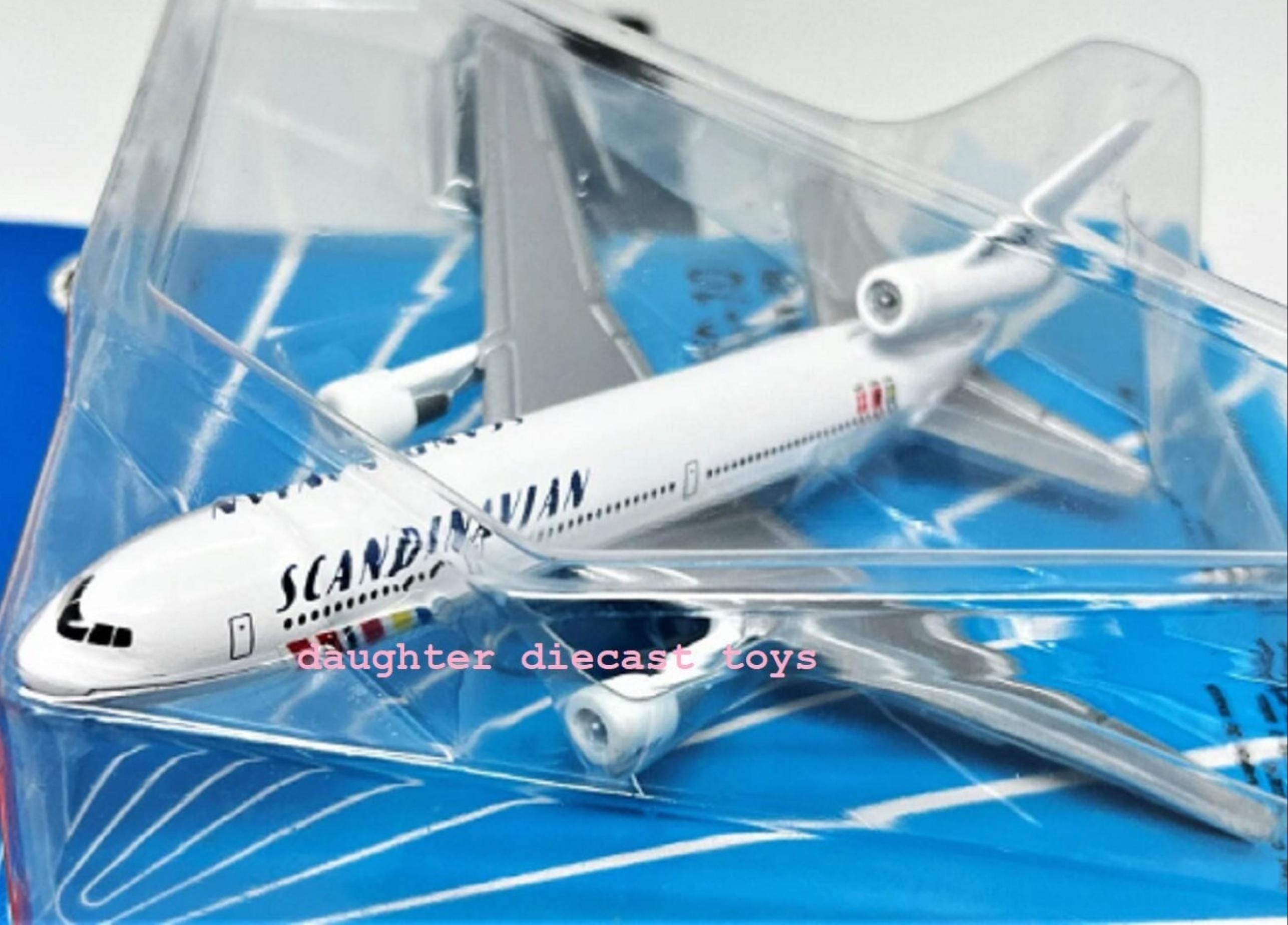
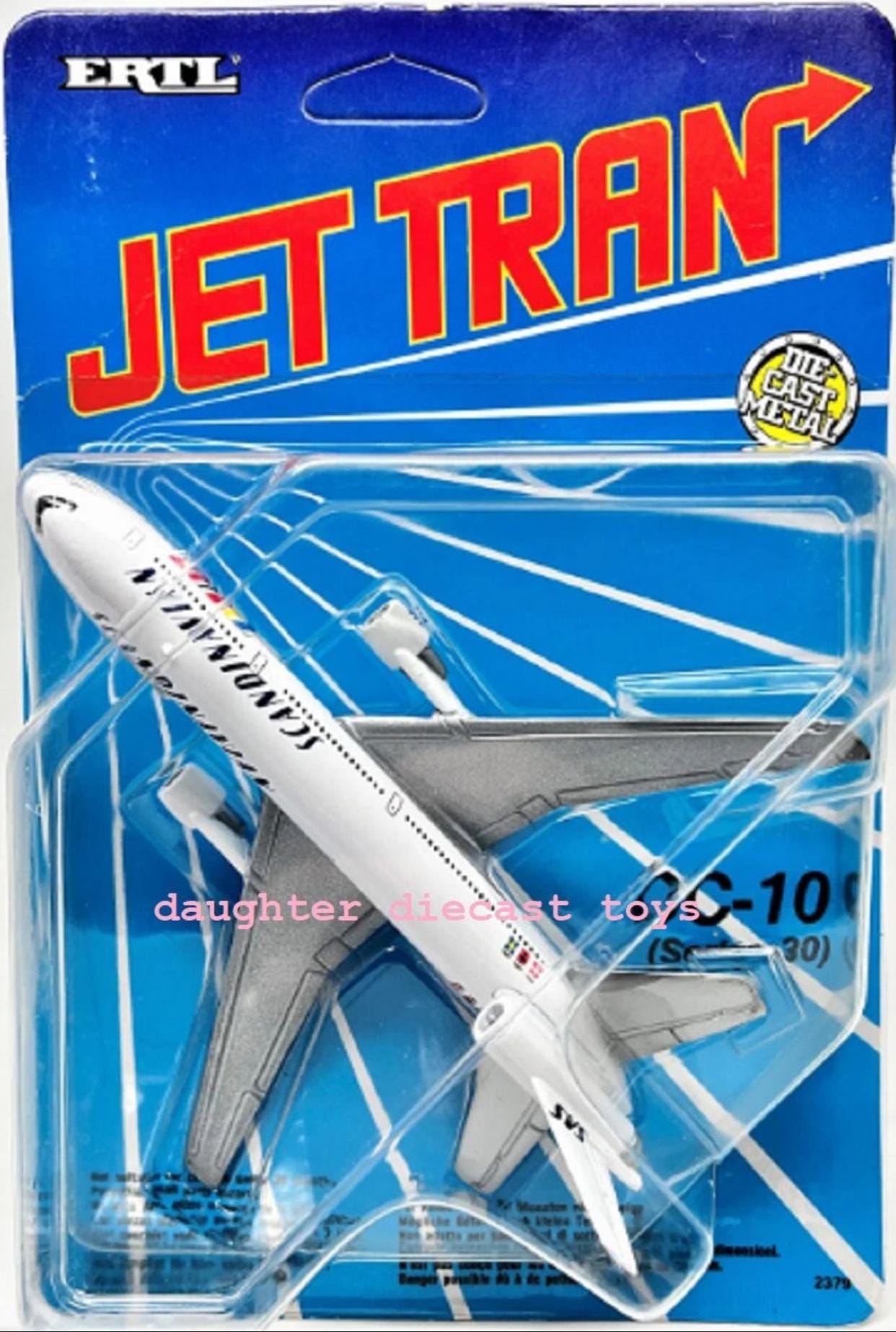
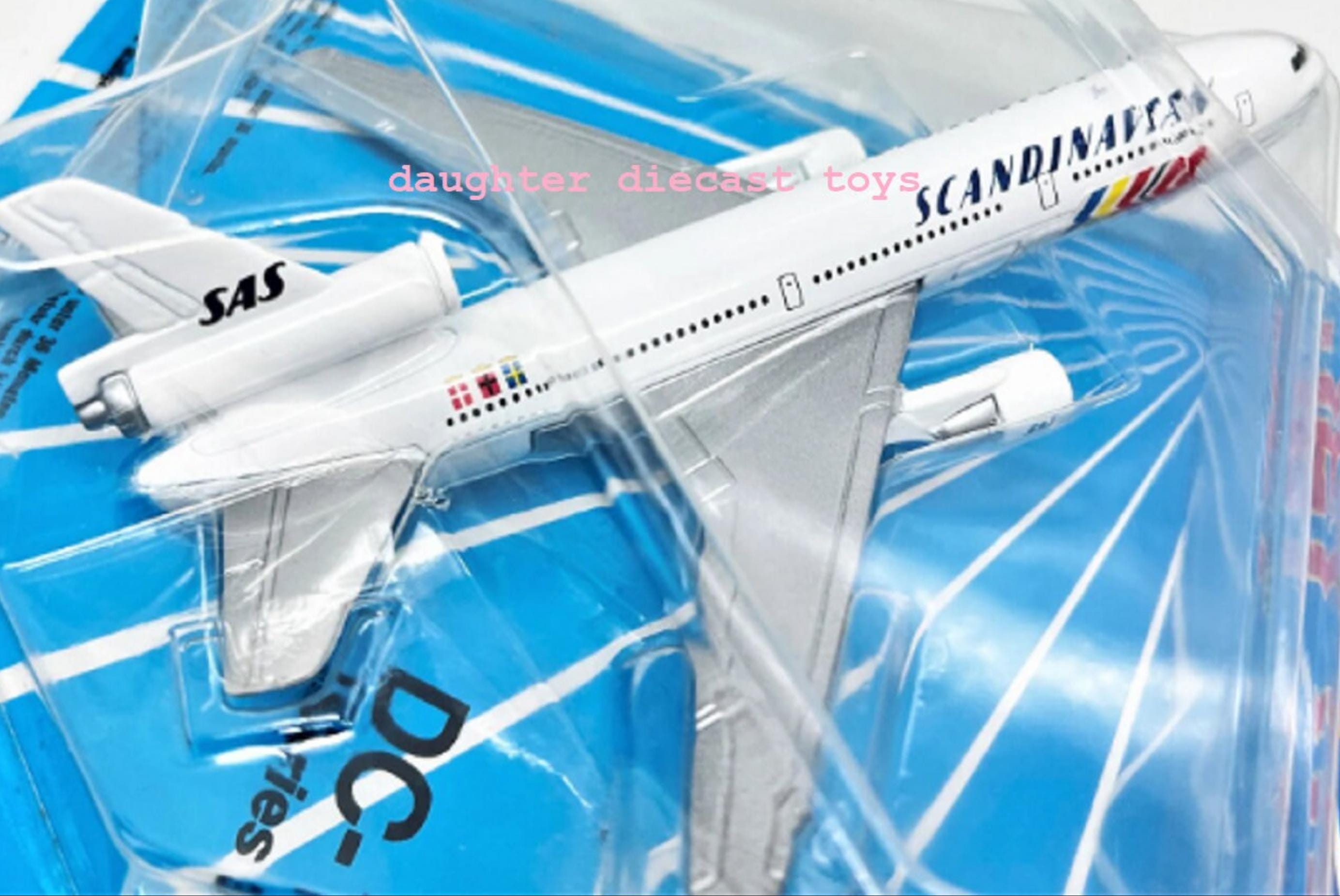
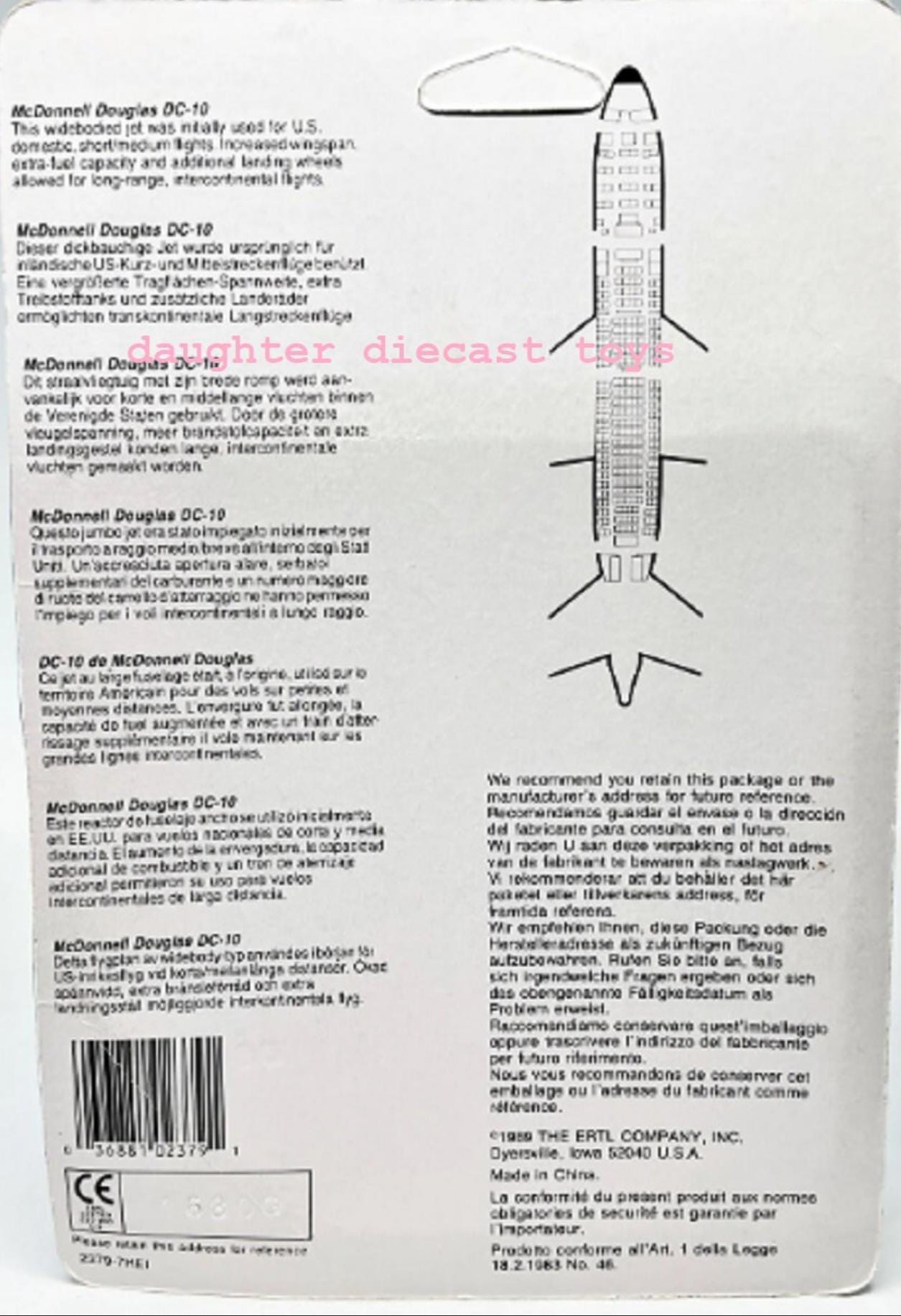

Vintage 1989 SCANDINAVIAN AIRLINES D.C.10 Hard to find Jet Airplane, Diecast Metal Pristine Condition / Factory Sealed! Ertl-Perfect gift!
$ 49.99

Really beautiful & hard to find: SCANDINAVIAN AIRLINES DC-10 JET AIRPLANE.
Constructed of die cast metal. Made in 1989 by ERTL. Highly sought-after, hard to find model! Large model-Measures 6"L x 5 1/2"W x 2"H. Beautiful, rare model-in Pristine condition-never been removed from its factory-sealed card. Perfect gift for Scandinavian Airlines employees, Airplane, Ertl and vintage die cast metal toy collectors! 100% happiness guaranteed! We ship fast & safe worldwide every day. Read airline and DC10 bio below....Note: My dad owned a Diecast toy store for 30 years. I inherited the store inventory when he passed away several years ago. I am (just now) able to bring myself to begin selling his cars-so they can be shared with the world. All pristine and mint condition vintage models will (eventually) be listed here on ETSY. All the inventory is NEW (vintage) merchandise-which was intended for retail sale. Please know-our diecast toys have NEVER been "played-with” we do not sell used, or damaged toys.
•
•
•FOR A LIMITED TIME
•
•
•Purchases totaling $35 and above qualify for FREE shipping to USA! Add more items to your Etsy shopping cart to save $$$.Scandinavian Airlines bio:Scandinavian Airlines, more commonly known and styled as SAS, is the flag carrier of Denmark, Norway, and Sweden.[3] SAS is an abbreviation of the company's full name, Scandinavian Airlines System[4] or legally Scandinavian Airlines System Denmark-Norway-Sweden.[5] Part of the SAS Group and headquartered at the SAS Frösundavik Office Building in Solna, Sweden, the airline operates 180 aircraft to 90 destinations (as of December 2019).[6] The airline's main hub is at Copenhagen-Kastrup Airport, with connections to 109 destinations around the world. Stockholm Arlanda Airport (with 106 destinations) is the second largest hub and Oslo Airport, Gardermoen being the third major hub of SAS.[7] Minor hubs also exist at Bergen Airport, Flesland, Göteborg Landvetter Airport, Stavanger Airport, Sola, and Trondheim Airport, Værnes. SAS Cargo is an independent, wholly owned subsidiary of Scandinavian Airlines and its main office is at Copenhagen Airport.[8]In 2017, SAS carried 28.6 million passengers, achieving revenues of 40 billion Swedish kronor.[9] This makes it the eighth-largest airline in Europe and the largest in Denmark and Sweden. The SAS fleet is composed of 180 aircraft consisting of Airbus A319, Airbus A320, Airbus A320neo, Airbus A321, Airbus A330, Airbus A350, and Boeing 737 Next Generation aircraft.[6] SAS also wet leases Airbus A320neo, ATR 72, and Bombardier CRJ900 aircraft.[10]The airline was founded in 1946 as a consortium to pool the transatlantic operations of Swedish airline Svensk Interkontinental Lufttrafik, Norway's Det Norske Luftfartselskap and Det Danske Luftfartselskab of Denmark. The consortium was extended to cover European and domestic cooperation two years later. In 1951, all the airlines were merged to create SAS. SAS has been described as "an icon of Norwegian Swedish–Danish cooperation".[11] On 27 June 2018, the Norwegian government announced that it had sold all its shares in SAS.[12][13]In 1997, SAS was a founding member of one of the major airline alliances, Star Alliance. Aircraft bio:The McDonnell Douglas DC-10 is an American tri-jet wide-body airliner manufactured by McDonnell Douglas. The DC-10 was intended to succeed the DC-8 for long-range flights. It first flew on August 29, 1970; it was introduced on August 5, 1971, by American Airlines.The trijet has two turbofans on underwing pylons and a third one at the base of the vertical stabilizer. The twin-aisle layout has a typical seating for 270 in two classes. The initial DC-10-10 had a 3,500 nmi (6,500 km) range for transcontinental flights. The DC-10-15 had more powerful engines for hot and high airports. The DC-10-30 and -40 models (with a third main landing gear leg to support higher weights) each had intercontinental ranges of up to 5,200 nmi (9,600 km). The KC-10 Extender (based on the DC-10-30) is a U.S. Air Force tanker.A design flaw in the cargo doors caused a poor safety record in early operations. Following the American Airlines Flight 191 crash (the deadliest aviation accident in US history), the US Federal Aviation Administration (FAA) grounded all U.S. DC-10s in June 1979. In August 1983, McDonnell Douglas announced that production would end due to a lack of orders, as it had a widespread public apprehension after the 1979 crash and a poor fuel economy reputation.[2] Design flaws were rectified and fleet hours increased, for a safety record later comparable to similar era passenger jets.Production ended in 1989, with 386 delivered to airlines along with 60 KC-10 tanker aircraft. The DC-10 outsold the similar Lockheed L-1011 TriStar. It was succeeded by the lengthened, heavier McDonnell Douglas MD-11. After merging with McDonnell Douglas in 1997, Boeing upgraded many in-service DC-10s as the MD-10 with a glass cockpit to eliminate the flight engineer position. In February 2014, the DC-10 made its last commercial passenger flight. Cargo airlines continue to operate it as a freighter, its largest operator is FedEx Express. The Orbis Flying Eye Hospital is a DC-10 adapted for eye surgery. A few DC-10s have been converted for aerial firefighting use. Some DC-10s are on display, while other retired aircraft are in storage.Development The 3-4-3 (left) and 2-5-2 (right) seating configurationFollowing an unsuccessful proposal for the U.S. Air Force's CX-HLS (Heavy Logistics System) in 1965, Douglas Aircraft began design studies based on its CX-HLS design. In 1966, American Airlines offered a specification to manufacturers for a widebody aircraft smaller than the Boeing 747 but capable of flying similar long-range routes from airports with shorter runways. The DC-10 became McDonnell Douglas's first commercial airliner after the merger between McDonnell Aircraft Corporation and Douglas Aircraft Company in 1967.[3] An early DC-10 design proposal was for a four-engine double-deck wide-body jet airliner with a maximum seating capacity of 550 passengers and similar in length to a DC-8. The proposal was shelved in favor of a trijet single-deck wide-body airliner with a maximum seating capacity of 399 passengers, and similar in length to the DC-8 Super 60.[4]On February 19, 1968, in what was supposed to be a knockout blow to the competing Lockheed L-1011, George A. Spater, President of American Airlines, and James S. McDonnell of McDonnell Douglas announced American Airlines' intention to acquire the DC-10. This was a shock to Lockheed and there was general agreement within the U.S. aviation industry that American Airlines had left its competitors at the starting gate. Together with American Airlines' decision to announce the DC-10 order, it was also reported that American Airlines had declared its intention to have the British Rolls-Royce RB211 turbofan engine on its DC-10 aircraft.[5] A prototype during flight testing, the DC-10 made its first flight on August 29, 1970List of military aircraft of Germany List of active Italian military aircraft List of aircraft of the Royal Air Force al facilities.
Constructed of die cast metal. Made in 1989 by ERTL. Highly sought-after, hard to find model! Large model-Measures 6"L x 5 1/2"W x 2"H. Beautiful, rare model-in Pristine condition-never been removed from its factory-sealed card. Perfect gift for Scandinavian Airlines employees, Airplane, Ertl and vintage die cast metal toy collectors! 100% happiness guaranteed! We ship fast & safe worldwide every day. Read airline and DC10 bio below....Note: My dad owned a Diecast toy store for 30 years. I inherited the store inventory when he passed away several years ago. I am (just now) able to bring myself to begin selling his cars-so they can be shared with the world. All pristine and mint condition vintage models will (eventually) be listed here on ETSY. All the inventory is NEW (vintage) merchandise-which was intended for retail sale. Please know-our diecast toys have NEVER been "played-with” we do not sell used, or damaged toys.
•
•
•FOR A LIMITED TIME
•
•
•Purchases totaling $35 and above qualify for FREE shipping to USA! Add more items to your Etsy shopping cart to save $$$.Scandinavian Airlines bio:Scandinavian Airlines, more commonly known and styled as SAS, is the flag carrier of Denmark, Norway, and Sweden.[3] SAS is an abbreviation of the company's full name, Scandinavian Airlines System[4] or legally Scandinavian Airlines System Denmark-Norway-Sweden.[5] Part of the SAS Group and headquartered at the SAS Frösundavik Office Building in Solna, Sweden, the airline operates 180 aircraft to 90 destinations (as of December 2019).[6] The airline's main hub is at Copenhagen-Kastrup Airport, with connections to 109 destinations around the world. Stockholm Arlanda Airport (with 106 destinations) is the second largest hub and Oslo Airport, Gardermoen being the third major hub of SAS.[7] Minor hubs also exist at Bergen Airport, Flesland, Göteborg Landvetter Airport, Stavanger Airport, Sola, and Trondheim Airport, Værnes. SAS Cargo is an independent, wholly owned subsidiary of Scandinavian Airlines and its main office is at Copenhagen Airport.[8]In 2017, SAS carried 28.6 million passengers, achieving revenues of 40 billion Swedish kronor.[9] This makes it the eighth-largest airline in Europe and the largest in Denmark and Sweden. The SAS fleet is composed of 180 aircraft consisting of Airbus A319, Airbus A320, Airbus A320neo, Airbus A321, Airbus A330, Airbus A350, and Boeing 737 Next Generation aircraft.[6] SAS also wet leases Airbus A320neo, ATR 72, and Bombardier CRJ900 aircraft.[10]The airline was founded in 1946 as a consortium to pool the transatlantic operations of Swedish airline Svensk Interkontinental Lufttrafik, Norway's Det Norske Luftfartselskap and Det Danske Luftfartselskab of Denmark. The consortium was extended to cover European and domestic cooperation two years later. In 1951, all the airlines were merged to create SAS. SAS has been described as "an icon of Norwegian Swedish–Danish cooperation".[11] On 27 June 2018, the Norwegian government announced that it had sold all its shares in SAS.[12][13]In 1997, SAS was a founding member of one of the major airline alliances, Star Alliance. Aircraft bio:The McDonnell Douglas DC-10 is an American tri-jet wide-body airliner manufactured by McDonnell Douglas. The DC-10 was intended to succeed the DC-8 for long-range flights. It first flew on August 29, 1970; it was introduced on August 5, 1971, by American Airlines.The trijet has two turbofans on underwing pylons and a third one at the base of the vertical stabilizer. The twin-aisle layout has a typical seating for 270 in two classes. The initial DC-10-10 had a 3,500 nmi (6,500 km) range for transcontinental flights. The DC-10-15 had more powerful engines for hot and high airports. The DC-10-30 and -40 models (with a third main landing gear leg to support higher weights) each had intercontinental ranges of up to 5,200 nmi (9,600 km). The KC-10 Extender (based on the DC-10-30) is a U.S. Air Force tanker.A design flaw in the cargo doors caused a poor safety record in early operations. Following the American Airlines Flight 191 crash (the deadliest aviation accident in US history), the US Federal Aviation Administration (FAA) grounded all U.S. DC-10s in June 1979. In August 1983, McDonnell Douglas announced that production would end due to a lack of orders, as it had a widespread public apprehension after the 1979 crash and a poor fuel economy reputation.[2] Design flaws were rectified and fleet hours increased, for a safety record later comparable to similar era passenger jets.Production ended in 1989, with 386 delivered to airlines along with 60 KC-10 tanker aircraft. The DC-10 outsold the similar Lockheed L-1011 TriStar. It was succeeded by the lengthened, heavier McDonnell Douglas MD-11. After merging with McDonnell Douglas in 1997, Boeing upgraded many in-service DC-10s as the MD-10 with a glass cockpit to eliminate the flight engineer position. In February 2014, the DC-10 made its last commercial passenger flight. Cargo airlines continue to operate it as a freighter, its largest operator is FedEx Express. The Orbis Flying Eye Hospital is a DC-10 adapted for eye surgery. A few DC-10s have been converted for aerial firefighting use. Some DC-10s are on display, while other retired aircraft are in storage.Development The 3-4-3 (left) and 2-5-2 (right) seating configurationFollowing an unsuccessful proposal for the U.S. Air Force's CX-HLS (Heavy Logistics System) in 1965, Douglas Aircraft began design studies based on its CX-HLS design. In 1966, American Airlines offered a specification to manufacturers for a widebody aircraft smaller than the Boeing 747 but capable of flying similar long-range routes from airports with shorter runways. The DC-10 became McDonnell Douglas's first commercial airliner after the merger between McDonnell Aircraft Corporation and Douglas Aircraft Company in 1967.[3] An early DC-10 design proposal was for a four-engine double-deck wide-body jet airliner with a maximum seating capacity of 550 passengers and similar in length to a DC-8. The proposal was shelved in favor of a trijet single-deck wide-body airliner with a maximum seating capacity of 399 passengers, and similar in length to the DC-8 Super 60.[4]On February 19, 1968, in what was supposed to be a knockout blow to the competing Lockheed L-1011, George A. Spater, President of American Airlines, and James S. McDonnell of McDonnell Douglas announced American Airlines' intention to acquire the DC-10. This was a shock to Lockheed and there was general agreement within the U.S. aviation industry that American Airlines had left its competitors at the starting gate. Together with American Airlines' decision to announce the DC-10 order, it was also reported that American Airlines had declared its intention to have the British Rolls-Royce RB211 turbofan engine on its DC-10 aircraft.[5] A prototype during flight testing, the DC-10 made its first flight on August 29, 1970List of military aircraft of Germany List of active Italian military aircraft List of aircraft of the Royal Air Force al facilities.
Other Products