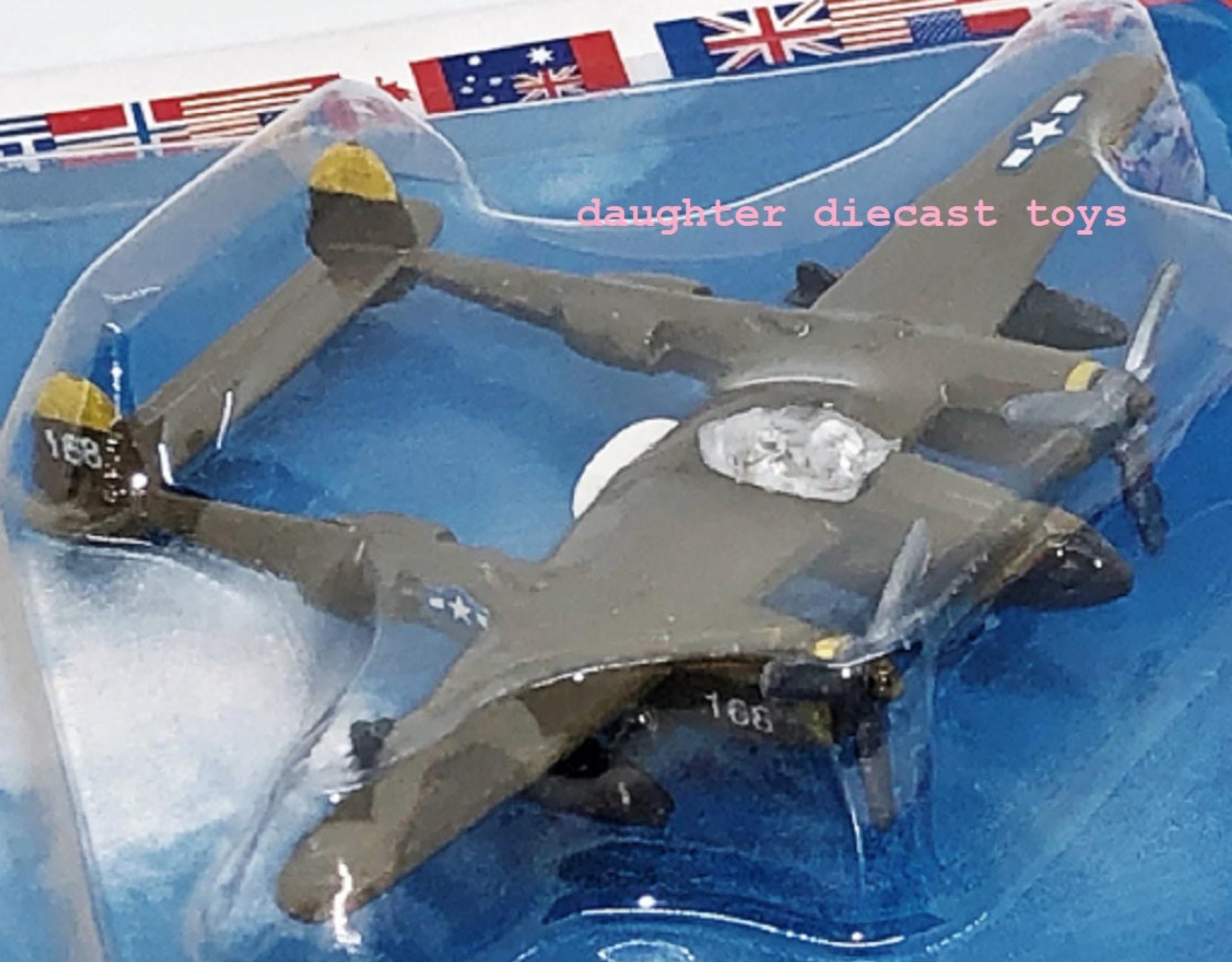
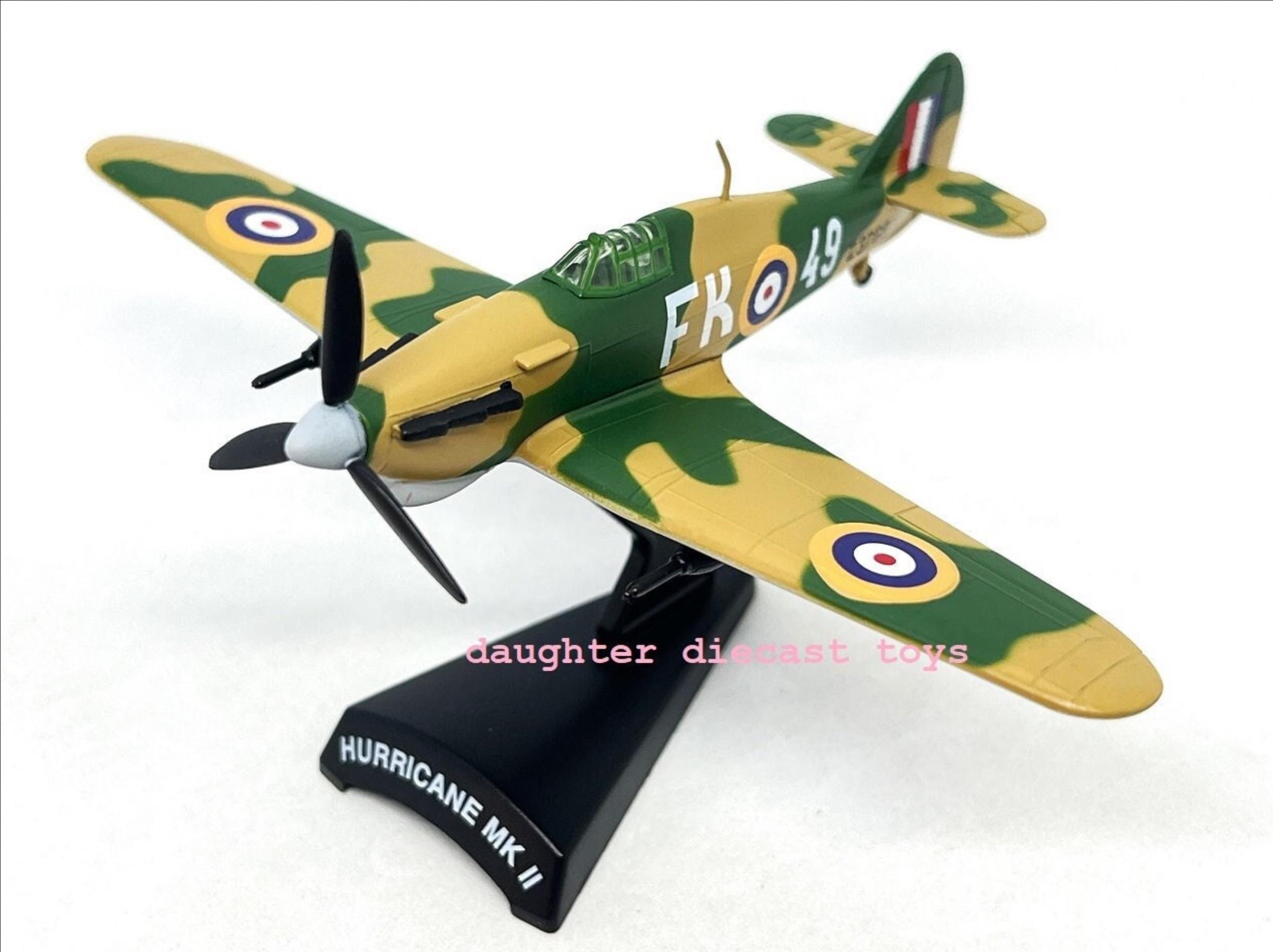
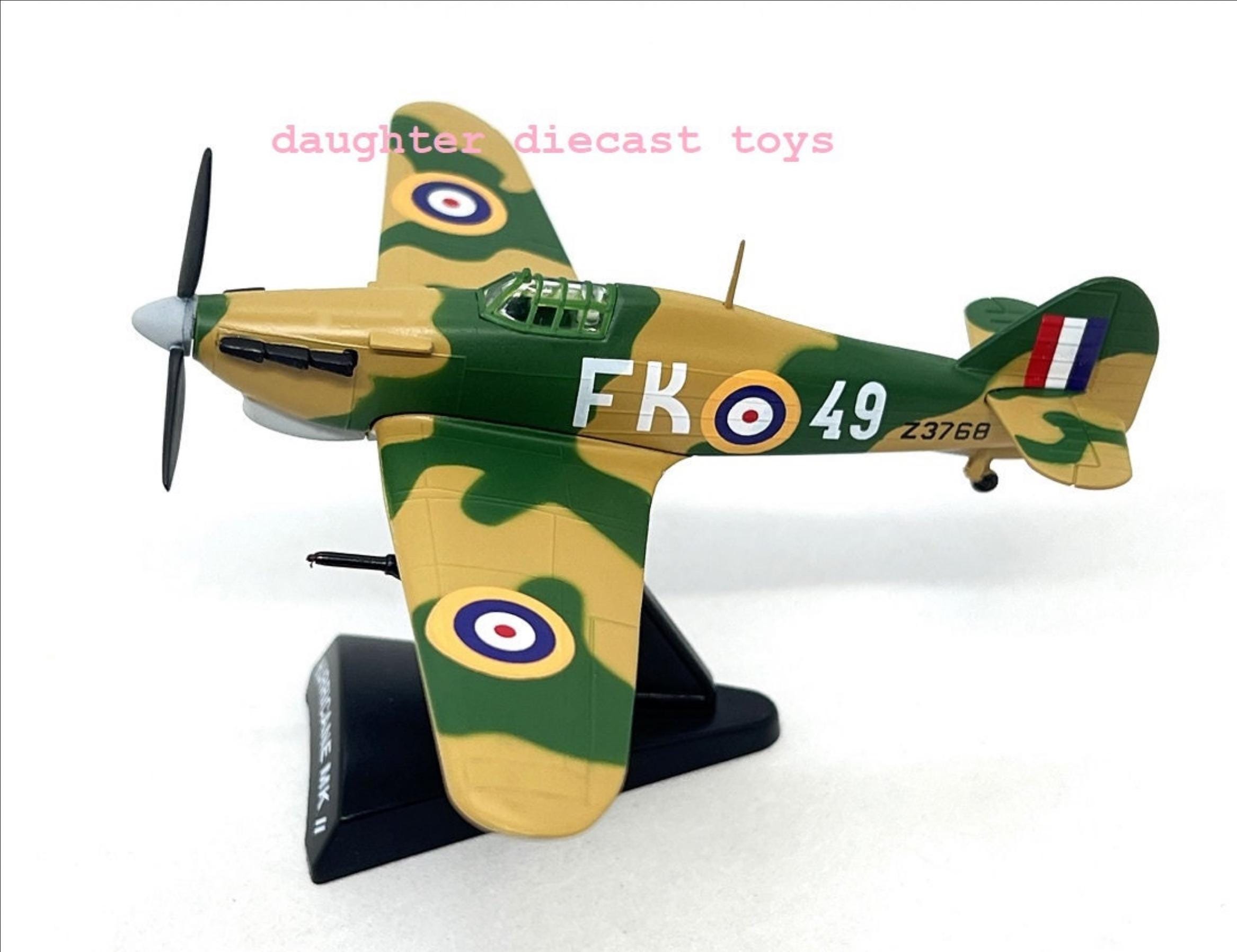
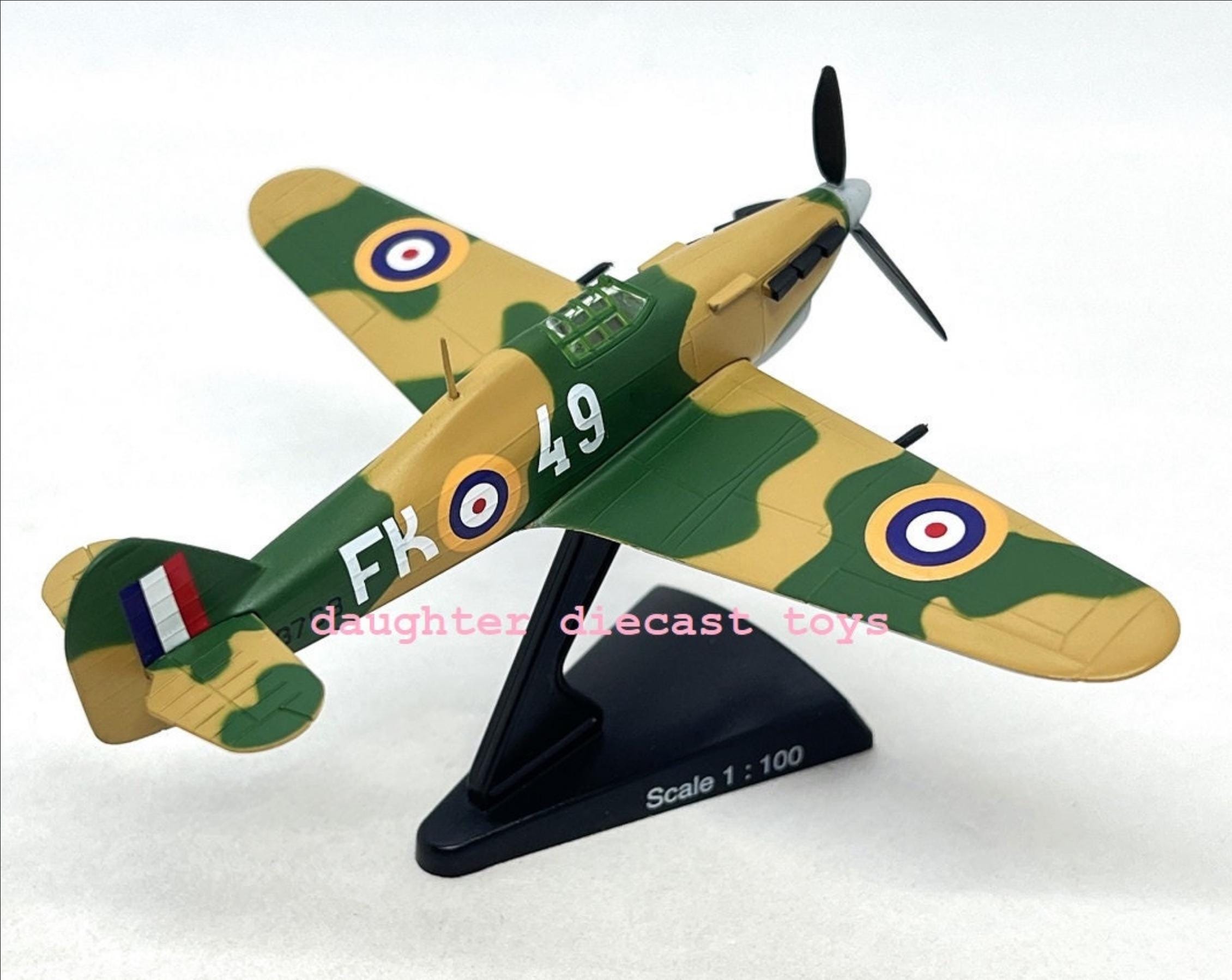
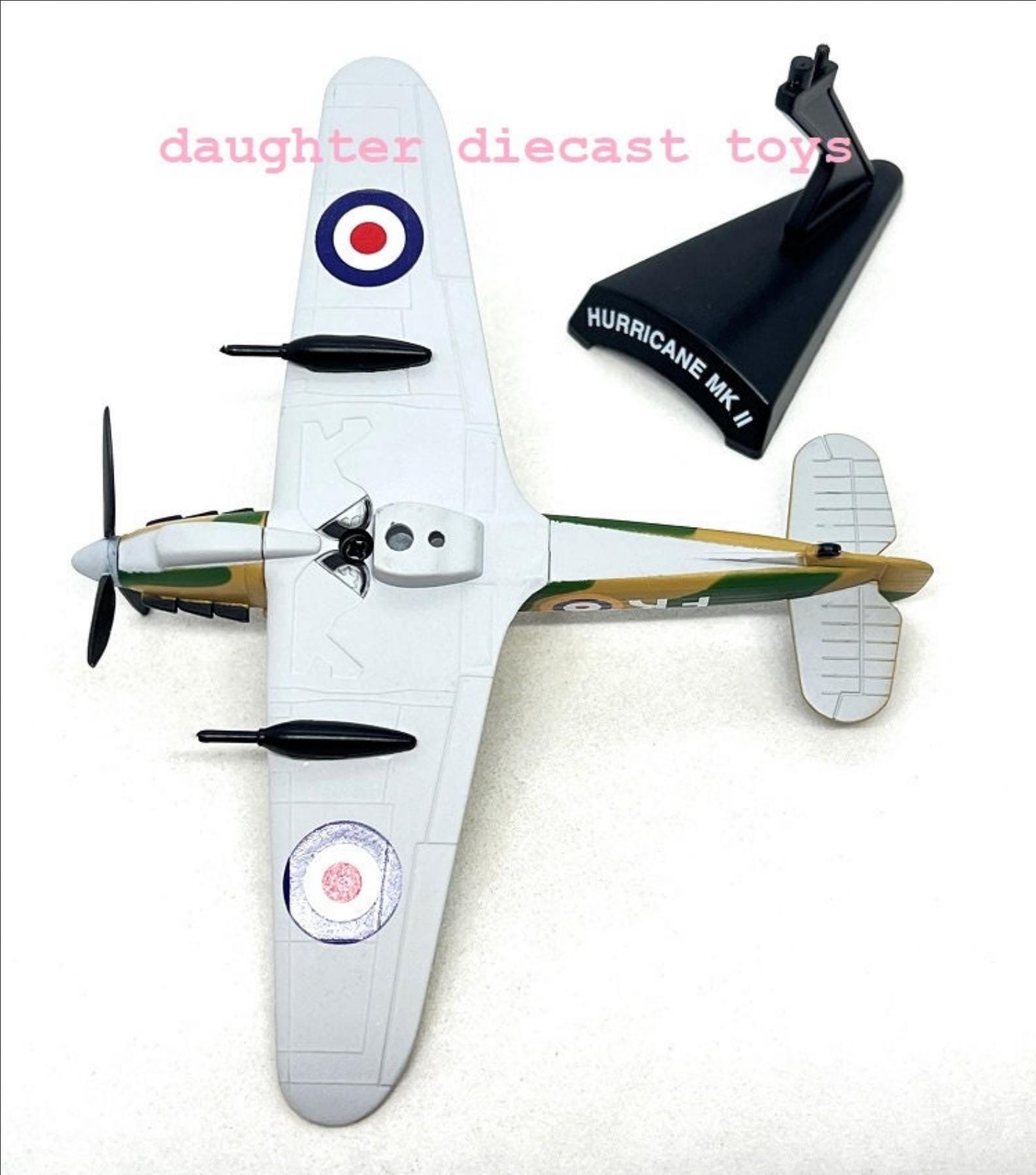

Vtg W.W.I.I. RAF HAWKER HURRICANE Airplane-Heavy Diecast Metal-Adult Collector Model-Perfect gift for Collectors & Military Aircraft Fans!
$ 60.00

VINTAGE WWII RAF HAWKER HURRICANE MKII FIGHTER PLANE-Heavy Diecast Metal-ADULT
COLLECTOR MODEL-Perfect gift for Collectors & Military Aircraft Fans!Fantastic....VINTAGE WWII RAF HAWKER HURRICANE MKII FIGHTER PLANE. Premium quality, intricately detailed Adult Collector. Constructed of (very heavy) diecast metal-by Model Power Co. Scale= 1/100, measures 3 3/4"L x 4 1/4"W x 2 1/2"H (mounted). Pristine condition model-This airplane has never been removed from its factory-sealed packaging until today for the photos in our listing. Aircraft comes complete with desktop display stand and is enclosed in a protective plastic clam shell case. Perfect gift for vintage toy collectors, military history enthusiasts, war diorama creators, and airshow fans (like me)! FREE shipping to anywhere in the continental USA. 100% happiness guaranteed. Read plane bio below....Purchases totaling $35 and above qualify for FREE shipping to USA! Add more items to your Etsy shopping cart to save $$$.Note: My dad owned a Diecast toy store for 30 years. I inherited the store inventory when he passed away several years ago. I am (just now) able to bring myself to begin selling his toys-so they can be shared with the world. All the inventory is NEW (vintage) merchandise-which was intended for retail sale. Please know-our diecast toys have NEVER been "played-with” we do not sell used, or damaged merchandise. AIRCRAFT BIO:The Hawker Hurricane is a British single-seat fighter aircraft of the 1930s–40s which was designed and predominantly built by Hawker Aircraft Ltd. for service with the Royal Air Force (RAF). It was overshadowed in the public consciousness by the Supermarine Spitfire during the Battle of Britain in 1940, but the Hurricane inflicted 60% of the losses sustained by the Luftwaffe in the campaign, and fought in all the major theatres of the Second World War.The Hurricane originated from discussions between RAF officials and aircraft designer Sir Sydney Camm about a proposed monoplane derivative of the Hawker Fury biplane in the early 1930s. Despite an institutional preference for biplanes and lack of interest by the Air Ministry, Hawker refined its monoplane proposal, incorporating several innovations which became critical to wartime fighter aircraft, including retractable landing gear and the more powerful Rolls-Royce Merlin engine. The Air Ministry ordered Hawker's Interceptor Monoplane in late 1934, and the prototype Hurricane K5083 performed its maiden flight on 6 November 1935.The Hurricane went into production for the Air Ministry In June 1936 and entered squadron service in December 1937. Its manufacture and maintenance were eased by using conventional construction methods so that squadrons could perform many major repairs without external support. The plane was rapidly procured prior to the outbreak of the Second World War; in September 1939, the RAF had 18 Hurricane-equipped squadrons in service. It was relied upon to defend against German aircraft operated by the Luftwaffe, including dogfighting with Messerschmitt Bf 109s in multiple theatres of action.The Hurricane was developed through several versions: bomber-interceptors, fighter-bombers, and ground support aircraft as well as fighters. Versions designed for the Royal Navy known as the Sea Hurricane had modifications enabling operation from ships. Some were converted as catapult-launched convoy escorts. By the end of production in July 1944, 14,487 units had been completed in Britain and Canada, with others built in Belgium and Yugoslavia.Battle of BritainAt the end of June 1940, following the fall of France, 31 of Fighter Command's 61 fighter squadrons were equipped with Hurricanes.[80] The Battle of Britain officially lasted from 10 July until 31 October 1940, but the heaviest fighting took place between 8 August and 21 September. Both the Supermarine Spitfire and the Hurricane are renowned for their part in having defended Britain against the Luftwaffe; generally, the Spitfires intercepted the German fighters, leaving Hurricanes to concentrate on the bombers, and, despite the undoubted abilities of the "thoroughbred" Spitfire, it was the "workhorse" Hurricane that scored the higher number of RAF victories during this period, accounting for 55% of the 2,739 German losses, according to Fighter Command, compared with 42% by Spitfires.[81] On 8 August 1940, Hurricanes of No. 145 Squadron were recorded as having fired the first shots of the Battle of Britain.[82] The highest scoring Hurricane squadron during the Battle of Britain was the No. 303 Polish Fighter Squadron. This squadron also had the distinction of having the highest ratio of enemy aircraft destroyed to own losses suffered.[83][84][85] Hurricane I of 1 Squadron flown by Plt Off A.V. Clowes.Another thing we did was to devise a manoeuvre which was aimed at getting us out of a difficult corner if we ever got into one. This may sound very extraordinary, probably, to practising pilots today, but it consisted of putting everything into the left hand front corner of the cockpit. If you saw a 109 on your tail, and it hadn't shot you down at that point, you put on full throttle, fine pitch, full left rudder, full left stick and full forward stick. This resulted in a horrible manoeuvre which was, in fact, a negative g spiral dive. But you would come out of the bottom with no 109 on your tail and your aeroplane intact.Roland Beamont describing how a Hurricane can get away from an Bf 109.[86]As a fighter, the Hurricane had some drawbacks. It was slightly slower than both the Spitfire I and II and the Messerschmitt Bf 109E, and the thicker wing profiles compromised acceleration; but it could out-turn both of them. In spite of its performance deficiencies against the Bf 109, the Hurricane was still capable of destroying the German fighter, especially at lower altitudes. The standard tactic of the 109s was to attempt to climb higher than the RAF fighters and "bounce" them in a dive; the Hurricanes could evade such tactics by turning into the attack or going into a "corkscrew dive", which the 109s, with their lower rate of roll, found hard to counter. If a 109 was caught in a dogfight, the Hurricane was just as capable of out-turning the 109 as the Spitfire. In a stern chase, the 109 could evade the Hurricane.[87]In September 1940, the more powerful Mk.IIa series 1 Hurricanes started entering service, although only in small numbers.[88] This version was capable of a maximum speed of 342 mph (550 km/h).[89] The Hurricane was a steady gun platform and had demonstrated its ruggedness as several were badly damaged yet returned to base.[90] The Hurricane's construction made it dangerous if it caught fire; the wood frames and fabric covering of the rear fuselage allowed fire to spread through the rear fuselage structure easily. The gravity fuel tank in the forward fuselage sat right in front of the instrument panel, without any form of protection for the pilot. Many Hurricane pilots were seriously burned as a consequence of a jet of flame which could burn through the instrument panel. This became of such concern to Hugh Dowding that he had Hawker retrofit the fuselage tanks of the Hurricanes with Linatex, a self-expanding rubber coating.[91] If the tank happened to be punctured by a bullet, the Linatex coating expanded when soaked with petrol and sealed it.[92] However, some Hurricane pilots felt that the fuel tanks in the wings, although they were also protected with a layer of Linatex, were vulnerable from behind, and it was thought that those, and not the fuselage tank, were the main fire risk.[93][94] Groundcrew refuelling a Hurricane Mk.I of 32 Squadron, RAF Biggin Hill, Bromley, London, August 1940From 10 July to 11 August 1940, RAF fighters fired at 114 German bombers and shot down 80, a destruction ratio of 70%. Against the Bf 109, the RAF fighters attacked 70 and shot down 54 of these, a ratio of 77%. It has been suggested that part of the success of the British fighters was possibly due to the use of the de Wilde incendiary round.[95] The Hurricane with the highest number of kills during the Battle of Britain was P3308, a Mk.I, flown between 15 August and 7 October 1940 by RAF (auxiliary) pilot Archie McKellar of 605 Squadron.[96] He is credited with 21 kills, 19 of those in a Hurricane during the Battle of Britain. On 7 October he is credited with shooting down five Bf 109s, making him one of only two RAF pilots (the other being Brian Carbury of New Zealand) to become an "ace in a day" during the Battle of Britain.[97][98] During his brief fighting career, McKellar earned the DSO,[99] DFC & Bar.[100][101] McKellar has remained in relative obscurity in Battle of Britain history, as he was killed in action one day after the date set by the War Ministry (after the war) as the official end date for the Battle of Britain. He died on 1 November 1940 while taking on a superior number of Bf 109s.[102][failed verification] As in the Spitfire, the Merlin engine suffered from negative-G cut-out, a problem not cured until the introduction of Miss Shilling's orifice in early 1941. 303 squadron pilots. L-R: F/O Ferić, F/Lt Lt Kent, F/O Grzeszczak, P/O Radomski, P/O Zumbach, P/O Łokuciewski, F/O Henneberg, Sgt Rogowski, Sgt Szaposznikow (in 1940).The only Battle of Britain Victoria Cross, and the only one awarded to a member of Fighter Command during the war,[103] was awarded to Flight Lieutenant James Brindley Nicolson of 249 Squadron as a result of an action on 16 August 1940 when his section of three Hurricanes was "bounced" from above by Bf 110 fighters. All three were hit simultaneously. Nicolson was badly wounded, and his Hurricane was damaged and engulfed in flames. While attempting to leave the cockpit, Nicolson noticed that one of the Bf 110s had overshot his aircraft. He returned to the cockpit, which by now was in an inferno, engaged the enemy, and may have shot down the Bf 110.[104][105][N 8] Afterward, he parachuted to safety, although he was mistakenly shot at by the Home Guard after landing. Night fighters and intruders Wartime colour photo of Hurricane IIC BE500 flown by Sqn Ldr Denis Smallwood of 87 Squadron in the RDM2 ("Special Night") scheme and used on intruder operations 1941–1942.Following the Battle of Britain the Hurricane continued to give service; through the Blitz of 1941 it was the principal single-seat night fighter in Fighter Command. F/Lt. Richard Stevens claimed 14 Luftwaffe bombers flying Hurricanes in 1941. In 1942 the cannon-armed Mk.IIc performed further afield, as a night intruder over occupied Europe. F/Lt. Karel Kuttelwascher of 1 Squadron proved the top scorer, with 15 Luftwaffe bombers claimed shot down. The year 1942 also saw the manufacture of 12 Hurricane II C(NF) night fighters, equipped with pilot-operated air interception Mark VI radar. After a brief operational deployment with No. 245 and No. 247 Squadron RAF during which these aircraft proved too slow for operations in Europe, the aircraft were sent to India to serve with No. 176 Squadron RAF in the defence of Calcutta.[107] They were withdrawn from service at the end of December 1943.[108]
COLLECTOR MODEL-Perfect gift for Collectors & Military Aircraft Fans!Fantastic....VINTAGE WWII RAF HAWKER HURRICANE MKII FIGHTER PLANE. Premium quality, intricately detailed Adult Collector. Constructed of (very heavy) diecast metal-by Model Power Co. Scale= 1/100, measures 3 3/4"L x 4 1/4"W x 2 1/2"H (mounted). Pristine condition model-This airplane has never been removed from its factory-sealed packaging until today for the photos in our listing. Aircraft comes complete with desktop display stand and is enclosed in a protective plastic clam shell case. Perfect gift for vintage toy collectors, military history enthusiasts, war diorama creators, and airshow fans (like me)! FREE shipping to anywhere in the continental USA. 100% happiness guaranteed. Read plane bio below....Purchases totaling $35 and above qualify for FREE shipping to USA! Add more items to your Etsy shopping cart to save $$$.Note: My dad owned a Diecast toy store for 30 years. I inherited the store inventory when he passed away several years ago. I am (just now) able to bring myself to begin selling his toys-so they can be shared with the world. All the inventory is NEW (vintage) merchandise-which was intended for retail sale. Please know-our diecast toys have NEVER been "played-with” we do not sell used, or damaged merchandise. AIRCRAFT BIO:The Hawker Hurricane is a British single-seat fighter aircraft of the 1930s–40s which was designed and predominantly built by Hawker Aircraft Ltd. for service with the Royal Air Force (RAF). It was overshadowed in the public consciousness by the Supermarine Spitfire during the Battle of Britain in 1940, but the Hurricane inflicted 60% of the losses sustained by the Luftwaffe in the campaign, and fought in all the major theatres of the Second World War.The Hurricane originated from discussions between RAF officials and aircraft designer Sir Sydney Camm about a proposed monoplane derivative of the Hawker Fury biplane in the early 1930s. Despite an institutional preference for biplanes and lack of interest by the Air Ministry, Hawker refined its monoplane proposal, incorporating several innovations which became critical to wartime fighter aircraft, including retractable landing gear and the more powerful Rolls-Royce Merlin engine. The Air Ministry ordered Hawker's Interceptor Monoplane in late 1934, and the prototype Hurricane K5083 performed its maiden flight on 6 November 1935.The Hurricane went into production for the Air Ministry In June 1936 and entered squadron service in December 1937. Its manufacture and maintenance were eased by using conventional construction methods so that squadrons could perform many major repairs without external support. The plane was rapidly procured prior to the outbreak of the Second World War; in September 1939, the RAF had 18 Hurricane-equipped squadrons in service. It was relied upon to defend against German aircraft operated by the Luftwaffe, including dogfighting with Messerschmitt Bf 109s in multiple theatres of action.The Hurricane was developed through several versions: bomber-interceptors, fighter-bombers, and ground support aircraft as well as fighters. Versions designed for the Royal Navy known as the Sea Hurricane had modifications enabling operation from ships. Some were converted as catapult-launched convoy escorts. By the end of production in July 1944, 14,487 units had been completed in Britain and Canada, with others built in Belgium and Yugoslavia.Battle of BritainAt the end of June 1940, following the fall of France, 31 of Fighter Command's 61 fighter squadrons were equipped with Hurricanes.[80] The Battle of Britain officially lasted from 10 July until 31 October 1940, but the heaviest fighting took place between 8 August and 21 September. Both the Supermarine Spitfire and the Hurricane are renowned for their part in having defended Britain against the Luftwaffe; generally, the Spitfires intercepted the German fighters, leaving Hurricanes to concentrate on the bombers, and, despite the undoubted abilities of the "thoroughbred" Spitfire, it was the "workhorse" Hurricane that scored the higher number of RAF victories during this period, accounting for 55% of the 2,739 German losses, according to Fighter Command, compared with 42% by Spitfires.[81] On 8 August 1940, Hurricanes of No. 145 Squadron were recorded as having fired the first shots of the Battle of Britain.[82] The highest scoring Hurricane squadron during the Battle of Britain was the No. 303 Polish Fighter Squadron. This squadron also had the distinction of having the highest ratio of enemy aircraft destroyed to own losses suffered.[83][84][85] Hurricane I of 1 Squadron flown by Plt Off A.V. Clowes.Another thing we did was to devise a manoeuvre which was aimed at getting us out of a difficult corner if we ever got into one. This may sound very extraordinary, probably, to practising pilots today, but it consisted of putting everything into the left hand front corner of the cockpit. If you saw a 109 on your tail, and it hadn't shot you down at that point, you put on full throttle, fine pitch, full left rudder, full left stick and full forward stick. This resulted in a horrible manoeuvre which was, in fact, a negative g spiral dive. But you would come out of the bottom with no 109 on your tail and your aeroplane intact.Roland Beamont describing how a Hurricane can get away from an Bf 109.[86]As a fighter, the Hurricane had some drawbacks. It was slightly slower than both the Spitfire I and II and the Messerschmitt Bf 109E, and the thicker wing profiles compromised acceleration; but it could out-turn both of them. In spite of its performance deficiencies against the Bf 109, the Hurricane was still capable of destroying the German fighter, especially at lower altitudes. The standard tactic of the 109s was to attempt to climb higher than the RAF fighters and "bounce" them in a dive; the Hurricanes could evade such tactics by turning into the attack or going into a "corkscrew dive", which the 109s, with their lower rate of roll, found hard to counter. If a 109 was caught in a dogfight, the Hurricane was just as capable of out-turning the 109 as the Spitfire. In a stern chase, the 109 could evade the Hurricane.[87]In September 1940, the more powerful Mk.IIa series 1 Hurricanes started entering service, although only in small numbers.[88] This version was capable of a maximum speed of 342 mph (550 km/h).[89] The Hurricane was a steady gun platform and had demonstrated its ruggedness as several were badly damaged yet returned to base.[90] The Hurricane's construction made it dangerous if it caught fire; the wood frames and fabric covering of the rear fuselage allowed fire to spread through the rear fuselage structure easily. The gravity fuel tank in the forward fuselage sat right in front of the instrument panel, without any form of protection for the pilot. Many Hurricane pilots were seriously burned as a consequence of a jet of flame which could burn through the instrument panel. This became of such concern to Hugh Dowding that he had Hawker retrofit the fuselage tanks of the Hurricanes with Linatex, a self-expanding rubber coating.[91] If the tank happened to be punctured by a bullet, the Linatex coating expanded when soaked with petrol and sealed it.[92] However, some Hurricane pilots felt that the fuel tanks in the wings, although they were also protected with a layer of Linatex, were vulnerable from behind, and it was thought that those, and not the fuselage tank, were the main fire risk.[93][94] Groundcrew refuelling a Hurricane Mk.I of 32 Squadron, RAF Biggin Hill, Bromley, London, August 1940From 10 July to 11 August 1940, RAF fighters fired at 114 German bombers and shot down 80, a destruction ratio of 70%. Against the Bf 109, the RAF fighters attacked 70 and shot down 54 of these, a ratio of 77%. It has been suggested that part of the success of the British fighters was possibly due to the use of the de Wilde incendiary round.[95] The Hurricane with the highest number of kills during the Battle of Britain was P3308, a Mk.I, flown between 15 August and 7 October 1940 by RAF (auxiliary) pilot Archie McKellar of 605 Squadron.[96] He is credited with 21 kills, 19 of those in a Hurricane during the Battle of Britain. On 7 October he is credited with shooting down five Bf 109s, making him one of only two RAF pilots (the other being Brian Carbury of New Zealand) to become an "ace in a day" during the Battle of Britain.[97][98] During his brief fighting career, McKellar earned the DSO,[99] DFC & Bar.[100][101] McKellar has remained in relative obscurity in Battle of Britain history, as he was killed in action one day after the date set by the War Ministry (after the war) as the official end date for the Battle of Britain. He died on 1 November 1940 while taking on a superior number of Bf 109s.[102][failed verification] As in the Spitfire, the Merlin engine suffered from negative-G cut-out, a problem not cured until the introduction of Miss Shilling's orifice in early 1941. 303 squadron pilots. L-R: F/O Ferić, F/Lt Lt Kent, F/O Grzeszczak, P/O Radomski, P/O Zumbach, P/O Łokuciewski, F/O Henneberg, Sgt Rogowski, Sgt Szaposznikow (in 1940).The only Battle of Britain Victoria Cross, and the only one awarded to a member of Fighter Command during the war,[103] was awarded to Flight Lieutenant James Brindley Nicolson of 249 Squadron as a result of an action on 16 August 1940 when his section of three Hurricanes was "bounced" from above by Bf 110 fighters. All three were hit simultaneously. Nicolson was badly wounded, and his Hurricane was damaged and engulfed in flames. While attempting to leave the cockpit, Nicolson noticed that one of the Bf 110s had overshot his aircraft. He returned to the cockpit, which by now was in an inferno, engaged the enemy, and may have shot down the Bf 110.[104][105][N 8] Afterward, he parachuted to safety, although he was mistakenly shot at by the Home Guard after landing. Night fighters and intruders Wartime colour photo of Hurricane IIC BE500 flown by Sqn Ldr Denis Smallwood of 87 Squadron in the RDM2 ("Special Night") scheme and used on intruder operations 1941–1942.Following the Battle of Britain the Hurricane continued to give service; through the Blitz of 1941 it was the principal single-seat night fighter in Fighter Command. F/Lt. Richard Stevens claimed 14 Luftwaffe bombers flying Hurricanes in 1941. In 1942 the cannon-armed Mk.IIc performed further afield, as a night intruder over occupied Europe. F/Lt. Karel Kuttelwascher of 1 Squadron proved the top scorer, with 15 Luftwaffe bombers claimed shot down. The year 1942 also saw the manufacture of 12 Hurricane II C(NF) night fighters, equipped with pilot-operated air interception Mark VI radar. After a brief operational deployment with No. 245 and No. 247 Squadron RAF during which these aircraft proved too slow for operations in Europe, the aircraft were sent to India to serve with No. 176 Squadron RAF in the defence of Calcutta.[107] They were withdrawn from service at the end of December 1943.[108]
Other Products