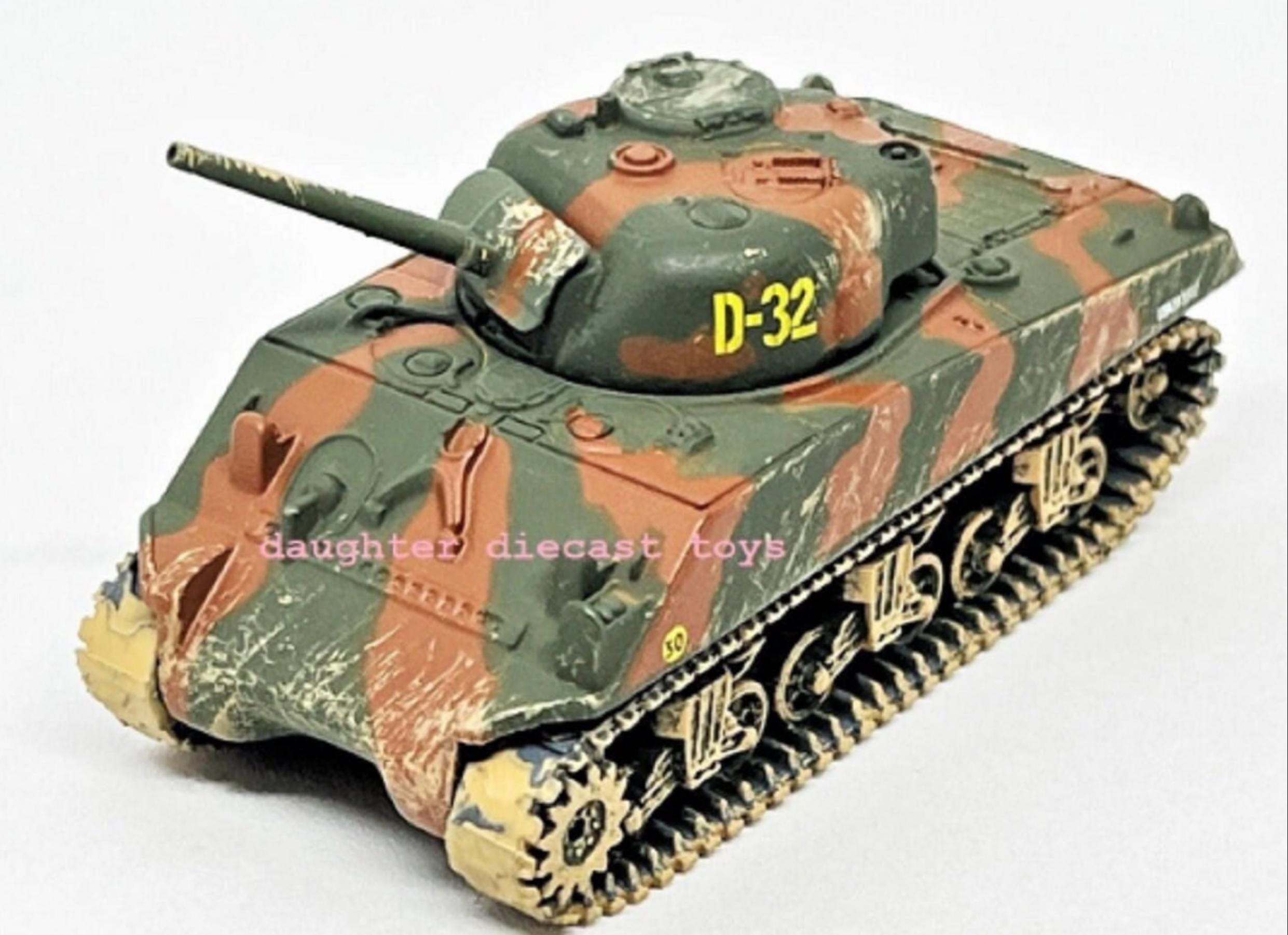
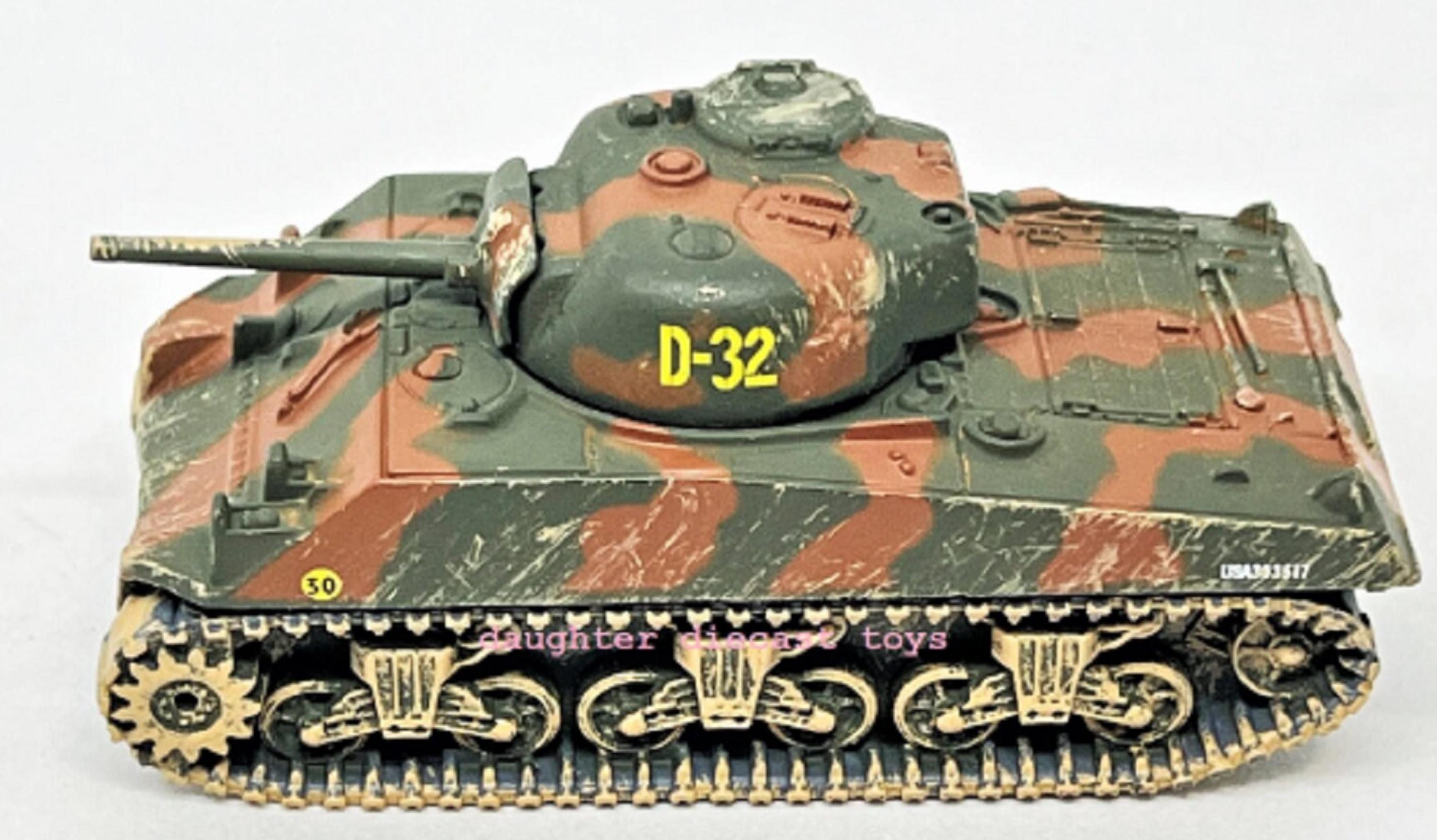
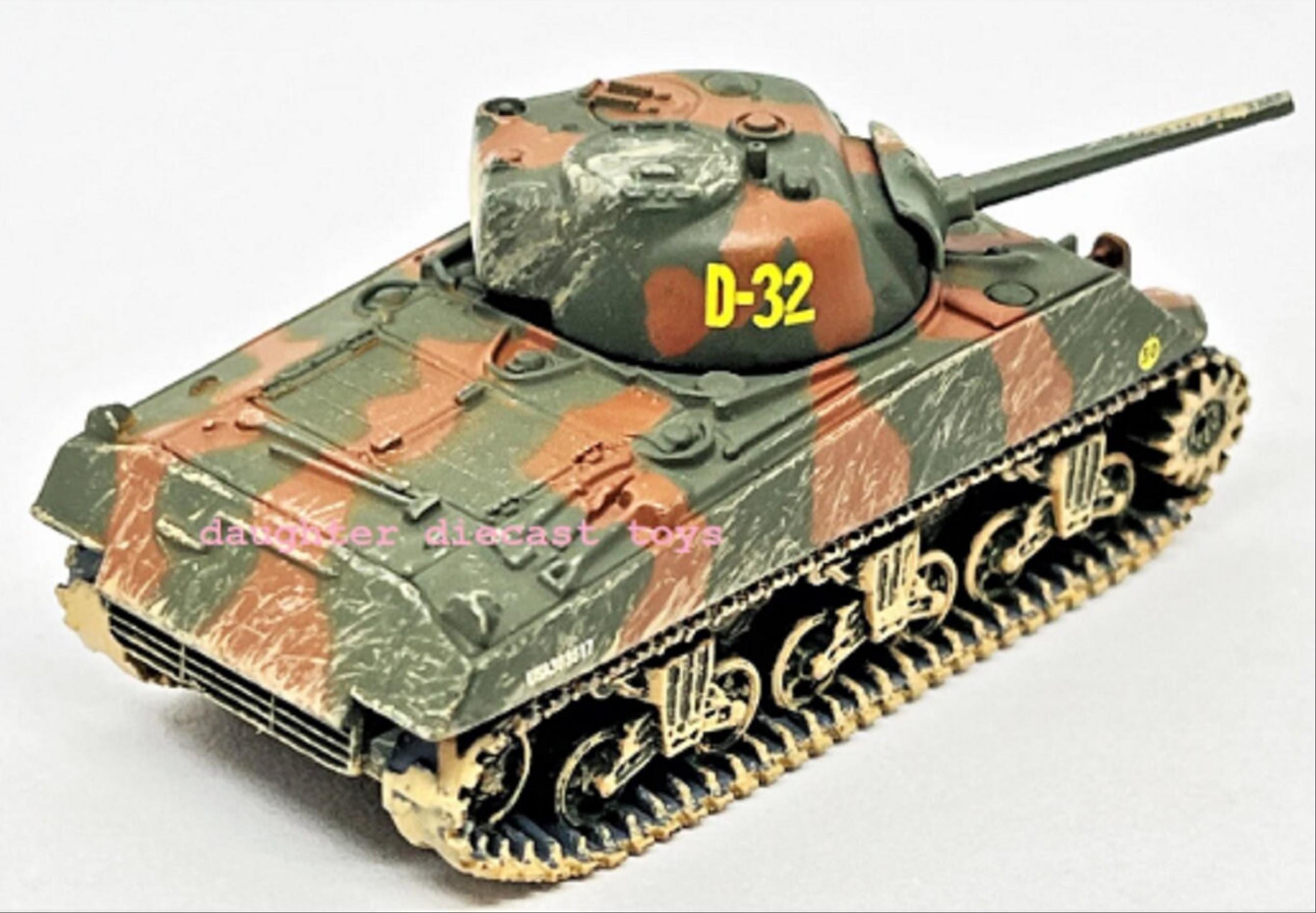
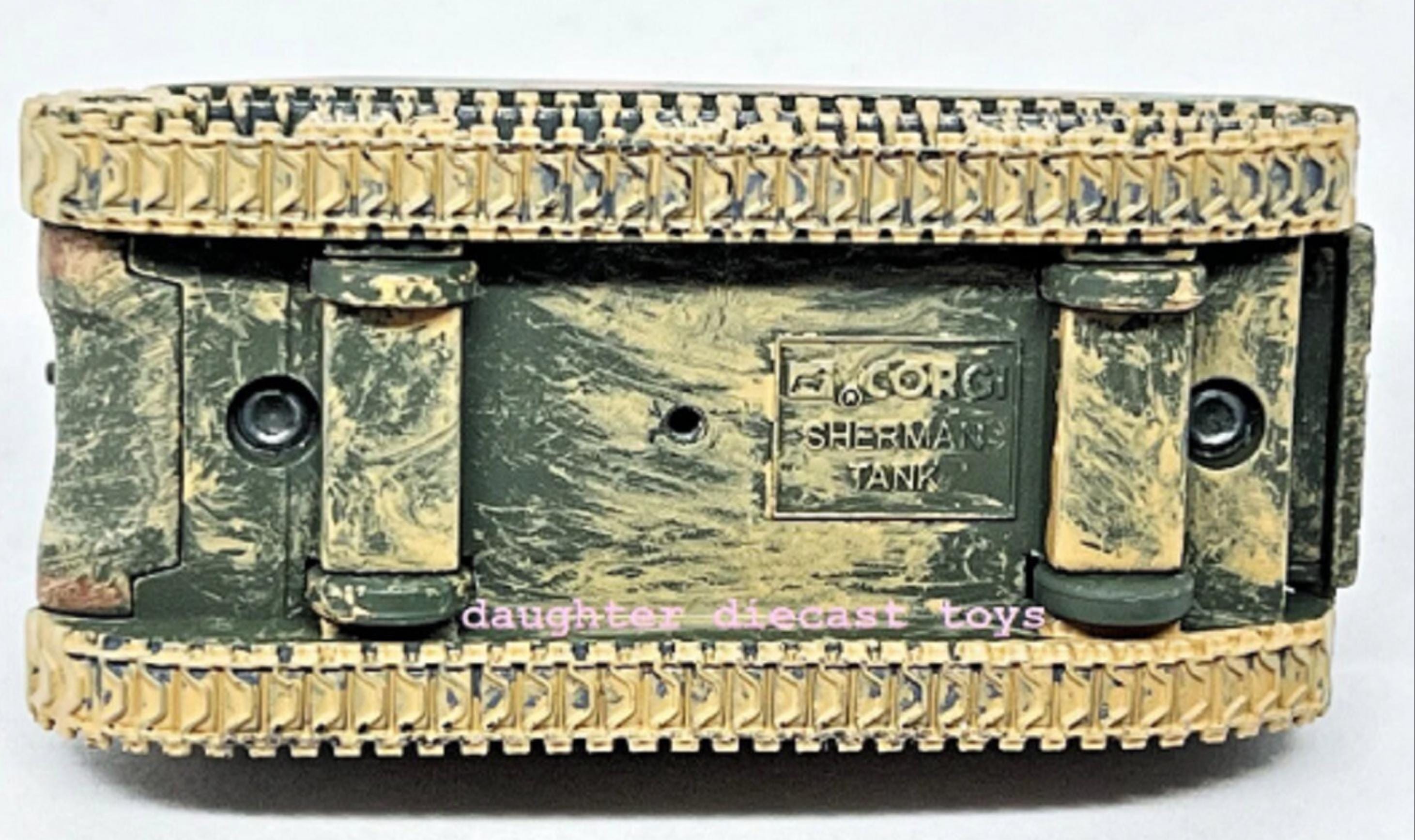

W.W.I.I. SHERMAN TANK -Adult Collector Model-Intricate Diecast Metal Replica-Pristine Condition! Perfect Gift for Military History Buffs!
$ 49.99

WWII SHERMAN TANK -Adult Collector Model-Intricate Diecast Metal
Replica-Pristine Condition! Perfect Gift for Military History Buffs!Awesome! WWII SHERMAN TANK. Intricately detailed Adult Collector Model. Weighty Diecast Metal Replica-Made by Corgi. Measures 3"L x 1 1/4"W x 1 3/8"H. Tank has rolling wheels and moveable gun turret. Pristine condition never handled or displayed (until today for our listing photos). Sold loose in collectors' bag. Perfect gift for vintage toy/tank collectors and Military history buffs! 100% happiness guaranteed. We ship fast & safe worldwide every day! Read car bio below....Note: My dad owned a Diecast toy store for 30 years. I inherited the store inventory when he passed away several years ago. I am (just now) able to bring myself to begin selling his cars-so they can be shared with the world. All pristine and mint condition vintage models will (eventually) be listed here on ETSY. All the inventory is NEW (vintage) merchandise-which was intended for retail sale. Please know-our diecast toys have NEVER been "played-with” we do not sell used, or damaged toys.
•
•
•FOR A LIMITED TIME
•
•
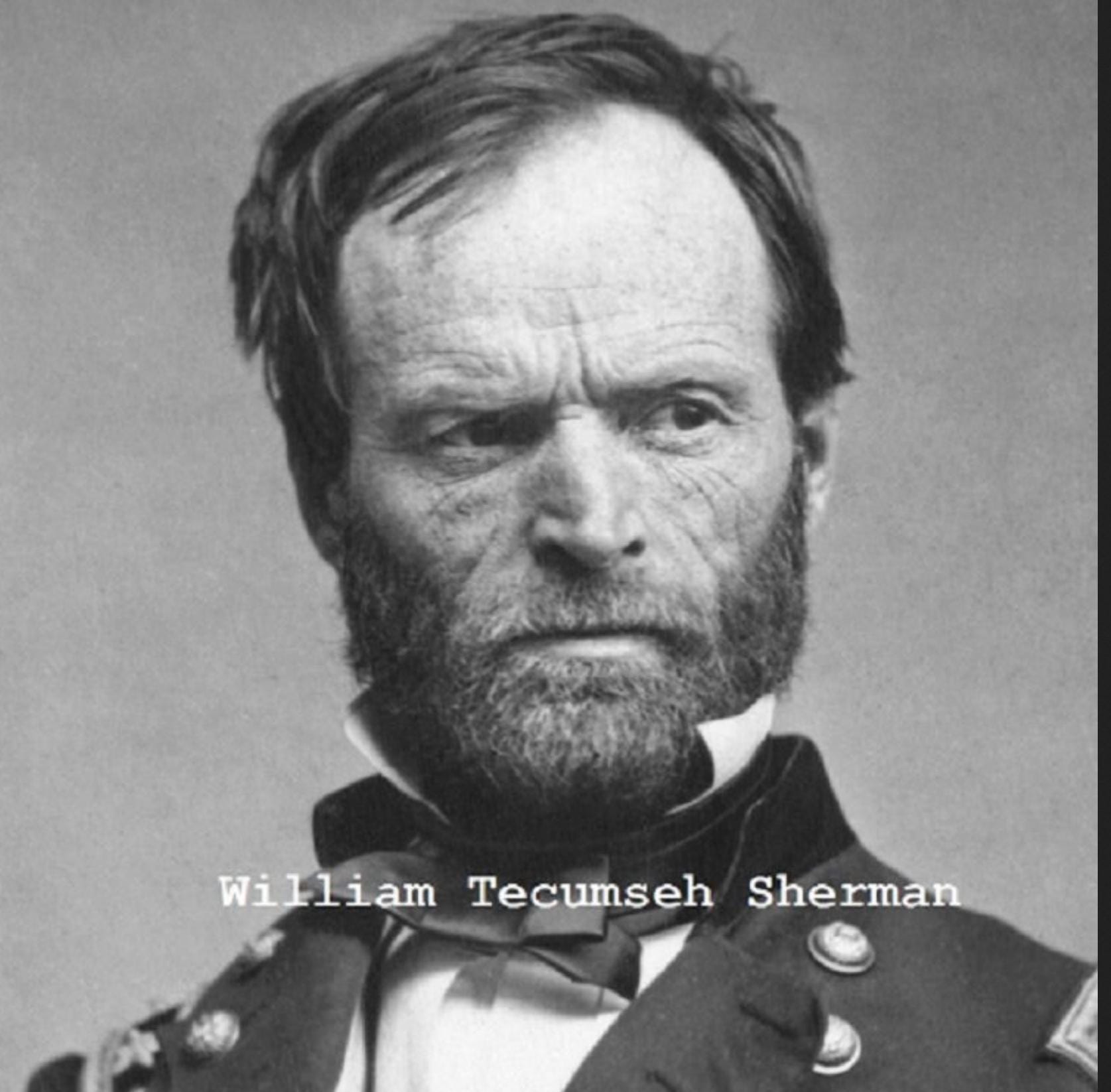
•Purchases totaling $35 and above qualify for FREE shipping to USA! Add more items to your Etsy shopping cart to save $$$.TANK BIO:The M4 Sherman, officially Medium Tank, M4, was the most widely used medium tank by the United States and Western Allies in World War II. The M4 Sherman proved to be reliable, relatively cheap to produce, and available in great numbers. It was also the basis of several other armored fighting vehicles including self-propelled artillery, tank destroyers, and armored recovery vehicles. Tens of thousands were distributed through the Lend-Lease program to the British Commonwealth and Soviet Union. The tank was named by the British after the American Civil War General William Tecumseh Sherman.[6]The M4 Sherman evolved from the M3 Medium Tank,[a] which – for speed of development – had its main armament in a side sponson mount. The M4 retained much of the previous mechanical design, but moved the main 75 mm gun into a fully traversing central turret. One feature, a one-axis gyrostabilizer, was not precise enough to allow firing when moving but did help keep the gun aimed in roughly the right direction for when the tank stopped to fire.[7] The designers stressed reliability, ease of production and maintenance, durability, standardization of parts and ammunition in a limited number of variants, and moderate size and weight (to facilitate shipping and for compatibility with existing bridging equipment size and weight limit restrictions.[8]). These factors, combined with Sherman's then-superior armor and armament, outclassed German light and medium tanks fielded in 1939–42. The M4 was the most-produced tank in American history, with 49,324 produced (including variants);[b] During World War II, the Sherman spearheaded many offensives by the Allies after 1942.When the M4 tank went into combat in North Africa with the British Army at the Second Battle of El Alamein in late 1942, it increased the advantage of Allied armor over Axis armor and was superior to the lighter German[10] and Italian tank designs. For this reason, the US Army believed that the M4 would be adequate to win the war, and relatively little pressure was initially exerted for further tank development. Logistical and transport restrictions, such as limitations imposed by roads, ports, and bridges, also complicated the introduction of a more capable but heavier tank.[11][c] Tank Destroyer battalions using vehicles built on the M4 hull and chassis, but with open-topped turrets and more potent high-velocity guns, also entered widespread use in the Allied armies. Even by 1944, most M4 Shermans kept their dual-purpose 75 mm gun.[12] By then, the M4 was inferior in firepower and armor to increasing numbers of German upgraded medium tanks and heavy tanks but was able to fight on with the help of considerable numerical superiority, greater mechanical reliability, better logistical support, and support from growing numbers of fighter-bombers and artillery pieces.[13] Some Shermans were produced with a more effective armor-piercing gun, the 76 mm gun M1, refitted with a 76.2 mm caliber Ordnance QF 17-pounder gun by the British (the Sherman Firefly), or given a 105 mm gun to act as infantry support vehicles.The relative ease of production allowed large numbers of the M4 to be manufactured, and significant investment in tank recovery and repair units allowed disabled vehicles to be repaired and returned to service quickly. These factors combined to give the Allies numerical superiority in most battles, and many infantry divisions were provided with M4s and tank destroyers. By 1944, a typical U.S. infantry division had attached for armor support an M4 Sherman battalion, a tank destroyer battalion, or both.[14]After World War II, the Sherman, particularly the many improved and upgraded versions, continued to see combat service in many conflicts around the world, including the UN forces in the Korean War, with Israel in the Arab–Israeli wars, briefly with South Vietnam in the Vietnam War, and on both sides of the Indo-Pakistani War of 1965.[15]First combatShermans were being issued in small numbers for familiarization to U.S. armored divisions when there was a turn of events in the Western Desert campaign. Axis forces had taken Tobruk and were advancing into Egypt and Britain's supply line through the Suez Canal was threatened. The US considered collecting all Shermans together to be able to send the 2nd Armored Division under Patton to reinforce Egypt, but delivering the Shermans directly to the British was quicker and over 300 – mostly M4A1s, but also including M4A2s – had arrived there by September 1942.[22][37]The Shermans were modified for desert warfare with shields over the tracks and another stowage. The Sherman first saw combat at the Second Battle of El Alamein in October 1942 with the British 8th Army. At the start of the offensive, there were 252 tanks fit for action. These equipped the British 9th Armoured Brigade (for the battle under the New Zealand Division), 2nd Armoured Brigade (1st Armoured Division), and 8th and 20th Armoured Brigades (10th Armoured Division). Their first encounter with tanks was against German Panzer III and IV tanks with long 50 mm and 75 mm guns engaging them at 2,000 yards (1,800 m). There were losses to both sides.[38]The first U.S. Shermans in battle were M4s and M4A1s in Operation Torch the following month. On 6 December, near Tebourba, Tunisia, a platoon from the 2nd Battalion, 13th Armored Regiment was lost to enemy tanks and anti-tank guns.[39]Additional M4s and M4A1s replaced M3s in U.S. tank battalions over the course of the North African campaign.The M4 and M4A1 were the main types in U.S. units until the fall of 1944 when the Army began replacing them with the preferred M4A3 with its more powerful 500 hp (370 kW) engine. Some M4s and M4A1s continued in U.S. service for the rest of the war. The first Sherman to enter combat with the 76 mm gun in July 1944 was the M4A1, then the M4A2, closely followed by the M4A3. By the end of the war, roughly half the U.S. Army Shermans in Europe had the 76 mm gun. The first HVSS-equipped Sherman to see combat was the M4A3(76)W in December 1944.[citation needed] Eastern FrontUnder Lend-Lease, 4,102 M4A2 medium tanks were sent to the Soviet Union. Of these, 2,007 were equipped with the original 75 mm main gun, with 2,095 mounting the more-capable 76 mm gun. The total number of Sherman tanks sent to the USSR under Lend-Lease represented 18.6% of all Lend-Lease Shermans.[40] The first 76 mm-armed M4A2 Shermans started to arrive in the Soviet Union in the late summer of 1944.[41]The Red Army considered the M4A2 to be much less prone to catch fire due to ammunition detonation than the T-34/76, but the M4A2 had a higher tendency to overturn in road accidents and collisions or because of rough terrain than the T-34 due to its higher center of gravity.[42]By 1945, some Red Army armored units were equipped entirely with the Sherman. Such units included the 1st Guards Mechanized Corps, the 3rd Guards Mechanized Corps and the 9th Guards Mechanized Corps, amongst others. According to Soviet tanker Dmitriy Loza, the Sherman was held in good regard and viewed positively by many Soviet tank crews, with compliments given to its reliability, ease of maintenance, generally good firepower (referring especially to the 76 mm gun version)[43] as well as an auxiliary power unit (APU) to keep the tank's batteries charged without having to run the main engine, as was required on the T-34. However, according to Soviet tank crews, the Sherman have some disadvantages, and the greatest of its weaknesses was its high center of gravity, cause the tank went over on its side, and easier to hit by enemy fires[44] The Sherman’s relatively narrow-set tracks struggled to negotiate mud terrain compared to the wider-set tracks of the T-34 or German Panther tank.[45] Pacific Theater A platoon of Sherman tanks of the 713th Tank Battalion gathered at a ridge on Okinawa. Chinese M4A4 Sherman of the Sino-American Provisional Tank Group in East BurmaWhile combat in the European theater often consisted of high-profile armored warfare, the mainly naval nature of the Pacific Theater of Operations (PTO) relegated it to secondary status for both the Allies and the Japanese. While the U.S. Army fielded 16 armored divisions and 70 separate tank battalions during the war, only a third of the battalions and none of the divisions were deployed to the Pacific Theater.[46] The Imperial Japanese Army (IJA) deployed only their 2nd Tank Division to the Pacific during the war.[47] Armor from both sides mostly operated in jungle terrain that was poorly suited to armored warfare. For this type of terrain, the Japanese and the Allies found light tanks easier to transport and employ.[48]During the early stages of combat in the Pacific, specifically, the Guadalcanal Campaign, the U.S. Marine Corps' M2A4 light tank fought against the equally-matched Type 95 Ha-Go light tank; both were armed with a 37 mm main gun. However, the M2 (produced in 1940) was newer by five years.[49] By 1943, the IJA still used the Type 95 and Type 97 Chi-Ha medium tanks, while Allied forces were quickly replacing their light tanks with 75 mm-armed M4s.[50] The Chinese in India received 100 M4 Shermans and used them to great effect in the subsequent 1944 and 1945 offensives in the China Burma India Theater.[citation needed] As part of Operation Dexterity, an M4A1 (75 mm) advances through a tropical rain forest on New Britain, in the South-West PacificTo counter the Sherman,[51] the Japanese developed the Type 3 Chi-Nu and the heavier Type 4 Chi-To; both tanks were armed with 75 mm guns, albeit of different type. Only 166 Type 3s and two Type 4s were built, and none saw combat; they were saved for the defense of the Japanese home islands, leaving 1930s era light and medium armor to do battle against 1940s built Allied light and medium armor.[citation needed]During the later years of the war, general purpose high explosive ammunition was preferred for fighting Japanese tanks because armor-piercing rounds, which had been designed for penetrating thicker steel, often went through the thin armor of the Type 95 Ha-Go (the most commonly encountered Japanese tank) and out the other side without stopping. Although the high-velocity guns of tank destroyers were useful for penetrating fortifications, M4s armed with flamethrowers were often deployed, as direct fire seldom destroyed Japanese fortifications.[52][53] Korean War Last type in US service: M4A3E8 Sherman used as artillery in firing position during the Korean WarDuring the Korean War, the M4A3E8 Easy Eight was the main tank force of the U.S. military until the signing of the armistice agreement. The tank was redesignated from M4A3(76)W HVSS to M4A3E8 after World War II.[54]At the outbreak of the war, the U.S. military tried to deploy the M4A3E8, a medium-sized tank of the same class, to respond to North Korean T-34-85, but there were few tanks available for rapid deployment from the Far East due to disarmament after World War II. The U.S. Far East Command collected 58 M4A3E8 scattered throughout Japan, created the 8072nd Temporary Tank Battalion (later renamed to the 89th Tank Battalion) on July 17 and landed them in Busan on August 1. The 8072nd Temporary Tank Battalion was immediately deployed for Battle of Masan to support the 25th U.S. Infantry Division.[54]Since then, a total of 679 M4A3E8 were deployed on the Korean Peninsula in 1950.[54] The M4A3E8 and T-34-85 were comparable and could destroy each other at normal combat ranges, although the use of High-Velocity Armor Piercing ammunition, advanced optics, and better crew training gave the Sherman an advantage.[55] The M4A3E8, using 76 mm HVAP ammunition, destroyed 41 enemy tanks from July to November 1950.[56]The M4A3E8 had weaker anti-tank combat capability compared to the larger caliber M26 Pershing and the M46 Patton that were operated at the same time. However, the lighter M4A3E8 became the preferred U.S. tank in the later phases of the war. It was considered more advantageous in terms of maneuverability on rough terrain and ease of maintenance due to the mechanical reliability. Because of this feature, the M4A3E8 were widely used for providing close support to infantry units, particularly during battles for high ground and mountains.[54]From December 1951, around 20 M4A3E8s saw service with the Republic of Korea Marine Corps during the war while the Army operated M36 GMCs as its main armored asset.[54] Other usesAfter World War II, the U.S. kept the M4A3E8 Easy Eight in service, with either the 76 mm gun or a 105 mm M4 howitzer. The U.S. Army replaced the M4 in 1957, in favor of the M47 Patton, M48 Patton and, M60 Patton. The U.S. continued to transfer Shermans to its allies, which contributed to widespread foreign use.[citation needed]
Replica-Pristine Condition! Perfect Gift for Military History Buffs!Awesome! WWII SHERMAN TANK. Intricately detailed Adult Collector Model. Weighty Diecast Metal Replica-Made by Corgi. Measures 3"L x 1 1/4"W x 1 3/8"H. Tank has rolling wheels and moveable gun turret. Pristine condition never handled or displayed (until today for our listing photos). Sold loose in collectors' bag. Perfect gift for vintage toy/tank collectors and Military history buffs! 100% happiness guaranteed. We ship fast & safe worldwide every day! Read car bio below....Note: My dad owned a Diecast toy store for 30 years. I inherited the store inventory when he passed away several years ago. I am (just now) able to bring myself to begin selling his cars-so they can be shared with the world. All pristine and mint condition vintage models will (eventually) be listed here on ETSY. All the inventory is NEW (vintage) merchandise-which was intended for retail sale. Please know-our diecast toys have NEVER been "played-with” we do not sell used, or damaged toys.
•
•
•FOR A LIMITED TIME
•
•
•Purchases totaling $35 and above qualify for FREE shipping to USA! Add more items to your Etsy shopping cart to save $$$.TANK BIO:The M4 Sherman, officially Medium Tank, M4, was the most widely used medium tank by the United States and Western Allies in World War II. The M4 Sherman proved to be reliable, relatively cheap to produce, and available in great numbers. It was also the basis of several other armored fighting vehicles including self-propelled artillery, tank destroyers, and armored recovery vehicles. Tens of thousands were distributed through the Lend-Lease program to the British Commonwealth and Soviet Union. The tank was named by the British after the American Civil War General William Tecumseh Sherman.[6]The M4 Sherman evolved from the M3 Medium Tank,[a] which – for speed of development – had its main armament in a side sponson mount. The M4 retained much of the previous mechanical design, but moved the main 75 mm gun into a fully traversing central turret. One feature, a one-axis gyrostabilizer, was not precise enough to allow firing when moving but did help keep the gun aimed in roughly the right direction for when the tank stopped to fire.[7] The designers stressed reliability, ease of production and maintenance, durability, standardization of parts and ammunition in a limited number of variants, and moderate size and weight (to facilitate shipping and for compatibility with existing bridging equipment size and weight limit restrictions.[8]). These factors, combined with Sherman's then-superior armor and armament, outclassed German light and medium tanks fielded in 1939–42. The M4 was the most-produced tank in American history, with 49,324 produced (including variants);[b] During World War II, the Sherman spearheaded many offensives by the Allies after 1942.When the M4 tank went into combat in North Africa with the British Army at the Second Battle of El Alamein in late 1942, it increased the advantage of Allied armor over Axis armor and was superior to the lighter German[10] and Italian tank designs. For this reason, the US Army believed that the M4 would be adequate to win the war, and relatively little pressure was initially exerted for further tank development. Logistical and transport restrictions, such as limitations imposed by roads, ports, and bridges, also complicated the introduction of a more capable but heavier tank.[11][c] Tank Destroyer battalions using vehicles built on the M4 hull and chassis, but with open-topped turrets and more potent high-velocity guns, also entered widespread use in the Allied armies. Even by 1944, most M4 Shermans kept their dual-purpose 75 mm gun.[12] By then, the M4 was inferior in firepower and armor to increasing numbers of German upgraded medium tanks and heavy tanks but was able to fight on with the help of considerable numerical superiority, greater mechanical reliability, better logistical support, and support from growing numbers of fighter-bombers and artillery pieces.[13] Some Shermans were produced with a more effective armor-piercing gun, the 76 mm gun M1, refitted with a 76.2 mm caliber Ordnance QF 17-pounder gun by the British (the Sherman Firefly), or given a 105 mm gun to act as infantry support vehicles.The relative ease of production allowed large numbers of the M4 to be manufactured, and significant investment in tank recovery and repair units allowed disabled vehicles to be repaired and returned to service quickly. These factors combined to give the Allies numerical superiority in most battles, and many infantry divisions were provided with M4s and tank destroyers. By 1944, a typical U.S. infantry division had attached for armor support an M4 Sherman battalion, a tank destroyer battalion, or both.[14]After World War II, the Sherman, particularly the many improved and upgraded versions, continued to see combat service in many conflicts around the world, including the UN forces in the Korean War, with Israel in the Arab–Israeli wars, briefly with South Vietnam in the Vietnam War, and on both sides of the Indo-Pakistani War of 1965.[15]First combatShermans were being issued in small numbers for familiarization to U.S. armored divisions when there was a turn of events in the Western Desert campaign. Axis forces had taken Tobruk and were advancing into Egypt and Britain's supply line through the Suez Canal was threatened. The US considered collecting all Shermans together to be able to send the 2nd Armored Division under Patton to reinforce Egypt, but delivering the Shermans directly to the British was quicker and over 300 – mostly M4A1s, but also including M4A2s – had arrived there by September 1942.[22][37]The Shermans were modified for desert warfare with shields over the tracks and another stowage. The Sherman first saw combat at the Second Battle of El Alamein in October 1942 with the British 8th Army. At the start of the offensive, there were 252 tanks fit for action. These equipped the British 9th Armoured Brigade (for the battle under the New Zealand Division), 2nd Armoured Brigade (1st Armoured Division), and 8th and 20th Armoured Brigades (10th Armoured Division). Their first encounter with tanks was against German Panzer III and IV tanks with long 50 mm and 75 mm guns engaging them at 2,000 yards (1,800 m). There were losses to both sides.[38]The first U.S. Shermans in battle were M4s and M4A1s in Operation Torch the following month. On 6 December, near Tebourba, Tunisia, a platoon from the 2nd Battalion, 13th Armored Regiment was lost to enemy tanks and anti-tank guns.[39]Additional M4s and M4A1s replaced M3s in U.S. tank battalions over the course of the North African campaign.The M4 and M4A1 were the main types in U.S. units until the fall of 1944 when the Army began replacing them with the preferred M4A3 with its more powerful 500 hp (370 kW) engine. Some M4s and M4A1s continued in U.S. service for the rest of the war. The first Sherman to enter combat with the 76 mm gun in July 1944 was the M4A1, then the M4A2, closely followed by the M4A3. By the end of the war, roughly half the U.S. Army Shermans in Europe had the 76 mm gun. The first HVSS-equipped Sherman to see combat was the M4A3(76)W in December 1944.[citation needed] Eastern FrontUnder Lend-Lease, 4,102 M4A2 medium tanks were sent to the Soviet Union. Of these, 2,007 were equipped with the original 75 mm main gun, with 2,095 mounting the more-capable 76 mm gun. The total number of Sherman tanks sent to the USSR under Lend-Lease represented 18.6% of all Lend-Lease Shermans.[40] The first 76 mm-armed M4A2 Shermans started to arrive in the Soviet Union in the late summer of 1944.[41]The Red Army considered the M4A2 to be much less prone to catch fire due to ammunition detonation than the T-34/76, but the M4A2 had a higher tendency to overturn in road accidents and collisions or because of rough terrain than the T-34 due to its higher center of gravity.[42]By 1945, some Red Army armored units were equipped entirely with the Sherman. Such units included the 1st Guards Mechanized Corps, the 3rd Guards Mechanized Corps and the 9th Guards Mechanized Corps, amongst others. According to Soviet tanker Dmitriy Loza, the Sherman was held in good regard and viewed positively by many Soviet tank crews, with compliments given to its reliability, ease of maintenance, generally good firepower (referring especially to the 76 mm gun version)[43] as well as an auxiliary power unit (APU) to keep the tank's batteries charged without having to run the main engine, as was required on the T-34. However, according to Soviet tank crews, the Sherman have some disadvantages, and the greatest of its weaknesses was its high center of gravity, cause the tank went over on its side, and easier to hit by enemy fires[44] The Sherman’s relatively narrow-set tracks struggled to negotiate mud terrain compared to the wider-set tracks of the T-34 or German Panther tank.[45] Pacific Theater A platoon of Sherman tanks of the 713th Tank Battalion gathered at a ridge on Okinawa. Chinese M4A4 Sherman of the Sino-American Provisional Tank Group in East BurmaWhile combat in the European theater often consisted of high-profile armored warfare, the mainly naval nature of the Pacific Theater of Operations (PTO) relegated it to secondary status for both the Allies and the Japanese. While the U.S. Army fielded 16 armored divisions and 70 separate tank battalions during the war, only a third of the battalions and none of the divisions were deployed to the Pacific Theater.[46] The Imperial Japanese Army (IJA) deployed only their 2nd Tank Division to the Pacific during the war.[47] Armor from both sides mostly operated in jungle terrain that was poorly suited to armored warfare. For this type of terrain, the Japanese and the Allies found light tanks easier to transport and employ.[48]During the early stages of combat in the Pacific, specifically, the Guadalcanal Campaign, the U.S. Marine Corps' M2A4 light tank fought against the equally-matched Type 95 Ha-Go light tank; both were armed with a 37 mm main gun. However, the M2 (produced in 1940) was newer by five years.[49] By 1943, the IJA still used the Type 95 and Type 97 Chi-Ha medium tanks, while Allied forces were quickly replacing their light tanks with 75 mm-armed M4s.[50] The Chinese in India received 100 M4 Shermans and used them to great effect in the subsequent 1944 and 1945 offensives in the China Burma India Theater.[citation needed] As part of Operation Dexterity, an M4A1 (75 mm) advances through a tropical rain forest on New Britain, in the South-West PacificTo counter the Sherman,[51] the Japanese developed the Type 3 Chi-Nu and the heavier Type 4 Chi-To; both tanks were armed with 75 mm guns, albeit of different type. Only 166 Type 3s and two Type 4s were built, and none saw combat; they were saved for the defense of the Japanese home islands, leaving 1930s era light and medium armor to do battle against 1940s built Allied light and medium armor.[citation needed]During the later years of the war, general purpose high explosive ammunition was preferred for fighting Japanese tanks because armor-piercing rounds, which had been designed for penetrating thicker steel, often went through the thin armor of the Type 95 Ha-Go (the most commonly encountered Japanese tank) and out the other side without stopping. Although the high-velocity guns of tank destroyers were useful for penetrating fortifications, M4s armed with flamethrowers were often deployed, as direct fire seldom destroyed Japanese fortifications.[52][53] Korean War Last type in US service: M4A3E8 Sherman used as artillery in firing position during the Korean WarDuring the Korean War, the M4A3E8 Easy Eight was the main tank force of the U.S. military until the signing of the armistice agreement. The tank was redesignated from M4A3(76)W HVSS to M4A3E8 after World War II.[54]At the outbreak of the war, the U.S. military tried to deploy the M4A3E8, a medium-sized tank of the same class, to respond to North Korean T-34-85, but there were few tanks available for rapid deployment from the Far East due to disarmament after World War II. The U.S. Far East Command collected 58 M4A3E8 scattered throughout Japan, created the 8072nd Temporary Tank Battalion (later renamed to the 89th Tank Battalion) on July 17 and landed them in Busan on August 1. The 8072nd Temporary Tank Battalion was immediately deployed for Battle of Masan to support the 25th U.S. Infantry Division.[54]Since then, a total of 679 M4A3E8 were deployed on the Korean Peninsula in 1950.[54] The M4A3E8 and T-34-85 were comparable and could destroy each other at normal combat ranges, although the use of High-Velocity Armor Piercing ammunition, advanced optics, and better crew training gave the Sherman an advantage.[55] The M4A3E8, using 76 mm HVAP ammunition, destroyed 41 enemy tanks from July to November 1950.[56]The M4A3E8 had weaker anti-tank combat capability compared to the larger caliber M26 Pershing and the M46 Patton that were operated at the same time. However, the lighter M4A3E8 became the preferred U.S. tank in the later phases of the war. It was considered more advantageous in terms of maneuverability on rough terrain and ease of maintenance due to the mechanical reliability. Because of this feature, the M4A3E8 were widely used for providing close support to infantry units, particularly during battles for high ground and mountains.[54]From December 1951, around 20 M4A3E8s saw service with the Republic of Korea Marine Corps during the war while the Army operated M36 GMCs as its main armored asset.[54] Other usesAfter World War II, the U.S. kept the M4A3E8 Easy Eight in service, with either the 76 mm gun or a 105 mm M4 howitzer. The U.S. Army replaced the M4 in 1957, in favor of the M47 Patton, M48 Patton and, M60 Patton. The U.S. continued to transfer Shermans to its allies, which contributed to widespread foreign use.[citation needed]
Altri Prodotti