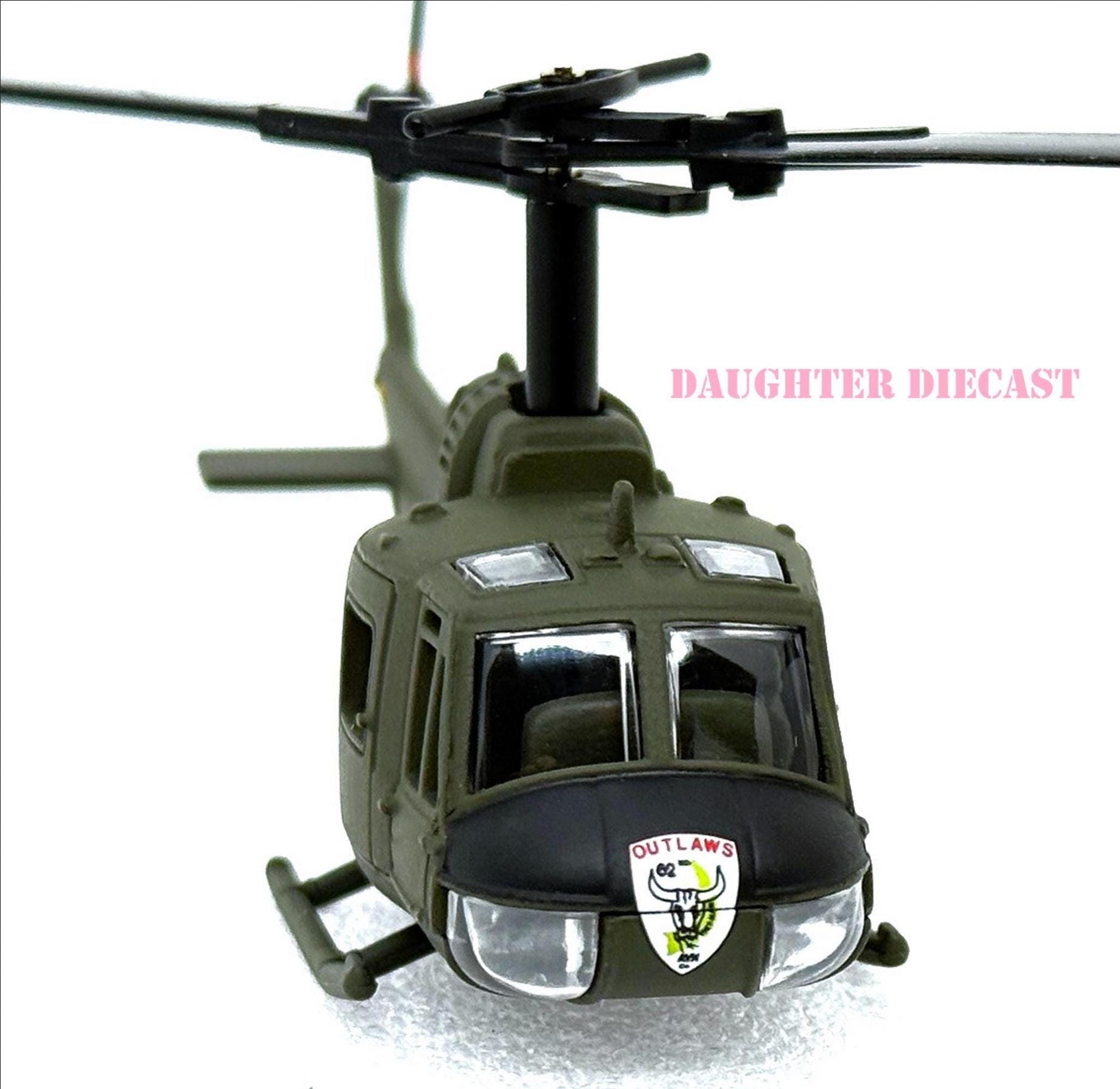
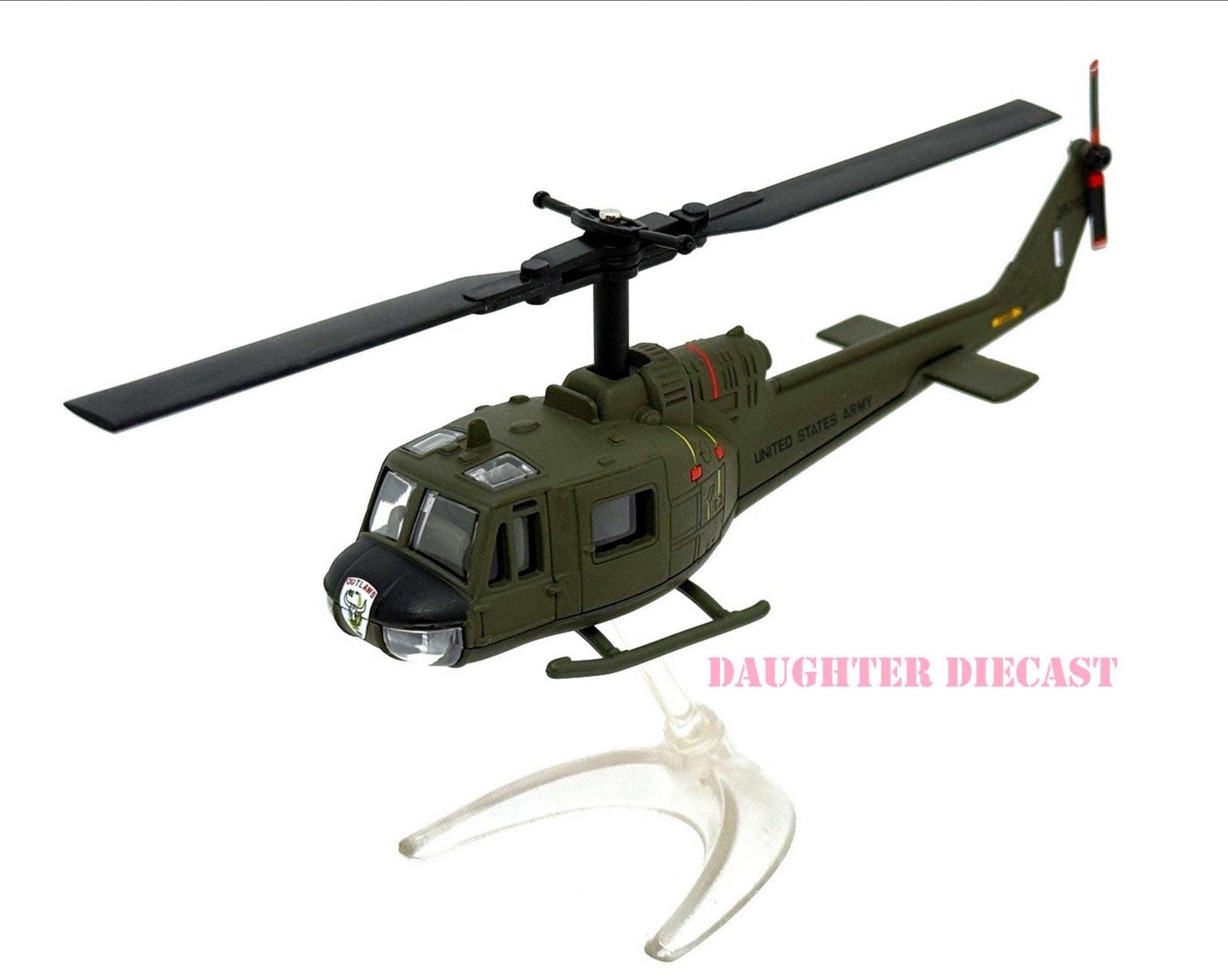
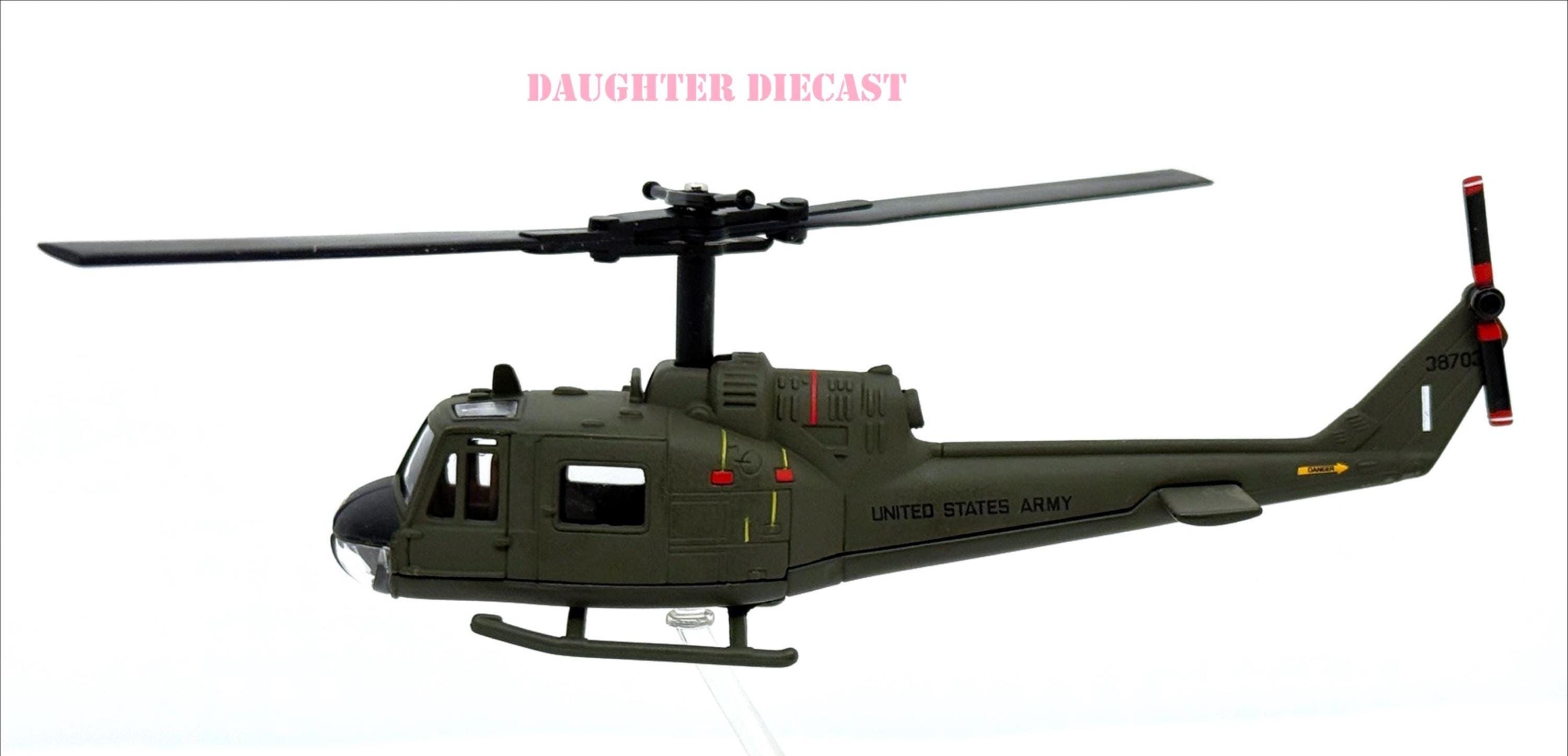
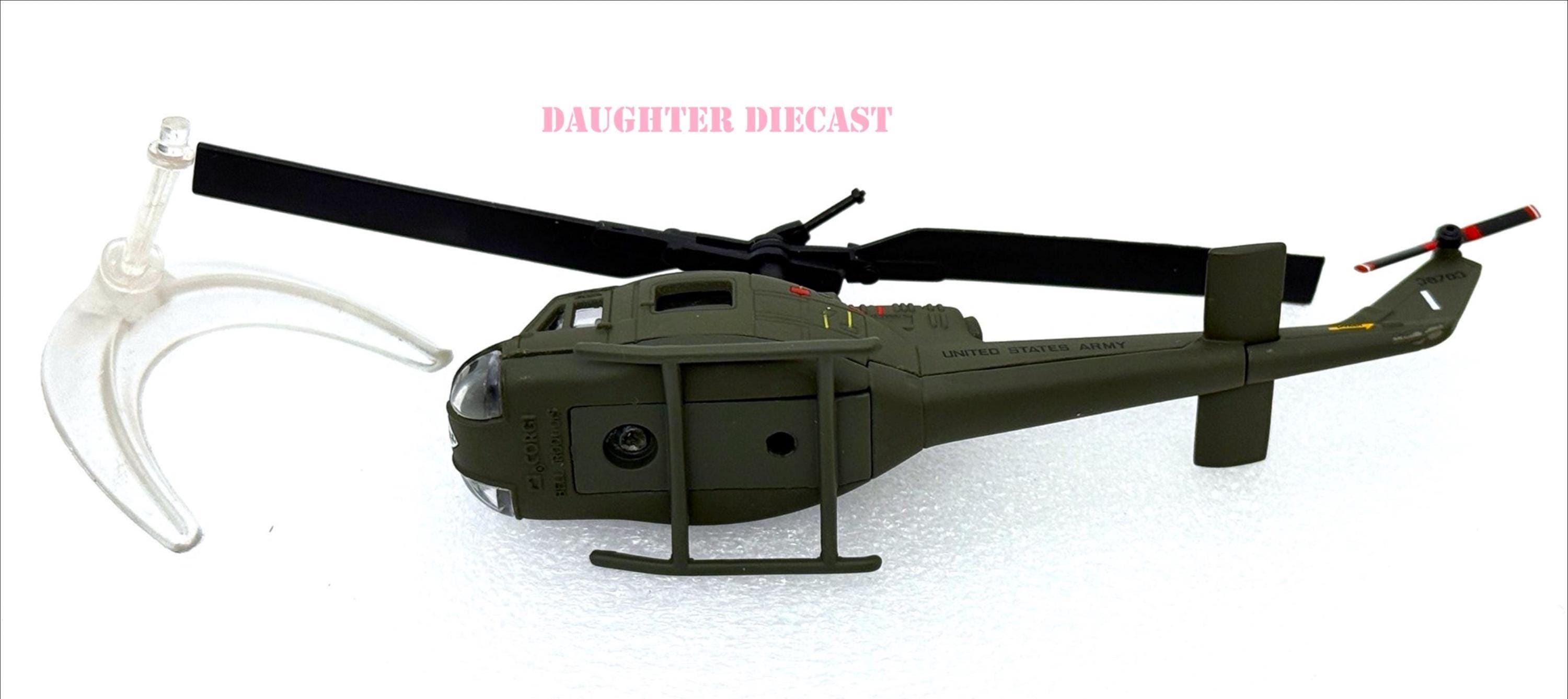

U.S. ARMY "HUEY" HELICOPTER-Outlaws Squadron-Adult Collector Diecast Metal-w/Stand-Pristine Condition/Corgi-Perfect Gift for Collectors!
$ 49.99

U.S. ARMY OUTLAWS SQUADRON "HUEY" UH-IB IRIQUOIS VIETNAM ERA HELICOPTER-Adult
Collector Diecast Metal-w/Stand-Pristine Condition/Corgi-Perfect Gift for Collectors!Bad Ass Gunship! U.S. ARMY "HUEY" UH-IB-VIETNAM ERA HELICOPTER. Weighty, constructed of diecast metal. Intricately-detailed, Adult Collector-made by Corgi. Paint depicts the aircraft as it appeared in use during the Vietnam War. Hard to find vintage model! Desktop display model-comes with (easy to set up) stand.Scale=1/72, measures 5"L x 1 1/4"W x 3"H (mounted), Rotor/blades measure 5 1/2" in diameter. Pristine condition model-never previously handled or displayed (until today for our photos). Sold loose in collectors bag with stand. The perfect gift for aviation history fans, vintage toy collectors, and veterans. We ship fast & safe worldwide every day. See Aircraft Bio below....Note: My dad owned a Diecast toy store for 30 years. I inherited the store inventory when he passed away several years ago. I am (just now) able to bring myself to begin selling his cars-so they can be shared with the world. All pristine and mint condition vintage models will (eventually) be listed here on ETSY. All the inventory is NEW (vintage) merchandise-which was intended for retail sale. Please know-our diecast toys have NEVER been "played-with” we do not sell used, or damaged toys.
•
•
•FOR A LIMITED TIME
•
•
•Purchases totaling $35 and above qualify for FREE shipping to USA! Add more items to your Etsy shopping cart to save $$$.AIRCRAFT BIO:A Bell UH-1B Iroquois Role Utility helicopter National origin United States Manufacturer Bell Helicopter First flight 20 October 1956 (XH-40) Introduction 1959 Status In service Primary users United States Army (historical) Japan Ground Self-Defense Force Australian Army (historical) See Operators section for others Produced 1956–1987 Number built >16,000 Variants Bell UH-1N Twin Huey Bell 204/205 Bell 212 Developed into Bell AH-1 Cobra Bell 214The Bell UH-1 Iroquois (nicknamed "Huey") is a utility military helicopter designed and produced by the American aerospace company Bell Helicopter. It is the first member of the prolific Huey family, as well as the first turbine-powered helicopter in service with the United States military.Development of the Iroquois started in the early 1950s, a major impetus being a requirement issued by the United States Army for a new medical evacuation and utility helicopter. The Bell 204, first flown on 20 October 1956, was warmly received, particularly for the performance of its single turboshaft engine over piston engine-powered counterparts. An initial production contract for 100 HU-1As was issued in March 1960. In response to criticisms over the rotorcraft's power, Bell quickly developed multiple models furnished with more powerful engines; in comparison to the prototype's Lycoming YT53-L-1 (LTC1B-1) engine, producing 700 shp (520 kW), by 1966, the Lycoming T53-L-13, capable of 1,400 shp (1,000 kW), was being installed on some models. A stretched version of the Iroquois, first flown during August 1961, was also produced in response to Army demands for a version than could accommodate more troops. Further modifications would include the use of all-aluminium construction, the adoption of a rotor brake, and alternative powerplants.The Iroquois was first used in combat operations during the Vietnam War, the first examples being deployed in March 1962. It was used for various purposes, conducting general support, air assault, cargo transport, aeromedical evacuation, search and rescue, electronic warfare, and ground attack missions. Armed Iroquois gunships carried a variety of weapons, including rockets, grenade launchers, and machine guns, and were often modified in the field to suit specific operations. The United States Air Force also deployed its Iroquois to Vietnam, using them to conduct reconnaissance operations, psychological warfare, and other support roles. Other nations' armed air services, such as the Royal Australian Air Force, also dispatched their own Iroquois to Vietnam. In total, around 7,000 Iroquois were deployed in the Vietnam theatre, over 3,300 of which were believed to be destroyed. Various other conflicts have seen combat deployments of the Iroquois, such as the Rhodesian Bush War, Falklands War, War in Afghanistan, and the 2007 Lebanon conflict.The Iroquois was originally designated HU-1, hence the Huey nickname, which has remained in common use, despite the official redesignation to UH-1 in 1962.[1] Various derivatives and developments of the Iroquois were produced. A dedicated attack helicopter, the Bell AH-1 Cobra, was derived from the UH-1, and retained a high degree of commonality. The Bell 204 and 205 are Iroquois versions developed for the civilian market. In response to demands from some customers, a twin-engined model, the UH-1N Twin Huey, was also developed during the late 1960s; a four-bladed derivative, the Bell UH-1Y Venom, was also developed during the early twenty-first century. In US Army service, the Iroquois was gradually phased out following the introduction of the Sikorsky UH-60 Black Hawk and the Eurocopter UH-72 Lakota, although hundreds were still in use more than 50 years following the type's introduction. In excess of 16,000 Iroquois have been built since 1960.[2]Operational history U.S. Army UH-1Ds airlift members of the 2nd Battalion, 14th Infantry Regiment from the Filhol Rubber Plantation area to a staging area in 1966.The HU-1A (later redesignated UH-1A) first entered service with the 101st Airborne Division at Fort Campbell, Kentucky, the 82nd Airborne Division, and the 57th Medical Detachment. Although intended for evaluation only, the Army quickly pressed the new helicopter into operational service, and Hueys with the 57th Medical Detachment arrived in Vietnam in March 1962.[14][4] The UH-1 has long been a symbol of US involvement in Southeast Asia in general and Vietnam in particular, and as a result of that conflict, has become one of the world's most recognized helicopters. In Vietnam primary missions included general support, air assault, cargo transport, aeromedical evacuation, search and rescue, electronic warfare, and later, ground attack. During the conflict, the craft was upgraded, notably to a larger version based on the Model 205. This version was initially designated the UH-1D and flew operationally from 1963.[citation needed]During its Vietnam War service, the UH-1 was used for various purposes and various terms for each task abounded. UH-1s tasked with ground attack or armed escort were outfitted with rocket launchers, grenade launchers, and machine guns. As early as 1962, UH-1s were modified locally by the companies themselves, who fabricated their own mounting systems.[24] These gunship UH-1s were commonly referred to as "Frogs" or "Hogs" if they carried rockets, and "Cobras" or simply "Guns" if they had guns.[25][26][N 4][27] UH-1s tasked and configured for troop transport were often called "Slicks" due to an absence of weapons pods. Slicks did have door gunners, but were generally employed in the troop transport and medevac roles.[9][14] A rifle squad from the 1st Squadron, 9th Cavalry exiting from a UH-1D.UH-1s also flew "hunter-killer" teams with observation helicopters, namely the Bell OH-58A Kiowa and the Hughes OH-6 Cayuse (Loach).[9][14] Towards the end of the conflict, the UH-1 was tested with TOW missiles, and two UH-1B helicopters equipped with the XM26 Armament Subsystem were deployed to help counter the 1972 Easter Invasion.[28] USAF Lieutenant James P. Fleming piloted a UH-1F on a 26 November 1968 mission that earned him the Medal of Honor.[29]During the course of the conflict, the UH-1 went through several upgrades. The UH-1A, B, and C models (short fuselage, Bell 204) and the UH-1D and H models (stretched-fuselage, Bell 205) each had improved performance and load-carrying capabilities. The UH-1B and C performed the gunship, and some of the transport, duties in the early years of the Vietnam War. UH-1B/C gunships were replaced by the new AH-1 Cobra attack helicopter from 1967 to late 1968. The increasing intensity and sophistication of NVA anti-aircraft defenses made continued use of UH-1 gunships impractical, and after Vietnam the Cobra was adopted as the Army's main attack helicopter. Devotees of the UH-1 in the gunship role cite its ability to act as an impromptu Dustoff if the need arose, as well as the superior observational capabilities of the larger Huey cockpit, which allowed return fire from door gunners to the rear and sides of the aircraft.[9][14] In air cavalry troops (i.e., companies) UH-1s were combined with infantry scouts, OH-6 and OH-58 aero-scout helicopters, and AH-1 attack helicopters to form several color-coded teams (viz., blue, white, red, purple, and pink) to perform various reconnaissance, security, and "economy of force" missions in fulfilling the traditional cavalry battlefield role.[citation needed] Two UH-1B gunships from HAL-3 "Seawolf" sit on the deck of USS Garrett County in Mekong Delta, South Vietnam.The Army tested a great variety of experimental weapons on the UH-1; nearly anything that could be carried. The Army desired weapons with large calibers and high rates of fire, which led to the testing of a 20 mm cannon on a large mount bolted to the cabin floor. The size of the weapon allowed very little room for movement. The Army further tested a full-size Vulcan cannon firing out the door of a UH-1. It was capable of firing 2400 rounds per minute, or about 40 rounds per second. Despite this being a significant reduction from the nearly 100 rounds per second fired by a standard Vulcan cannon, the installation proved "too kinetic" for the UH-1. Podded versions of the M24 20 mm cannon were tested in combat over Vietnam. There was a wide variety of 7.62 mm automatic weapons tested, including different installations of the M60 machine gun. AS-10 and SS-11 missiles were tested in several different configurations. High-capacity rocket launchers were also tested, such as the XM3 launcher, which had 24 launching tubes. Press photos were taken with the XM5 and XM3 installed on the same aircraft, but this arrangement could not be used because it was more than the gross take-off weight of the aircraft.[30]During the Easter Offensive of 1972 by North Vietnam, experimental models of the TOW-firing XM26 were taken out of storage and sent to South Vietnam in response to the onslaught. The pilots had never fired a TOW missile before, and were given brief crash courses. Despite having little training with the units, the pilots managed to hit targets with 151 of the 162 missiles fired in combat, including a pair of tanks. The airborne TOW launchers were known as "Hawks Claws" and were based at Camp Holloway.[30] During the conflict, 7,013 UH-1s served in Vietnam and of these 3,305 were destroyed. In total, 1,151 pilots were killed, along with 1,231 other crew members (these figures are not including Army of the Republic of Vietnam losses).[31][4]Post Vietnam, the US Army continued to operate large numbers of Iroquois; they would see further combat during the US invasion of Grenada in 1983, the US invasion of Panama in 1989, and the Gulf War in 1991.[4] In the latter conflict, in excess of 400 Iroquois performed a variety of missions in the region; over a nine-month period, the fleet cumulatively reached 31,000 flight hours and achieved a stable fully mission capable rate of 70%. The type comprised more than 20% of all rotorcraft across the coalition and recorded 21% of the overall flying hours.[4] Even after the Gulf War, the US Army had more than 2,800 Iroquois in its inventory; in particular, 389 UH-1Vs comprised 76% of the Army's medevac aircraft. Nevertheless, plans were mooted as early as 1992 to undertake a slow withdrawal of the aging type in favour of larger and more technologically advanced rotorcraft.[4]
Collector Diecast Metal-w/Stand-Pristine Condition/Corgi-Perfect Gift for Collectors!Bad Ass Gunship! U.S. ARMY "HUEY" UH-IB-VIETNAM ERA HELICOPTER. Weighty, constructed of diecast metal. Intricately-detailed, Adult Collector-made by Corgi. Paint depicts the aircraft as it appeared in use during the Vietnam War. Hard to find vintage model! Desktop display model-comes with (easy to set up) stand.Scale=1/72, measures 5"L x 1 1/4"W x 3"H (mounted), Rotor/blades measure 5 1/2" in diameter. Pristine condition model-never previously handled or displayed (until today for our photos). Sold loose in collectors bag with stand. The perfect gift for aviation history fans, vintage toy collectors, and veterans. We ship fast & safe worldwide every day. See Aircraft Bio below....Note: My dad owned a Diecast toy store for 30 years. I inherited the store inventory when he passed away several years ago. I am (just now) able to bring myself to begin selling his cars-so they can be shared with the world. All pristine and mint condition vintage models will (eventually) be listed here on ETSY. All the inventory is NEW (vintage) merchandise-which was intended for retail sale. Please know-our diecast toys have NEVER been "played-with” we do not sell used, or damaged toys.
•
•
•FOR A LIMITED TIME
•
•
•Purchases totaling $35 and above qualify for FREE shipping to USA! Add more items to your Etsy shopping cart to save $$$.AIRCRAFT BIO:A Bell UH-1B Iroquois Role Utility helicopter National origin United States Manufacturer Bell Helicopter First flight 20 October 1956 (XH-40) Introduction 1959 Status In service Primary users United States Army (historical) Japan Ground Self-Defense Force Australian Army (historical) See Operators section for others Produced 1956–1987 Number built >16,000 Variants Bell UH-1N Twin Huey Bell 204/205 Bell 212 Developed into Bell AH-1 Cobra Bell 214The Bell UH-1 Iroquois (nicknamed "Huey") is a utility military helicopter designed and produced by the American aerospace company Bell Helicopter. It is the first member of the prolific Huey family, as well as the first turbine-powered helicopter in service with the United States military.Development of the Iroquois started in the early 1950s, a major impetus being a requirement issued by the United States Army for a new medical evacuation and utility helicopter. The Bell 204, first flown on 20 October 1956, was warmly received, particularly for the performance of its single turboshaft engine over piston engine-powered counterparts. An initial production contract for 100 HU-1As was issued in March 1960. In response to criticisms over the rotorcraft's power, Bell quickly developed multiple models furnished with more powerful engines; in comparison to the prototype's Lycoming YT53-L-1 (LTC1B-1) engine, producing 700 shp (520 kW), by 1966, the Lycoming T53-L-13, capable of 1,400 shp (1,000 kW), was being installed on some models. A stretched version of the Iroquois, first flown during August 1961, was also produced in response to Army demands for a version than could accommodate more troops. Further modifications would include the use of all-aluminium construction, the adoption of a rotor brake, and alternative powerplants.The Iroquois was first used in combat operations during the Vietnam War, the first examples being deployed in March 1962. It was used for various purposes, conducting general support, air assault, cargo transport, aeromedical evacuation, search and rescue, electronic warfare, and ground attack missions. Armed Iroquois gunships carried a variety of weapons, including rockets, grenade launchers, and machine guns, and were often modified in the field to suit specific operations. The United States Air Force also deployed its Iroquois to Vietnam, using them to conduct reconnaissance operations, psychological warfare, and other support roles. Other nations' armed air services, such as the Royal Australian Air Force, also dispatched their own Iroquois to Vietnam. In total, around 7,000 Iroquois were deployed in the Vietnam theatre, over 3,300 of which were believed to be destroyed. Various other conflicts have seen combat deployments of the Iroquois, such as the Rhodesian Bush War, Falklands War, War in Afghanistan, and the 2007 Lebanon conflict.The Iroquois was originally designated HU-1, hence the Huey nickname, which has remained in common use, despite the official redesignation to UH-1 in 1962.[1] Various derivatives and developments of the Iroquois were produced. A dedicated attack helicopter, the Bell AH-1 Cobra, was derived from the UH-1, and retained a high degree of commonality. The Bell 204 and 205 are Iroquois versions developed for the civilian market. In response to demands from some customers, a twin-engined model, the UH-1N Twin Huey, was also developed during the late 1960s; a four-bladed derivative, the Bell UH-1Y Venom, was also developed during the early twenty-first century. In US Army service, the Iroquois was gradually phased out following the introduction of the Sikorsky UH-60 Black Hawk and the Eurocopter UH-72 Lakota, although hundreds were still in use more than 50 years following the type's introduction. In excess of 16,000 Iroquois have been built since 1960.[2]Operational history U.S. Army UH-1Ds airlift members of the 2nd Battalion, 14th Infantry Regiment from the Filhol Rubber Plantation area to a staging area in 1966.The HU-1A (later redesignated UH-1A) first entered service with the 101st Airborne Division at Fort Campbell, Kentucky, the 82nd Airborne Division, and the 57th Medical Detachment. Although intended for evaluation only, the Army quickly pressed the new helicopter into operational service, and Hueys with the 57th Medical Detachment arrived in Vietnam in March 1962.[14][4] The UH-1 has long been a symbol of US involvement in Southeast Asia in general and Vietnam in particular, and as a result of that conflict, has become one of the world's most recognized helicopters. In Vietnam primary missions included general support, air assault, cargo transport, aeromedical evacuation, search and rescue, electronic warfare, and later, ground attack. During the conflict, the craft was upgraded, notably to a larger version based on the Model 205. This version was initially designated the UH-1D and flew operationally from 1963.[citation needed]During its Vietnam War service, the UH-1 was used for various purposes and various terms for each task abounded. UH-1s tasked with ground attack or armed escort were outfitted with rocket launchers, grenade launchers, and machine guns. As early as 1962, UH-1s were modified locally by the companies themselves, who fabricated their own mounting systems.[24] These gunship UH-1s were commonly referred to as "Frogs" or "Hogs" if they carried rockets, and "Cobras" or simply "Guns" if they had guns.[25][26][N 4][27] UH-1s tasked and configured for troop transport were often called "Slicks" due to an absence of weapons pods. Slicks did have door gunners, but were generally employed in the troop transport and medevac roles.[9][14] A rifle squad from the 1st Squadron, 9th Cavalry exiting from a UH-1D.UH-1s also flew "hunter-killer" teams with observation helicopters, namely the Bell OH-58A Kiowa and the Hughes OH-6 Cayuse (Loach).[9][14] Towards the end of the conflict, the UH-1 was tested with TOW missiles, and two UH-1B helicopters equipped with the XM26 Armament Subsystem were deployed to help counter the 1972 Easter Invasion.[28] USAF Lieutenant James P. Fleming piloted a UH-1F on a 26 November 1968 mission that earned him the Medal of Honor.[29]During the course of the conflict, the UH-1 went through several upgrades. The UH-1A, B, and C models (short fuselage, Bell 204) and the UH-1D and H models (stretched-fuselage, Bell 205) each had improved performance and load-carrying capabilities. The UH-1B and C performed the gunship, and some of the transport, duties in the early years of the Vietnam War. UH-1B/C gunships were replaced by the new AH-1 Cobra attack helicopter from 1967 to late 1968. The increasing intensity and sophistication of NVA anti-aircraft defenses made continued use of UH-1 gunships impractical, and after Vietnam the Cobra was adopted as the Army's main attack helicopter. Devotees of the UH-1 in the gunship role cite its ability to act as an impromptu Dustoff if the need arose, as well as the superior observational capabilities of the larger Huey cockpit, which allowed return fire from door gunners to the rear and sides of the aircraft.[9][14] In air cavalry troops (i.e., companies) UH-1s were combined with infantry scouts, OH-6 and OH-58 aero-scout helicopters, and AH-1 attack helicopters to form several color-coded teams (viz., blue, white, red, purple, and pink) to perform various reconnaissance, security, and "economy of force" missions in fulfilling the traditional cavalry battlefield role.[citation needed] Two UH-1B gunships from HAL-3 "Seawolf" sit on the deck of USS Garrett County in Mekong Delta, South Vietnam.The Army tested a great variety of experimental weapons on the UH-1; nearly anything that could be carried. The Army desired weapons with large calibers and high rates of fire, which led to the testing of a 20 mm cannon on a large mount bolted to the cabin floor. The size of the weapon allowed very little room for movement. The Army further tested a full-size Vulcan cannon firing out the door of a UH-1. It was capable of firing 2400 rounds per minute, or about 40 rounds per second. Despite this being a significant reduction from the nearly 100 rounds per second fired by a standard Vulcan cannon, the installation proved "too kinetic" for the UH-1. Podded versions of the M24 20 mm cannon were tested in combat over Vietnam. There was a wide variety of 7.62 mm automatic weapons tested, including different installations of the M60 machine gun. AS-10 and SS-11 missiles were tested in several different configurations. High-capacity rocket launchers were also tested, such as the XM3 launcher, which had 24 launching tubes. Press photos were taken with the XM5 and XM3 installed on the same aircraft, but this arrangement could not be used because it was more than the gross take-off weight of the aircraft.[30]During the Easter Offensive of 1972 by North Vietnam, experimental models of the TOW-firing XM26 were taken out of storage and sent to South Vietnam in response to the onslaught. The pilots had never fired a TOW missile before, and were given brief crash courses. Despite having little training with the units, the pilots managed to hit targets with 151 of the 162 missiles fired in combat, including a pair of tanks. The airborne TOW launchers were known as "Hawks Claws" and were based at Camp Holloway.[30] During the conflict, 7,013 UH-1s served in Vietnam and of these 3,305 were destroyed. In total, 1,151 pilots were killed, along with 1,231 other crew members (these figures are not including Army of the Republic of Vietnam losses).[31][4]Post Vietnam, the US Army continued to operate large numbers of Iroquois; they would see further combat during the US invasion of Grenada in 1983, the US invasion of Panama in 1989, and the Gulf War in 1991.[4] In the latter conflict, in excess of 400 Iroquois performed a variety of missions in the region; over a nine-month period, the fleet cumulatively reached 31,000 flight hours and achieved a stable fully mission capable rate of 70%. The type comprised more than 20% of all rotorcraft across the coalition and recorded 21% of the overall flying hours.[4] Even after the Gulf War, the US Army had more than 2,800 Iroquois in its inventory; in particular, 389 UH-1Vs comprised 76% of the Army's medevac aircraft. Nevertheless, plans were mooted as early as 1992 to undertake a slow withdrawal of the aging type in favour of larger and more technologically advanced rotorcraft.[4]
Other Products