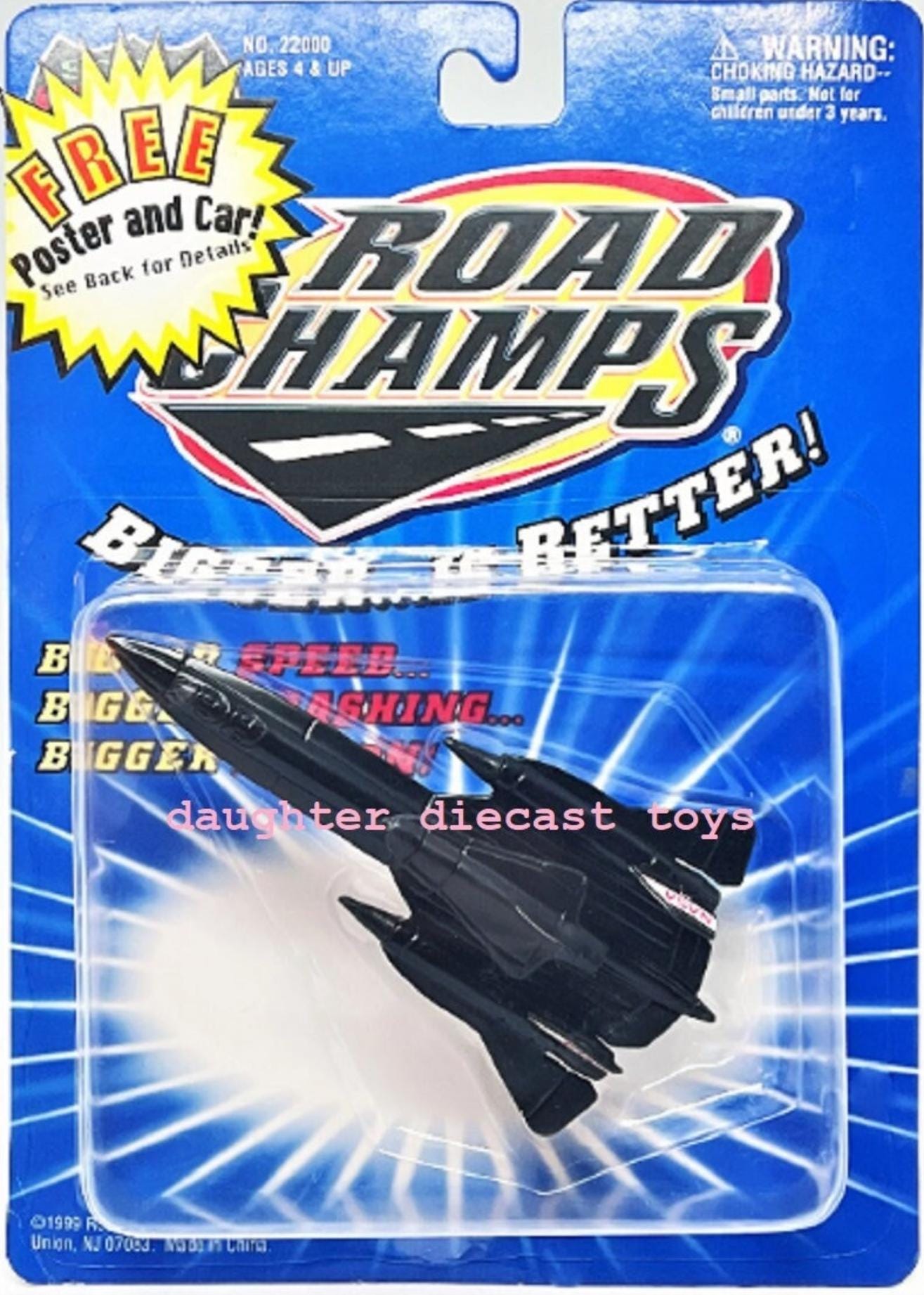
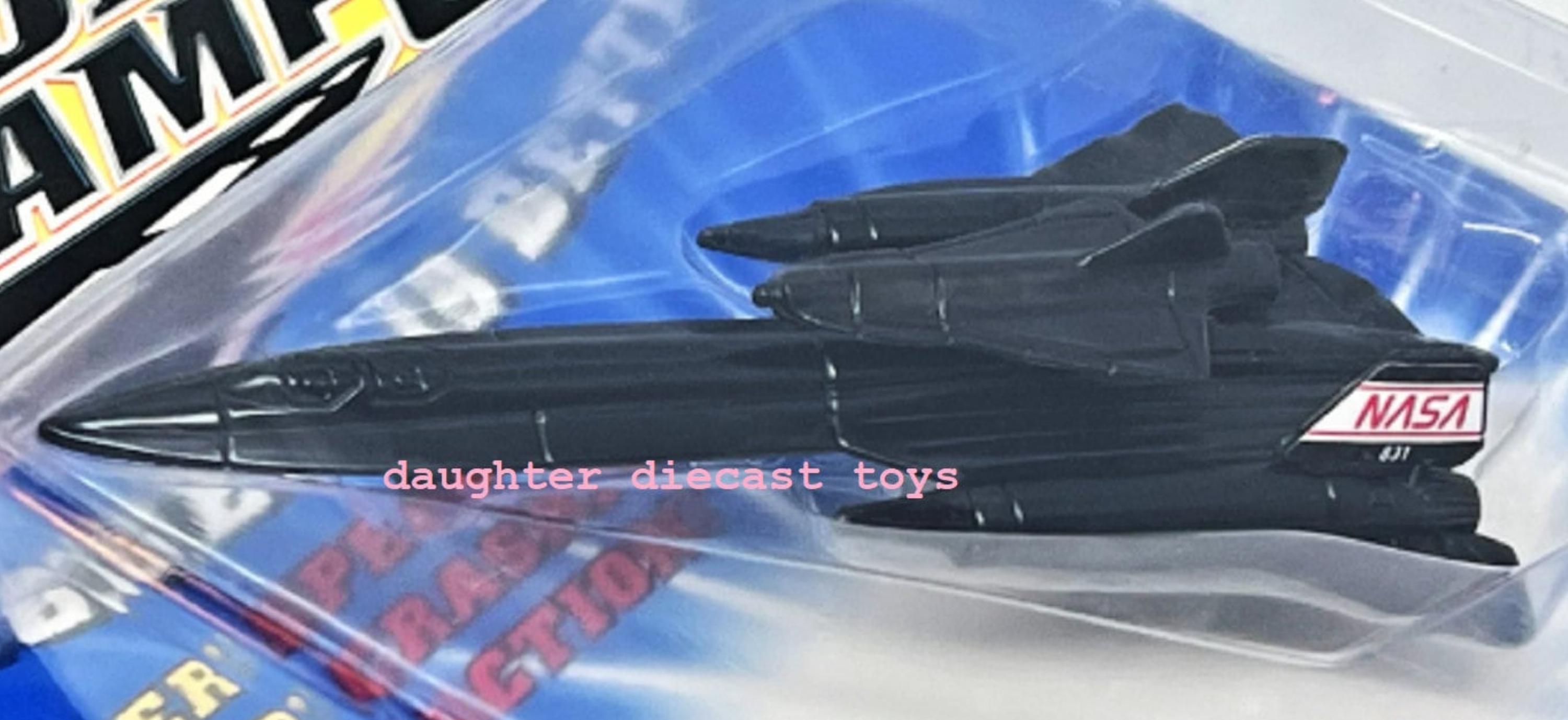
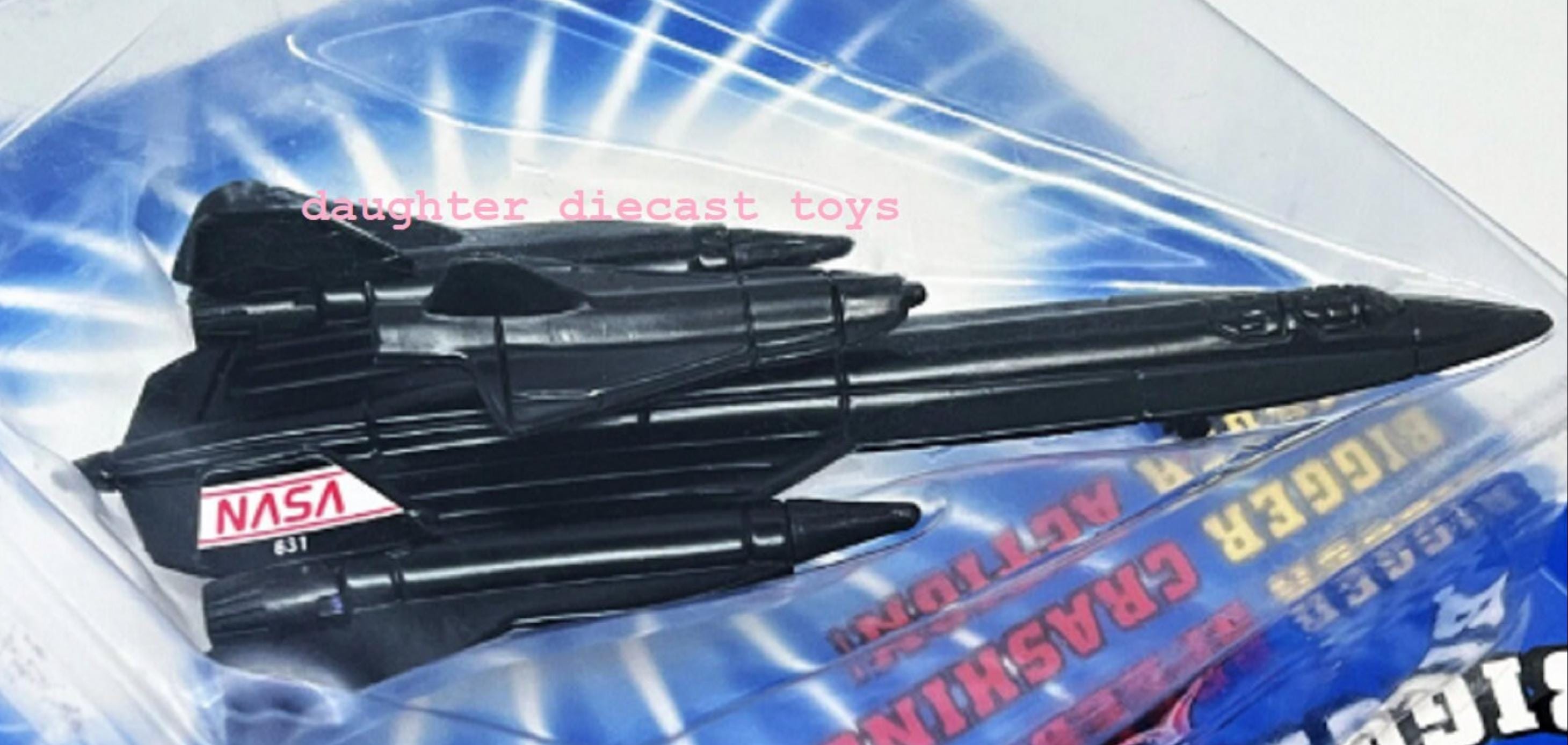


SR-71 BLACKBIRD Supersonic Recon Jet with Drone - Diecast Metal Airplane Mint Condition/Factory Sealed! Road Champs Toys - Great Gift!
$ 34.99

SR-71 BLACKBIRD Supersonic Recon Jet with Drone - Diecast Metal Airplane Mint
Condition/Factory Sealed! Road Champs Toys - Great Gift!Bad ass! SR-71 BLACKBIRD SUPERSONIC RECON JET WITH DRONE. Constructed of die cast metal. Highly sought-after, hard to find vintage model! Made by Road Champs. Nice size...measures 5"L x 2 1/2"W x 1 1/2 "H. Pristine/mint condition. Never removed from its factory-sealed card. Perfect gift for Veterans, Road Champs, Miltary aircraft, and vintage toy collectors! We ship fast & safe worldwide every day! See Aircraft bio below:Note: My dad owned a Diecast toy store for 30 years. I inherited the store inventory when he passed away several years ago. I am (just now) able to bring myself to begin selling his cars-so they can be shared with the world. All pristine and mint condition vintage models will (eventually) be listed here on ETSY. All the inventory is NEW (vintage) merchandise-which was intended for retail sale. Please know-our diecast toys have NEVER been "played-with” we do not sell used, or damaged toys.
•
•
•FOR A LIMITED TIME
•
•
•Purchases totaling $35 and above qualify for FREE shipping to USA! Add more items to your Etsy shopping cart to save $$$.AIRCRAFT BIO:The Lockheed SR-71 "Blackbird" is a long-range, high-altitude, Mach 3+ strategic reconnaissance aircraft developed and manufactured by the American aerospace company Lockheed Corporation. It was operated by both the United States Air Force (USAF) and NASA.[1]The SR-71 was developed as a black project from the Lockheed A-12 reconnaissance aircraft during the 1960s by Lockheed's Skunk Works division. American aerospace engineer Clarence "Kelly" Johnson was responsible for many of the aircraft's innovative concepts. The shape of the SR-71 was based on that of the A-12, which was one of the first aircraft to be designed with a reduced radar cross-section. At one point, a bomber variant of the aircraft was under consideration, before the program was focused solely on reconnaissance. Mission equipment for the reconnaissance role included signals intelligence sensors, a side-looking airborne radar, and a photo camera; the SR-71 was both longer and heavier than the A-12, allowing it to hold more fuel as well as a two-seat cockpit. The SR-71 designation has been attributed to lobbying efforts by USAF Chief of Staff General Curtis LeMay, who preferred the SR (Strategic Reconnaissance) designation over simply RS (Reconnaissance, Strategic). The aircraft was introduced to operational service in January 1966.During aerial reconnaissance missions, the SR-71 operated at high speeds and altitudes (Mach 3.2 and 85,000 feet, 25,900 meters), allowing it to outrace or entirely avoid threats. If a surface-to-air missile launch was detected, the standard evasive action was simply to accelerate and outpace the missile.[2] On average, each SR-71 could fly once per week due to the extended turnaround required after mission recovery. A total of 32 aircraft were built; 12 were lost in accidents with none lost to enemy action.[3][4] During 1988, the USAF retired the SR-71 largely for political reasons; several were briefly reactivated during the 1990s before their second retirement in 1998. NASA was the final operator of the type, retiring their examples in 1999. Since its retirement, the SR-71's role has been taken up by a combination of reconnaissance satellites and unmanned aerial vehicles (UAVs); a proposed UAV successor, the SR-72, is under development by Lockheed Martin, and scheduled to fly in 2025.[5] The SR-71 has been given several nicknames, including "Blackbird" and "Habu".[6] As of 2021 the SR-71 continues to hold the official world record it set in 1976 for the fastest air-breathing manned aircraft, previously held by the related Lockheed YF-12.[7][8][9][10]Overview The flight instrumentation of an SR-71's forward cockpit Forward cockpit The SR-71 was designed for flight at over Mach 3 with a flight crew of two in tandem cockpits, with the pilot in the forward cockpit and the reconnaissance systems officer operating the surveillance systems and equipment from the rear cockpit, and directing navigation on the mission flight path.[23][24] The SR-71 was designed to minimize its radar cross-section, an early attempt at stealth design.[25] Finished aircraft were painted a dark blue, almost black, to increase the emission of internal heat and to act as camouflage against the night sky. The dark color led to the aircraft's nickname "Blackbird".While the SR-71 carried radar countermeasures to evade interception efforts, its greatest protection was its combination of high altitude and very high speed, which made it almost invulnerable. Along with its low radar cross-section, these qualities gave a very short time for an enemy surface-to-air missile (SAM) site to acquire and track the aircraft on radar. By the time the SAM site could track the SR-71, it was often too late to launch a SAM, and the SR-71 would be out of range before the SAM could catch up to it. If the SAM site could track the SR-71 and fire a SAM in time, the SAM would expend nearly all of the delta-v of its boost and sustainer phases just reaching the SR-71's altitude; at this point, out of thrust, it could do little more than follow its ballistic arc. Merely accelerating would typically be enough for an SR-71 to evade a SAM;[2] changes by the pilots in the SR-71's speed, altitude, and heading were also often enough to spoil any radar lock on the plane by SAM sites or enemy fighters.[24] At sustained speeds of more than Mach 3.2, the plane was faster than the Soviet Union's fastest interceptor, the Mikoyan-Gurevich MiG-25, which also could not reach the SR-71's altitude.[26] During its service life, no SR-71 was ever shot down.[3]
Condition/Factory Sealed! Road Champs Toys - Great Gift!Bad ass! SR-71 BLACKBIRD SUPERSONIC RECON JET WITH DRONE. Constructed of die cast metal. Highly sought-after, hard to find vintage model! Made by Road Champs. Nice size...measures 5"L x 2 1/2"W x 1 1/2 "H. Pristine/mint condition. Never removed from its factory-sealed card. Perfect gift for Veterans, Road Champs, Miltary aircraft, and vintage toy collectors! We ship fast & safe worldwide every day! See Aircraft bio below:Note: My dad owned a Diecast toy store for 30 years. I inherited the store inventory when he passed away several years ago. I am (just now) able to bring myself to begin selling his cars-so they can be shared with the world. All pristine and mint condition vintage models will (eventually) be listed here on ETSY. All the inventory is NEW (vintage) merchandise-which was intended for retail sale. Please know-our diecast toys have NEVER been "played-with” we do not sell used, or damaged toys.
•
•
•FOR A LIMITED TIME
•
•
•Purchases totaling $35 and above qualify for FREE shipping to USA! Add more items to your Etsy shopping cart to save $$$.AIRCRAFT BIO:The Lockheed SR-71 "Blackbird" is a long-range, high-altitude, Mach 3+ strategic reconnaissance aircraft developed and manufactured by the American aerospace company Lockheed Corporation. It was operated by both the United States Air Force (USAF) and NASA.[1]The SR-71 was developed as a black project from the Lockheed A-12 reconnaissance aircraft during the 1960s by Lockheed's Skunk Works division. American aerospace engineer Clarence "Kelly" Johnson was responsible for many of the aircraft's innovative concepts. The shape of the SR-71 was based on that of the A-12, which was one of the first aircraft to be designed with a reduced radar cross-section. At one point, a bomber variant of the aircraft was under consideration, before the program was focused solely on reconnaissance. Mission equipment for the reconnaissance role included signals intelligence sensors, a side-looking airborne radar, and a photo camera; the SR-71 was both longer and heavier than the A-12, allowing it to hold more fuel as well as a two-seat cockpit. The SR-71 designation has been attributed to lobbying efforts by USAF Chief of Staff General Curtis LeMay, who preferred the SR (Strategic Reconnaissance) designation over simply RS (Reconnaissance, Strategic). The aircraft was introduced to operational service in January 1966.During aerial reconnaissance missions, the SR-71 operated at high speeds and altitudes (Mach 3.2 and 85,000 feet, 25,900 meters), allowing it to outrace or entirely avoid threats. If a surface-to-air missile launch was detected, the standard evasive action was simply to accelerate and outpace the missile.[2] On average, each SR-71 could fly once per week due to the extended turnaround required after mission recovery. A total of 32 aircraft were built; 12 were lost in accidents with none lost to enemy action.[3][4] During 1988, the USAF retired the SR-71 largely for political reasons; several were briefly reactivated during the 1990s before their second retirement in 1998. NASA was the final operator of the type, retiring their examples in 1999. Since its retirement, the SR-71's role has been taken up by a combination of reconnaissance satellites and unmanned aerial vehicles (UAVs); a proposed UAV successor, the SR-72, is under development by Lockheed Martin, and scheduled to fly in 2025.[5] The SR-71 has been given several nicknames, including "Blackbird" and "Habu".[6] As of 2021 the SR-71 continues to hold the official world record it set in 1976 for the fastest air-breathing manned aircraft, previously held by the related Lockheed YF-12.[7][8][9][10]Overview The flight instrumentation of an SR-71's forward cockpit Forward cockpit The SR-71 was designed for flight at over Mach 3 with a flight crew of two in tandem cockpits, with the pilot in the forward cockpit and the reconnaissance systems officer operating the surveillance systems and equipment from the rear cockpit, and directing navigation on the mission flight path.[23][24] The SR-71 was designed to minimize its radar cross-section, an early attempt at stealth design.[25] Finished aircraft were painted a dark blue, almost black, to increase the emission of internal heat and to act as camouflage against the night sky. The dark color led to the aircraft's nickname "Blackbird".While the SR-71 carried radar countermeasures to evade interception efforts, its greatest protection was its combination of high altitude and very high speed, which made it almost invulnerable. Along with its low radar cross-section, these qualities gave a very short time for an enemy surface-to-air missile (SAM) site to acquire and track the aircraft on radar. By the time the SAM site could track the SR-71, it was often too late to launch a SAM, and the SR-71 would be out of range before the SAM could catch up to it. If the SAM site could track the SR-71 and fire a SAM in time, the SAM would expend nearly all of the delta-v of its boost and sustainer phases just reaching the SR-71's altitude; at this point, out of thrust, it could do little more than follow its ballistic arc. Merely accelerating would typically be enough for an SR-71 to evade a SAM;[2] changes by the pilots in the SR-71's speed, altitude, and heading were also often enough to spoil any radar lock on the plane by SAM sites or enemy fighters.[24] At sustained speeds of more than Mach 3.2, the plane was faster than the Soviet Union's fastest interceptor, the Mikoyan-Gurevich MiG-25, which also could not reach the SR-71's altitude.[26] During its service life, no SR-71 was ever shot down.[3]
Other Products