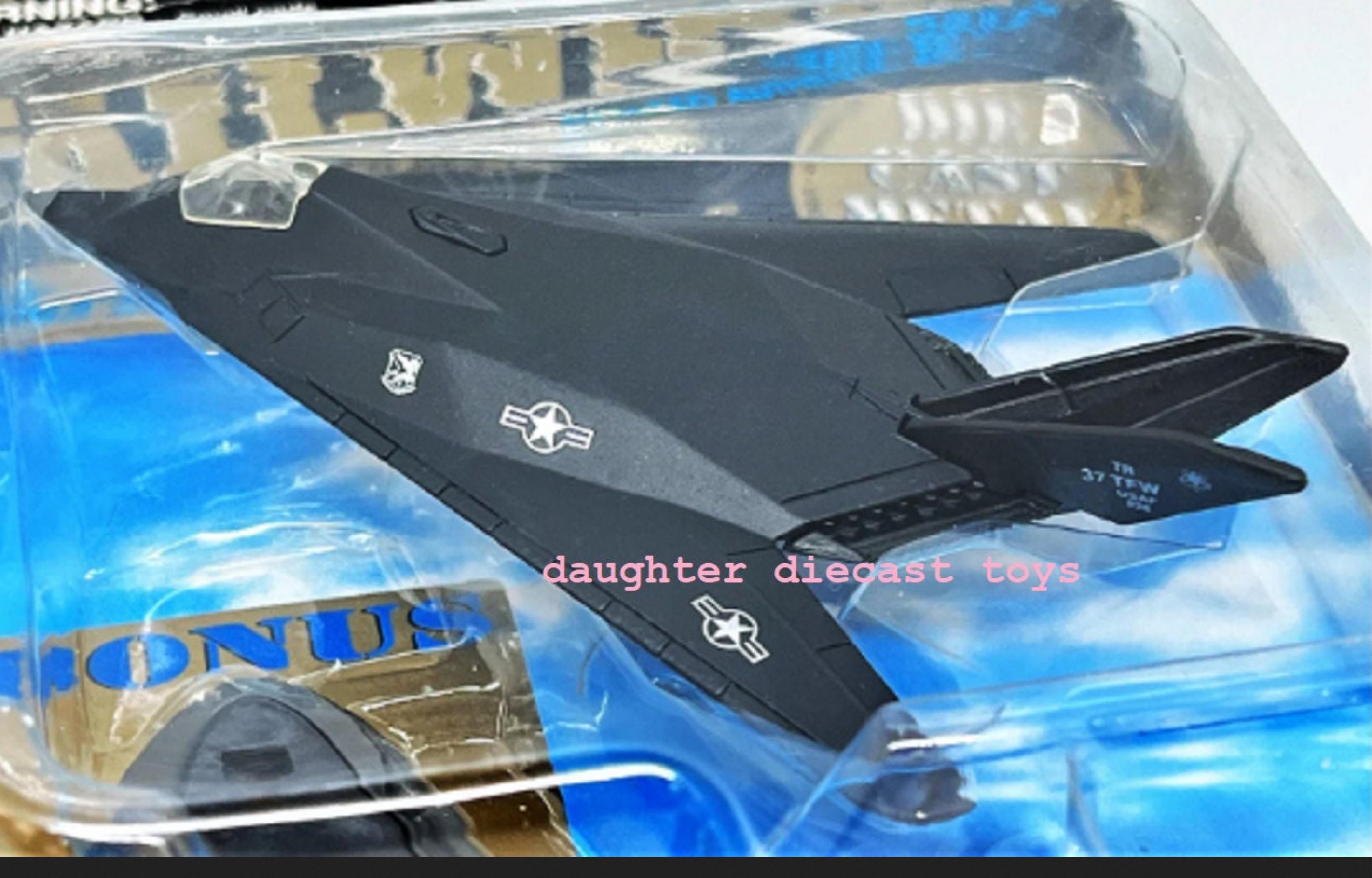
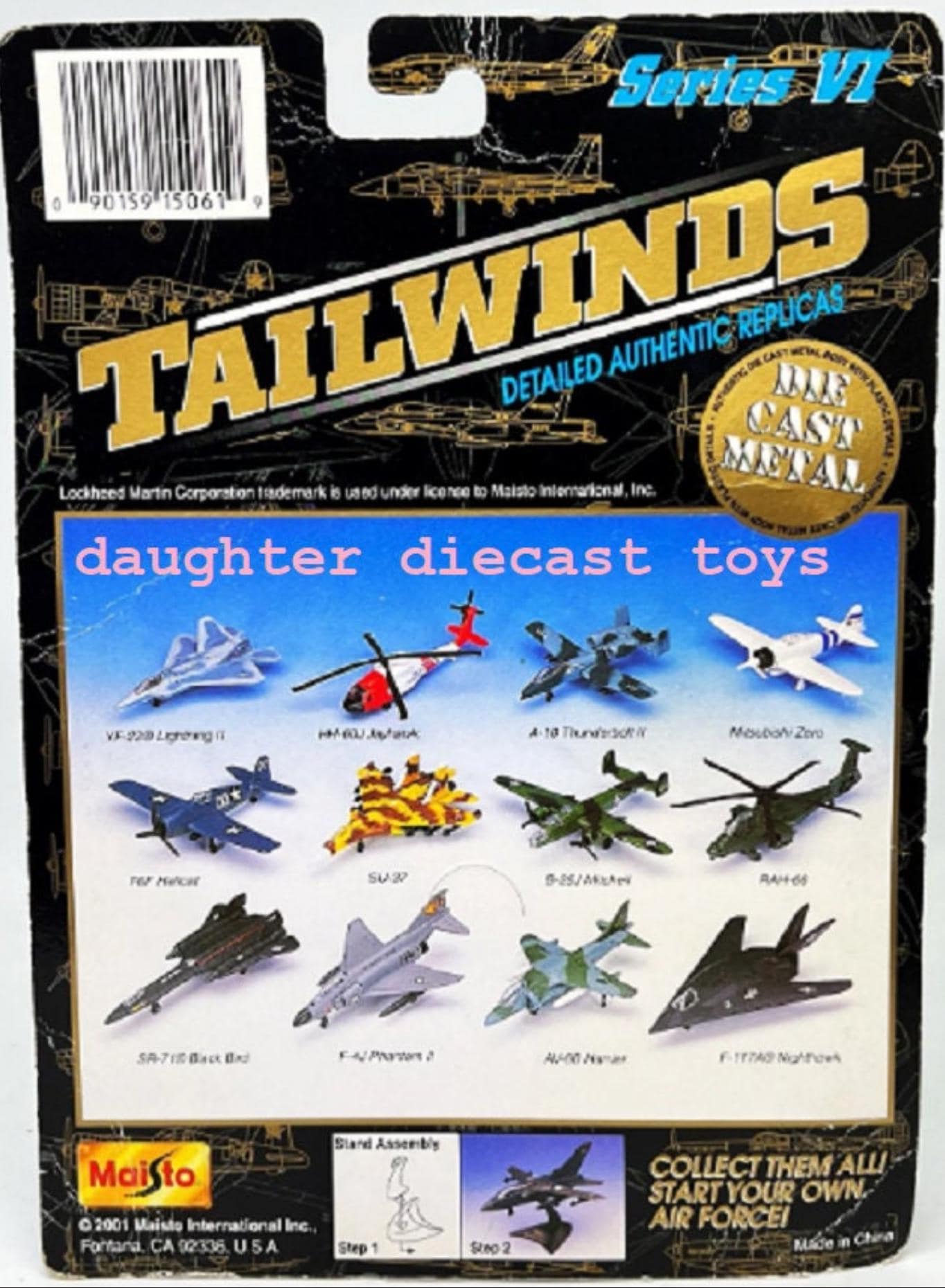
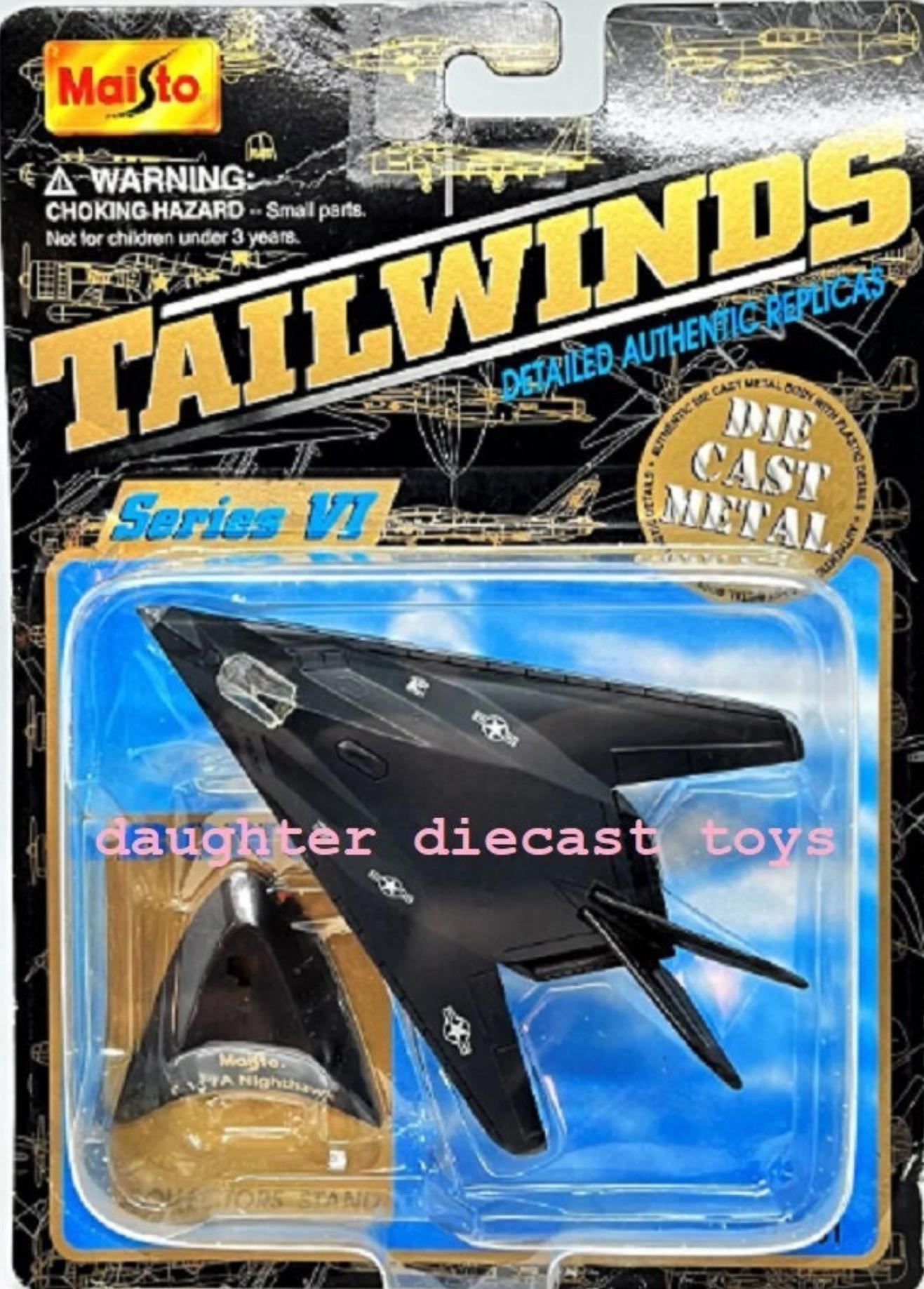

USAF F-117A NIGHTHAWK Stealth Fighter Jet Diecast Metal Airplane- With Stand! Mint Condition/Factory Sealed! Maisto Toys Super Cool!
$ 39.99

USAF F-117A NIGHTHAWK Stealth Fighter Jet Diecast Metal Airplane- With Stand!
Mint Condition/Factory Sealed! Maisto Toys Super Cool!Super cool... USAF F-117A NIGHTHAWK Stealth Fighter Jet (see bio below). Made by Maisto Toys/constructed of die cast metal. Stand is included. Highly sought-after model! Measures 5"L x 3 1/2"W x 1 "H. Beautiful/pristine condition model. Never removed from its factory-sealed card. Perfect gift for Military aircraft, and vintage toy collectors! We ship fast & safe worldwide every day!Note: My dad owned a Diecast toy store for 30 years. I inherited the store inventory when he passed away several years ago. I am (just now) able to bring myself to begin selling his cars-so they can be shared with the world. All pristine and mint condition vintage models will (eventually) be listed here on ETSY. All the inventory is NEW (vintage) merchandise-which was intended for retail sale. Please know-our diecast toys have NEVER been "played-with” we do not sell used, or damaged toys.
•
•
•FOR A LIMITED TIME
•
•
•Purchases totaling $35 and above qualify for FREE shipping to USA! Add more items to your Etsy shopping cart to save $$$.AIRCRAFT BIO: The Lockheed F-117 Nighthawk is a retired American single-seat, twin-engine stealth attack aircraft that was developed by Lockheed's secretive Skunk Works division and operated by the United States Air Force. The F-117 was based on the Have Blue technology demonstrator. Wikipedia Top speed: 617 mph Introduced: October 1983 Retired: April 22, 2008 Wingspan: 43′ 0″ Unit cost: 42,600,000–111,200,000 USD Engine types: General Electric F404, TurbofanDesignationThe operational aircraft was officially designated "F-117A".[31] Most modern U.S. military aircraft use post-1962 designations in which the designation "F" is usually an air-to-air fighter, "B" is usually a bomber, "A" is usually a ground-attack aircraft, etc. (Examples include the F-15, the B-2 and the A-6.) The F-117 is primarily an attack aircraft,[1] so its "F" designation is inconsistent with the DoD system. This is an inconsistency that has been repeatedly employed by the U.S. Air Force with several of its attack aircraft since the late 1950s, including the Republic F-105 Thunderchief and General Dynamics F-111 Aardvark. A televised documentary quoted project manager Alan Brown as saying that Robert J. Dixon, a four-star Air Force general who was the head of Tactical Air Command felt that the top-notch USAF fighter pilots required to fly the new aircraft were more easily attracted to an aircraft with an "F" designation for fighter, as opposed to a bomber ("B") or attack ("A") designation.[32][33]The designation "F-117" seems to indicate that it was given an official designation prior to the 1962 U.S. Tri-Service Aircraft Designation System and could be considered numerically to be a part of the earlier "Century series" of fighters. The assumption prior to the revealing of the aircraft to the public was that it would likely receive the F-19 designation as that number had not been used. However, there were no other aircraft to receive a "100" series number following the F-111. Soviet fighters obtained by the U.S. via various means under the Constant Peg program[34] were given F-series numbers for their evaluation by U.S. pilots, and with the advent of the Teen Series fighters, most often Century Series designations.[35]As with other exotic military aircraft types flying in the southern Nevada area, such as captured fighters, an arbitrary radio call of "117" was assigned. This same radio call had been used by the enigmatic 4477th Test and Evaluation Squadron, also known as the "Red Hats" or "Red Eagles", that often had flown expatriated MiG jet fighters in the area, but there was no relationship to the call and the formal F-19 designation then being considered by the Air Force. Apparently, use of the "117" radio call became commonplace and when Lockheed released its first flight manual (i.e., the Air Force "dash one" manual for the aircraft), F-117A was the designation printed on the cover.[36] Design Closeup view of the nose of a black jet, emphasizing the many angled-surfaces Front view of an F-117When the Air Force first approached Lockheed with the stealth concept, Skunk Works Director Kelly Johnson proposed a rounded design. He believed smoothly blended shapes offered the best combination of speed and stealth. However, his assistant, Ben Rich, showed that faceted-angle surfaces would provide a significant reduction in radar signature, and the necessary aerodynamic control could be provided with computer units. A May 1975 Skunk Works report, "Progress Report No. 2, High Stealth Conceptual Studies", showed the rounded concept that was rejected in favor of the flat-sided approach.[37]The resulting unusual design surprised and puzzled experienced pilots. A Royal Air Force (RAF) pilot who flew it as an exchange officer stated that when he first saw a photograph of the still-secret F-117, he "promptly giggled and thought [to himself] 'this clearly can't fly'".[38] Early stealth aircraft were designed with a focus on minimal radar cross-section (RCS) rather than aerodynamic performance. Highly stealthy aircraft like the F-117 Nighthawk are aerodynamically unstable in all three aircraft principal axes and require constant flight corrections from a fly-by-wire (FBW) flight system to maintain controlled flight.[39] It is shaped to deflect radar signals and is approximately the size of an F-15 Eagle.The single-seat Nighthawk is powered by two non-afterburning General Electric F404 turbofan engines. It is air refuelable and features a V-tail. The maximum speed is 623 mph (1,003 km/h; 541 kn) at high altitude, the max rate of climb is 2,820 feet (860 m) per minute, and service ceiling is 43,000 to 45,000 feet (13,000 to 14,000 m).[40] The cockpit was quite spacious, with ergonomic displays and controls, but the field of view was somewhat obstructed with a large blind spot to the rear.[41] AvionicsIt has quadruple-redundant fly-by-wire flight controls. To lower development costs, the avionics, fly-by-wire systems, and other parts were derived from the General Dynamics F-16 Fighting Falcon, McDonnell Douglas F/A-18 Hornet and McDonnell Douglas F-15E Strike Eagle. The parts were originally described as spares on budgets for these aircraft, to keep the F-117 project secret.[citation needed] CockpitThe aircraft is equipped with sophisticated navigation and attack systems integrated into a digital avionics suite. It navigates primarily by GPS and high-accuracy inertial navigation.[42] Missions are coordinated by an automated planning system that can automatically perform all aspects of an attack mission, including weapons release. Targets are acquired by a thermal imaging infrared system, paired with a laser rangefinder/laser designator that finds the range and designates targets for laser-guided bombs. The F-117A's split internal bay can carry 5,000 pounds (2,300 kg) of ordnance. Typical weapons are a pair of GBU-10, GBU-12, or GBU-27 laser-guided bombs, two BLU-109 penetration bombs, or two Joint Direct Attack Munitions (JDAM) GPS/INS guided stand-off bombs. Stealth Main article: Stealth aircraftThe F-117 has a radar cross-section of about 0.001 m2 (0.0108 sq ft).[43] Among the penalties for stealth are lower engine thrust due to losses in the inlet and outlet, a very low wing aspect ratio, and a high sweep angle (50°) needed to deflect incoming radar waves to the sides.[11][failed verification] With these design considerations and no afterburner, the F-117 is limited to subsonic speeds.The F-117A carries no radar, which lowers emissions and cross-section, and whether it carries any radar detection equipment remained classified as of 2008.[11] Its faceted shape (made from 2-dimensional flat surfaces) resulted from the limitations of the 1970s-era computer technology used to calculate its radar cross-section. Later supercomputers made it possible for subsequent aircraft like the B-2 bomber to use curved surfaces while maintaining stealth, through the use of far more computational resources to perform the additional calculations.[44]The radar-absorbent flat sheets covering the F-117A weighed almost one ton, and were held in place by glue, with the gaps between the sheets filled with a kind of putty material called "butter".[11]An exhaust plume contributes a significant infrared signature. The F-117 reduces IR signature with a non-circular tail pipe (a slit shape) to minimize the exhaust cross-section and maximize the mixing of hot exhaust with cool ambient air. The F-117 lacks afterburners, because the hot exhaust would increase the infrared signature, and breaking the sound barrier would produce an obvious sonic boom, as well as surface heating of the aircraft skin which also increases the infrared footprint. As a result, its performance in air combat maneuvering required in a dogfight would never match that of a dedicated fighter aircraft. This was unimportant in the case of this aircraft since it was designed to be a bomber.Passive (multistatic) radar, bistatic radar[45] and especially multistatic radar systems detect some stealth aircraft better than conventional monostatic radars, since first-generation stealth technology (such as the F-117) reflects energy away from the transmitter's line of sight, effectively increasing the radar cross section (RCS) in other directions, which the passive radars monitor. Operational history An F-117 conducts a live exercise bombing run using GBU-27 laser-guided bombsDuring the program's early years, from 1984 to mid-1992, the F-117A fleet was based at Tonopah Test Range Airport, Nevada, where it served under the 4450th Tactical Group. Because the F-117 was classified during this time, the unit was officially located at Nellis Air Force Base, Nevada, and equipped with A-7 Corsair II aircraft. All military personnel were permanently assigned to Nellis AFB, and most personnel and their families lived in Las Vegas. This required commercial air and trucking to transport personnel between Las Vegas and Tonopah each week. The 4450th was absorbed by the 37th Tactical Fighter Wing in 1989. In 1992, the entire fleet was transferred to Holloman Air Force Base, New Mexico, under the command of the 49th Fighter Wing. This move also eliminated the Key Air and American Trans Air contract flights to Tonopah, which flew 22,000 passenger trips on 300 flights from Nellis to Tonopah per month.The F-117 reached initial operating capability status in 1983.[2] The Nighthawk's pilots called themselves "Bandits". Each of the 558 Air Force pilots who have flown the F-117 has a Bandit number, such as "Bandit 52", that indicates the sequential order of their first flight in the F-117.[46] Pilots told friends and families that they flew the Northrop F-5 in aggressor squadrons against Tactical Air Command.[26]The F-117 has been used several times in war. Its first mission was during the United States invasion of Panama in 1989.[47] During that invasion two F-117A Nighthawks dropped two bombs on Rio Hato airfield.During the Gulf War in 1991, the F-117 flew approximately 1,300 sorties and scored direct hits on 1,600 high-value targets in Iraq[2] over 6,905 flight hours.[48] Leaflet drops on Iraqi forces displayed the F-117 destroying ground targets and warned "Escape now and save yourselves".[27] Only 229 Coalition tactical aircraft could drop and designate laser-guided bombs of which 36 F-117s represented 15.7%, and only the USAF had the I-2000 bombs intended for hardened targets. So the F-117 represented 32% of all coalition aircraft that could deliver such bombs.[49] Initial claims of its effectiveness were later found to be overstated.[50] initial reports of F-117s hitting 80% of their targets were later scaled back to "41–60%".[51] On the first night, they failed to hit 40% of their assigned air-defense targets, including the Air Defense Operations Center in Baghdad, and 8 such targets remained functional out of 10 that could be assessed.[52] In their Desert Storm white paper, the USAF stated that "the F-117 was the only airplane that the planners dared risk over downtown Baghdad" and that this area was particularly well defended.[53] In fact, most of the air defenses were on the outskirts of the city and many other aircraft hit targets in the downtown area, with minimal casualties when they attacked at night like the F-117.[53] This meant they avoided the optically aimed anti-aircraft cannon and infrared SAMs which were the biggest threat to Coalition aircraft.[54]The aircraft was operated in secret from Tonopah for almost a decade, but after the Gulf War the aircraft moved to Holloman in 1992—however, its integration with the USAF's non-stealth "iron jets" occurred slowly. As one senior F-117A pilot later said: Because of ongoing secrecy others continued to see the aircraft as "none of their business, a stand-alone system".[11] The F-117A and the men and women of the 49th Fighter Wing were deployed to Southwest Asia on multiple occasions. On their first deployment, with the aid of aerial refueling, pilots flew non-stop from Holloman to Kuwait, a flight of approximately 18.5 hours.[55] Combat over Yugoslavia Main article: 1999 F-117A shootdown Canopy of F-117 shot down in Serbia in March 1999 at the Museum of Aviation in BelgradeOne F-117 (AF ser. no. 82-0806) was lost to enemy action. It was downed during a Operation Allied Force mission against the Army of Yugoslavia on 27 March 1999.[56] The aircraft was acquired by a fire control radar at a distance of 8.1 mi (13 km) and an altitude of 5.0 mi (8 km). SA-3s were then launched by a Yugoslav version of the Soviet Isayev S-125 "Neva" (NATO name SA-3 "Goa") anti-aircraft missile system.[56][57][58] The launcher was run by the 3rd Battalion of the 250th Air Defence Missile Brigade under the command of Colonel Zoltán Dani.[59]After the explosion, the aircraft became uncontrollable, forcing the pilot to eject.[56] The pilot was recovered six hours later by a United States Air Force Pararescue team.[56][60] The stealth technology from the downed F-117 may have been acquired by Russia and China,[61] but the United States did not attempt to destroy the wreckage because senior Pentagon officials argued that its technology was already dated and no longer important to protect.[26]American sources state that a second F-117 was targeted and damaged during the campaign, allegedly on 30 April 1999.[62][63] The aircraft returned to Spangdahlem base,[63] but it supposedly never flew again.[64][65] However, the USAF continued to use the F-117 during Allied Force.
Mint Condition/Factory Sealed! Maisto Toys Super Cool!Super cool... USAF F-117A NIGHTHAWK Stealth Fighter Jet (see bio below). Made by Maisto Toys/constructed of die cast metal. Stand is included. Highly sought-after model! Measures 5"L x 3 1/2"W x 1 "H. Beautiful/pristine condition model. Never removed from its factory-sealed card. Perfect gift for Military aircraft, and vintage toy collectors! We ship fast & safe worldwide every day!Note: My dad owned a Diecast toy store for 30 years. I inherited the store inventory when he passed away several years ago. I am (just now) able to bring myself to begin selling his cars-so they can be shared with the world. All pristine and mint condition vintage models will (eventually) be listed here on ETSY. All the inventory is NEW (vintage) merchandise-which was intended for retail sale. Please know-our diecast toys have NEVER been "played-with” we do not sell used, or damaged toys.
•
•
•FOR A LIMITED TIME
•
•
•Purchases totaling $35 and above qualify for FREE shipping to USA! Add more items to your Etsy shopping cart to save $$$.AIRCRAFT BIO: The Lockheed F-117 Nighthawk is a retired American single-seat, twin-engine stealth attack aircraft that was developed by Lockheed's secretive Skunk Works division and operated by the United States Air Force. The F-117 was based on the Have Blue technology demonstrator. Wikipedia Top speed: 617 mph Introduced: October 1983 Retired: April 22, 2008 Wingspan: 43′ 0″ Unit cost: 42,600,000–111,200,000 USD Engine types: General Electric F404, TurbofanDesignationThe operational aircraft was officially designated "F-117A".[31] Most modern U.S. military aircraft use post-1962 designations in which the designation "F" is usually an air-to-air fighter, "B" is usually a bomber, "A" is usually a ground-attack aircraft, etc. (Examples include the F-15, the B-2 and the A-6.) The F-117 is primarily an attack aircraft,[1] so its "F" designation is inconsistent with the DoD system. This is an inconsistency that has been repeatedly employed by the U.S. Air Force with several of its attack aircraft since the late 1950s, including the Republic F-105 Thunderchief and General Dynamics F-111 Aardvark. A televised documentary quoted project manager Alan Brown as saying that Robert J. Dixon, a four-star Air Force general who was the head of Tactical Air Command felt that the top-notch USAF fighter pilots required to fly the new aircraft were more easily attracted to an aircraft with an "F" designation for fighter, as opposed to a bomber ("B") or attack ("A") designation.[32][33]The designation "F-117" seems to indicate that it was given an official designation prior to the 1962 U.S. Tri-Service Aircraft Designation System and could be considered numerically to be a part of the earlier "Century series" of fighters. The assumption prior to the revealing of the aircraft to the public was that it would likely receive the F-19 designation as that number had not been used. However, there were no other aircraft to receive a "100" series number following the F-111. Soviet fighters obtained by the U.S. via various means under the Constant Peg program[34] were given F-series numbers for their evaluation by U.S. pilots, and with the advent of the Teen Series fighters, most often Century Series designations.[35]As with other exotic military aircraft types flying in the southern Nevada area, such as captured fighters, an arbitrary radio call of "117" was assigned. This same radio call had been used by the enigmatic 4477th Test and Evaluation Squadron, also known as the "Red Hats" or "Red Eagles", that often had flown expatriated MiG jet fighters in the area, but there was no relationship to the call and the formal F-19 designation then being considered by the Air Force. Apparently, use of the "117" radio call became commonplace and when Lockheed released its first flight manual (i.e., the Air Force "dash one" manual for the aircraft), F-117A was the designation printed on the cover.[36] Design Closeup view of the nose of a black jet, emphasizing the many angled-surfaces Front view of an F-117When the Air Force first approached Lockheed with the stealth concept, Skunk Works Director Kelly Johnson proposed a rounded design. He believed smoothly blended shapes offered the best combination of speed and stealth. However, his assistant, Ben Rich, showed that faceted-angle surfaces would provide a significant reduction in radar signature, and the necessary aerodynamic control could be provided with computer units. A May 1975 Skunk Works report, "Progress Report No. 2, High Stealth Conceptual Studies", showed the rounded concept that was rejected in favor of the flat-sided approach.[37]The resulting unusual design surprised and puzzled experienced pilots. A Royal Air Force (RAF) pilot who flew it as an exchange officer stated that when he first saw a photograph of the still-secret F-117, he "promptly giggled and thought [to himself] 'this clearly can't fly'".[38] Early stealth aircraft were designed with a focus on minimal radar cross-section (RCS) rather than aerodynamic performance. Highly stealthy aircraft like the F-117 Nighthawk are aerodynamically unstable in all three aircraft principal axes and require constant flight corrections from a fly-by-wire (FBW) flight system to maintain controlled flight.[39] It is shaped to deflect radar signals and is approximately the size of an F-15 Eagle.The single-seat Nighthawk is powered by two non-afterburning General Electric F404 turbofan engines. It is air refuelable and features a V-tail. The maximum speed is 623 mph (1,003 km/h; 541 kn) at high altitude, the max rate of climb is 2,820 feet (860 m) per minute, and service ceiling is 43,000 to 45,000 feet (13,000 to 14,000 m).[40] The cockpit was quite spacious, with ergonomic displays and controls, but the field of view was somewhat obstructed with a large blind spot to the rear.[41] AvionicsIt has quadruple-redundant fly-by-wire flight controls. To lower development costs, the avionics, fly-by-wire systems, and other parts were derived from the General Dynamics F-16 Fighting Falcon, McDonnell Douglas F/A-18 Hornet and McDonnell Douglas F-15E Strike Eagle. The parts were originally described as spares on budgets for these aircraft, to keep the F-117 project secret.[citation needed] CockpitThe aircraft is equipped with sophisticated navigation and attack systems integrated into a digital avionics suite. It navigates primarily by GPS and high-accuracy inertial navigation.[42] Missions are coordinated by an automated planning system that can automatically perform all aspects of an attack mission, including weapons release. Targets are acquired by a thermal imaging infrared system, paired with a laser rangefinder/laser designator that finds the range and designates targets for laser-guided bombs. The F-117A's split internal bay can carry 5,000 pounds (2,300 kg) of ordnance. Typical weapons are a pair of GBU-10, GBU-12, or GBU-27 laser-guided bombs, two BLU-109 penetration bombs, or two Joint Direct Attack Munitions (JDAM) GPS/INS guided stand-off bombs. Stealth Main article: Stealth aircraftThe F-117 has a radar cross-section of about 0.001 m2 (0.0108 sq ft).[43] Among the penalties for stealth are lower engine thrust due to losses in the inlet and outlet, a very low wing aspect ratio, and a high sweep angle (50°) needed to deflect incoming radar waves to the sides.[11][failed verification] With these design considerations and no afterburner, the F-117 is limited to subsonic speeds.The F-117A carries no radar, which lowers emissions and cross-section, and whether it carries any radar detection equipment remained classified as of 2008.[11] Its faceted shape (made from 2-dimensional flat surfaces) resulted from the limitations of the 1970s-era computer technology used to calculate its radar cross-section. Later supercomputers made it possible for subsequent aircraft like the B-2 bomber to use curved surfaces while maintaining stealth, through the use of far more computational resources to perform the additional calculations.[44]The radar-absorbent flat sheets covering the F-117A weighed almost one ton, and were held in place by glue, with the gaps between the sheets filled with a kind of putty material called "butter".[11]An exhaust plume contributes a significant infrared signature. The F-117 reduces IR signature with a non-circular tail pipe (a slit shape) to minimize the exhaust cross-section and maximize the mixing of hot exhaust with cool ambient air. The F-117 lacks afterburners, because the hot exhaust would increase the infrared signature, and breaking the sound barrier would produce an obvious sonic boom, as well as surface heating of the aircraft skin which also increases the infrared footprint. As a result, its performance in air combat maneuvering required in a dogfight would never match that of a dedicated fighter aircraft. This was unimportant in the case of this aircraft since it was designed to be a bomber.Passive (multistatic) radar, bistatic radar[45] and especially multistatic radar systems detect some stealth aircraft better than conventional monostatic radars, since first-generation stealth technology (such as the F-117) reflects energy away from the transmitter's line of sight, effectively increasing the radar cross section (RCS) in other directions, which the passive radars monitor. Operational history An F-117 conducts a live exercise bombing run using GBU-27 laser-guided bombsDuring the program's early years, from 1984 to mid-1992, the F-117A fleet was based at Tonopah Test Range Airport, Nevada, where it served under the 4450th Tactical Group. Because the F-117 was classified during this time, the unit was officially located at Nellis Air Force Base, Nevada, and equipped with A-7 Corsair II aircraft. All military personnel were permanently assigned to Nellis AFB, and most personnel and their families lived in Las Vegas. This required commercial air and trucking to transport personnel between Las Vegas and Tonopah each week. The 4450th was absorbed by the 37th Tactical Fighter Wing in 1989. In 1992, the entire fleet was transferred to Holloman Air Force Base, New Mexico, under the command of the 49th Fighter Wing. This move also eliminated the Key Air and American Trans Air contract flights to Tonopah, which flew 22,000 passenger trips on 300 flights from Nellis to Tonopah per month.The F-117 reached initial operating capability status in 1983.[2] The Nighthawk's pilots called themselves "Bandits". Each of the 558 Air Force pilots who have flown the F-117 has a Bandit number, such as "Bandit 52", that indicates the sequential order of their first flight in the F-117.[46] Pilots told friends and families that they flew the Northrop F-5 in aggressor squadrons against Tactical Air Command.[26]The F-117 has been used several times in war. Its first mission was during the United States invasion of Panama in 1989.[47] During that invasion two F-117A Nighthawks dropped two bombs on Rio Hato airfield.During the Gulf War in 1991, the F-117 flew approximately 1,300 sorties and scored direct hits on 1,600 high-value targets in Iraq[2] over 6,905 flight hours.[48] Leaflet drops on Iraqi forces displayed the F-117 destroying ground targets and warned "Escape now and save yourselves".[27] Only 229 Coalition tactical aircraft could drop and designate laser-guided bombs of which 36 F-117s represented 15.7%, and only the USAF had the I-2000 bombs intended for hardened targets. So the F-117 represented 32% of all coalition aircraft that could deliver such bombs.[49] Initial claims of its effectiveness were later found to be overstated.[50] initial reports of F-117s hitting 80% of their targets were later scaled back to "41–60%".[51] On the first night, they failed to hit 40% of their assigned air-defense targets, including the Air Defense Operations Center in Baghdad, and 8 such targets remained functional out of 10 that could be assessed.[52] In their Desert Storm white paper, the USAF stated that "the F-117 was the only airplane that the planners dared risk over downtown Baghdad" and that this area was particularly well defended.[53] In fact, most of the air defenses were on the outskirts of the city and many other aircraft hit targets in the downtown area, with minimal casualties when they attacked at night like the F-117.[53] This meant they avoided the optically aimed anti-aircraft cannon and infrared SAMs which were the biggest threat to Coalition aircraft.[54]The aircraft was operated in secret from Tonopah for almost a decade, but after the Gulf War the aircraft moved to Holloman in 1992—however, its integration with the USAF's non-stealth "iron jets" occurred slowly. As one senior F-117A pilot later said: Because of ongoing secrecy others continued to see the aircraft as "none of their business, a stand-alone system".[11] The F-117A and the men and women of the 49th Fighter Wing were deployed to Southwest Asia on multiple occasions. On their first deployment, with the aid of aerial refueling, pilots flew non-stop from Holloman to Kuwait, a flight of approximately 18.5 hours.[55] Combat over Yugoslavia Main article: 1999 F-117A shootdown Canopy of F-117 shot down in Serbia in March 1999 at the Museum of Aviation in BelgradeOne F-117 (AF ser. no. 82-0806) was lost to enemy action. It was downed during a Operation Allied Force mission against the Army of Yugoslavia on 27 March 1999.[56] The aircraft was acquired by a fire control radar at a distance of 8.1 mi (13 km) and an altitude of 5.0 mi (8 km). SA-3s were then launched by a Yugoslav version of the Soviet Isayev S-125 "Neva" (NATO name SA-3 "Goa") anti-aircraft missile system.[56][57][58] The launcher was run by the 3rd Battalion of the 250th Air Defence Missile Brigade under the command of Colonel Zoltán Dani.[59]After the explosion, the aircraft became uncontrollable, forcing the pilot to eject.[56] The pilot was recovered six hours later by a United States Air Force Pararescue team.[56][60] The stealth technology from the downed F-117 may have been acquired by Russia and China,[61] but the United States did not attempt to destroy the wreckage because senior Pentagon officials argued that its technology was already dated and no longer important to protect.[26]American sources state that a second F-117 was targeted and damaged during the campaign, allegedly on 30 April 1999.[62][63] The aircraft returned to Spangdahlem base,[63] but it supposedly never flew again.[64][65] However, the USAF continued to use the F-117 during Allied Force.
Other Products