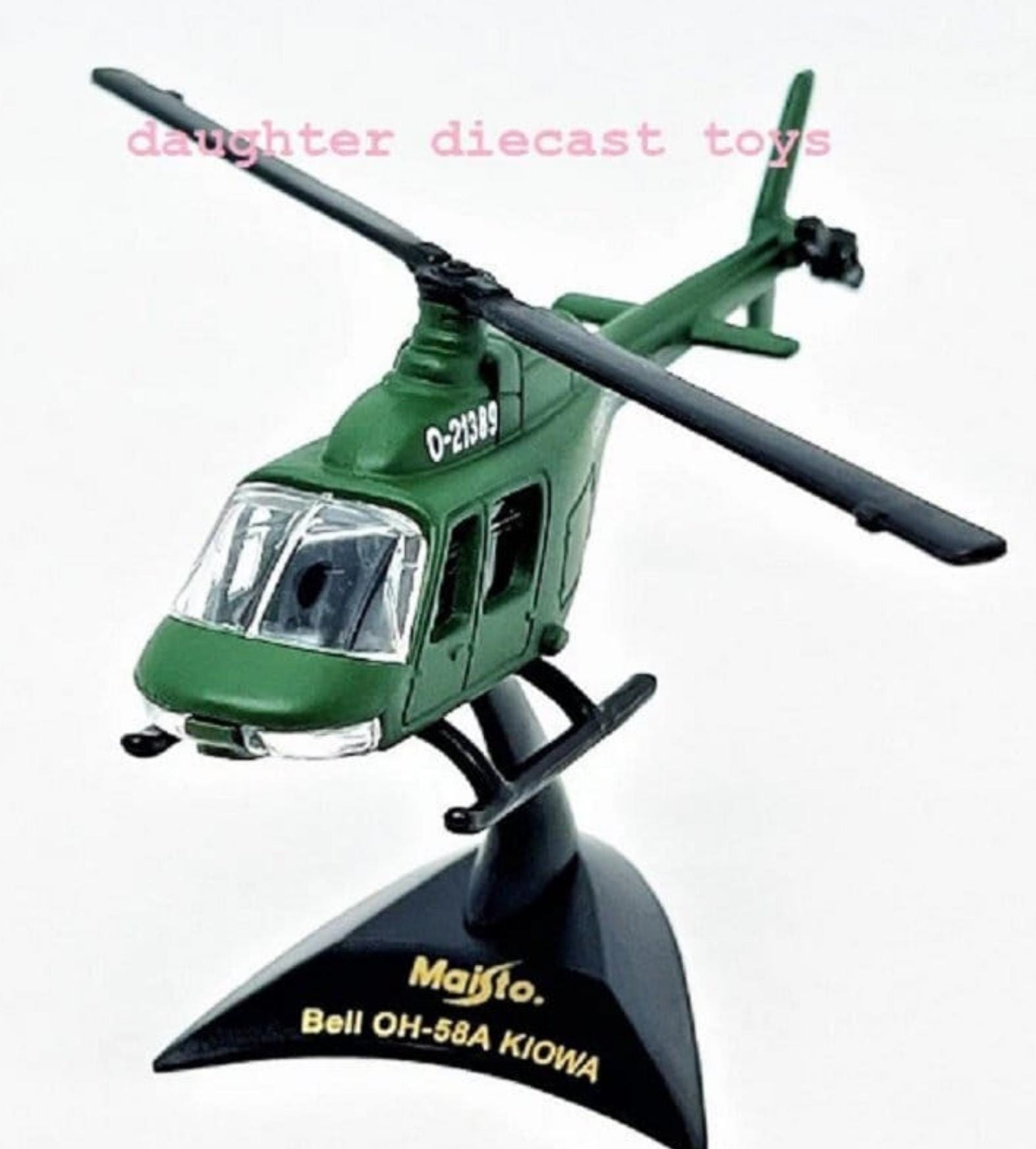
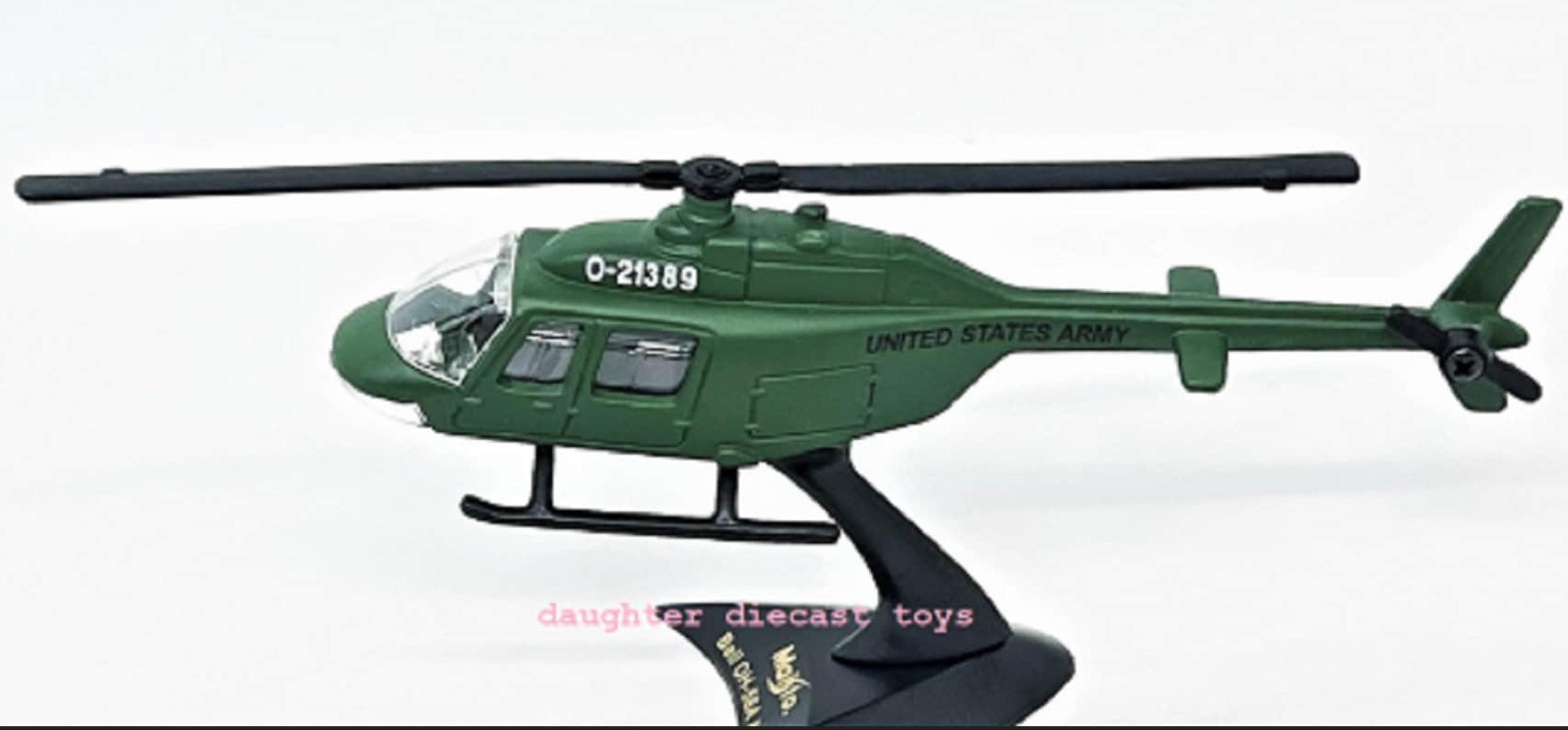
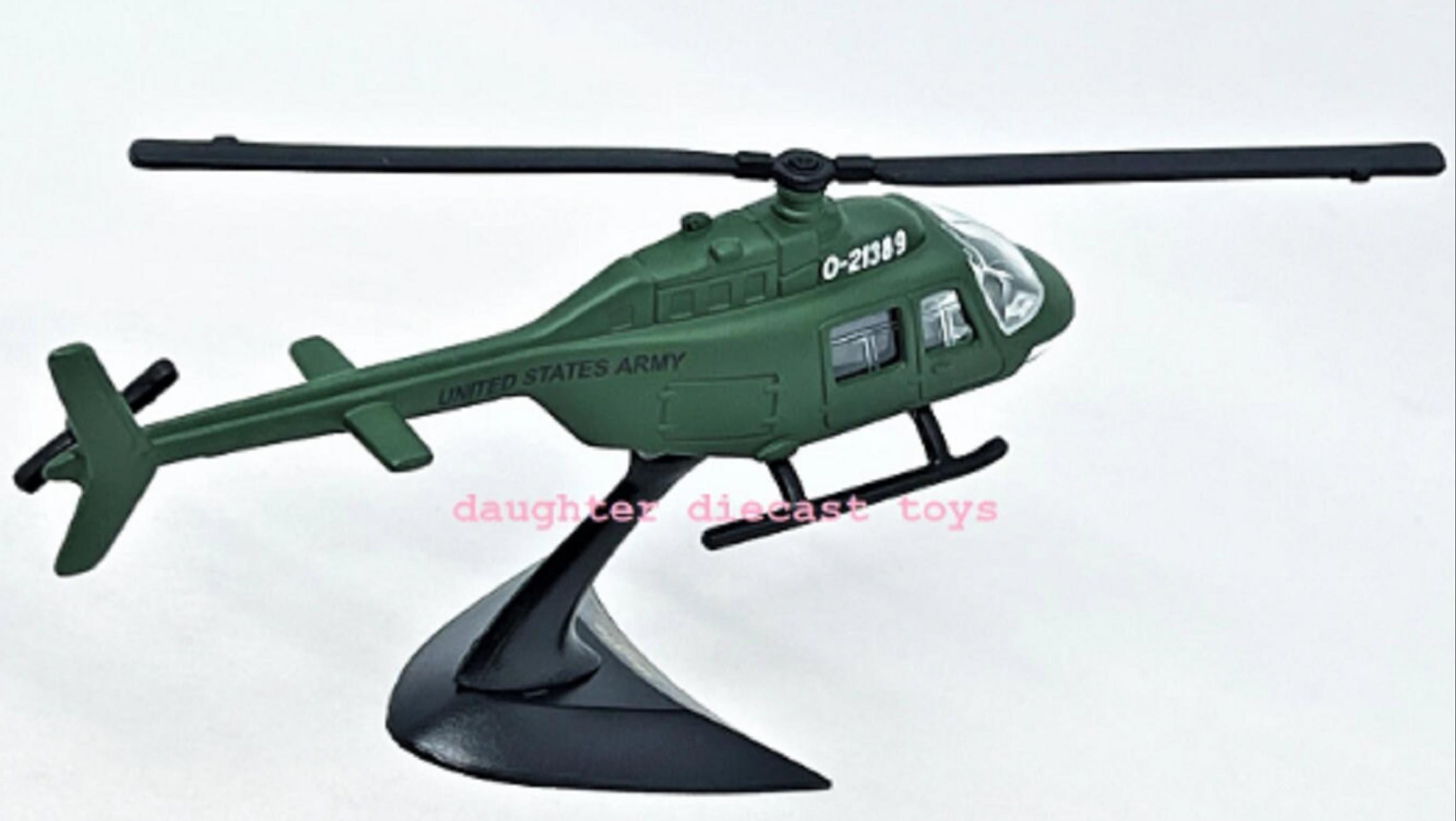
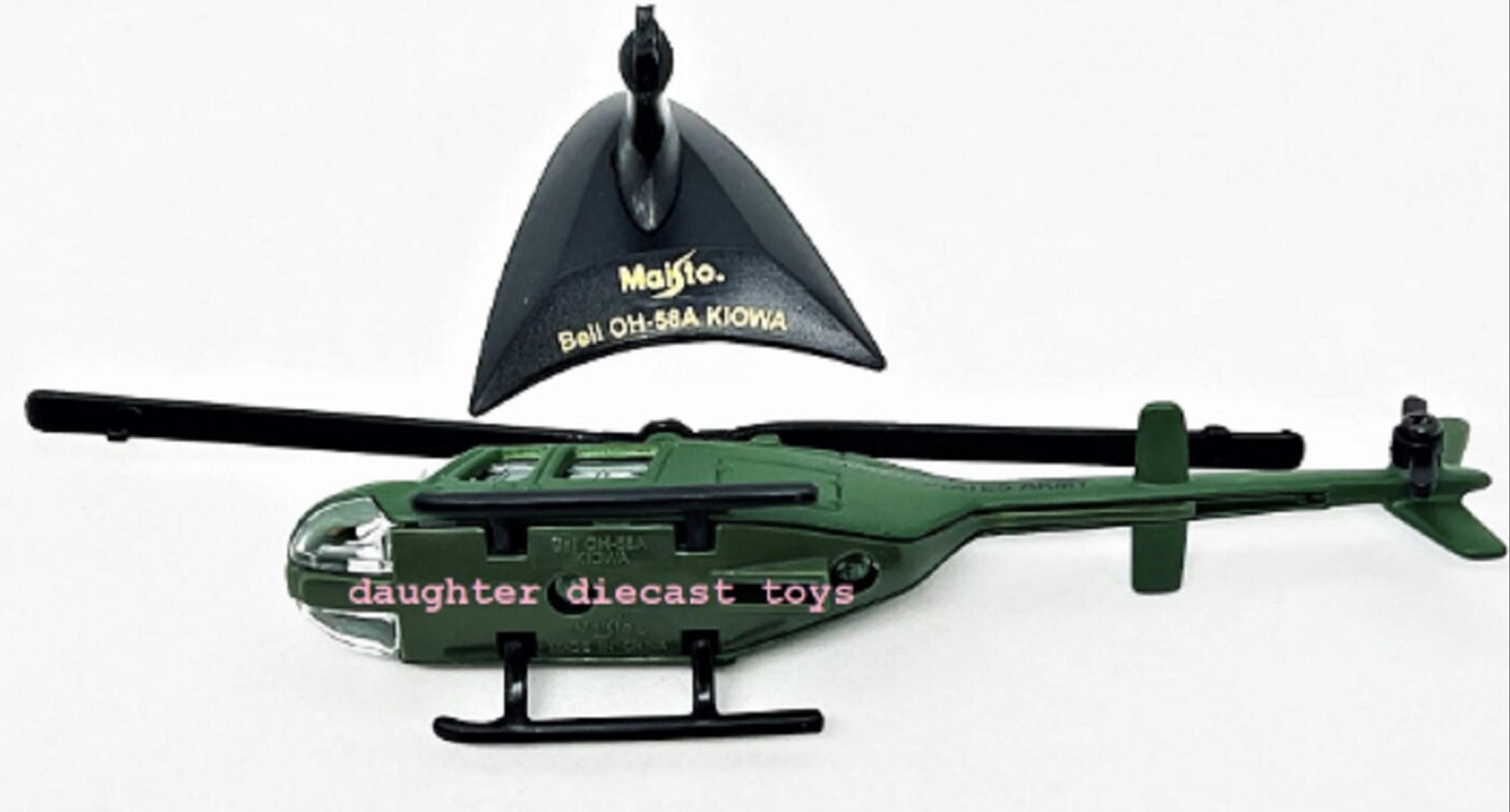

Vintage U.S. ARMY HELICOPTER- Bell OH-58A Kiowa -Diecast Metal-Pristine condition! Maisto Toys-Great Gift for Collectors & Veterans!
$ 49.99

Vintage U.S. ARMY HELICOPTER- Bell OH-58A Kiowa -Diecast Metal-Pristine
condition! Maisto Toys-Great Gift for Collectors & Veterans!Awesome! US ARMY HELICOPTER-BELL OH-58A KIOWA. Adult collector model-constructed of heavy die cast-made metal by Maisto Toys. Highly sought-after, hard to find vintage model! Scale= 1/72 prox-measures 5"L x 1 1/4 "W x 3"H (mounted). Rotor blades measure 5 1/2" tip to tip. Beautiful/pristine condition model-never handled or displayed (until today for our photos). Sold loose-comes in collectors bag with desk-top mounting stand. Perfect gift for military aircraft/vintage toy collectors, Veterans, and fans of aviation history (like me)! We ship fast & safe worldwide every day! Read Aircraft bio below...
•
•
•FOR A LIMITED TIME
•
•
•Purchases totaling $35 and above qualify for FREE shipping to USA! Add more items to your Etsy shopping cart to save $$$.NOTE: My dad owned a Diecast toy store for 30 years. I inherited the store inventory when he passed away many years ago. I am just now, beginning to sell the mint condition vintage models. All are store-inventory is new-old-stock, models have never been "played with". Please visit often-as I am adding more cool stuff every day! AIRCRAFT BIO: BELL OH-58 KIOWA HELICOPTERThe Bell OH-58 Kiowa is a family of single-engine single-rotor military helicopters used for observation, utility, and direct fire support. It was produced by the American manufacturer Bell Helicopter and is closely related to the Model 206A JetRanger civilian helicopter.The OH-58 was originally developed during the early 1960s as the D-250 for the Light Observation Helicopter (LOH). While the rival Hughes OH-6 Cayuse was picked over Bell's submission in May 1965, the company refined its design to create the Model 206A, a variant of which it successfully submitted to the reopened LOH competition two years later. The initial model, designated by the service as the OH-58A, was introduced in May 1969. Successive models would follow, often with uprated engines, enhanced protection systems, and other improvements, culminating in the OH-58F. Additional improvements, such as the OH-58X, were proposed but ultimately not pursued.During the 1970s, the US Army became interested in pursuing an advanced scout helicopter, for which the OH-58 would be further developed, evaluated, and ultimately procured as the OH-58D Kiowa Warrior. The OH-58D is equipped to perform armed reconnaissance missions and to provide fire support to friendly ground forces; it is equipped with a distinctive Mast Mounted Sight (MMS) containing various sensors for target acquisition and laser designation. Another visible feature present on most OH-58s are knife-like extensions above and below the cockpit that form part of the passive wire strike protection system. The early-build OH-58s were equipped with a two-bladed main rotor, while the OH-58D and newer variants have a four-bladed rotor.The OH-58 was primarily produced for the United States Army. Only two months after the type's entry to service, it was first deployed into the Vietnam War. The US Army would make extensive use of various OH-58 models across numerous war zones over the decades, seeing active combat during the Gulf War, the Invasion of Panama, and the War in Afghanistan among others. During 2017, the US Army opted to withdraw its remaining OH-58s and replace them with newer rotorcraft, such as the Boeing AH-64 Apache and Eurocopter UH-72 Lakota, as well as increasing use of unmanned aerial vehicles (UAVs). Furthermore, the OH-58 has been exported to Austria, Canada, Croatia, the Dominican Republic, Taiwan, Saudi Arabia, and Greece. It has also been produced under license in Australia.Operational historyDuring May 1969, the first OH-58A Kiowa was officially received at a ceremony held at Bell Helicopter's Fort Worth plant, officiated by Major General John Norton, commanding general of the Army Aviation Materiel Command (AMCOM).[29] Two months later, on 17 August 1969, production OH-58A helicopters arrived in South Vietnam for the first time;[30] their deployment was accompanied by a New Equipment Training Team (NETT) comprising personnel from both the US Army and Bell Helicopters.[31] Although the Kiowa production contract had replaced the LOH contract with Hughes, the OH-58A did not automatically replace the OH-6A in operations; subsequently, the Kiowa and the Cayuse would continue operating in the same theater until the end of the conflict.Vietnam WarAustralian Army OH-58A in South Vietnam, December 1971 On 27 March 1970, an OH-58A Kiowa (s/n 68-16785) was shot down over South Vietnam, one of the first OH-58A losses of the war. The pilot, Warrant Officer Ralph Quick, Jr., was flying Lieutenant Colonel Joseph Benoski, Jr. as an artillery spotter. After completing a battle damage assessment for a previous fire mission, the aircraft was damaged by .51 inch (13 mm) machine gun fire and crashed, killing both crew members. Approximately 45 OH-58A helicopters were destroyed during the Vietnam War due to combat losses and accidents.[32] One of the last combat losses in the theatre was of an OH-58A (s/n 68-16888) from A Troop, 3-17th Cavalry, flown by First Lieutenant Thomas Knuckey. On 27 May 1971, Lieutenant Knuckey was also flying a battle damage assessment mission when his aircraft came under machine gun fire and exploded. Knuckey and his observer, Sergeant Philip Taylor, both died in the explosion.[33]Operation Prime Chance During early 1988, it was decided that armed OH-58D (AHIP) helicopters from the 118th Aviation Task Force would be phased in to replace the SEABAT (AH-6/MH-6) teams of Task Force 160th to carry out Operation Prime Chance, the escort of oil tankers during the Iran–Iraq War. On 24 February 1988, two AHIP helicopters reported to the Mobile Sea Base Wimbrown VII, and the helicopter team ("SEABAT" team after their callsign) stationed on the barge returned to the United States. For the next few months, the AHIP helicopters on the Wimbrown VII shared patrol duties with the SEABAT team on the Hercules. Coordination proved difficult, despite frequent requests from TF-160, the SEABAT team on the Hercules was not replaced by an AHIP detachment until June 1988.[34] The OH-58D helicopter crews involved in the operation received deck landing and underwater survival training from the Navy.In November 1988, the number of OH-58D helicopters that supported Task Force 118 was reduced. However, the rotorcraft continued to operate from the Navy's Mobile Sea Base Hercules, the frigate Underwood, and the destroyer Conolly. OH-58D operations primarily entailed reconnaissance flights at night, and depending on maintenance requirements and ship scheduling, Army helicopters usually rotated from the mobile sea base and other combatant ships to a land base every seven to fourteen days. On 18 September 1989, an OH-58D crashed during night gunnery practice and sank, but with no loss of personnel. When the Mobile Sea Base Hercules was deactivated in September 1989, all but five OH-58D helicopters redeployed to the continental United States.[35]
condition! Maisto Toys-Great Gift for Collectors & Veterans!Awesome! US ARMY HELICOPTER-BELL OH-58A KIOWA. Adult collector model-constructed of heavy die cast-made metal by Maisto Toys. Highly sought-after, hard to find vintage model! Scale= 1/72 prox-measures 5"L x 1 1/4 "W x 3"H (mounted). Rotor blades measure 5 1/2" tip to tip. Beautiful/pristine condition model-never handled or displayed (until today for our photos). Sold loose-comes in collectors bag with desk-top mounting stand. Perfect gift for military aircraft/vintage toy collectors, Veterans, and fans of aviation history (like me)! We ship fast & safe worldwide every day! Read Aircraft bio below...
•
•
•FOR A LIMITED TIME
•
•
•Purchases totaling $35 and above qualify for FREE shipping to USA! Add more items to your Etsy shopping cart to save $$$.NOTE: My dad owned a Diecast toy store for 30 years. I inherited the store inventory when he passed away many years ago. I am just now, beginning to sell the mint condition vintage models. All are store-inventory is new-old-stock, models have never been "played with". Please visit often-as I am adding more cool stuff every day! AIRCRAFT BIO: BELL OH-58 KIOWA HELICOPTERThe Bell OH-58 Kiowa is a family of single-engine single-rotor military helicopters used for observation, utility, and direct fire support. It was produced by the American manufacturer Bell Helicopter and is closely related to the Model 206A JetRanger civilian helicopter.The OH-58 was originally developed during the early 1960s as the D-250 for the Light Observation Helicopter (LOH). While the rival Hughes OH-6 Cayuse was picked over Bell's submission in May 1965, the company refined its design to create the Model 206A, a variant of which it successfully submitted to the reopened LOH competition two years later. The initial model, designated by the service as the OH-58A, was introduced in May 1969. Successive models would follow, often with uprated engines, enhanced protection systems, and other improvements, culminating in the OH-58F. Additional improvements, such as the OH-58X, were proposed but ultimately not pursued.During the 1970s, the US Army became interested in pursuing an advanced scout helicopter, for which the OH-58 would be further developed, evaluated, and ultimately procured as the OH-58D Kiowa Warrior. The OH-58D is equipped to perform armed reconnaissance missions and to provide fire support to friendly ground forces; it is equipped with a distinctive Mast Mounted Sight (MMS) containing various sensors for target acquisition and laser designation. Another visible feature present on most OH-58s are knife-like extensions above and below the cockpit that form part of the passive wire strike protection system. The early-build OH-58s were equipped with a two-bladed main rotor, while the OH-58D and newer variants have a four-bladed rotor.The OH-58 was primarily produced for the United States Army. Only two months after the type's entry to service, it was first deployed into the Vietnam War. The US Army would make extensive use of various OH-58 models across numerous war zones over the decades, seeing active combat during the Gulf War, the Invasion of Panama, and the War in Afghanistan among others. During 2017, the US Army opted to withdraw its remaining OH-58s and replace them with newer rotorcraft, such as the Boeing AH-64 Apache and Eurocopter UH-72 Lakota, as well as increasing use of unmanned aerial vehicles (UAVs). Furthermore, the OH-58 has been exported to Austria, Canada, Croatia, the Dominican Republic, Taiwan, Saudi Arabia, and Greece. It has also been produced under license in Australia.Operational historyDuring May 1969, the first OH-58A Kiowa was officially received at a ceremony held at Bell Helicopter's Fort Worth plant, officiated by Major General John Norton, commanding general of the Army Aviation Materiel Command (AMCOM).[29] Two months later, on 17 August 1969, production OH-58A helicopters arrived in South Vietnam for the first time;[30] their deployment was accompanied by a New Equipment Training Team (NETT) comprising personnel from both the US Army and Bell Helicopters.[31] Although the Kiowa production contract had replaced the LOH contract with Hughes, the OH-58A did not automatically replace the OH-6A in operations; subsequently, the Kiowa and the Cayuse would continue operating in the same theater until the end of the conflict.Vietnam WarAustralian Army OH-58A in South Vietnam, December 1971 On 27 March 1970, an OH-58A Kiowa (s/n 68-16785) was shot down over South Vietnam, one of the first OH-58A losses of the war. The pilot, Warrant Officer Ralph Quick, Jr., was flying Lieutenant Colonel Joseph Benoski, Jr. as an artillery spotter. After completing a battle damage assessment for a previous fire mission, the aircraft was damaged by .51 inch (13 mm) machine gun fire and crashed, killing both crew members. Approximately 45 OH-58A helicopters were destroyed during the Vietnam War due to combat losses and accidents.[32] One of the last combat losses in the theatre was of an OH-58A (s/n 68-16888) from A Troop, 3-17th Cavalry, flown by First Lieutenant Thomas Knuckey. On 27 May 1971, Lieutenant Knuckey was also flying a battle damage assessment mission when his aircraft came under machine gun fire and exploded. Knuckey and his observer, Sergeant Philip Taylor, both died in the explosion.[33]Operation Prime Chance During early 1988, it was decided that armed OH-58D (AHIP) helicopters from the 118th Aviation Task Force would be phased in to replace the SEABAT (AH-6/MH-6) teams of Task Force 160th to carry out Operation Prime Chance, the escort of oil tankers during the Iran–Iraq War. On 24 February 1988, two AHIP helicopters reported to the Mobile Sea Base Wimbrown VII, and the helicopter team ("SEABAT" team after their callsign) stationed on the barge returned to the United States. For the next few months, the AHIP helicopters on the Wimbrown VII shared patrol duties with the SEABAT team on the Hercules. Coordination proved difficult, despite frequent requests from TF-160, the SEABAT team on the Hercules was not replaced by an AHIP detachment until June 1988.[34] The OH-58D helicopter crews involved in the operation received deck landing and underwater survival training from the Navy.In November 1988, the number of OH-58D helicopters that supported Task Force 118 was reduced. However, the rotorcraft continued to operate from the Navy's Mobile Sea Base Hercules, the frigate Underwood, and the destroyer Conolly. OH-58D operations primarily entailed reconnaissance flights at night, and depending on maintenance requirements and ship scheduling, Army helicopters usually rotated from the mobile sea base and other combatant ships to a land base every seven to fourteen days. On 18 September 1989, an OH-58D crashed during night gunnery practice and sank, but with no loss of personnel. When the Mobile Sea Base Hercules was deactivated in September 1989, all but five OH-58D helicopters redeployed to the continental United States.[35]
Other Products